SaaS SEO: Converting Organic Visitors to Paying Customers
The harsh reality of SaaS organic growth: 72% of B2B SaaS companies generate less than 2% of revenue from organic search, despite investing heavily in content and SEO. Even with abundant traffic, most fail at the conversion stage. The bottleneck isn't visibility—it's turning browsers into buyers. The gap between average B2B SaaS conversion rates of 2.1% and top-performer rates of 8–15% represents millions in lost revenue. Here's how to close that gap with a system that turns organic visitors into paying customers.
Key Takeaways
- Average B2B SaaS conversion from organic traffic is 2.1%, but top performers achieve 8–15% (First Page Sage, 2026)
- SEO delivers 702% ROI for B2B SaaS with payback in 7 months, making it the most cost-efficient long-term acquisition channel
- Form-length reduction alone drives 120% conversion lift; combined with headline optimization (27–104% lift), strategic proof placement, and intent-matched messaging, this compounds rapidly
- Align Traffic Source to Landing Page: Match messaging between search intent and page copy to eliminate friction and increase immediate relevance.
- Optimize the Conversion Path: Reduce form fields, simplify CTAs, and place social proof near friction points to reduce decision paralysis.
- Build Product-Market Signals: Use transparent pricing, demos, and outcome-driven copy to move prospects through trial-to-paid conversion.
- Measure Funnel Stage Metrics: Track homepage-to-trial, trial-to-paid, and CAC separately to identify and fix bottlenecks systematically.
- Automate Content Scaling: Compound your SEO engine by automating keyword research, content production, and internal linking to accelerate organic momentum without burnout.
Why Most SaaS Companies Fail to Convert Organic Traffic
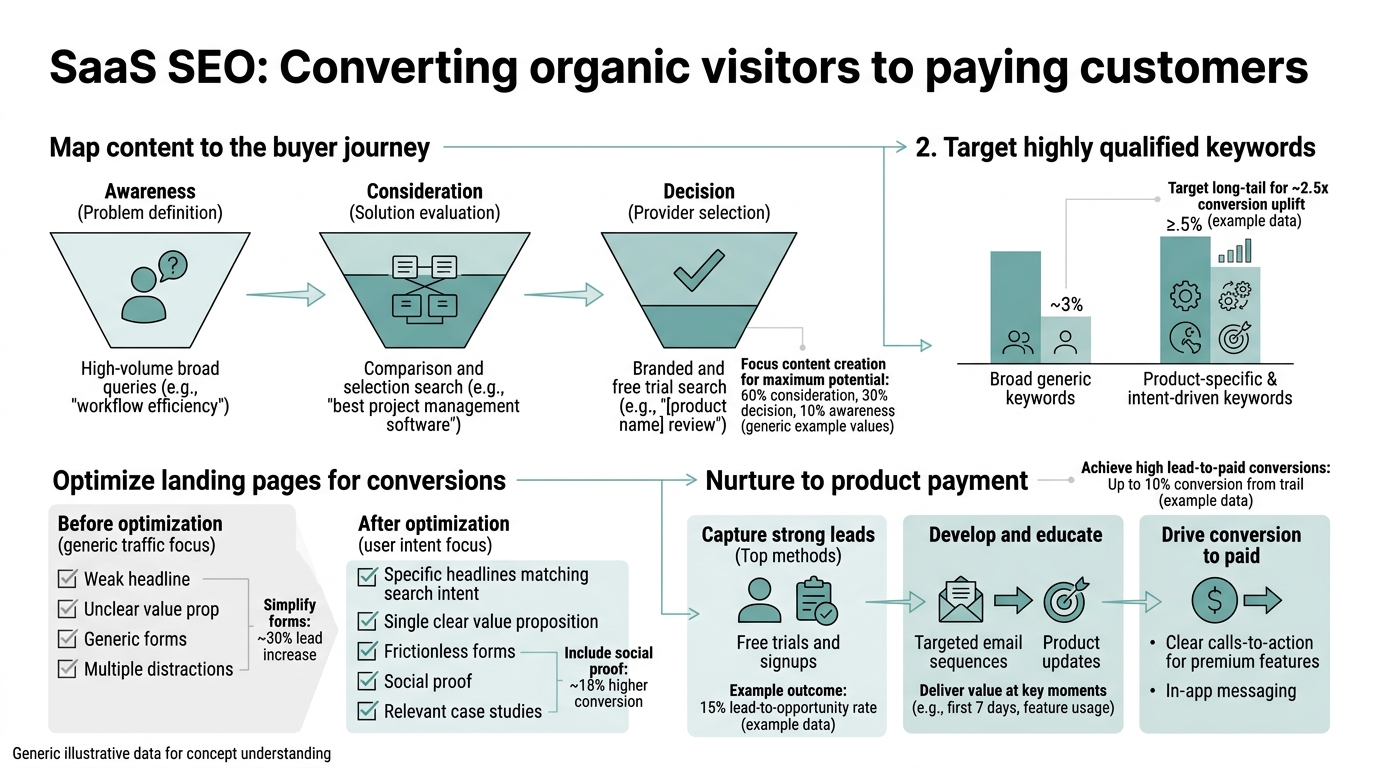
The assumption that "more traffic equals more customers" is the first trap. 44.6% of all B2B revenue originates from organic search, yet the majority of SaaS companies never capture a fraction of that potential. The reason: they optimize for volume, not velocity. They rank for keywords but fail to engineer the experience that turns a curious visitor into a trial signup, then a paying customer.
The breakdown is real. Average MQL-to-SQL conversion in SaaS is only 13%, meaning most leads generated from organic traffic never reach a salesperson. Even worse, many SaaS companies treat their website as a brochure rather than a conversion machine. No clear value proposition above the fold. Forms that ask for too much too early. Pricing hidden behind a "Contact Us" button. Trust signals buried three scrolls down.
"The conversion variance directly correlates with how well companies optimize the post-click experience, not just pre-click visibility. Top performers systematically remove friction at every decision point while average performers focus solely on ranking."
This is why First Page Sage's 2026 SaaS conversion benchmarks show such a wide variance: median SaaS websites convert 2.1% of visitors to leads, while the top 10% convert 8–15%. That's not luck. It's systematic. It's a clear understanding of how organic search visitors differ from other audiences, and how to remove friction at every decision point. A solid SeoProfy analysis of SEO ROI statistics confirms that the conversion variance directly correlates with how well companies optimize the post-click experience, not just pre-click visibility.
Align SEO Traffic with Conversion-Ready Landing Pages
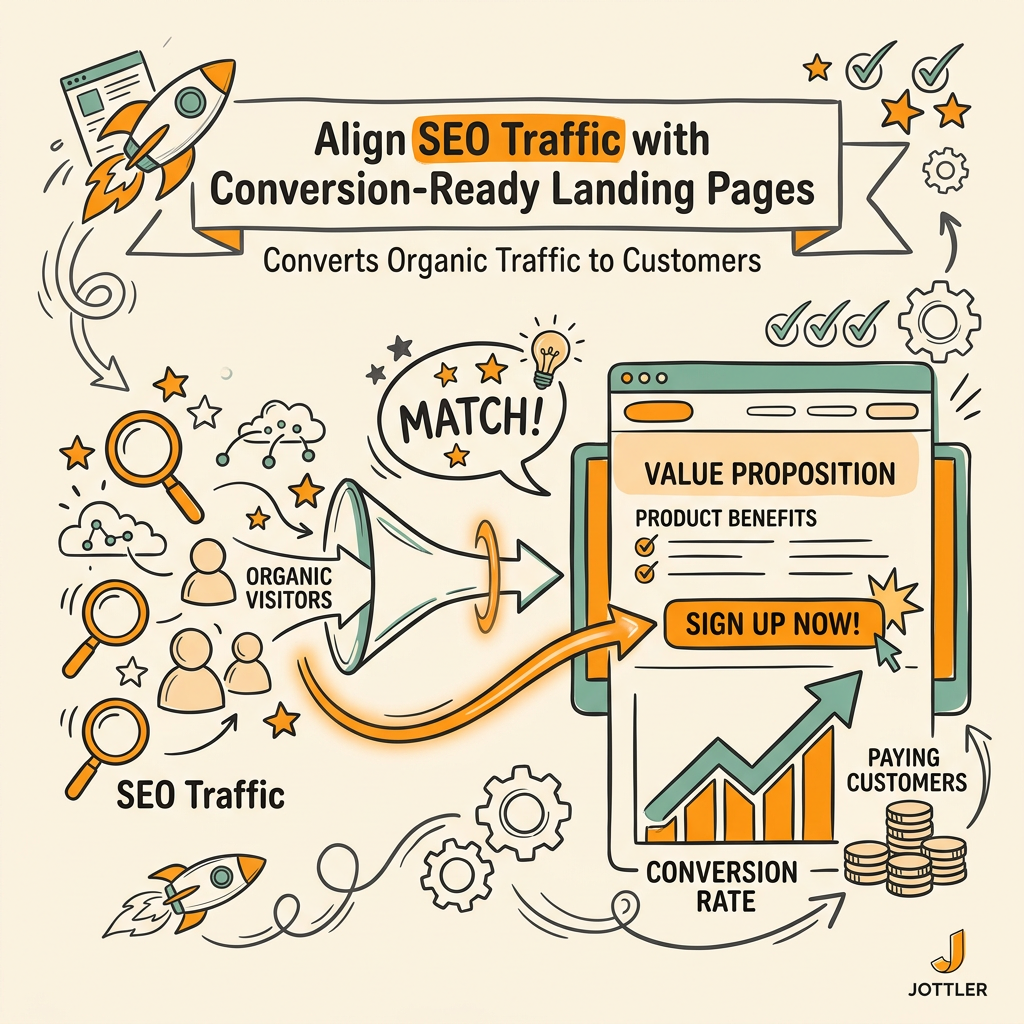
Intent matching is the foundational lever. When a prospect types "SaaS SEO tools for automation," they're not looking for a 10,000-word guide on SEO theory. They want to know if your tool solves their specific problem. The page they land on must answer that immediately, in the first 5 seconds. Anything else is friction.
Match Search Intent to Page Copy and Offer
SaaS companies ranking for "how to automate content marketing" often send visitors to a generic homepage or a broad product overview page. That's a missed opportunity. The prospect is already warm—they've admitted they want automation. Your page should lead with how your product delivers automation, not explain what content marketing is. One 2026 best-practices guide emphasizes that page copy must communicate the core value within 5 seconds, and every section must reinforce the same outcome the visitor is already searching for.
This applies to each keyword segment. High-intent keywords ("SaaS SEO automation tool," "AI content generator") route to product pages or free trial signup pages. Educational keywords ("how to improve SaaS conversion," "SaaS landing page best practices") route to content hubs or ebooks that capture email for nurturing. Competitive keywords ("alternative to X," "X vs Y") route to comparison pages that position your solution as the better-fit option. The same organic visitor converts 3–5x better when the page matches their intent, which is why implementing a comprehensive SaaS content marketing framework becomes essential at scale.
Tools like Jottler automate this at scale. Instead of manually researching topics and routing them to the right page, an autonomous SEO system analyzes search intent, creates dedicated landing pages for high-conversion keywords, and dynamically links them to your existing product pages and guides. The result: every organic visitor lands on a page that speaks directly to their need.
Create Dedicated Landing Pages for High-Value Keywords
A single homepage can't convert all traffic equally. Visitors searching "SaaS SEO for bootstrapped startups" have different pain points than those searching "enterprise SaaS SEO automation." Dedicated landing pages let you speak to each segment in their language. One 2026 SaaS CRO framework calls this "intent-specific architecture"—different page variants for different acquisition sources.
"The best-performing SaaS companies don't use one landing page for all audiences. They build segment-specific pages where the headline, proof points, and CTA all speak directly to the visitor's role, company size, and pain point. This simple change compounds conversion by 40–60%."
The mechanics are simple: headline speaks to the pain, short intro reinforces the solution, features are outcome-focused, social proof is specific to the segment, and the CTA is clear and singular. No competing navigation. No hidden pricing. No generic language. A startup-focused landing page emphasizes speed, affordability, and quick wins. An enterprise page emphasizes security, integrations, and scalability. Same company, same product, different messaging.
This level of personalization compounds conversion. Landingi's 2026 landing page benchmarks show that pages built around a single goal and clear intent match convert 40–60% better than pages trying to be all things to all visitors. Building this systematically requires scaling your content production, which is where content automation tools for SaaS teams become invaluable for maintaining velocity and consistency.
Engineer the Conversion Path from Visitor to Trial to Paid Customer
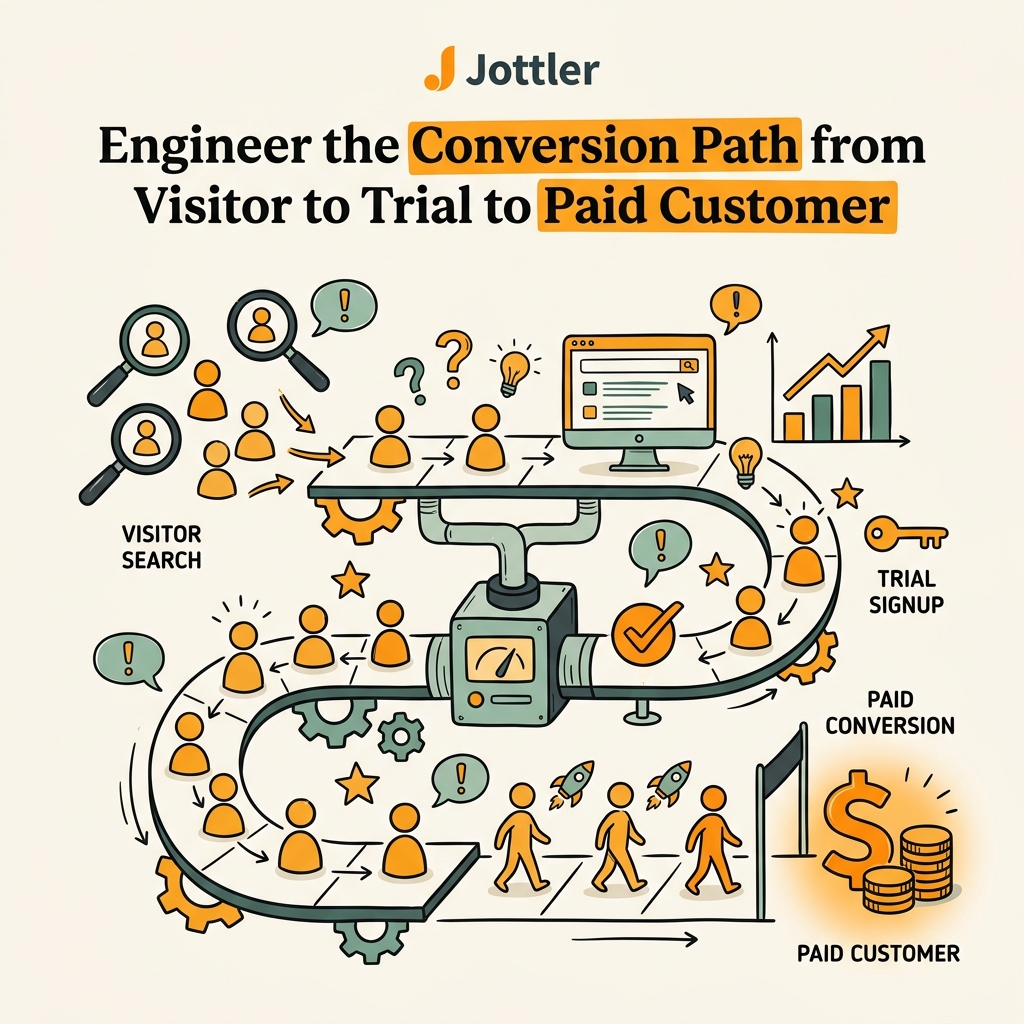
The conversion path for SaaS has three distinct stages: awareness-to-interest (landing page), interest-to-trial (signup flow), and trial-to-paid (onboarding and product experience). Most SaaS companies optimize only the first stage. That's the error. The highest-leverage improvements often happen at stages two and three, where friction compounds and kills momentum.
Reduce Form Friction to Maximize Trial Signups
Form length is the single highest-leverage conversion lever. One 2026 analysis of thousands of A/B tests found that reducing form fields delivered a 120% average conversion lift. Yet most SaaS signup forms ask for 8–12 fields at first touch: name, email, company, role, company size, use case, budget, timeline. Prospects abandon at the second field.
The best practice is ruthlessly simple: ask for name and email first. That's it. You get the visitor to trial. Everything else—company role, team size, use case, budget—gets collected during the trial onboarding when the prospect is already invested and willing to share. This two-stage approach increases signup completion by 3–5x compared to comprehensive upfront forms.
Additionally, headline optimization on landing pages drives 27–104% conversion lift, making it the second-highest-impact lever after form simplification. Your headline must state the problem-solved or outcome-achieved, not the product name. Instead of "Jottler—AI Content Platform," use "Publish 3,000+ Words of Ranking Content Every Day Without Burnout." The second version attracts visitors already sold on the benefit.
Use Proof Placement and Outcome-Driven Copy to Build Trust
Social proof matters, but placement matters more. A testimonial buried on a lower section of the page doesn't reduce risk when the prospect is deciding whether to try your free trial. Instead, place social proof near the headline, near the CTA button, and mid-page where it can address objections in real time. Best-in-class pages use specific testimonials with quantified outcomes ("We increased qualified leads by 340% in 6 months," not "Jottler is awesome"), full names, job titles, and professional photos.
Outcome-driven copy reinforces trust. Instead of listing features ("Advanced AI agents," "Smart internal linking"), translate features into results: "Our 12 AI agents handle everything—from keyword research to fact-checking to CMS publishing—so you get 3,000+ words published daily without lifting a finger." The visitor immediately understands what life looks like with your product.
Case studies and proprietary research are especially effective for B2B SaaS. A page showing "How [Customer Name] Scaled Organic Traffic 300% in 12 Weeks" is far more credible than generic marketing copy. One 2026 SaaS marketing synthesis identified proprietary research, case studies, and transparent metrics as the top three trust-builders for organic visitors. Organizations leveraging AI-powered SEO strategies often excel at generating this type of case study content at scale.
Pricing Clarity Reduces Decision Paralysis
Transparent pricing is a conversion accelerator. One 2026 SaaS CRO framework recommends 3–4 pricing tiers to eliminate choice paralysis. Too many options freeze decision-making. Too few create uncertainty about whether the product fits the budget.
The best structure is: Starter (free or freemium), Professional (most popular, middle tier), and Enterprise (custom). Visually guide visitors toward the Professional tier with messaging like "Most popular," "Best value," or a visual highlight. Use a comparison table to show clear feature differences between tiers. Add a calculator that estimates price based on company size or usage to reduce perceived risk.
Critically, make pricing visible before the signup form. Every second spent searching for pricing is a moment the prospect might bounce to a competitor. Transparency builds urgency and trust simultaneously.
Track and Optimize Funnel-Stage Conversion Metrics Separately
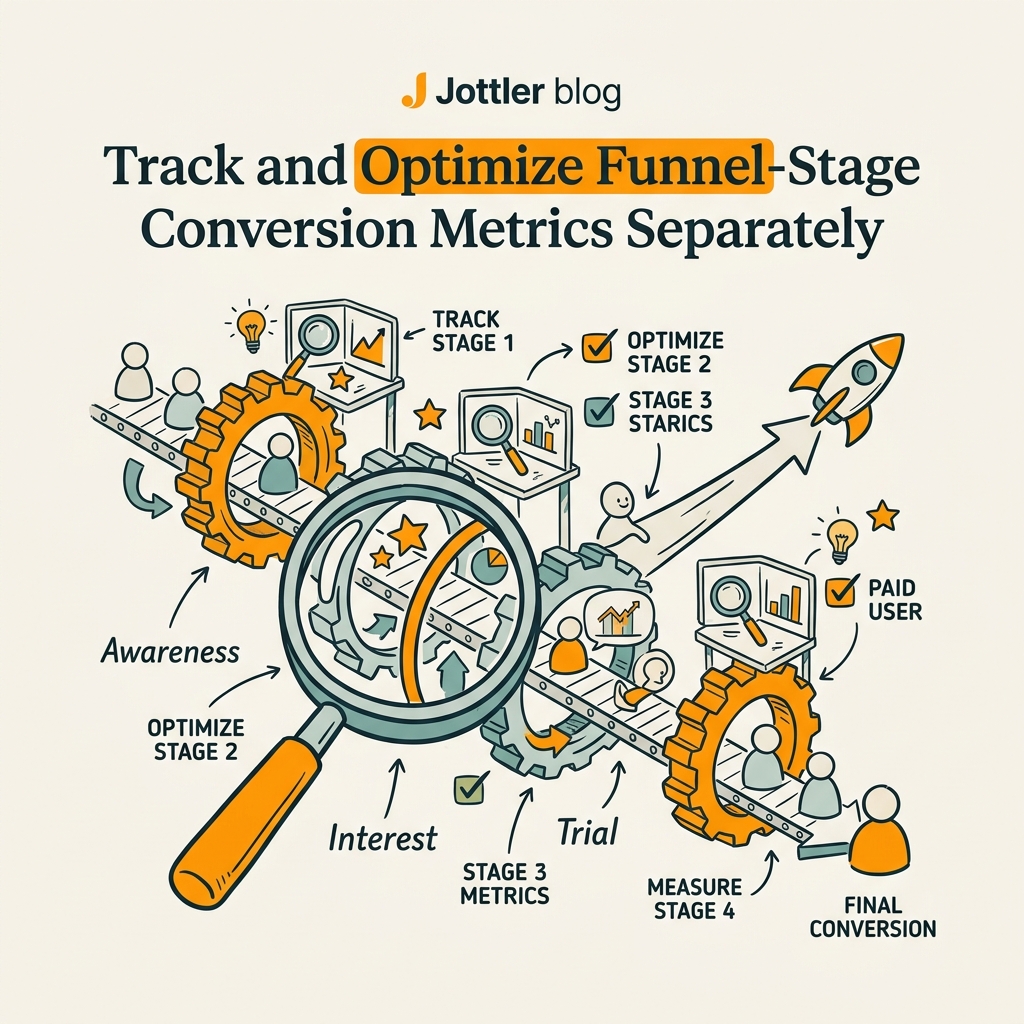
You can't optimize what you don't measure. Most SaaS teams obsess over top-of-funnel metrics—traffic, keyword rankings, cost-per-click. They ignore the funnel bottlenecks that actually determine revenue. Average MQL-to-SQL conversion in SaaS is only 13%, meaning 87% of leads are wasted. But you can't fix what you don't measure at granular stages.
Define Conversion Metrics by Funnel Stage
Break conversion into distinct stages and measure each independently:
- Visitor-to-Trial Conversion: Percentage of website visitors who click "Start Free Trial" and complete the signup form. Target: 3–5% baseline, 7%+ excellent. This measures landing page effectiveness and form friction.
- Trial-to-Paid Conversion: Percentage of trial users who enter a paid subscription before the trial expires. Target: 10–15% baseline, 25%+ suggests strong product-market fit. This measures product value and onboarding quality, not marketing.
- Customer Acquisition Cost (CAC): Total organic traffic acquisition cost divided by new customers acquired. Benchmark: $205 per customer via organic vs $341 for paid channels. Track CAC by traffic source (organic vs paid), landing page variant, and campaign to identify the highest-ROI paths.
- CAC Payback Period: How many months until customer revenue exceeds acquisition cost. Benchmark for SaaS: 7–12 months for organic, lower for renewal revenue. Organic's strength is that payback accelerates with time, while paid costs remain constant.
Tools like Segment, Amplitude, or native CRM integrations give you real-time funnel visibility. The moment you see trial-to-paid dropping, you can investigate: Is it product quality? Onboarding? Pricing? Price transparency isn't enough if prospects are committing to a trial and then bouncing during onboarding. This is where the leverage lies.
Identify and Fix Specific Conversion Bottlenecks
Once you're measuring by stage, run small optimization tests at the weakest stage. If visitor-to-trial conversion is 1.5% (below benchmark), test shorter forms, stronger headlines, and clearer CTAs. If trial-to-paid is 5% (below benchmark), the problem is product experience or onboarding—not marketing. Invite trial users who didn't convert to a brief feedback call; you'll often find friction invisible to analytics.
The compounding effect is real. Improving visitor-to-trial conversion from 2% to 3% is a 50% lift. Improving trial-to-paid from 10% to 15% is another 50% lift. Stacked together, these moves can 2–3x total customer acquisition from the same traffic volume. That's where top-performing SaaS companies live: not at 8–15% conversion to leads, but at 8–15% conversion to paying customers through a systematic funnel, which is why automation at every SEO stage accelerates this compounding.
How Automation Multiplies Organic SEO Conversion
The challenge for bootstrapped teams and early-stage founders is throughput. Optimizing conversion paths, testing landing page variants, and building topical authority with linked clusters of content—this takes weeks of work per quarter. Most teams can't sustain that pace while running the business. The result: they build content, rank for a few keywords, but never develop the breadth and depth of organic traffic that scales to meaningful revenue.
Automate Content Creation to Feed the Conversion Funnel Consistently
The highest-performing SaaS companies publish content at volume. Not just blog posts, but targeted landing pages, case studies, comparison articles, and resource guides—all optimized for specific keywords with internal linking that feeds organic authority. Manually producing this takes 40–60 hours per week for a content team. Most founders can't afford that.
"At scale, you own more of the keyword space. Instead of ranking for 50 high-intent keywords, you rank for 500. Instead of owning the first page of Google for one pain point, you own five. Each additional landing page is a new entry point, a new chance to convert an organic visitor. The law of large numbers takes over."
An autonomous SEO engine removes the bottleneck. Tools like Jottler use AI agents to research topics, write comprehensive 3,000+ word articles, fact-check claims against real sources, optimize for target keywords, and publish directly to your CMS. The system can produce 1–5 articles per day, compounding your organic footprint without requiring full-time content staff.
The conversion advantage is that at scale, you own more of the keyword space. Instead of ranking for 50 high-intent keywords, you rank for 500. Instead of owning the first page of Google for one pain point, you own five. Each additional landing page is a new entry point, a new chance to convert an organic visitor. The law of large numbers takes over: more pages, more visitors, more conversions.
Implement Smart Internal Linking to Boost Page Authority and Conversion Path Clarity
Internal linking is the most underutilized conversion lever in SaaS. A homepage without internal links to high-intent landing pages or case studies sends visitors away when they're most receptive. An educational article without contextual links to product pages or relevant tools wastes the engagement already built.
The best practice is strategic relevance: each article links to 3–5 related pages (other blog posts, product pages, comparison articles, case studies) where the anchor text reinforces the value of the next step. Instead of generic "learn more" links, use: "See how we automate this process," "Compare this tool to alternatives," or "View case study: How X Increased Conversion 300%." These contextual links guide the visitor deeper into your funnel while signaling to search engines which pages matter most.
An autonomous SEO system automates this. After publishing an article, the system analyzes what other pages exist on your site, identifies high-relevance linking opportunities, and creates semantic anchor text that reinforces topical authority and guides conversions. This creates a compounding effect: earlier-published content gains ranking authority from newer content linking back, new content benefits from established topical authority, and every page funnels visitors toward conversion pages.
| Funnel Stage | Metric | Benchmark (Typical) | Top Performer |
|---|---|---|---|
| Visitor → Trial | Conversion Rate | 2–3% | 7%+ |
| Trial → Paid | Conversion Rate | 10–15% | 25%+ |
| Organic Traffic | Customer Acquisition Cost | $205–$480 | $290 |
| Organic Channel | ROI (Long-term) | – | 702% |
| Lead Pipeline | MQL → SQL Conversion | 13% | 30%+ |
Conclusion
Converting organic visitors to paying customers in SaaS isn't about conjuring more traffic. It's about engineering a system where every step from awareness to trial to paid subscription is optimized. The gap between average B2B SaaS conversion (2.1%) and top-performer rates (8–15%) represents hundreds of thousands or millions in lost lifetime value per year. Closing that gap requires three moves: (1) align landing pages to search intent so visitors feel understood, (2) measure and fix conversion bottlenecks at every funnel stage, and (3) compound your content engine by automating research, writing, and publishing so you can own more keywords and more entry points into your conversion path.
The companies winning at organic SaaS growth are the ones who treat SEO as a revenue engine, not a traffic tactic. They track CAC and payback period alongside rankings. They test landing page variants and form friction. They publish content at velocity without sacrificing quality. Doing this by hand requires 40–60 hours per week from a skilled team. But with an autonomous SEO engine handling research, writing, optimization, and publishing, you can compound your organic growth 3–5x faster. Start your SEO agent today and stop leaving revenue on the table.
FAQs
What is the average conversion rate for SaaS organic traffic?
The average B2B SaaS conversion rate from organic search is 2.1%, meaning one in 50 visitors becomes a lead. However, this masks significant variation. Top-performing SaaS companies convert organic visitors to leads at 8–15%, and when you measure all the way to paid customers (not just leads), the best teams achieve 3–5% conversion from visitor to paying customer. The difference between median and top-decile performance is often attributed to intent-matched landing pages, reduced form friction, strategic proof placement, and multi-stage funnel optimization rather than traffic volume alone.
How long does it take to see SaaS SEO results in customer revenue?
SEO payback for B2B SaaS typically takes 7–12 months from consistent content publication to meaningful revenue impact. The timeline breaks down as follows: months 1–3 (content published, domain authority builds gradually), months 3–6 (pages begin ranking, early organic traffic arrives), months 6–9 (traffic compounds, trials convert to customers), and months 9–12 (revenue payback achieved). The strong advantage of organic SEO is that once the payback period is reached, the customer acquisition cost remains near-zero, unlike paid channels where costs remain constant. This long-term efficiency is why SEO delivers 702% ROI for B2B SaaS compared to one-time paid campaign returns.
What is the biggest bottleneck preventing SaaS conversion from organic traffic?
The primary bottleneck is misalignment between search intent and landing page experience. Most SaaS companies drive organic traffic to generic homepages or broad product pages rather than creating dedicated landing pages that match the specific intent of each keyword segment. A visitor searching "SaaS SEO automation for bootstrapped startups" has different needs than one searching "enterprise SaaS SEO tools," yet both often land on the same page. The secondary bottleneck is form friction: collecting too many fields at signup reduces completion by 60–70% compared to simple two-field forms (name and email). The third is missing proof placement near the CTA and above-the-fold trust signals. Companies fixing all three of these systematically move from 2% to 5–8% conversion, which on a typical SaaS organic program translates to 150–300% more revenue from the same traffic.