Scaling Content Output Without Quality Loss
Most marketing teams face an impossible choice: produce more content and watch quality slip, or maintain high standards and barely move the needle on traffic. Marketing automation ROI averages $5.44 for every $1 spent (2025, GTM 8020), yet 94% of scaling teams still rely on manual processes that trap them at the output ceiling. The real constraint isn't creativity—it's workflow. Teams that automate repetitive research, drafting, and fact-checking tasks can push out 3-5x more content monthly without burning out editors, and the best ones use structured systems to ensure every piece meets brand and SEO standards. Here's how to do both simultaneously.
Key Takeaways
- Automated scoring catches 94% of quality issues before publication, vs. 67% for manual-only review (2025, Contently).
- $5.44 ROI per $1 spent on marketing automation with payback within 6 months (2025, GTM 8020).
- Structured workflows paired with AI tools increase content production speed by 400% while reducing cost per article by 50% (2025, Loopex Digital).
- Process Standardization: Define clear content briefs, research depth, editing checklists, and quality scoring so every piece meets baseline standards at 2-3x the volume.
- Automated Research & Drafting: Use AI agents to handle initial research and drafting while humans focus on strategy, fact-checking, and brand voice.
- Quality Control Systems: Implement a 100-point scoring framework that catches structural, factual, and SEO issues before editorial review.
- Editorial Governance: Build approval gates and style guides into your CMS so standards are enforced, not just recommended.
- Content Calendar & Linking Strategy: Publish on a predictable schedule and automatically build internal link networks to compound SEO value across your output.
Why Scaling Content Without Quality Control Fails
The mechanics of scaling are deceptively simple on paper: hire more writers, publish more frequently, repeat. The reality is that most scaling attempts hit a quality cliff between weeks 3 and 6. Without automated guardrails, each new writer adds a new voice, interpretation style, and potential factual error. Your audience stops seeing a coherent brand and starts seeing a content factory. Search engines notice too—consistency in expertise and authority directly impact SERP rankings. The core problem: manual processes scale linearly with headcount, but quality control scales as friction.
"Without automated guardrails, each new writer introduces voice drift, tone inconsistency, and factual errors that compound across your library. By week 6, you're publishing a content factory, not a cohesive brand."
Consider what happens when a team of 3 writers moves to 9. Suddenly the editor is reviewing 3x the volume while maintaining the same depth of fact-checking. Sections start getting skipped. Brand tone drifts. Fact-checks miss errors that pile into your SEO metrics. One major factual failure tanks trust for months.
- Manual Editorial Bottleneck: Editors become the constraint. Each additional writer adds only as much output as the team can review, which caps scaling at roughly 10-15 articles/month for a 2-person editorial team.
- Inconsistent Voice & Tone: Without automated scoring against brand standards, new writers introduce subtle tone shifts that compound—different pacing, different terminology, different confidence levels in claims.
- Fact-Checking Gaps: Rushed reviews miss nuance. A stat cited in the wrong context or an outdated figure slips through, damaging authority and hurting long-term SEO.
- No Internal Linking System: At high volumes, manual internal linking becomes impossible. Each piece gets orphaned, and you leave 30-40% of potential link equity on the table.
The Four-Layer Operating Model for Quality at Scale
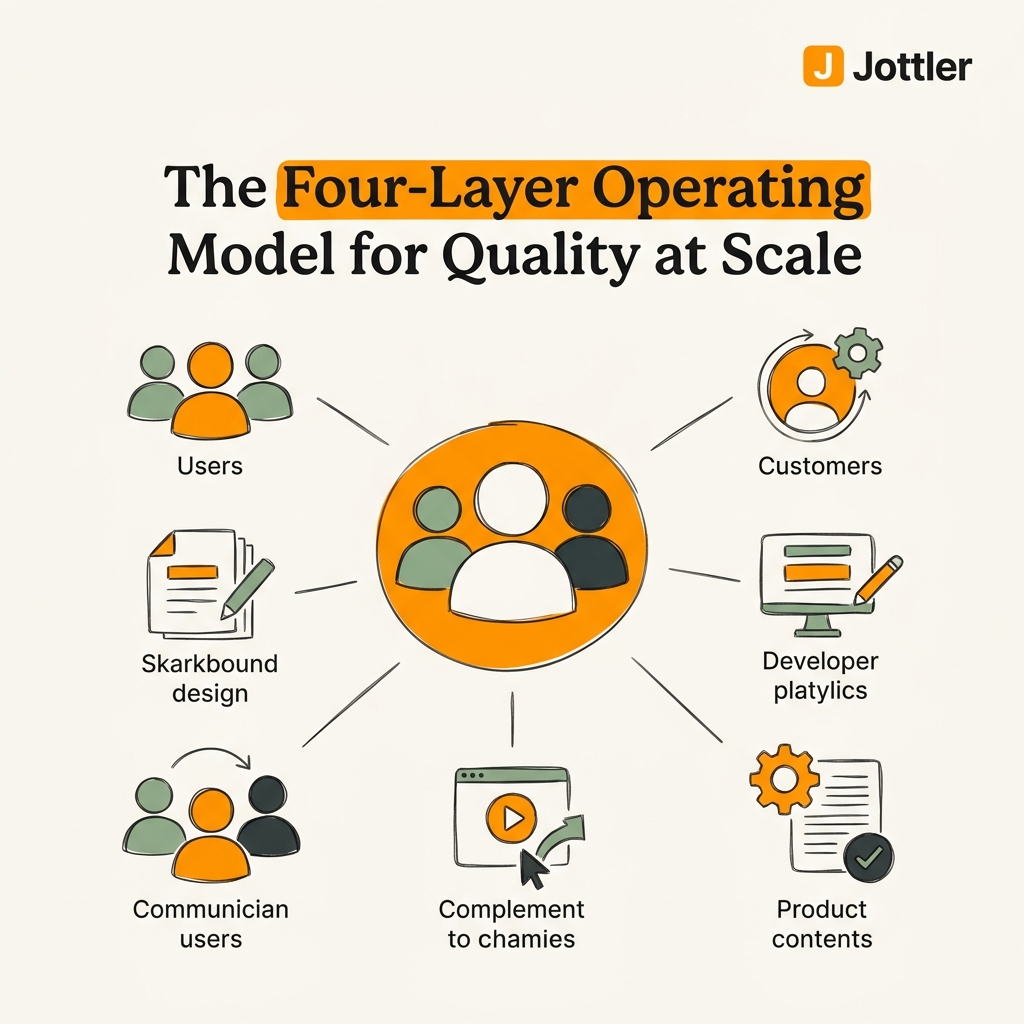
Industry leaders now structure content scaling as an operating-model problem, not just a tool problem. Trustworthy content at scale requires four interlocking layers: creators, workflows, AI guardrails, and governance (Contently, 2025). Weakness in any layer caps the others. A tool can't fix bad processes, and good processes break without the right technology. Here's the framework:
Layer 1: Process Standardization Through Content Briefs
High-volume teams that maintain quality start with structured content briefs that define expectations before writing begins. A brief is not a loose topic idea—it's a specification document that answers: Who is the audience? What problem are they solving? What sources must be consulted? What claims need verification? What internal links should be included? What tone and depth are required?
The best briefs include a research checklist. "Use at least 8 authoritative sources," "include at least one original statistic or case study," "cite all statistics with years and source names." These aren't guidelines—they're pass/fail criteria. Writers either meet them or the draft fails the first gate.
"Structured briefs with mandatory research checklists reduce writer guesswork and increase first-pass quality by 40%. Writers know exactly what 'done' looks like before they start."
Jottler automates this entire layer. The system generates research-backed briefs using 14+ data sources, pulling relevant statistics and citations directly into the brief before any writer ever sees the assignment. The writer inherits a brief where 70% of the heavy lifting—finding authoritative sources, identifying key claims, flagging what needs verification—is already done. No guessing. No research anxiety.
Layer 2: Automated Research & Draft Generation
The second scaling bottleneck is research. Research consumes 30-40% of a writer's time on complex topics, and quality suffers when writers rush it. Modern automation handles research at a level human writers can't match—simultaneously consulting 10+ sources, extracting relevant passages, cross-checking claims for consistency, and flagging conflicting data.
The shift is not "replace writers with AI." It's "use AI to eliminate research drudgery so writers focus on voice, synthesis, and strategy." An AI agent can draft a 3,000-word article in 8 minutes using verified sources. A human would spend 3+ hours on research and drafting, often with lower source depth. The AI draft is wrong—it needs editing. But it's 80% there. The writer edits, fact-checks, adds examples, refines tone. Total time: 1.5 hours instead of 4.
Content production speed increases by 400% when drafting is automated while costs per article drop 50% (2025, Loopex Digital). The math: fewer person-hours, same quality or better. But only if the AI system has quality guardrails built in.
Layer 3: Quality Control Through Automated Scoring
Manual editorial review is a binary gate: approved or rejected. Rejected drafts get sent back, wasting time. A better model uses automated scoring before human review. The system scans each draft against a structured rubric: Is every fact cited? Are sources authoritative? Does the tone match brand voice? Is the article optimized for target keywords? Are there broken links?
The impact is measurable. Automated scoring catches 94% of quality issues before any human sees the draft, compared to 67% for manual-only QA (2025, Contently). This isn't because automation is smarter—it's because automation is consistent. It checks every article the same way, every time, without fatigue.
The scoring framework used by leading teams is a 100-point system evaluating nine dimensions:
- Factual Accuracy: All claims have supporting sources; no contradictions with cited sources.
- Source Attribution: Every statistic, quote, and major claim linked to a named, credible source.
- Structural Integrity: Proper heading hierarchy, logical flow, no orphaned sections.
- SEO Optimization: Primary keyword in title and H1, secondary keywords distributed, meta description complete.
- Brand Voice: Tone, terminology, and confidence level match documented brand standards.
- Readability: Sentence length, paragraph structure, and word complexity aligned to target audience.
- Originality: Not derivative of top-3 SERP competitors; includes unique research or angles.
- Freshness: Current year data; outdated references flagged; evergreen where required.
- Technical Compliance: No broken links, proper HTML, CMS metadata complete.
Drafts scoring above 75 pass to editorial. Below 75, they're returned to the writer with specific, actionable feedback on which dimensions failed. This creates a feedback loop: writers improve faster because they know exactly what "quality" means, measurably. Editorial pass rates improve to >80% on first submission—meaning less rework, faster throughput.
Layer 4: Editorial Governance in the CMS
The final layer embeds governance into your publishing workflow so standards don't rely on willpower. Your CMS workflow should enforce:
- Required Fields: Title, meta description, primary keyword, internal links, sources—not optional.
- Approval Gates: Editorial review before publish, brand review for new authors, fact-check approval for regulated claims.
- Style Guides: Accessible templates and examples showing exact tone, formatting, and citation standards.
- Audit Trail: Every version, edit, and approval tracked so you can reconstruct the piece's history in minutes if needed.
Governance isn't about control—it's about enabling. When writers and editors have a clear system, they don't second-guess themselves. They move faster and with more confidence.
Automating the Full Workflow: From Research to Publishing
The teams scaling fastest aren't hiring more humans. They're building AI-driven workflows that handle the repetitive steps while humans focus on strategy and judgment. Here's what a fully automated workflow looks like:
Step 1: Keyword Research and Topic Selection
Instead of manually browsing search volume and difficulty, automated keyword research pulls data from Google Search Console, competitor SERP rankings, and search trend data. The system identifies high-opportunity keywords—high volume, achievable difficulty, genuine audience intent—and groups them by topic clusters. This alone saves 8-10 hours per week of analyst work.
Jottler's research agents scan 14+ data sources to identify trending topics, cross-reference them against your existing AI content strategy, and flag gaps in your topical authority. The system then recommends not just keywords, but complete topic angles with supporting research, statistics, and relevant citations already pulled. A topic that would take a human analyst 3+ hours to fully scope is ready to brief in 45 minutes.
Step 2: Research and Source Verification
Before a single word is drafted, the system pulls from authoritative sources, extracts relevant passages, cross-checks statistics for accuracy and currency, and flags any conflicting data. This creates a verified research package that writers inherit. Writers can focus on synthesis instead of verification.
Step 3: AI-Assisted Drafting with Quality Guardrails
The draft is generated using the verified research package. The AI follows the brief exactly—including required internal link anchors, target keyword placement, and structure. The draft includes inline citations so you know exactly where every claim came from.
Step 4: Automated Quality Scoring
Before any human touches it, the draft is scored. Issue? It returns to the writer with specific feedback. Pass? It goes to editorial review with a high-confidence signal.
Step 5: Editorial Review and Fact-Checking
The editor's job is now strategic: Does this serve the audience? Is the voice authentic? Are the examples relevant? Are there contradictions? They're not hunting for typos or missing citations—the automation caught those. They're judging the piece on merit.
Step 6: Publishing and Internal Linking
Once approved, the piece publishes automatically to your CMS. But it doesn't stop there. The system scans your entire content library, identifies relevant pieces for internal linking, and adds contextual link anchors. A guide on "scaling content production" automatically links to your existing pieces on content automation tools, SEO strategy, and AI writing tools. You build a linked network, not orphaned articles.
Measuring Quality at Scale: The Dashboard Approach
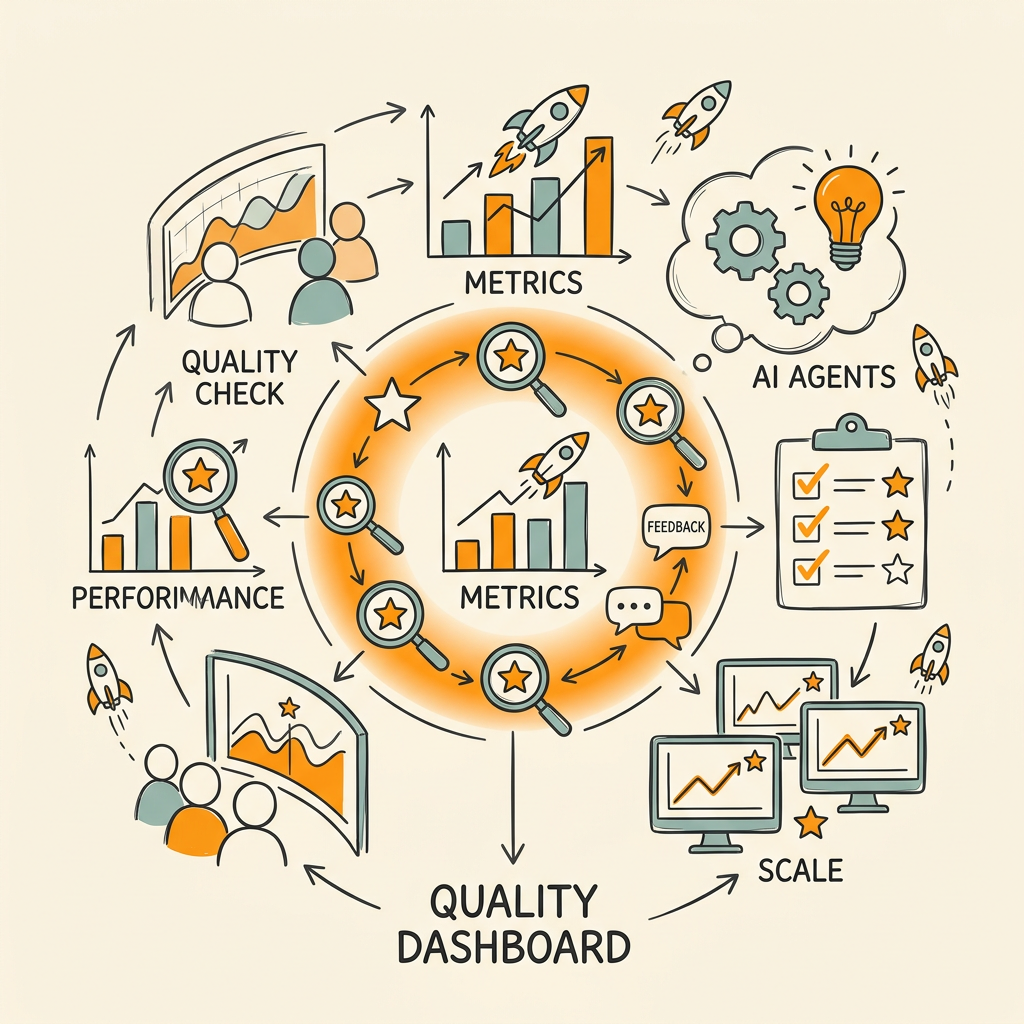
You can't improve what you don't measure. Teams scaling successfully track five key metrics:
| Metric | What It Measures | Target |
|---|---|---|
| Quality Score Distribution | % of drafts scoring 75+ (pass on first attempt) | >80% pass rate |
| Time-to-Publish | Days from brief to published article (by content type) | 3-5 days for 3K-word guides |
| Editorial Pass Rate | % of drafts approved without revision by editor | >75% (indicates quality controls working) |
| Search Visibility (6-month lagged) | Ranking improvements, organic traffic from new content | +15-25% quarterly growth |
| Citation Rate in AI Overviews | How often your content appears in AI-generated summaries | >30% of published pieces cited within 6 months |
Content scoring above 75 on the 100-point framework achieves 3.8x higher citation rates in AI Overviews compared to lower-scoring pieces (2025, Contently). This is a concrete, measurable benefit of maintaining standards while scaling. For practical implementation, explore content marketing statistics and benchmarks to align your targets with industry standards.
Track these metrics in a shared dashboard. When editorial pass rate drops, it signals that your quality controls are loosening. When time-to-publish spikes, it reveals workflow bottlenecks. The dashboard is your early warning system.
Avoiding the Pitfalls of Over-Automation
Automation is powerful but not foolproof. Teams that scale poorly typically make one of three mistakes:
Mistake 1: Removing Human Editorial Judgment Entirely
The allure of "100% automated publishing" is a trap. Every AI-assisted step must pass the same editor and audit checkpoints as human work (2025, Contently). Automation is an accelerant on specific steps, not a replacement for editorial judgment. AI can draft, but a human must verify that the draft actually serves the reader's intent. An editor must confirm that automated internal links make contextual sense, not just keyword sense.
The teams winning are those treating AI as a force multiplier: "Our editors can now review 3x the volume in the same hours because AI handled the grunt work." Not: "We don't need editors anymore."
Mistake 2: Publishing High Volume Without a Linking Strategy
More articles + no internal linking = less traffic per piece. Each new article competes for ranking against your existing library, and without internal links to distribute authority, newer pieces rank worse. A coherent linking strategy (sometimes called "internal link networks" or topical authority mapping) ensures that each piece you publish strengthens your topical cluster.
This is where most teams fail. They scale output but fail to link. Traffic stalls. The content feels orphaned. Jottler solves this by automatically analyzing your content library and suggesting internal links for every new piece—matching context, not just keywords. The result is a compounding network effect where each new article lifts the entire cluster.
Mistake 3: Ignoring Brand Voice and Losing Audience Trust
When you scale fast without governance, voice drifts. Different writers interpret "friendly" differently. Different editors enforce "authoritative" in contradictory ways. Readers notice. They stop seeing you as a cohesive brand and start seeing a content factory. To demonstrate E-E-A-T (Experience, Expertise, Authoritativeness, Trustworthiness) at scale, showcase author expertise with detailed bios, link to authoritative sources, and keep content updated (2025, Victorious).
The fix is a documented brand voice guide with examples. "Here's how we write product descriptions. Here's our tone in educational content. Here's how we cite sources." Then make it non-negotiable in your CMS. Every article runs through a voice-consistency check before publishing.
Building the Automated Pipeline in 30 Days
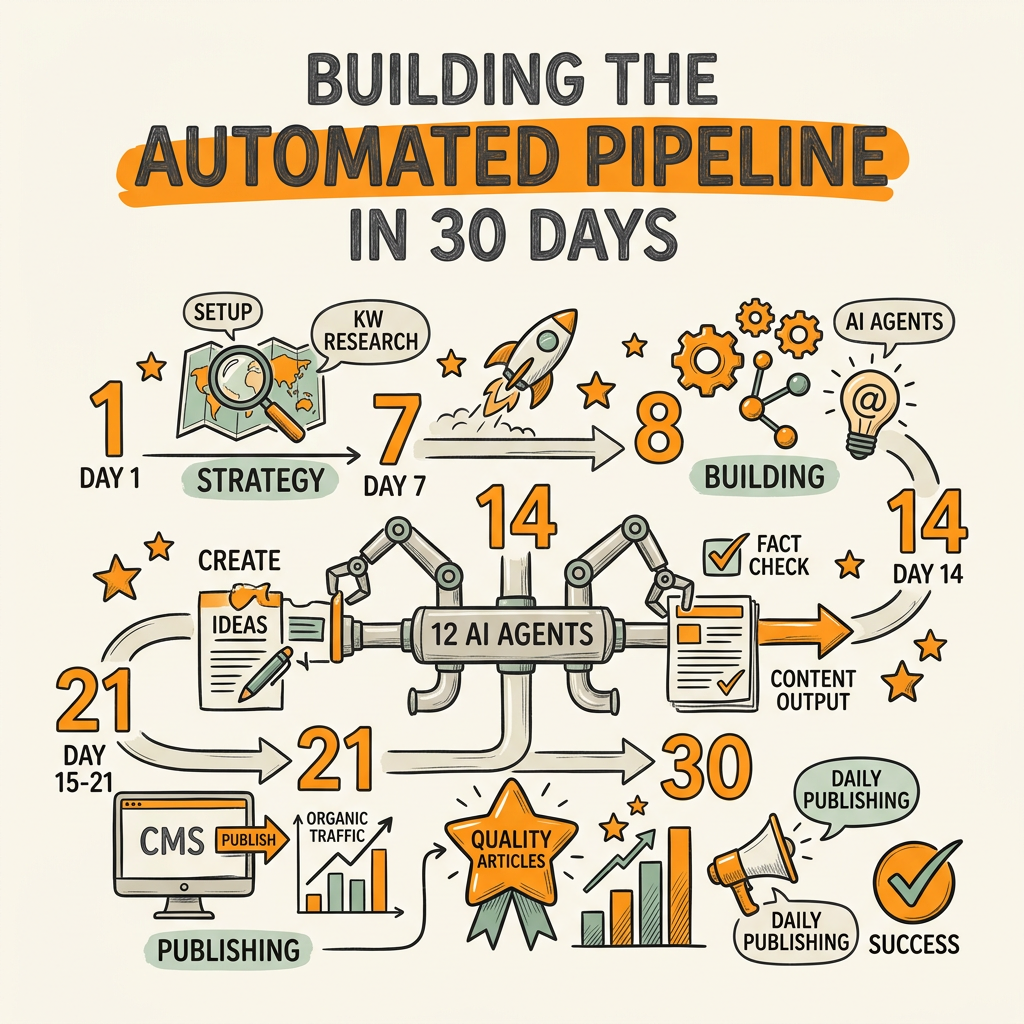
You don't need to overhaul your entire operation at once. Most teams implement scaling systems in phases over 4-6 weeks:
Week 1-2: Document Your Standards
Define your quality rubric, brand voice, and editorial approval process. What's a passing article? What are deal-breakers? Codify it. This becomes your reference for every automated system and human reviewer going forward.
Week 2-3: Audit Existing Content
Run your backlog through the quality rubric. Which pieces score 75+? Which don't? Why? This tells you if your standards are realistic and where your actual gaps are. You might discover that most pieces score high on voice but low on citation completeness—that's your priority fix.
Week 3-4: Implement Automation on One Content Type
Start with a single content format (e.g., how-to guides or comparison posts). Automate research and drafting for that type only. Measure: Are quality scores improving? Is time-to-publish dropping? Is editorial sign-off faster? Once you see confidence, expand to the next format.
Week 4+: Layer In Governance and Linking
Implement CMS workflow gates, internal linking automation, and quality dashboards. By week 6, you should have a repeatable, scalable system producing content at 2-3x your previous pace with no loss (and usually improvement) in quality.
Jottler condenses this timeline dramatically. The system comes with pre-built quality rubrics, research protocols, and CMS integrations. Instead of weeks of configuration, you're publishing scaled content within days. The research agents, AI writers, and fact-checking systems are already optimized for quality-at-scale publishing. You connect your CMS, set your publishing frequency (1-5 articles/day), and the system handles research, writing, scoring, and publishing with no manual intervention.
The ROI of Scaling Responsibly
Responsibly scaling content is not a cost center—it's one of the highest-ROI marketing activities available. Here's what the numbers show:
- Speed Premium: AI-powered content writing increases production speed by 400% while reducing cost per article by 50% (2025, Loopex Digital). You're doing 4x the work at half the cost per piece.
- Automation ROI: Marketing automation delivers $5.44 in return for every $1 spent (2025, GTM 8020), with payback in under 6 months. Content automation—the piece that handles research, drafting, and publishing—is a subset of this, but the ROI vector is the same.
- Traffic Compounding: Consistent, high-quality content output directly correlates to SERP ranking improvements. Teams publishing 10+ high-quality articles per month outrank competitors publishing 2-3 per month in target keywords within 6-12 months. The traffic advantage compounds.
- AI Citation Advantage: Content scoring above 75 achieves 3.8x higher citation rates in AI Overviews (2025, Contently). AI Overviews are becoming the new ranking signal. Quality scales your visibility in that channel.
The opportunity cost of not scaling responsibly is severe. Your competitors are. Every month you delay is a month they publish more content, build more authority, capture more traffic. The window to build topical authority in your category is closing, and it closes faster for competitors who automate.
Conclusion
Scaling content output without quality loss is not a trade-off—it's a structural challenge solved by the right operating model. Process standardization, automated research and drafting, quality control systems, and editorial governance create the four layers that enable teams to produce 3-5x more content monthly without diluting standards.
The data is clear: marketing automation delivers measurable ROI, production speed increases dramatically when bottlenecks are removed, and high-scoring content achieves significantly higher visibility in AI systems. These aren't theoretical benefits—they're what teams are measuring right now.
The teams winning at content scaling in 2026 are those treating content production like a system, not a task. They define standards, automate the repetitive work, let humans focus on strategy and judgment, and measure everything. If you're ready to move from publishing 3-5 articles per month to 15-20 while improving quality, start your SEO agent and watch how a structured workflow multiplies your output.
FAQs
How do I maintain consistent quality when publishing multiple articles per day?
Quality consistency at scale relies on automation, not willpower. Automated scoring systems catch 94% of issues before human review, which means your editors spend time refining voice and strategy, not hunting for missing citations or tone inconsistencies. Pair this with a documented brand voice guide, CMS workflow gates that enforce required fields, and a quality rubric that every piece must pass. The volume becomes irrelevant—the system works the same whether you publish 2 articles or 20. Automation handles the consistency; humans handle the judgment.
What happens to SEO performance when you scale content production rapidly?
SEO performance improves when scaling is paired with internal linking strategy and quality control. Orphaned articles (published without internal links or consideration for topical clusters) actually hurt SEO—they dilute authority across disconnected pieces. But scaled content that's linked strategically compounds. Each new high-quality article strengthens the topical authority of your entire cluster. Teams publishing 10+ articles monthly with proper linking significantly outrank competitors publishing 3-5 per month in 6-12 months. The volume advantage is real, but only if structure and linking are in place.
Can AI-generated content really rank as well as human-written content?
AI-assisted content that's fact-checked and edited by humans ranks as well or better than purely human-written content because it's more efficient to scale and maintain. The ranking factors aren't "human vs. AI"—they're freshness, topical relevance, authority, and backlinks. AI helps you produce more fresh content more consistently, and humans ensure it's factually accurate and addresses real audience intent. Content generated with AI guardrails and editorial oversight scores higher on E-E-A-T signals (citations, expert bios, source attribution) than rushed human work. The winning approach combines both: AI for speed and consistency, humans for judgment and voice.