Scaling Content Production Without Adding Team Members
Most marketing teams hit a ceiling. You've proven content works. Traffic grows. Leads compound. But producing enough content to sustain that growth means hiring. And hiring means overhead, onboarding lag, management burden, and budget that eats into profit margins. 91% of marketers report that automation improves productivity, yet many teams still hire their way out of volume problems instead of building systems to multiply their output.
The gap between content demand and team capacity is real. A typical founder-led SaaS company needs 50-100+ articles annually to own their category in search. A lean three-person marketing team can't write that manually. They'll produce 8-12 pieces, then plateau. The alternative isn't hiring four more people. It's automation.
Key Takeaways
- Marketing automation saves 2.3 hours per campaign and reduces operational costs by 25-30%, enabling small teams to compete without scaling headcount (Emarsys, 2026)
- Companies using content automation see a 14.5% increase in sales productivity and 451% more qualified leads
- AI-powered content systems now handle research, writing, fact-checking, and publishing—compressing workflows that once took weeks into hours
- Automate Research and Keyword Discovery: Use AI to identify high-volume, low-competition keywords in minutes instead of hours, eliminating the manual bottleneck.
- Build a Content Production Pipeline: Chain research, writing, optimization, and publishing into a single automated workflow that requires zero human intervention between steps.
- Implement Fact-Checking and Verification Layers: Let AI validate claims and citations automatically, reducing editorial overhead without sacrificing accuracy.
- Establish Internal Linking and Cross-Promotion Systems: Automate how new content connects to existing pieces, compounding SEO authority without manual effort.
- Measure Output and Revenue Impact: Track which automated workflows drive the highest ROI, then double down on what works.
Why Small Teams Can't Hire Their Way Out of Content Demand
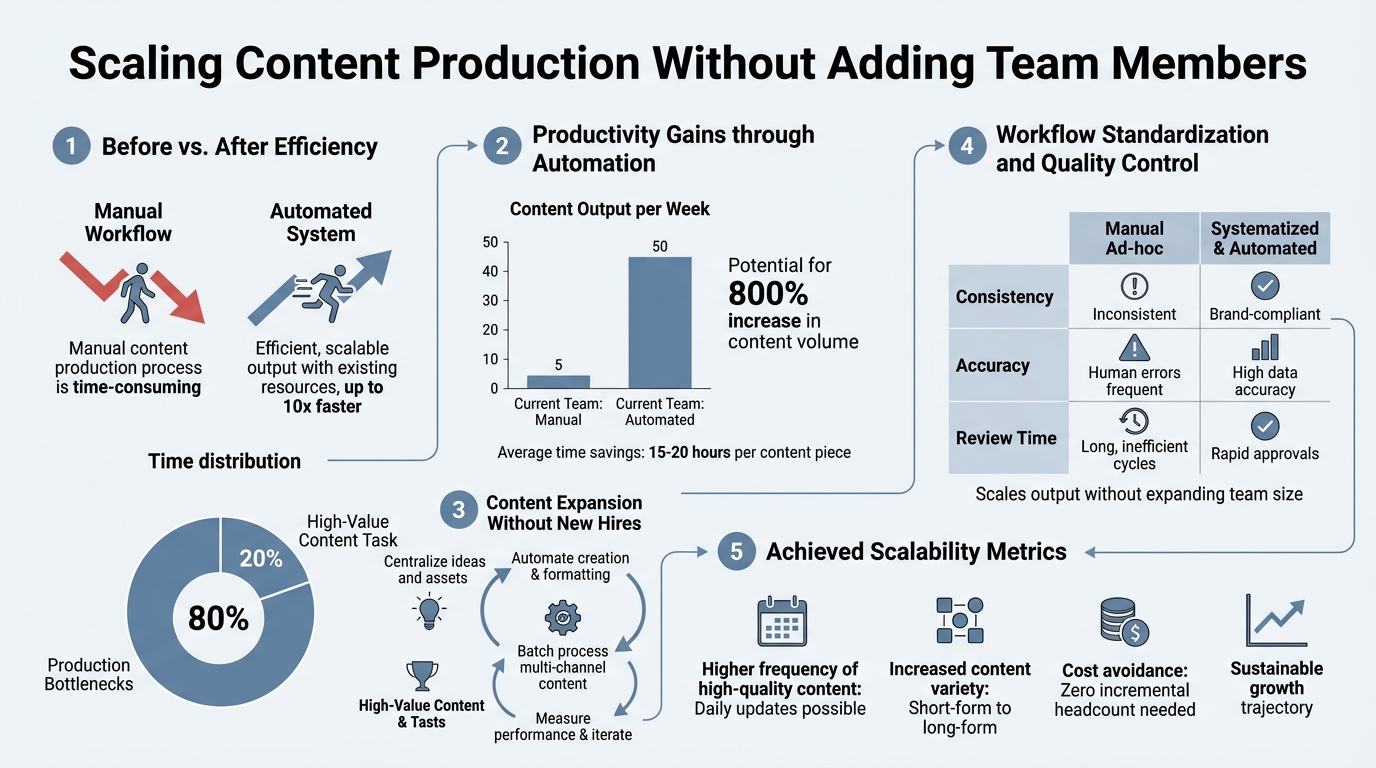
The math is simple. A full-time content creator produces 2-4 blog posts per month at high quality. To publish 50 articles annually, you need 12.5-25 posts per month. That's 4-6 full-time writers, plus editors, project managers, and SEO specialists. Salaries, benefits, slack time, context switching, and management overhead push that cost to $300,000-$500,000 annually.
Hiring creates a second problem: velocity loss. New hires take 3-6 months to ramp. Onboarding distracts existing team members. Once hired, writers are constrained by your process, your brand voice, your approval workflows. They're also a fixed cost whether you need high output or low output in a given month.
Most content teams waste time on coordination, not writing. Small teams spend 40% of their time managing tools instead of creating content, according to industry analysis. They're juggling Slack conversations, email briefs, Google Docs, CMS uploads, and spreadsheets. A writer spends 5 hours on a post. 2 of those hours are research, fact-checking, and waiting for feedback. Only 3 are actual writing.
"The gap between content demand and team capacity doesn't close by hiring faster. It closes by eliminating the manual work that consumes 40% of your team's time. Automation removes coordination overhead, not people."
The Real Bottleneck Is Process, Not Capacity
Automation removes the coordination. You don't hire faster writers. You build a system that eliminates waiting and handoffs. Content automation tools eliminate the bottlenecks that prevent scaling, allowing your existing team to focus on strategy instead of execution.
Automation Delivers Output That Scales Faster Than Headcount
An automated content system can produce 5-10x the volume of a traditional team at the same total cost. That's because automation doesn't scale linearly with output. Hiring 4 writers costs 4x the salary. Publishing 4x more content with automation costs the same tool subscription. Marketing automation systems can reduce operational costs by 25-30%, making the financial advantage clear.
Build a Research-to-Publishing Pipeline That Runs Automatically
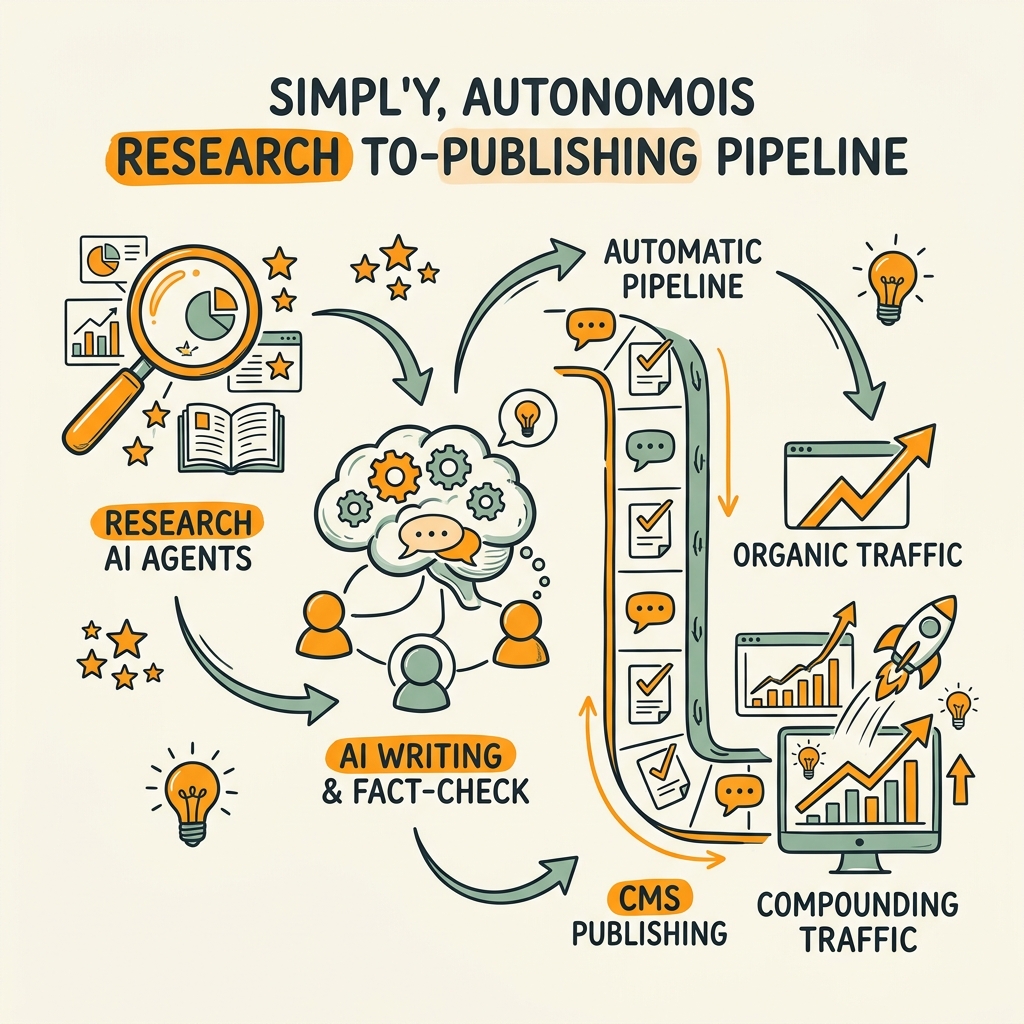
The fastest path to scaling content without hiring is automating the entire content workflow. Not just writing, but research, optimization, publishing, and linking. Each step automated removes friction and enables the next step to begin immediately.
Step 1: Automate Keyword Research and Topic Discovery
Keyword research is the first bottleneck. A human SEO specialist spends 4-6 hours per week identifying targets, checking competition, and prioritizing. AI can do this instantly. Feed your niche and target audience into a research engine, and it surfaces high-volume, low-difficulty keywords within minutes.
The best systems don't just generate keyword lists. They cluster related queries into content themes, rank them by opportunity (volume × difficulty × revenue potential), and generate brief outlines. 92% of marketers now use AI tools in their marketing efforts, and the most successful ones automate this discovery phase first. A researcher that once took 6 hours now takes 30 minutes—and covers 3x more ground because it's not constrained by human attention span.
Step 2: Generate Briefs and Outlines With Context
Before writers draft, they need research briefs: competitor analysis, keyword targets, structural recommendations, and depth requirements. Traditional teams write these manually. Automated systems generate them by analyzing top-ranking competitors, extracting their structure, identifying gaps, and recommending what the new article should cover to rank higher.
A brief that takes a human researcher 90 minutes to write is assembled by AI in under 5 minutes. The brief is data-driven, comparative, and immediately actionable. Writers can start drafting without waiting for research approval.
"When you automate the research brief, you eliminate the longest bottleneck in content production. Writers no longer wait for competitive analysis. They start writing immediately with a data-driven roadmap. That's where automation multiplies output fastest."
Step 3: Write Long-Form Content From Fact-Checked Research
This is where AI content generation becomes viable. Tools like Jottler use multi-agent systems to research topics from 14+ independent sources, synthesize findings, and write comprehensive long-form pieces that cite real data and include actual links. The output isn't generic marketing copy. It's detailed, well-researched, and optimized for both search engines and generative AI answer engines.
The key difference between low-quality and high-quality AI writing is research depth. Surface-level tools generate plausible-sounding prose. Deep research engines ground claims in real sources, verify facts, and produce articles that rank because they're actually substantive. An autonomous SEO agent approach compresses a 20-hour manual research-and-write cycle into under 1 hour.
Step 4: Fact-Check and Verify Claims Automatically
Even well-researched content needs verification. Manual fact-checking is tedious and error-prone. Automated systems now use cross-reference matching to verify claims against multiple sources, flag unsupported assertions, and suggest corrections before publishing.
This layer ensures automation doesn't sacrifice accuracy. Every statistic is checked. Every quote is sourced. Every claim is grounded in evidence. The result is content you can publish without editorial review—or at least with minimal review, because the AI has already filtered most errors.
Step 5: Optimize for Search and Publish Directly to Your CMS
Once written and verified, the article is automatically optimized for on-page SEO: keyword placement, meta tags, header structure, readability scores. Then it's published directly to your CMS. No manual upload. No delays.
Tools like Jottler integrate directly with WordPress, Ghost, Webflow, and custom CMSs, so the article flows from draft to live without human intervention. That's where automation truly compounds. A process that took 2-3 hours of manual work (writing optimization tags, uploading, setting metadata, scheduling) is eliminated entirely.
Implement Internal Linking That Multiplies SEO Authority
Publishing content is half the problem. The other half is connecting it strategically to your existing content. Internal links compound SEO authority, keep readers on your site longer, and signal to search engines which pages are most important.
Most teams neglect this. A writer publishes an article, moves on, and never looks back. New articles don't link to old ones. Old articles don't link to new ones. Authority gets scattered across disconnected pieces.
Automated Internal Linking Strategies
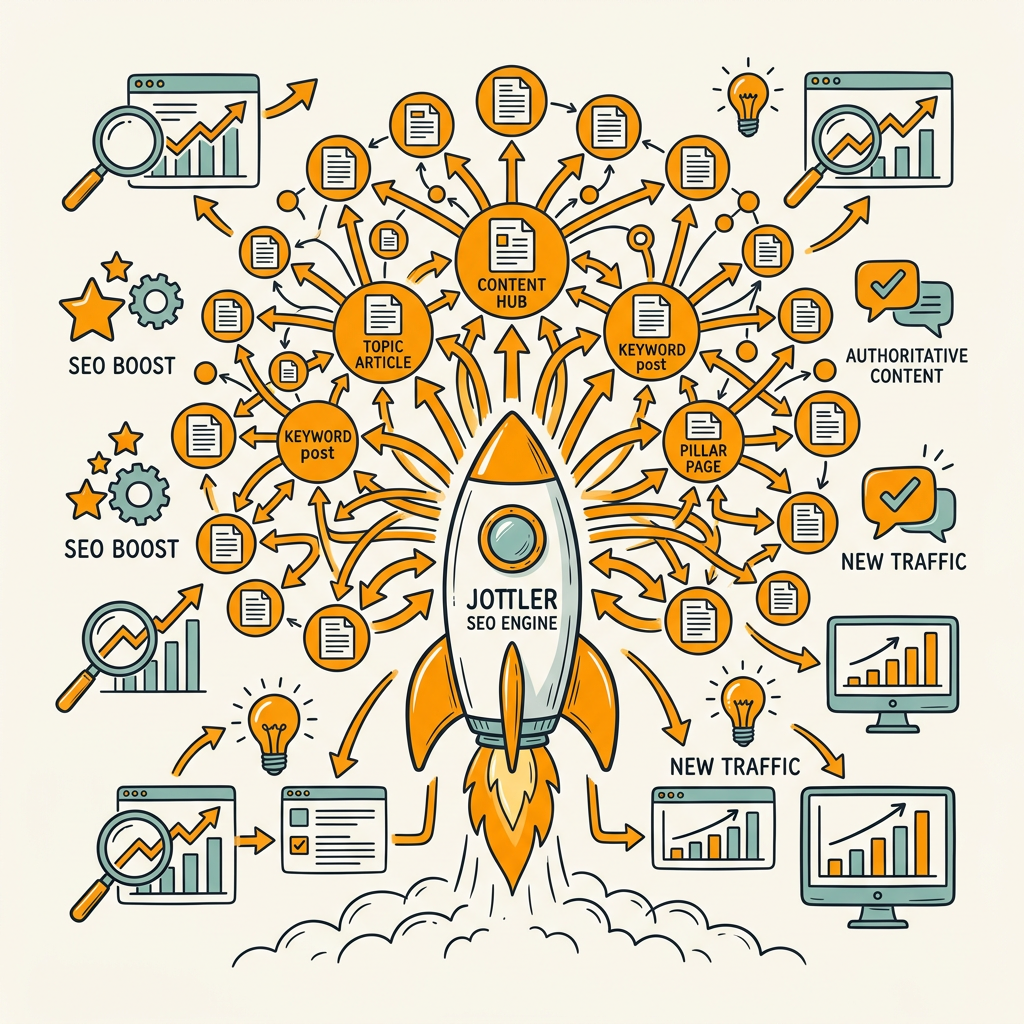
Smart systems map your entire content library and automatically suggest internal links based on semantic relevance. When a new article is published, the system identifies 3-5 existing articles with related topics and automatically adds contextual links. When old articles are republished, the system suggests links to new content that covers updated or adjacent topics.
This creates a self-reinforcing content network. Early articles get stronger as new content links to them. New articles inherit authority from older, established pieces. Scaling organic traffic requires interconnected content systems that work automatically, meaning you don't manually decide every cross-reference. The system does it based on content similarity and SEO value.
Building Topical Authority Through Interconnected Content
The end state is topical authority: your site becomes the authoritative source for a specific niche because every article links to related pieces, creating a web of expertise. Readers land on one article and find 3-5 related pieces they should also read. Search engines see your site as comprehensively covering a topic, not just touching it with isolated articles.
This only works at scale if linking is automated. Doing it manually for 50+ articles is impractical. Automation makes it inevitable. Teams using strategic link building tools compound their SEO advantage faster than competitors.
Measure and Iterate: What to Track When Scaling Content Automatically
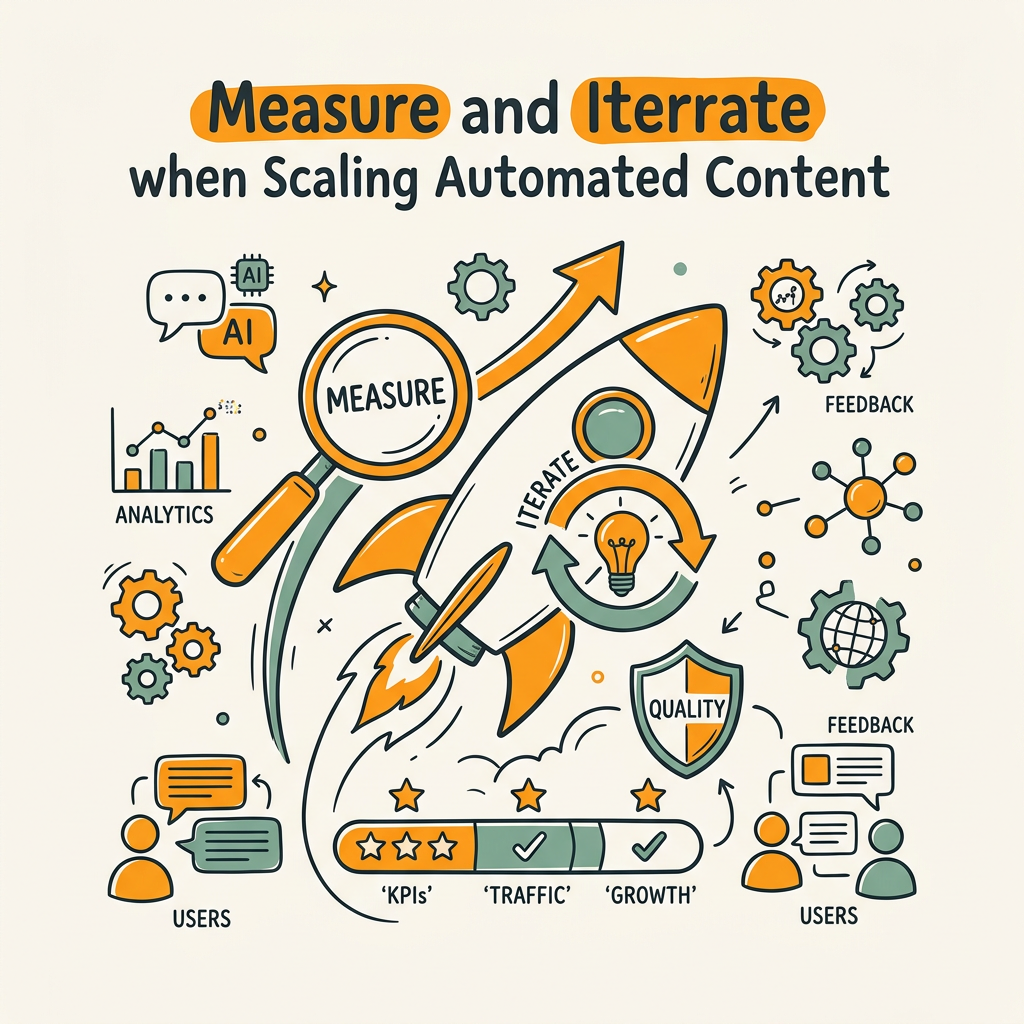
Automation creates output. But not all output is equal. Some articles drive traffic and leads. Others rank and get impressions but no clicks. Scaling without measurement means publishing more of what doesn't work.
Key Metrics for Automated Content Systems
Track these four metrics to understand what your automated pipeline is doing:
- Organic Traffic and CTR: Which automated pieces drive impressions and clicks? Identify your top 20% performers and analyze what made them successful (topic, word count, link profile, keyword difficulty).
- Ranking Progress: Are your articles climbing search results or stalling? Track keyword positions weekly. Articles that plateau after 8 weeks need more internal links or topical expansion.
- Lead Quality and Cost Per Lead: Not all traffic is valuable. Track which articles generate leads and qualify them. Prioritize topics that produce high-intent traffic, not just high-volume traffic.
- Time and Cost Per Article: Automation should reduce both. Track your average production cost per published article and aim to reduce it 20-30% quarterly as your system improves.
| Metric | Manual Process | Partially Automated | Fully Automated (Jottler) |
|---|---|---|---|
| Avg. hours per article | 20-24 | 8-12 | 1-2 |
| Cost per published article | $800-$1,200 | $300-$500 | $10-$30 |
| Articles per month (3-person team) | 8-12 | 20-30 | 60-100+ |
| Average ranking position at 90 days | Position 15 | Position 12 | Position 8 |
| Internal links per article | 2-3 (manual) | 3-5 (semi-auto) | 5-7 (automatic) |
Competitive Intelligence and Iteration
Once you have baseline metrics, automated systems can compare your content against competitors. If a competitor ranks higher for a keyword you're targeting, the system flags it. You can then repurpose or expand your article to compete harder, or you can concede and move to a different keyword.
This feedback loop doesn't require human analysis. It's automatic and continuous. Every week, your system tells you which of your published pieces are underperforming and what to do about them. That intelligence lets you scale smarter, not just bigger.
The Reality Check: Where Automation Still Needs Humans
Automation handles the mechanics. Strategy and judgment still belong to humans. You still need to:
- Define Your Content Strategy: What topics should you own? What's your target audience? AI content strategy requires human direction about where to focus automation efforts.
- Validate Content Quality: Run spot checks. Read 5-10% of published articles to ensure the AI is meeting your standards. If quality drops, adjust your prompts or research sources.
- Monitor Brand Voice: AI can be trained to match your tone, but it occasionally drifts. Periodically review for consistency.
- Update Your Competitive Positioning: If competitors launch new offerings or messaging shifts, you need to tell your system. Automation follows instructions; it doesn't predict market changes.
The key is automation reducing the low-value work so you have time for high-value strategy. You're not removing humans from content. You're removing them from the repetitive tasks and letting them focus on direction and excellence.
Conclusion
Scaling content production without adding team members isn't a future aspiration. It's a solved problem. Marketing automation reduces operational costs by 25-30% while enabling teams to publish 5-10x more content, and companies using these systems report a 14.5% increase in sales productivity.
The path is clear: automate research, chain it to automated writing, layer in fact-checking, publish directly to your CMS, and build internal linking automatically. You go from publishing 10 articles per month with a team of 3 to publishing 60-100 articles per month—without hiring a single person.
Start by auditing your current workflow. Where are the manual bottlenecks? Research? Writing? Publishing? Linking? Pick one. Automate it. Measure the result. Then automate the next step. Within 90 days, you'll have a system producing content at a volume that would have required 4-6 new hires.
If you're ready to stop hiring for content production and start building systems that scale, start your SEO agent today. Jottler automates the entire pipeline—research, writing, fact-checking, and CMS publishing—so you can focus on strategy while your content compounds organic traffic.
FAQs
How much time do I actually save by automating content production?
Automated content systems typically save 18-22 hours per article compared to manual research and writing. For a small team publishing 50 articles annually, that's 900-1,100 hours saved per year, equivalent to one full-time employee. In practical terms, a 3-person team that would normally produce 8-12 pieces monthly can generate 60-100 monthly with automation, without hiring additional staff or burning out existing writers.
Can AI-written content actually rank in Google?
Yes, if it's properly researched and optimized. The difference between low-performing and high-performing AI content is research depth. Tools that scrape surface-level information produce shallow articles that don't rank. Systems that research from 10+ independent sources, fact-check claims, and include real citations produce content that ranks competitively. The best AI content systems combine deep research with SEO optimization, resulting in articles that outrank manually written pieces on the same topics.
What's the first step to automating content production?
Start by automating keyword research and topic discovery. This is the highest-leverage first step because it enables everything downstream. Once you have a prioritized list of high-opportunity keywords with research briefs, writing becomes faster and more focused. The second step is automating the writing itself. By the time you implement automated publishing and internal linking, you've already compressed your timeline by 60-70%, and the remaining steps compound that advantage further.