
Scaling Content Production Without Hiring More Writers
Most content teams hit the same wall: demand for blog posts, guides, emails, and social copy outpaces what your writers can deliver. The instinctive move is to hire more staff. But onboarding costs, training time, and unpredictable content needs make traditional hiring an expensive gamble. Here's the reality: 76% of companies now use marketing automation, and those that do report 77% higher conversion rates. The solution isn't more headcount—it's smarter systems. You can multiply content output by 3–5 times without expanding your internal team by combining automation, strategic workflows, and AI-assisted production.
Key Takeaways
- 76% of companies use marketing automation and report 77% higher conversion rates as a result (2026, SQ Magazine)
- Content repurposing multiplies output 3–5 times per long-form asset, with one source-piece yielding 3–5 platform-specific derivatives without additional writing
- 80% of marketers now use AI for content creation, and teams using agentic AI systems report 45% adoption for automated content variant generation and QA
- Content Repurposing Strategy: Extract 3–5 assets from one comprehensive blog post to multiply distribution without proportional effort increases.
- Workflow Automation and Tools: Implement automation across research, writing, fact-checking, and publishing to compress timeline and reduce manual overhead.
- AI-Assisted Content Production: Use AI agents for first drafts, metadata generation, and variant creation while keeping human review for tone and accuracy.
- Batch Production and Systems: Group similar content types together and establish repeatable processes to reduce context-switching and accelerate output.
- CMS Integration and Publishing: Connect your content automation pipeline directly to your publishing system to eliminate manual posting and internal linking delays.
Why Hiring More Writers Often Fails to Solve the Scaling Problem
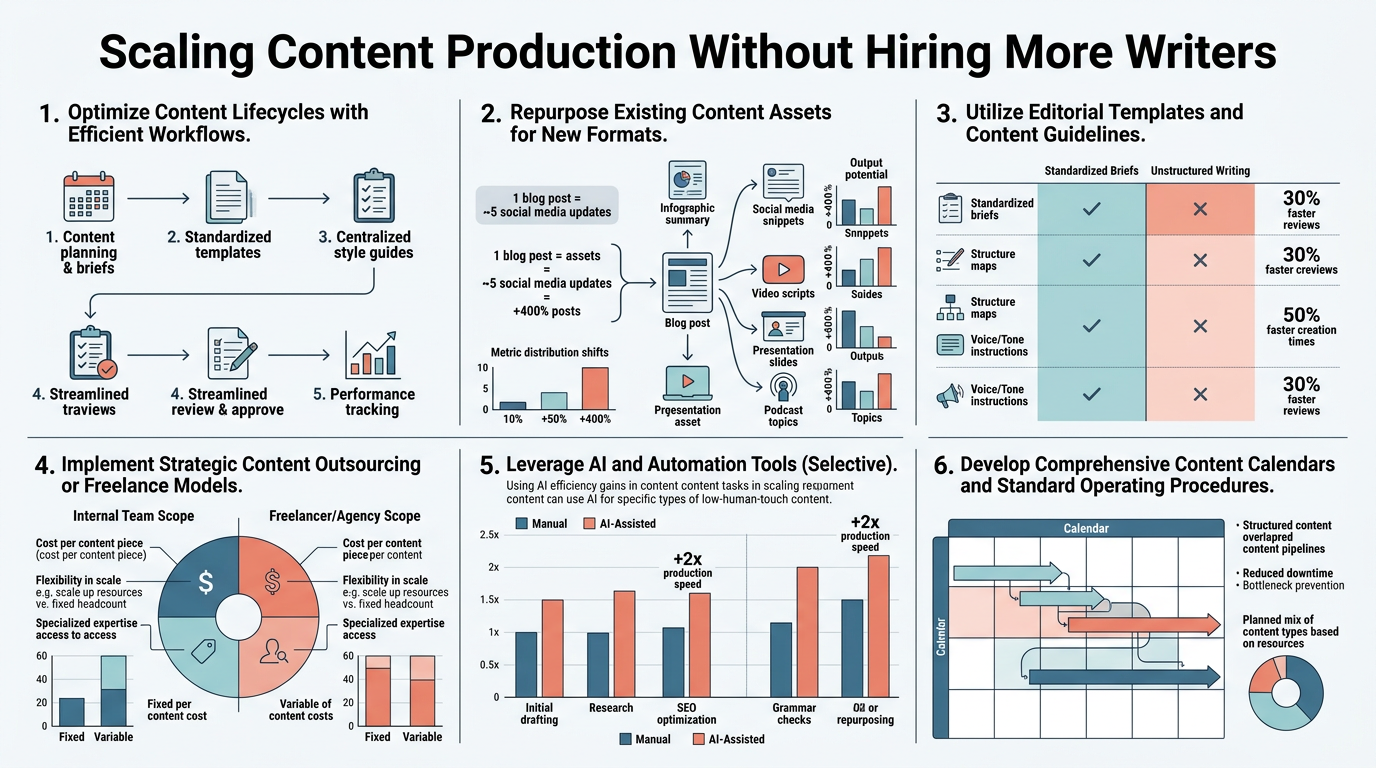
Adding headcount feels like the logical answer, but the math doesn't support it. Hiring a full-time writer costs $50,000–$80,000 per year in salary alone, plus recruitment fees, onboarding overhead, benefits, and management time. Meanwhile, content demand fluctuates seasonally or by campaign, meaning you're often paying for unused capacity or scrambling during spikes. The real bottleneck isn't writing speed—it's approval cycles, research time, and the fragmented workflow that forces writers to hunt for information, wait for sign-offs, and recreate similar content they can't easily find.
"The real bottleneck isn't writing speed—it's approval cycles, research time, and the fragmented workflow that forces writers to hunt for information, wait for sign-offs, and recreate similar content they can't easily find."
Most teams struggle because they face multiple bottlenecks simultaneously. A single writer handles blogs, social snippets, email campaigns, website copy, and sales materials across different departments. Content gets stuck in lengthy review cycles with conflicting feedback. Assets bounce between writers, editors, and stakeholders, doubling or tripling production time. Without clear templates, brief standards, or asset management systems, teams essentially start from scratch for every piece. This is where content automation tools begin to show their value—by removing the coordination overhead entirely.
How Content Repurposing Multiplies Output Without New Hires
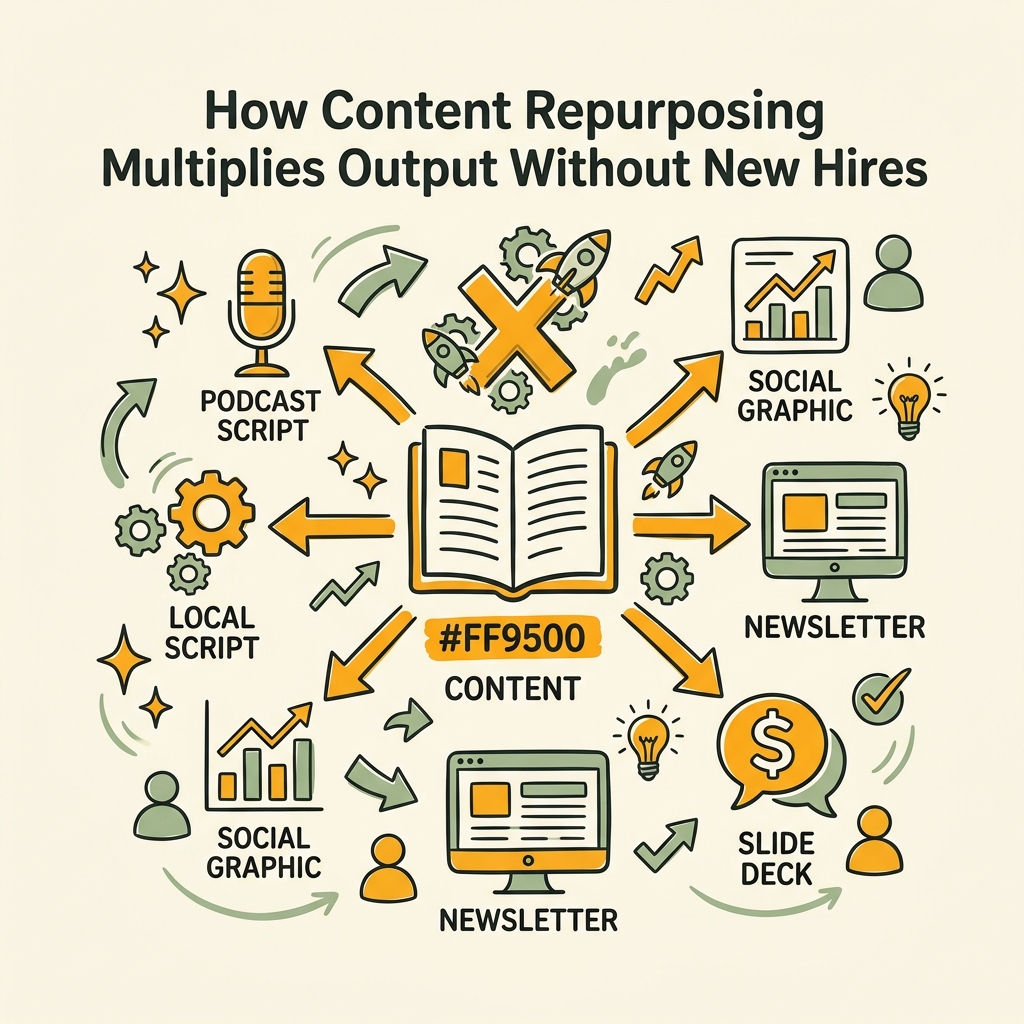
The most immediate scaling lever is repurposing. One comprehensive blog post becomes the hub; social snippets, email content, infographics, video scripts, and downloadable assets become the spokes. Research shows teams following a repurposing system can extract 3–5 distinct assets from a single long-form piece, each tailored to a different platform or audience. This isn't copying verbatim—it's reformatting and adapting the core insight to fit native experiences on LinkedIn, email, social feeds, and video platforms.
A practical monthly workflow published by content practitioners in 2026 recommends producing 2 long-form blogs, 8–12 micro-content pieces extracted from those blogs, 1 downloadable asset, 1 refreshed older article, and 2 short videos derived from past content. That's an average of 5–6 outputs per blog post—without hiring one new writer. The process requires discipline: identify high-signal evergreen content, batch the transformations, use AI to speed extraction, and maintain human review for brand consistency.
"One long-form blog post can generate 5–6 platform-specific outputs through systematic repurposing, effectively multiplying content output without expanding the writing team."
- Hub-and-Spoke System: One core asset (a comprehensive guide or case study) serves as the content hub. Platform-specific derivatives—carousel posts, email sequences, video clips—become the spokes.
- Format Adaptation: Transform blogs into carousel posts, webinars into checklists, videos into short-form clips. Adapt the message to the channel, not just the format.
- Batching by Asset Type: Group similar outputs together (e.g., all social snippets in one session) to reduce context-switching and boost throughput.
- Evergreen-Plus-Refresh Model: Identify top-performing or foundational assets. Refresh them with new data every 6–12 months, then republish as "new" content.
Automation as a Force Multiplier for Your Existing Team
Automation doesn't replace writers—it eliminates the busywork that slows them down. Research shows 93% of marketers report that AI helps them create content faster, and 45% of marketing teams now use at least one agentic AI system for tasks like lead routing, content variant generation, and quality assurance. The goal is to let AI handle first drafts, metadata extraction, headline generation, and repurposing workflows, freeing your writers to focus on research depth, narrative flow, and fact-checking.
Tools designed for this workflow—often called autonomous SEO agents—automate the entire research-to-publish pipeline. They ingest a keyword, research 14+ sources, write a comprehensive piece, fact-check claims, generate meta tags, and publish directly to your CMS while building internal link networks. This approach compounds: one agent running daily can produce the equivalent of a 3–4 person writing team without the coordination overhead.
"An autonomous agent running daily can produce the equivalent of a 3–4 person writing team without the coordination overhead, eliminating tool-switching and manual handoffs that slow traditional workflows."
- AI-Driven Research: Tools aggregate data from multiple sources, summarize findings, and cite claims automatically—eliminating hours of manual research per article.
- First-Draft Generation: AI generates structural outlines and prose that your writers refine rather than starting blank, compressing writing time by 40–60%.
- Fact-Checking and Verification: AI cross-references claims against source data in real time, flagging unsupported assertions before publication.
- Metadata and Variant Generation: Automated systems produce meta descriptions, title tag alternatives, and social snippets in seconds.
Workflow Optimization: The Often-Overlooked Bottleneck
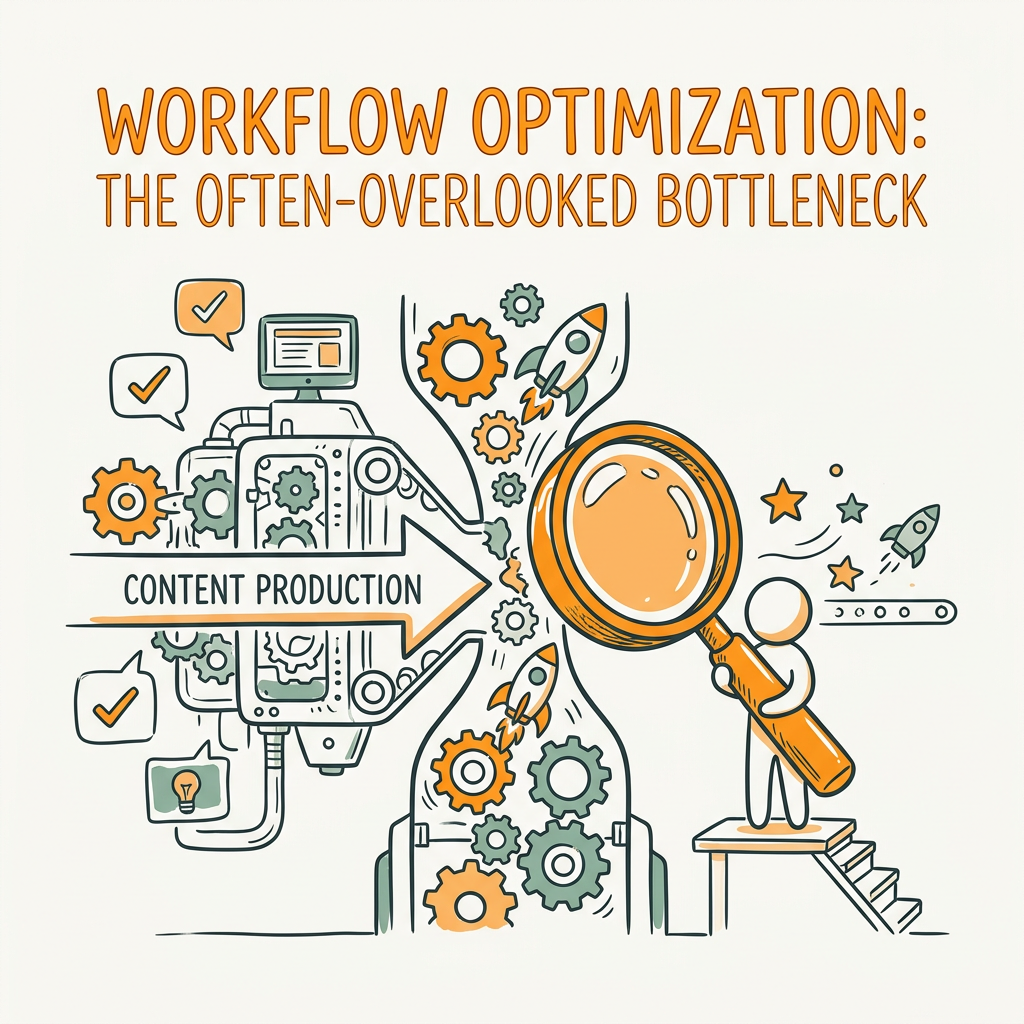
Many teams don't realize how much time is lost to poor coordination. Writers spend hours searching for guidelines, waiting for brief feedback, or spinning up on context for similar projects they've done before. Approval chains stall content for days. Publishing to multiple channels—blog, email, social, docs—requires manual copying and linking. Systematizing these workflows can recover 10–15 hours per week per writer without touching writing itself. For teams serious about scaling, implementing a robust content strategy with AI support eliminates much of this friction by consolidating tools and automating handoffs.
Start by mapping your current process from idea to publication. Identify friction points: Where does content wait? Where do revisions loop? Where is manual work happening that could be templated? The answers usually cluster around three areas: brief clarity, approval speed, and publishing distribution. Solve these with repeatable templates, asynchronous feedback tools, and integrated publishing systems.
- Content Briefs as Templates: Standardize what goes into a brief: topic, keyword targets, word count, link requirements, and tone guidelines. This prevents back-and-forth and keeps writers aligned.
- Approval SLAs: Set fixed review windows (24–48 hours) so content doesn't stall in review cycles. Async tools like Slack threads or Google Docs comments accelerate feedback without meetings.
- Publishing Checklists: Automate SEO checks, internal linking, format standardization, and CMS publishing through integrated platforms or custom workflows.
- Asset Management System: Use a centralized library (Notion, Airtable, or wiki) so writers can find and repurpose past work instead of reinventing insights.
Building a Scalable Content Engine with the Right Tools
Not all tools are equal. The best scaling solutions combine keyword research, AI writing, fact-checking, and CMS integration in one platform. This eliminates tool-switching, data loss between platforms, and manual hand-offs that slow production. 80% of marketers now use AI for content creation, and the trend is toward fully automated workflows rather than point solutions. When evaluating platforms, prioritize those that offer integrated SEO automation across the entire publishing pipeline.
| Capability | Manual Process | Jottler (Autonomous SEO Agent) | Other AI Tools |
|---|---|---|---|
| Keyword Research | 3–4 hours per topic | Automated across 1000+ opportunities per month | Requires external SEO platform |
| Research & Sourcing | 5–7 hours, 3–5 sources | Deep research from 14+ sources, fact-checked | Shallow sources, limited verification |
| Writing | 6–8 hours for 3,000-word piece | 1,800–3,200 words daily per agent | Requires manual editing and quality review |
| Publishing & Linking | 1–2 hours, manual CMS entry and linking | Direct CMS integration, smart internal links built automatically | Manual publishing, external tools needed |
| Output Per Month | ~8–12 articles, 1 person | 60–150+ articles with full automation, 1 agent | ~20–30 articles, requires heavy manual input |
The efficiency gap is stark. Traditional workflows require multiple touch points and tools. An autonomous agent compresses the entire pipeline—research, writing, fact-checking, optimization, and publishing—into a continuous cycle. HubSpot's 2026 marketing data shows that companies automating this pipeline see faster rankings, higher content volume, and measurably lower cost-per-asset than manual or hybrid approaches.
Measuring Output Gains: What Success Looks Like
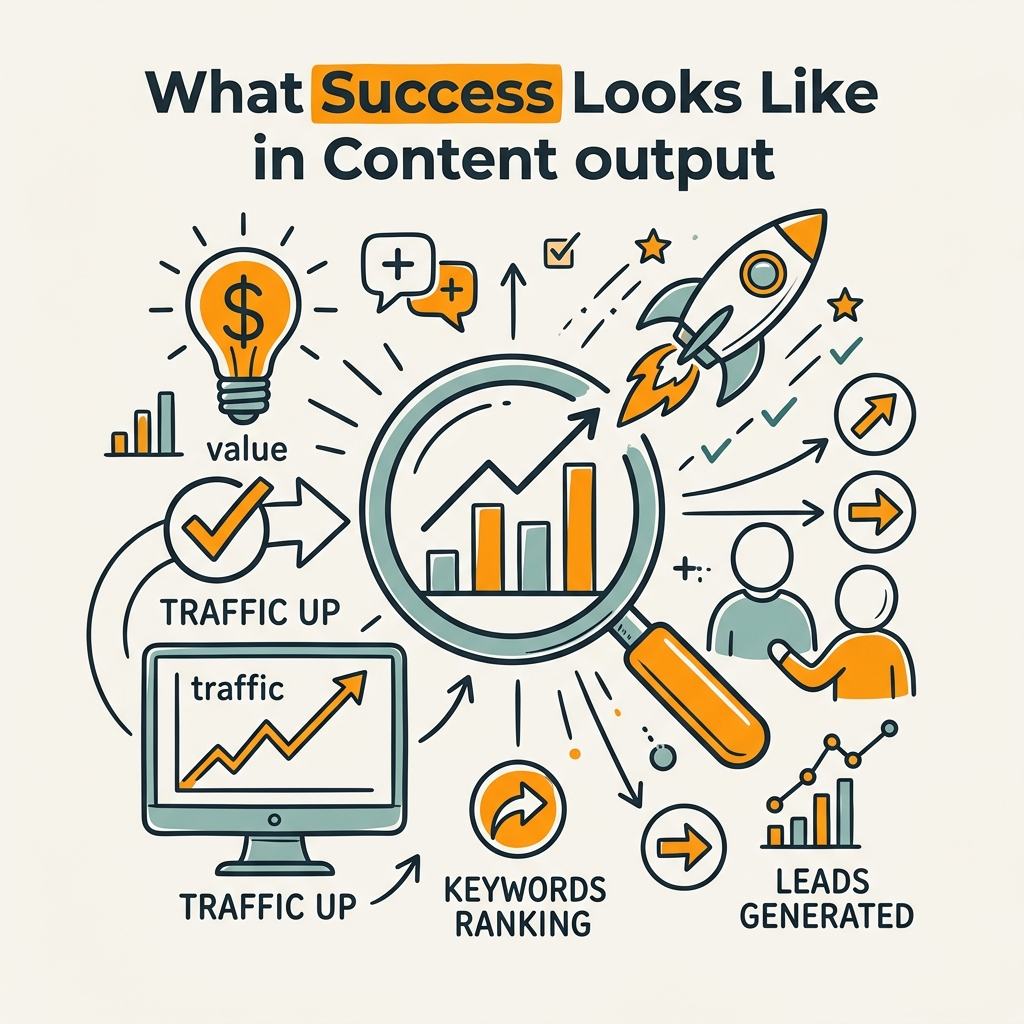
Scaling without hiring is only valuable if you can measure the impact. The key metrics to track are output per headcount, cost per asset, and organic traffic velocity. Most teams see immediate wins: a 1–2 person writing team using automation and repurposing strategies can match the output of a 4–5 person traditional team. Over a year, that's a 200–300% productivity multiplier. Understanding how to measure content marketing ROI correctly ensures you're tracking the metrics that actually drive business value.
Start simple. Count how many pieces you publish per month today. Set a target (e.g., 2x current volume) and measure time-to-publish per piece. Then layer in automation and repurposing, and track how time and cost per asset change. Marketing teams using automation report a baseline $5.44 ROI for every $1 spent, meaning the investment pays back within weeks for most teams.
- Output Metrics: Articles published per month, assets per source piece (target: 3–5), distribution channels per article (target: 4+).
- Efficiency Metrics: Hours per article, cost per published piece, time from brief to live publication.
- Business Impact: Organic traffic growth, new keyword rankings per month, backlinks from repurposed content visibility.
- Quality Assurance: Fact-check errors per article, fact accuracy rate post-publication, reader engagement (comments, shares, conversions).
Common Pitfalls and How to Avoid Them
Most teams fail at scaling not because the strategies are wrong, but because they execute halfway. They adopt a tool, skip the workflow redesign. They repurpose without adapting to the platform. They automate writing but keep manual publishing. The result: modest gains instead of transformation.
The biggest pitfall is underestimating the importance of human review. AI-first tools excel at speed and volume, but they still need human eyes for tone, nuance, and fact-verification. The winning formula is AI for drafting and ideation, humans for editing and fact-checking. This isn't the bottleneck it sounds like—a senior writer can fact-check and refine 3–4 AI drafts faster than writing one from scratch.
- Half-hearted Automation: Adopting tools without redesigning workflows leads to small gains. Commit to full integration—research through publishing—or expect minimal ROI.
- Platform-Agnostic Repurposing: Copying blog text directly to social media fails because platforms have different native formats. Always adapt, don't just copy.
- Skipping Fact-Checking: Speed is meaningless if credibility suffers. Automated fact-checking tools reduce this risk, but human spot-checks remain critical for high-stakes content.
- Ignoring Analytics: Track what works. Many teams automate content that doesn't rank or convert. Audit performance quarterly and adjust topic selection and optimization accordingly.
Conclusion
Scaling content production without hiring doesn't require magic—it requires systems. The data is clear: automation delivers $5.44 ROI per $1 spent, and teams using AI for content creation report dramatically faster output. Repurposing multiplies your assets, workflow optimization recovers hours per week, and integrated publishing platforms eliminate manual bottlenecks. Together, these strategies let a small team deliver the output of a much larger one.
Start where you feel the most friction. If research takes forever, automate it. If approval delays content, fix the SLA. If you publish to one channel, add repurposing. Build in layers. The goal isn't perfection on day one—it's compounding improvements that add up to 3–5x output growth without the headcount.
The time to act is now. Your competitors are automating. Founders and marketing leaders who haven't yet adopted this approach are leaving revenue on the table. The businesses that scale their content production efficiently will own their category's organic presence for years to come.
Ready to automate your content production pipeline? Start your SEO agent today and see how autonomous content production compounds your organic traffic growth without the hiring overhead. Visit https://jottler.co/auth/signup to begin.
FAQs
Can I really scale content production without hiring new writers?
Yes. Teams using repurposing and automation strategies report 3–5x output growth without expanding headcount. The key is shifting from "write more" to "write smarter." One comprehensive piece becomes 3–5 platform-specific assets through repurposing. AI tools handle first drafts and research, compressing writing time by 40–60%. Workflow automation eliminates manual bottlenecks that artificially slow production. Combined, these approaches let a 2–3 person team match the output of a 4–5 person traditional team.
How much time does repurposing actually save?
Repurposing saves 60–70% of production time for secondary assets. Creating one blog post from scratch takes 8–10 hours. Extracting and adapting it into a social carousel, email sequence, and video script takes 2–3 hours combined. You're reusing research, frameworks, and core insights—just reformatting for each platform. A practical monthly workflow shows 5–6 outputs per blog post, meaning your effective output per writing hour increases five-fold. Factor in batching (grouping similar outputs) and the gains compound further.
What's the best tool for automating a content production pipeline?
Look for platforms that cover the full pipeline: keyword research, multi-source research, writing, fact-checking, and CMS publishing. Point solutions (writing tool + separate SEO platform + publishing tool) force manual hand-offs that slow everything down. Integrated platforms compress the entire workflow into one system, eliminating data loss and tool-switching overhead. The best choice combines ease of use, depth of research, accuracy of fact-checking, and native CMS integrations so you're not managing content across three separate platforms.