SEO Fundamentals: The Non-Negotiable Basics Every Team Needs
Most teams treat SEO like an afterthought. They publish content, cross their fingers, and hope Google notices. The reality is brutal: 53% of all website traffic comes from organic search, yet only 27.6% of users click the #1 organic result. If your team doesn't nail the fundamentals, you're leaving nine figures on the table. The fix isn't complicated—it's about executing the three pillars of SEO flawlessly: quality content, technical excellence, and authority through backlinks.
Key Takeaways
- Organic search drives 53% of website traffic, with the top 3 results capturing 54.4% of all clicks (2026, WordStream).
- SEO leads convert 9x better than outbound marketing—14.6% vs. 1.7% close rates.
- E-E-A-T (Experience, Expertise, Authoritativeness, Trustworthiness) now dominates ranking algorithms; first-hand experience is non-negotiable.
- Technical SEO Foundation: Speed, crawlability, and mobile optimization directly affect rankings—non-negotiable prerequisites for visibility.
- Keyword Intent Alignment: Matching user search intent to content format drives conversion rates 4x higher than generic topics.
- Content Depth & Original Data: Shallow content ranks nowhere; demonstrable expertise and original insights outrank AI-generated summaries.
- Backlink Authority: Quality links from relevant domains remain the #3 ranking factor; 1-2 high-authority links outweigh 10 low-quality ones.
- Content Maintenance Cycles: Stale content loses rankings fast; regular updates signal freshness and relevance to Google's algorithms.
How Does Technical SEO Impact Your Rankings?
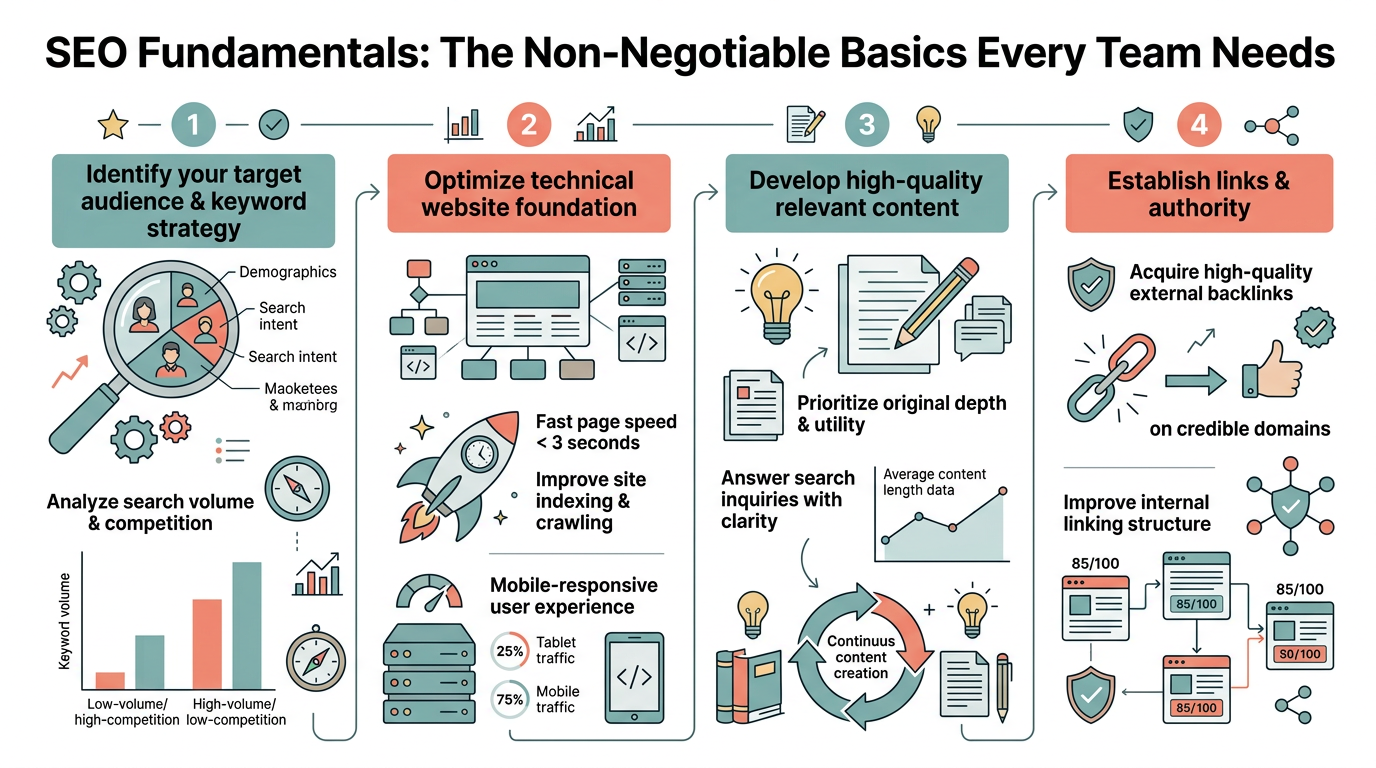
Technical SEO is the foundation that allows Google to crawl, index, and understand your site structure. Without it, even brilliant content stays buried. Page speed, mobile responsiveness, and secure HTTPS connections are now ranking prerequisites (2026, Google). If your site takes 5+ seconds to load on mobile, you've already lost users—and rankings. According to WordStream's SEO research, slow load times cause 75% of users to abandon pages before they load.
"Page speed is a ranking factor. A site that loads 1 second faster than competitors captures measurably higher CTR and longer session duration—both signals of quality to Google's algorithms." — Google Search Central, 2026
Google's Core Web Vitals measure three critical metrics:
- Largest Contentful Paint (LCP): How fast your main content loads. Target under 2.5 seconds.
- Cumulative Layout Shift (CLS): How stable your page is. Avoid sudden shifts that break user experience. Target under 0.1.
- First Input Delay (FID): How responsive your page is to user interaction. Target under 100 milliseconds.
These aren't suggestions. Google officially confirmed that Core Web Vitals are ranking factors. A site that loads 1 second faster than competitors captures measurably higher CTR and longer session duration—both signals of quality.
Crawlability and Indexability
Google can't rank what it can't find. Your site structure must be logical: clear navigation, internal linking, and a sitemap that guides crawlers through all important pages. Common crawl blockers kill visibility instantly. Blocked JavaScript, incorrect robots.txt rules, and noindex tags on valuable pages are silent killers. Test your site in Google Search Console—it shows exactly what Google can and cannot access.
Mobile-First Indexing
Over 60% of searches happen on mobile, and Google now crawls your mobile version first. If your mobile site is a disaster, your desktop rankings suffer too. Responsive design isn't optional—it's mandatory. According to Rankwriters' 2026 SEO data, 80% of local searches on mobile lead to conversions. This means mobile optimization directly impacts revenue for companies targeting local audiences.
Schema Markup and Structured Data
Rich snippets from schema markup increase CTR by 20-30%. Adding JSON-LD markup tells Google exactly what your content is about: articles, products, local businesses, FAQs. When you're publishing at scale, manually adding schema to hundreds of pages becomes unsustainable. This is where autonomous SEO agents automate the technical foundation, injecting correct schema markup into every published article and ensuring consistency across your entire content library.
What Content Strategy Actually Wins in Organic Search?
Content is the second pillar—but not all content is created equal. Generic, AI-generated summaries rank nowhere. First-hand expertise, original data, and human insight dominate (2026, Whitehat SEO). Google's E-E-A-T algorithm update prioritized Experience above all else: the author must prove they've done the thing they're writing about.
"The single biggest ranking advantage in 2026 is original research, case studies, and data you've created yourself. Generic content recycles the same sources everyone else cites. Original insights are impossible to compete against." — Whitehat SEO Report, 2026
The content strategy that works is the one that combines keyword research with audience intent. You need to understand what your audience is actually searching for—and why. Then you create the definitive answer to that question. According to Beomniscient's B2B SEO analysis, search engines drive 76% of all traffic to B2B sites and 44.6% of all revenue—making keyword and intent alignment critical for growth.
Keyword Intent and Content Format Alignment
Not all keywords are created equal. Searchers use different keywords for different purposes. "Best project management tools" is commercial intent (they want to buy). "How does Agile work?" is informational (they want to learn). "Asana pricing" is navigational (they want specifics). Misalign your content format to intent and you rank nowhere.
- Informational queries: Write guides, explainers, and how-tos. Long-form depth wins.
- Commercial queries: Write comparison posts, buyer's guides, and pros/cons analyses. Include pricing and feature breakdowns.
- Transactional queries: Write product pages, case studies, and conversion-focused content with clear CTAs.
Align format to intent and your content gets cited more by AI Overviews—a growing traffic driver in 2026. Research shows visitors arriving from AI platforms convert 4.4x better than traditional searchers, meaning high-intent traffic continues to dominate even in the zero-click era.
Original Data and First-Hand Proof
The single biggest ranking advantage in 2026 is original research, case studies, and data you've created yourself. Generic content recycles the same sources everyone else cites. Original insights are impossible to compete against. Run surveys, publish case studies with real metrics, share proprietary data. This is what moves you from page 3 to page 1. Teams leveraging AI-powered content strategy can now produce original, research-backed articles at scale without sacrificing quality.
Content Depth and Topical Authority
Shallow 500-word posts don't rank for competitive terms anymore. The average top-10 ranking article is 2,000+ words, with multiple related subtopics (2026, RankTracker). More importantly, Google rewards clusters of related content—called topical authority. If you write one article about "SEO basics" but nothing about keyword research, on-page optimization, or link building, you lose to competitors with comprehensive coverage of the topic.
"Teams publishing 3-5 articles daily across a topical cluster compound authority faster than competitors publishing one article monthly. This is the velocity advantage that separates winners from the pack in 2026." — SaaS SEO Growth Analysis
This is why many growing teams are turning to automation. Publishing 3-5 articles daily across a topical cluster compounds your authority faster than publishing one article monthly. Discover how SaaS companies scale organic traffic systematically without burning out their teams.
How Do You Build Authority Through Backlinks?
Backlinks remain the #3 ranking factor. Not all links are equal: 1 link from a high-authority domain (like Forbes or TechCrunch) is worth more than 100 links from low-quality directories (2026, Whitehat SEO). Quality beats quantity in every scenario. Teams moving fast understand this distinction and focus link-building efforts on sources with real referral authority and audience overlap.
Authority-building is a three-phase process: earn links through original research, build them through guest contributions, and reinforce them through press coverage and citations.
Earning Links Through Original Research
Publish something no one else has. Conduct original surveys, compile unique data, or uncover insights through analysis. Journalists and bloggers naturally link to original research because it's valuable—and citable. This is the hardest way to build links but also the most durable. Once published, original research compounds over time as more competitors reference your findings and link back.
Strategic Guest Posting and Partnerships
Contributing to relevant, high-authority publications (not link-farm sites) builds credibility and drives referral traffic. Publish a guest post on a site with 50,000+ monthly visitors and thousands of readers see your brand. A fraction of those readers share your content, creating secondary links.
Competitive and Broken Link Recovery
Identify what pages link to your competitors, then create better versions of that content. Use tools to find broken links on authority sites in your industry, then pitch your content as a replacement. This is systematic link-building that scales. For teams lacking in-house resources, link-building tools combined with consistent content output automate the workflow and improve your competitive positioning.
How Do You Measure and Maintain SEO Success?

Too many teams treat SEO like a set-it-and-forget-it strategy. Publish 10 articles, disappear for 6 months, wonder why rankings dropped. The reality: SEO requires continuous measurement and maintenance. Stale content loses rankings quickly. Competitors improve constantly. You must measure progress and iterate. This is why measuring content marketing ROI becomes critical as teams scale.
Tracking Organic Traffic and Conversions
Vanity metrics like rankings don't matter. What matters: organic traffic to your site, and conversions from that traffic. Set up Google Analytics 4 and Search Console properly to track which keywords drive visits, how long people stay, and what they do next. Track conversion rates by landing page and keyword cluster. SEO delivers 14.6% conversion rates compared to 1.7% for outbound, but only if traffic is qualified. Make sure your analytics prove this.
Regular Content Audits and Updates
Audit top-performing pages every quarter. Are they still accurate? Is the data current? Does the page load fast? Does it link to your newer content? Outdated content loses rankings fast. A 2-year-old article about "best tools" will have obsolete recommendations. Refresh it and re-publish with a new date. This signals freshness and can recapture lost rankings.
Competitive Analysis and Monitoring
Don't guess what your competitors are doing. Track them systematically. Which keywords are they ranking for that you're not? What content are they publishing? How many backlinks do they have? Use tools to monitor your competitive landscape monthly. When you see a competitor gaining ground, improve faster.
What's the Role of AI in SEO Fundamentals Today?
AI has changed execution speed, not strategy. The fundamentals—quality content, technical excellence, authority—still drive rankings. But AI has transformed the labor required to compound these fundamentals at scale. Teams publishing daily now see ranking velocity 4x faster than those publishing monthly, simply because they're compounding authority and coverage at an accelerated pace.
AI for Keyword Research and Strategy
AI research tools now process 14+ sources in seconds, identifying keyword opportunities and content gaps humans would miss. Instead of spending 6 hours on keyword research, teams now spend 15 minutes refining AI recommendations. The output is better because it's informed by data, not intuition.
AI Content Generation with Quality Control
Generic AI writing that repeats the same phrases everyone else uses ranks nowhere. But AI paired with human fact-checking and original data insertion creates content faster than humans alone. This is where tools that combine deep research with multi-agent content generation separate winners from the pack. They handle the research, writing, fact-checking, and publishing—compounding your content advantage daily instead of monthly.
AI-Powered Internal Linking
Internal link networks are tedious to build manually. Strategic internal linking boosts content discovery and distributes authority across your topical clusters. AI systems now automate this—identifying which pages link logically to which, ensuring every article reinforces your topical authority structure. This is the difference between publishing and publishing to win.
| SEO Fundamental | Why It Matters | Impact on Rankings | Effort to Maintain |
|---|---|---|---|
| Technical SEO | Google must crawl and understand your site | Prerequisite—fail here and nothing ranks | Low (audit quarterly) |
| Content Quality | Users find answers; Google ranks authority | Top 3 factor; depth and originality matter most | High (continuous improvement) |
| Keyword Intent Alignment | Content must match what searchers actually want | 50% of ranking variance; wrong format = no ranking | Medium (research upfront, maintain ongoing) |
| Backlinks | External validation of authority and relevance | Top 3 factor; quality >> quantity | High (requires strategy and outreach) |
| Content Maintenance | Stale content loses rankings; freshness signals matter | Compounding loss without updates | Medium (quarterly audits, updates) |
| Topical Depth | Comprehensive coverage outranks one-off articles | Cluster strategy wins; isolated content loses | High (requires systematic publishing) |
This table shows what separates the teams that compound SEO growth from those that stagnate. Teams that execute all six fundamentals simultaneously—research, write, publish, fact-check, link, and monitor—pull ahead quickly. Teams that skip any one of these create gaps competitors will exploit.
Conclusion
SEO fundamentals haven't changed in a decade: quality content, technical excellence, and authoritative backlinks. What has changed is execution speed. The teams winning in 2026 aren't smarter—they're faster. They publish more content, maintain it better, and build authority systematically instead of waiting for organic opportunities.
The metric that matters: organic search now generates 53% of all trackable website traffic and delivers 14.6% conversion rates—vastly outperforming paid and social channels. The #1 organic result captures 27.6% CTR, meaning first-page visibility is worth six-figure revenue to most growing companies.
This is where automation meets fundamentals. If your team is still manually researching keywords, writing articles one at a time, and publishing slowly—you're losing. The solution is systematic: research deeply, write comprehensively, fact-check rigorously, publish consistently, and link strategically. Jottler does this every day, researching, writing, fact-checking, and publishing long-form SEO content while building topical authority and internal link networks automatically. For busy founders and marketing teams at growing companies, this is the difference between stagnant organic traffic and compounding growth.
Start your SEO agent and begin compounding organic traffic immediately. The fundamentals don't change—but the speed at which you execute them determines whether you rank or disappear.
FAQs
What are the 4 pillars of SEO?
The core pillars of SEO are quality content, technical excellence, authority through backlinks, and user experience signals. Quality content must demonstrate first-hand expertise (E-E-A-T) and match user intent—not generic summaries. Technical excellence means fast loading speeds, mobile responsiveness, and clean crawlability. Authority comes from backlinks from relevant, high-quality domains, not quantity. User experience encompasses page speed, layout stability, and interaction responsiveness. All four pillars must work together—excellence in one pillar doesn't overcome weakness in another. Many teams focus too heavily on content and backlinks while ignoring technical fundamentals, which costs them 30-40% of potential rankings.
How long does it take for SEO fundamentals to produce results?
Most teams see measurable organic traffic increases within 3-6 months of executing SEO fundamentals consistently. However, competitive ranking improvements typically take 6-12 months because Google needs time to crawl, index, and rank new or improved content. The timeline accelerates dramatically with frequency and consistency. Teams publishing 3-5 articles weekly see ranking velocity 4x faster than teams publishing monthly. This is why compounding content strategy—publishing daily instead of weekly—delivers ranking traction in 60-90 days instead of a year. Your first month of execution feels slow. Months 4-12 are where exponential growth appears.
Is SEO still worth the investment in 2026?
Absolutely. SEO delivers 748% ROI on average, making it the highest-ROI marketing channel available. Organic search drives 53% of website traffic and generates 44.6% of all revenue for B2B companies, outpacing paid search, social media, and email combined. The misconception that AI Overviews and zero-click searches have killed SEO is incorrect—while 58% of queries are zero-click, the remaining traffic is more qualified and converts 9x better than outbound leads. The question isn't whether to invest in SEO; it's whether you can afford not to. For growing companies, organic traffic compounds your customer acquisition cost advantage over time while reducing reliance on paid ads, which get more expensive yearly.