SEO Keyword Planning Framework for SaaS Companies
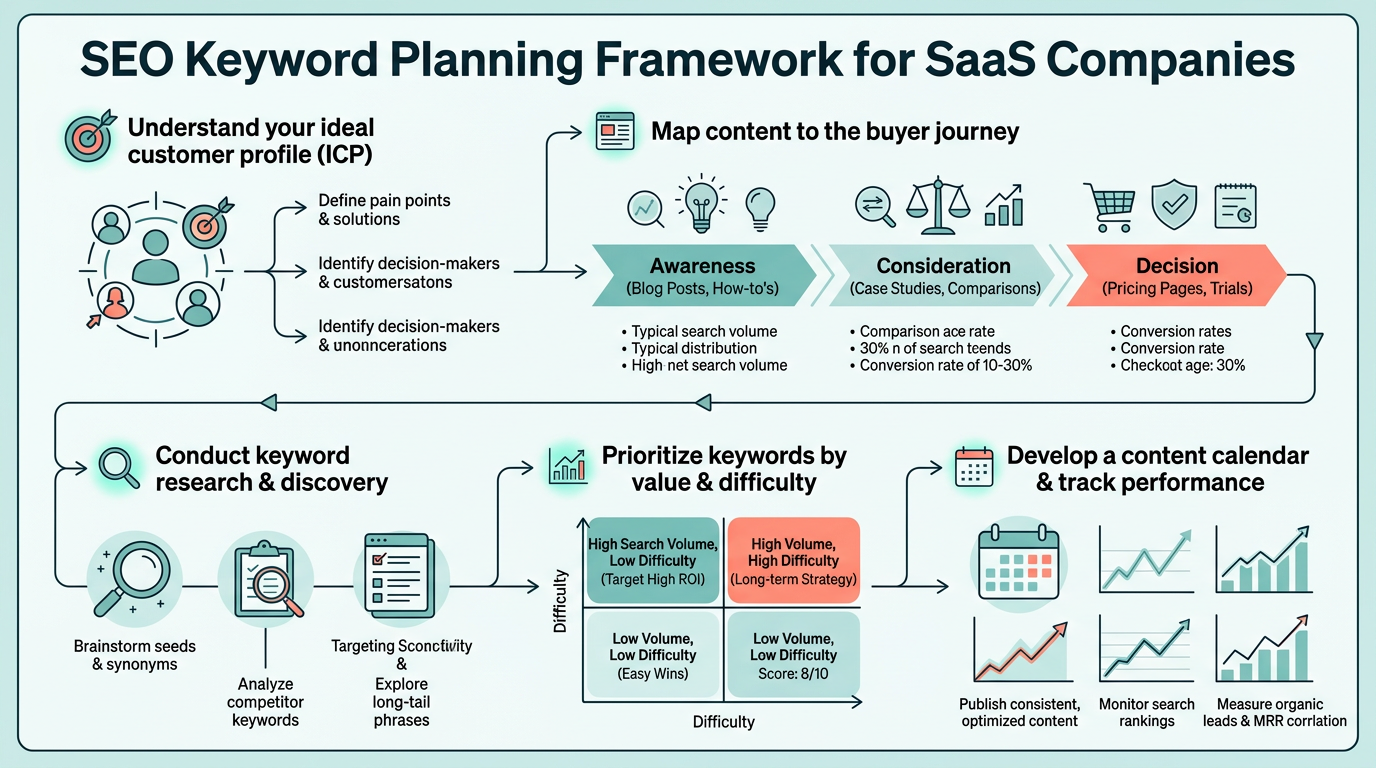
Most SaaS founders know organic traffic matters. Organic search drives 53% of SaaS website visits, yet finding the right keywords to target feels like guessing in the dark. You face a brutal choice: hire an expensive SEO specialist, spend weeks on DIY research, or default to high-volume vanity keywords that bring tire-kickers instead of buyers. The real problem isn't a lack of keywordsit's that most SaaS teams chase volume instead of revenue potential, landing on content that gets clicks but never converts. A structured keyword planning framework fixes this by aligning keyword research to buyer intent, business stage, and competitive feasibility from day one.
Key Takeaways
- Organic search generates 44.6% of B2B revenue, but only when keywords align with commercial intent (2026, SeoProfy)
- Long-tail keywords drive 68% of SaaS organic trafficprioritize specificity over volume for faster conversions
- The SEO pyramid framework segments keywords by purchase intent, revealing high-value low-competition opportunities most teams miss
- Intent-First Keyword Research: Map keywords to buyer stage and decision-maker role to eliminate wasted content effort.
- The SEO Pyramid Model: Categorize keywords by type (brand, solution, problem, integration, alternative, upstream/downstream, general) to uncover underexploited opportunities.
- Difficulty-Weighted Prioritization: Score keywords by business value, intent fit, and competitive difficulty to find quick-win pages that compound over time.
- Topic Cluster Architecture: Build pillar pages surrounded by thematic clusters to dominate entire keyword families rather than one-off ranking attempts.
- Automation-Driven Execution: Scale consistent keyword research, content creation, and SERP optimization without manual bottlenecks.
Why SaaS Keyword Planning Differs From Generic SEO
B2B SaaS keyword research plays by different rules than content blogs or ecommerce sites. Your buyers are specificthey have titles, team structures, budgets, and buying processes. B2B SaaS companies generate a 702% ROI from SEO with a 7-month break-even period, making it the highest-efficiency growth channel for software companies that commit to a structured approach. A Slack buyer searches differently than a blogger researching "productivity tools." Understanding this distinction is the first step toward building an effective SaaS SEO strategy.
The Buyer Intent Gap Most Teams Miss
Traditional keyword research obsesses over search volume. You see "project management software" with 12,000 monthly searches and think it's a prize. In reality, that volume includes curious students, competitors researching you, and buyers in 6-month evaluation cycles who won't convert for months. Meanwhile, "Asana alternative for distributed teams" gets 400 searches but converts at 3x the rate because the searcher is actively comparison-shopping. Your framework must separate high-volume vanity keywords from revenue keywords that actually bring qualified trials and demos. This distinction drives resource allocation decisions in every stage of keyword planning.
The Role of Long-Tail Keywords in SaaS Growth
Long-tail keywords drive 68% of SaaS organic traffic, yet most teams dedicate 80% of effort to attacking a dozen head terms. The math is simple: a specific keyword like "CRM for construction companies using Zapier integration" has lower competition, faster ranking timeline, and better intent alignment than trying to rank for "CRM software." SaaS buyers use long-tail language in real search queries because they're solving specific problems, not exploring categories. Your framework should hunt aggressively in the long-tail tier, where you'll find less competition but higher commercial intent per visitor.
The SEO Pyramid: Your Mental Model for Keyword Categories
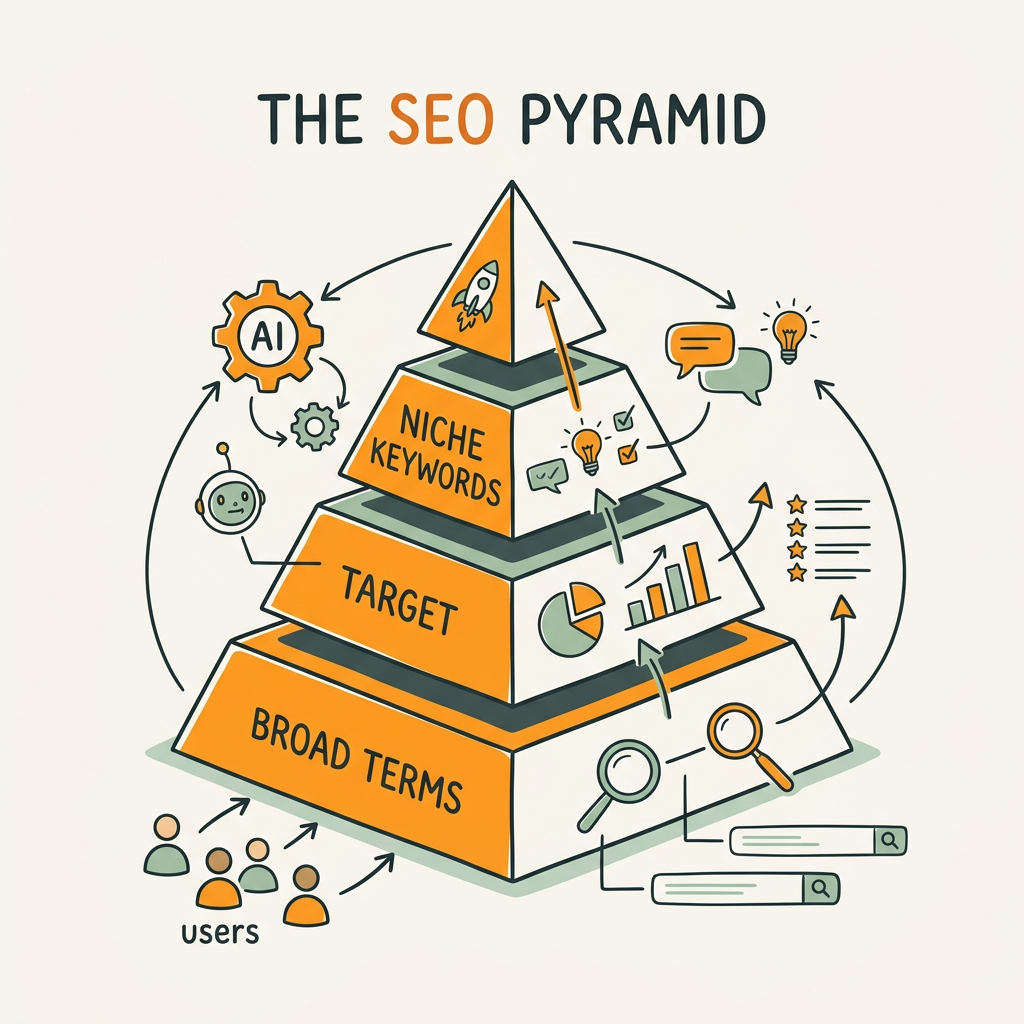
The SEO pyramid, popularized for B2B SaaS by industry experts, organizes keywords into seven tiers based on purchase intent and business value. The top of the pyramid has low volume but high conversion intent; the bottom has high volume but low intent. Understanding where your opportunities live across this pyramid prevents wasted content cycles. Each tier requires different content formats, different sales readiness, and different ranking timelines. This framework has become standard because it reliably identifies where the highest-ROI keywords actually hide.
Top-Tier Keywords: Brand, Solution, and Integration Terms
Brand keywords (your company name or product) are the easiest to rank for but the least valuablesomeone searching "Jottler" already knows about you. Solution keywords like "autonomous SEO engine" or "AI content generator" are higher-value targets because they indicate product-aware buyers. Integration keywords (e.g., "Jottler + Zapier integration") attract power users actively coupling tools. All three tiers have modest volume but high commercial intent. Rank for these first because they convert fastest and establish domain authority for downstream cluster expansion.
Problem and Alternative Terms: The Conversion Pyramid's Engine
Problem keywords ("how to automate content marketing," "why my blog doesn't rank") target pain-aware buyers who don't yet know your solution exists. Alternative keywords ("Surfer SEO alternative," "best AI content generator 2026") capture vendor-comparison shoppers ready to evaluate. These mid-tier keywords have higher volume than solution terms but require educational content that leads into your product story. This tier is where compounding growth lives. A single problem-keyword pillar page can attract hundreds of monthly visitors and nurture them toward your solution layer over time. For teams implementing a structured AI content strategy, this tier is where volume and intent finally align.
Upstream, Downstream, and General Terms: Playing the Volume Game Strategically
Upstream keywords cover broader categories your product sits within (e.g., "content marketing," "SEO automation"). Downstream keywords are ultra-specific (e.g., "how to use AI for internal linking"). General keywords ("content marketing 2026") cast wide nets. All three have volume but low direct purchase intent. Target these selectively to build topical authority and funnel traffic downward through internal linking. Don't lead your strategy herethey're supporting players, not stars. Use them to amplify domain authority in service of the higher-intent tiers above.
Building Your Keyword Research and Prioritization System
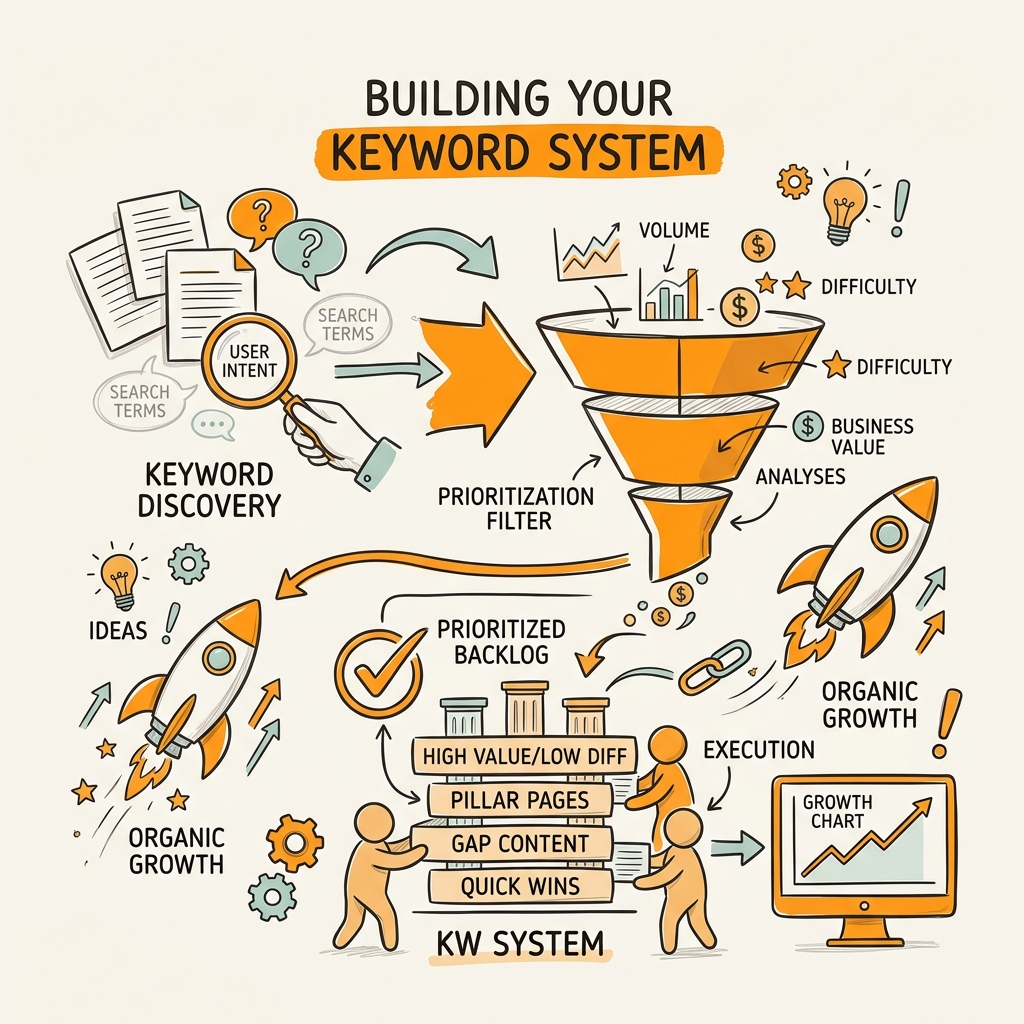
Once you understand the pyramid, the next step is systematic prioritization. You can't target everything. Your framework must score keywords by business value, ranking feasibility, and resource effort to allocate content budget toward the highest-ROI opportunities. This is where most SaaS teams fail: they research thousands of keywords, then randomize the publishing order instead of shipping high-value pages first. A disciplined approach to SEO content planning ensures each article compounds the previous one's authority.
Step 1: Seed Keywords From Customer Language
Start by extracting real language from your customer research, not your imagination. Pull from support tickets, sales call transcripts, demo questions, and customer interviews. When a prospect asks "how do you compare to Semrush?", that's a keyword you should target. When your support team answers "here's how to integrate with HubSpot" 40 times per month, there's a keyword cluster. Your seed list should be 50-100 low-noise, high-intent phrases pulled directly from how real customers talk about your space. Tools are useful here, but customer language is gospel. This foundation ensures every keyword you research has proof of real-world demand.
Step 2: Expand With Keyword Tools and Intent Mapping
Use platforms like Ahrefs, Semrush, or Google Search Console to expand your seed list and gather metrics. For each keyword, capture search volume, keyword difficulty, current ranking (if applicable), and estimated commercial intent. Then map each keyword to a single funnel stage (awareness, consideration, decision) based on the language. A keyword like "what is an autonomous SEO agent?" is awareness-stage. "Jottler vs Content at Scale" is decision-stage. This mapping prevents tone-deaf content mismatches and ensures your team invests development effort where conversions actually happen.
Step 3: Score Keywords by Business Value and Feasibility
Create a simple scoring matrix. For each keyword, assign points for: search volume (higher is better, but not the main factor), keyword difficulty (lower is better), commercial intent (highest priority), current ranking position (lower is faster to improve), and funnel alignment (does it serve your current customer acquisition strategy?). Weight commercial intent heaviest. A keyword with low volume but high intent from a decision-stage buyer outscores a high-volume awareness keyword every time. Your top 20 keywords should cluster in the high-score range. This disciplined approach prevents chasing vanity metrics at the expense of actual revenue.
Step 4: Validate With Competitive SERP Analysis
Before committing resources, analyze what's currently ranking for your top-20 keywords. If positions 1–3 are dominated by massive brands with unlimited authority, that keyword may require 18+ months to crack. If top results are weak blog posts or outdated content, it's a quick-win target. This reality check prevents chasing keywords where the moat is too wide. The goal is to find pockets where volume + intent + competitive gap = fast ranking opportunity. Look for opportunities where you can outrank competitors with superior content depth, fresher data, or better user experience.
How Topic Clusters Amplify Keyword Authority
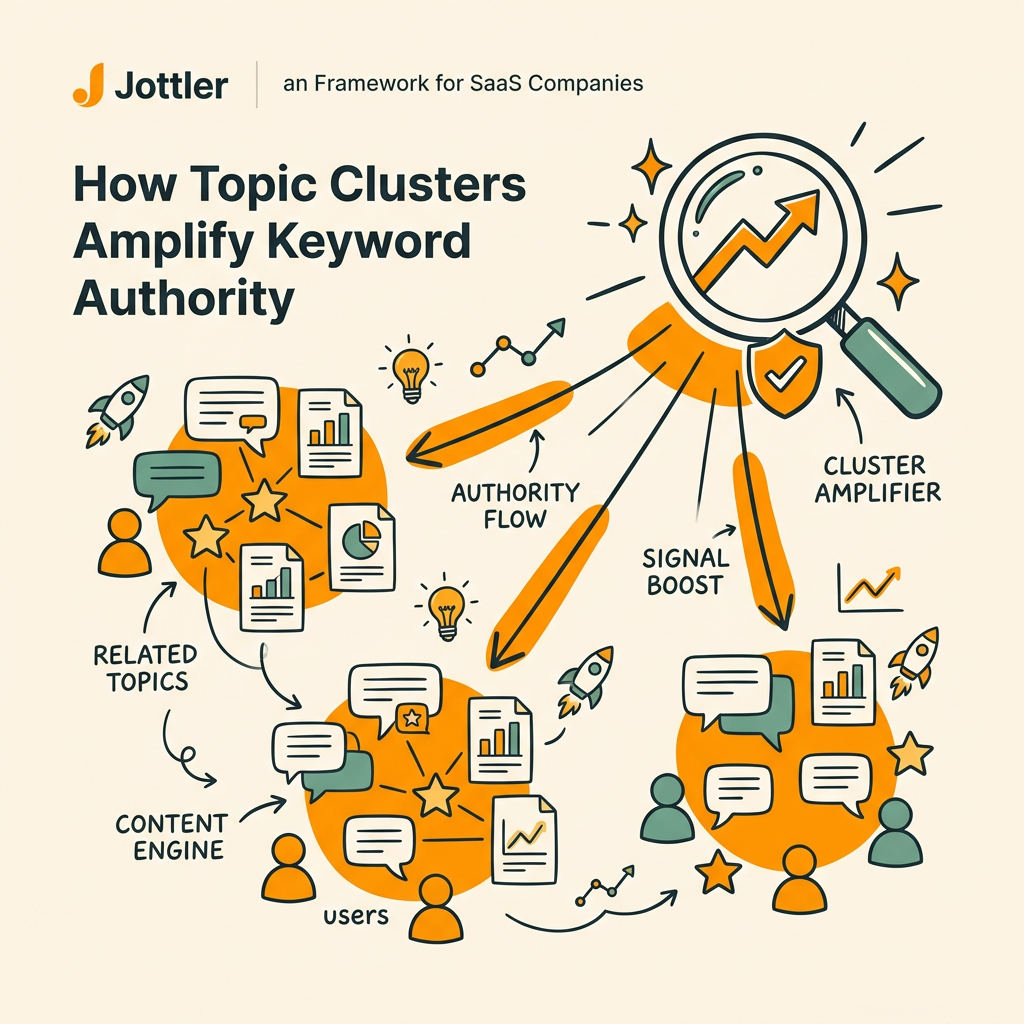
Once you've prioritized keywords, the worst move is creating one-off blog posts with no internal linking strategy. Instead, use topic clusters: one pillar page addressing a broad keyword surrounded by 5-12 cluster pages targeting related long-tail variants. Google rewards topical depth. A single pillar page on "SEO keyword research for SaaS" linked to clusters on "buyer intent," "keyword difficulty scoring," "the SEO pyramid," and "SERP feature optimization" establishes more authority than five isolated posts on unrelated topics. Your framework should group prioritized keywords into 3-5 pillar themes, then design clusters underneath to create semantic cohesion.
Pillar Page Strategy: Broad, Authoritative, Internal Hub
Your pillar page targets the broadest keyword in a cluster (e.g., "SEO keyword research for SaaS companies"). It's comprehensive, 2,500–3,500 words, and answers every foundational question a buyer in early research stages might ask. It doesn't try to rank for ten different keywords. Instead, it establishes topical authority and internally links to 8–10 cluster pages that dive deeper. The pillar page is your hub. Everything else funnels back to it via contextual internal links, guiding visitors down the funnel toward your product pages. This architecture creates a powerful trust signal to search engines that you own this topic.
Cluster Pages: Deep, Specific, Conversion-Ready
Each cluster page targets one or two long-tail keyword variants and solves a specific, narrow problem. A cluster page on "how to use the SEO pyramid to identify SaaS keywords" targets a long-tail query but sits within the broader "keyword research" pillar. Cluster pages are 800–1,500 words, hyper-focused, and rich with internal links back to the pillar and to adjacent clusters. They rank faster than pillar pages because they're more specific. They also convert better because searchers find exactly what they need without friction.
Linking Architecture: Connect Keywords Into Networks
Don't scatter links randomly. Map each cluster keyword to the pillar page with an exact-match anchor (e.g., "SEO keyword research for SaaS"). Link cluster pages to adjacent clusters when they share intent. Example: the "keyword difficulty scoring" cluster links to "buyer intent mapping" because understanding difficulty helps you prioritize by intent. This architecture signals to Google that your content covers a topic comprehensively. It also keeps visitors surfing within your ecosystem, improving engagement and time-on-site metrics that boost rankings.
Using Automation to Scale Keyword Research and Content Execution
Manual keyword research and content production are bottlenecks. Most SaaS teams can research 20–30 keywords per month with a dedicated person. Scaling beyond that requires automation that doesn't sacrifice quality. This is where autonomous SEO systems enter the game. Rather than hiring three content contractors and managing them individually, you can implement a platform that handles keyword discovery, content research, writing, and optimization concurrently across dozens of articles per month without requiring human review at every step.
Automated Discovery and Clustering
Instead of manually brainstorming keywords and grouping them, modern platforms can ingest your customer data, support transcripts, and competitor keyword lists, then algorithmically identify keyword clusters and suggest pillar-cluster architectures. This doesn't replace human judgmentyou still validate the clustersbut it compresses months of research into days. The system can flag high-intent, low-difficulty opportunities you'd miss in manual discovery, especially in the long-tail tier where your highest-ROI growth actually lives. Jottler's keyword research engine evaluates competitive landscape, demand signals, and intent alignment to surface opportunities most traditional tools miss.
Deep Research and SERP-First Content Drafting
Once keywords are clustered, the next bottleneck is content research. A good keyword-targeted article requires analyzing top-ranking pages, extracting insights, adding original perspective, and weaving in statistics. Tools that automate thispulling SERP results, identifying content gaps, suggesting section outlines, and drafting from multiple research sourceseliminate weeks of manual work per article. Jottler conducts deep research from 14+ sources per article, fact-checks claims against primary sources, and drafts 3,000+ word pieces daily, ensuring each article competes structurally with top-ranked content in your space while maintaining unique perspective.
Continuous Optimization and Internal Linking at Scale
Static content ages. Ranking pages lose authority as competitors improve. Automation allows continuous optimization: updating stale statistics, adding new sections based on SERP shifts, and intelligently linking new articles back to existing clusters. Manual internal linking across dozens of articles is tedious and error-prone. Automated systems can map keyword intent across your content inventory and suggest high-value internal links, ensuring each new article strengthens the cluster architecture rather than standing alone.
| Approach | Research Time | Content Quality | Scalability | Long-Tail Coverage |
|---|---|---|---|---|
| Manual keyword research + writing | 20–30 keywords/month | High (inconsistent) | Limited | Shallow |
| Hire freelance writers + tools | 50–80 keywords/month | Medium to high | Moderate | Moderate |
| Automated SEO system (Jottler) | 100+ keywords/month | High (consistent) | Unlimited | Deep |
| Agency SEO + content production | 40–60 keywords/month | High | Constrained by budget | Depends on agency |
Real-World Application: From Framework to Monthly Publishing
Theory matters less than execution. Here's how a SaaS team would apply this framework in practice. Start with your seed keywords extracted from customer research and support tickets. Use SaaS SEO statistics and benchmarks to understand what realistic conversion rates look like for your vertical, then use that data to grade keyword commercial intent. Score your top 50 keywords by the matrix above, then group them into 5 pillar themes. For each pillar, create a comprehensive 3,000-word pillar page, then design 8–10 cluster pages targeting long-tail variants.
Publish the pillar first, wait 2 weeks for crawling and indexing, then begin publishing cluster pages with internal links back to the pillar and between related clusters. Measure organic traffic by keyword tier, funnel stage, and conversion path. After 4–6 months, analyze which clusters are driving leads vs. vanity traffic, then double down on high-converting clusters while deprioritizing low-intent tiers. Use SEO ROI benchmarks to validate that your framework is producing expected returns and adjust keyword prioritization accordingly.
Conclusion
A structured keyword planning framework is the foundation of compounding SaaS organic growth. By aligning keywords to buyer intent, organizing them into the SEO pyramid, prioritizing by business value and competitive feasibility, and building topic clusters instead of isolated posts, you create a sustainable engine that compounds month over month. With the right framework in place, B2B SaaS companies see 702% ROI from SEO, far exceeding paid acquisition channels.
The challenge is execution at scale. Manual keyword research and content creation are bottlenecks that prevent teams from leveraging high-opportunity long-tail keywords. This is why automated SEO systems matter: they let busy founders and marketing teams focus on strategy while the system handles research, writing, optimization, and publishing at a pace impossible to achieve manually. Begin with your seed keywords from customer language, build your pyramid, and commit to clusters over isolated posts. Then automate the operational work so your team stays focused on high-leverage decisions.
Start your SEO agent today and let automation handle the repetitive keyword research and content production work.
FAQs
What is the difference between head keywords and long-tail keywords for SaaS?
Head keywords are broad, high-volume search terms like "CRM software" or "project management tool." Long-tail keywords are specific, lower-volume phrases like "CRM for construction companies with offline access" or "project management tool for remote teams." Long-tail keywords drive 68% of SaaS organic traffic because they have lower competition and higher buyer intent. A SaaS founder should prioritize long-tail keywords that match specific use cases and pain points your product solves, as they rank faster, convert better, and reveal untapped market segments head keywords ignore.
How do I know if a keyword is worth targeting for my SaaS company?
Evaluate each keyword using four criteria: search intent (is the searcher evaluating solutions or just researching the topic?), commercial relevance (would someone ranking this keyword realistically trial or buy?), keyword difficulty (can you rank within 3–6 months with your domain authority?), and business fit (does it align with your growth stage and product roadmap?). Always prioritize commercial intent over raw search volume. A keyword with 500 monthly searches and high buyer intentlike "[competitor] alternative for [specific use case]"outperforms a 5,000-search generic keyword where the audience has no purchase intent. Use tools like Ahrefs or Google Search Console, but validate every keyword against real customer language from sales calls and support tickets.
What is a topic cluster, and why does it matter for SaaS SEO?
A topic cluster is a content architecture where one comprehensive pillar page supports 5–12 related cluster pages, all internally linked to establish topical authority. Instead of writing isolated blog posts, cluster pages target long-tail variants of a core keyword and link back to the pillar, creating a semantic network Google rewards. For SaaS, topic clusters are critical because they allow you to dominate entire keyword familiesnot just one keywordwhile keeping cluster pages focused and conversion-ready. A pillar on "keyword research for SaaS" links to clusters on "buyer intent," "SEO pyramid," "keyword difficulty," and "SERP analysis," each driving qualified traffic to shared infrastructure and internal funnel pages.