SEO Strategy Roadmap for Growing Companies
Most growing companies treat SEO like an afterthought—pursuing quick wins, chasing algorithm updates, and reacting to competitor moves without a coherent long-term plan. The cost of this reactive approach is steep: organic search accounts for 53.3% of all website traffic, yet without a structured roadmap, teams fail to capture the 14.6% close rate that SEO leads deliver versus 1.7% for outbound marketing. The result is predictable: traffic plateaus, rankings stagnate, and founders watch competitors climb the SERP while they scramble to compete.
A formal SEO strategy roadmap changes everything. It aligns SEO efforts with revenue outcomes, prioritizes the highest-impact tactics, and creates a repeatable system that compounds over time. Here's how to build one that actually drives growth.
Key Takeaways
- Organic search generates 53.3% of website traffic and delivers a median ROI of 748%, yet most growing companies lack a structured roadmap to capture it (2026, SeoProfy)
- SEO lead close rates are 14.6%—more than 8x higher than outbound marketing at 1.7%, making organic a revenue driver, not just a traffic channel
- Top 3 organic results capture 68.7% of all clicks; without ranking intent, even high-traffic content doesn't convert
- Growing teams need an automation layer to scale content production and SEO execution without burnout
- Align SEO with business outcomes: Map organic traffic goals directly to revenue targets, customer acquisition cost (CAC), and lifetime value (LTV) rather than vanity metrics like rankings or impressions.
- Audit your current state: Analyze technical foundation, content gaps, competitor positioning, and keyword opportunity to establish a baseline for growth.
- Build a content and keyword strategy: Identify high-intent keywords aligned to your sales funnel and create a content cluster system that builds topical authority.
- Execute with an automation framework: Use AI-powered tools to research, write, and publish at scale while maintaining quality and internal linking discipline.
- Measure the right KPIs: Track organic conversion rate, assisted revenue, and CAC instead of just traffic or rankings to prove SEO's business impact.
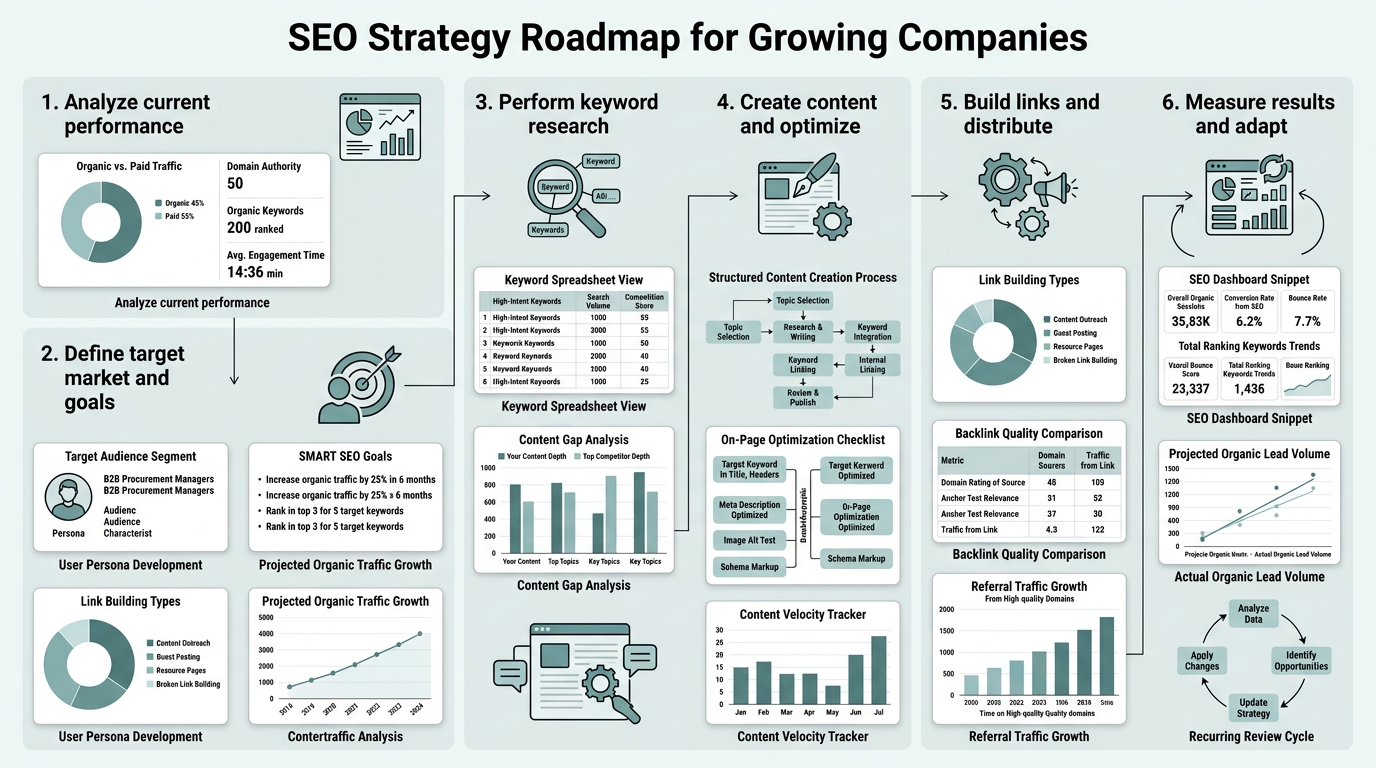
Why Growing Companies Need a Formal SEO Roadmap
A structured SEO roadmap is not optional—it's the difference between organic traffic that compounds and traffic that flatlines. Without a roadmap, teams operate in reactive mode: they chase ranking opportunities without considering intent, produce content without a content cluster strategy, and publish without internal linking discipline. The result is scattered effort that never builds momentum.
"77% of companies report that SEO generates the highest-quality leads compared to paid channels, yet the average company spends less than 10 hours per month on SEO strategy. This gap between potential and execution is where growing companies leave millions on the table."
According to SeoProfy's 2026 ROI benchmarks, companies with formal SEO strategies see 2-3x better results than reactive approaches.
The ROI Foundation
Growing companies understand metrics. SEO's business case is stronger than most realize: organic search delivers a median ROI of approximately 748%, and 49% of marketers identify organic as the top ROI-driving channel. Unlike paid advertising, which stops generating leads the moment you stop spending, organic traffic is an asset that compounds. A piece of content ranking for a high-intent keyword today continues to generate qualified leads for months or years.
The trap: many teams measure SEO by vanity metrics (rankings, impressions, traffic volume) instead of business outcomes (conversions, revenue, CAC). A roadmap forces alignment between SEO execution and revenue goals, turning SEO from a cost center into an investment with predictable returns. This is why performance marketing leaders recommend revenue-aligned KPIs as the foundation of any SEO strategy.
The Execution Gap
Most growing companies understand what needs to be done: keyword research, content creation, technical optimization, internal linking. But execution is where they falter. Between fundraising, product development, and customer success, marketing gets squeezed. SEO requires sustained, consistent effort—but founders and marketing teams lack the bandwidth to manage daily research, writing, optimization, and publishing.
"Nearly 70% of businesses see higher ROI from using AI in SEO, but automation requires structure. A formal roadmap creates the guardrails that allow AI tools to operate effectively without producing commodity content or ranking for irrelevant keywords."
Phase 1: Define Business Outcomes and Set Revenue-Aligned KPIs
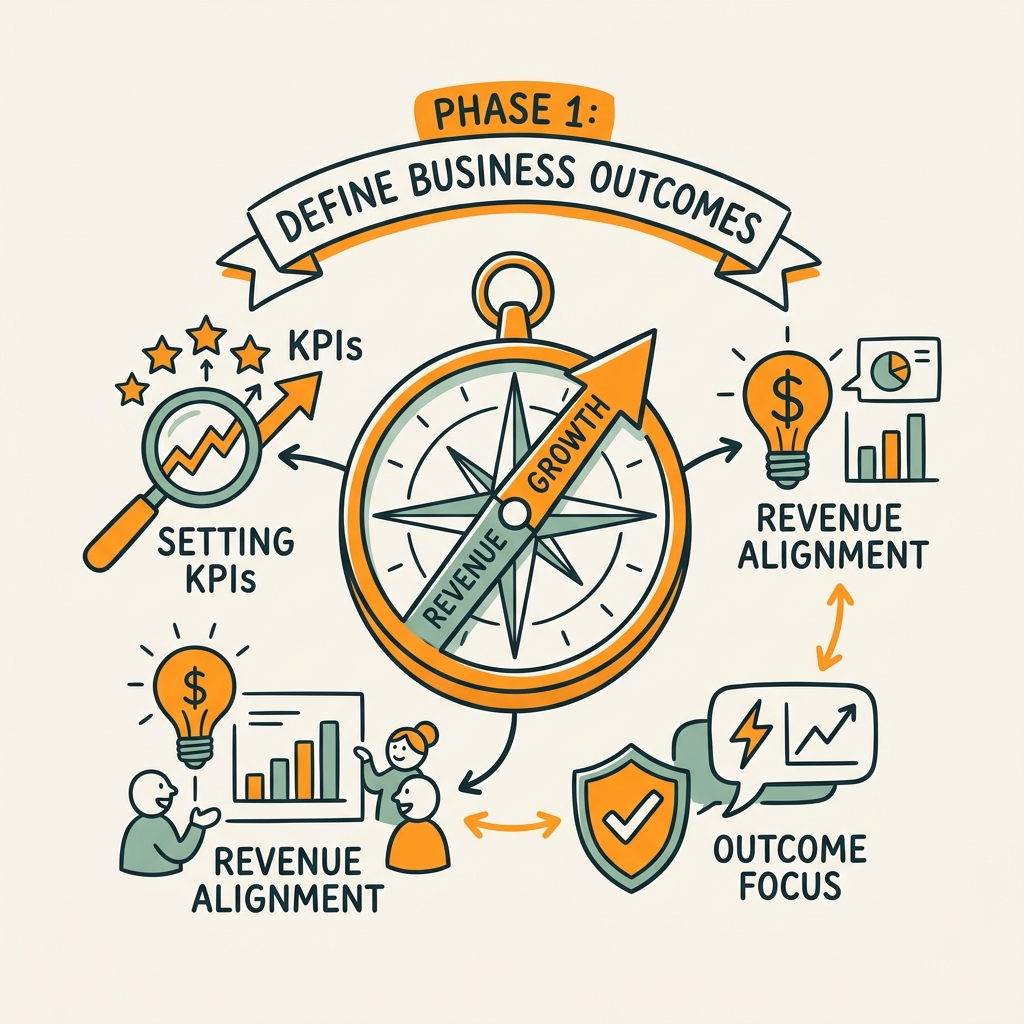
Before you research a single keyword, align SEO goals with business reality. This step separates winners from teams that waste months chasing vanity metrics.
Link SEO Goals to Customer Acquisition and Revenue
Start with your sales funnel and work backward. If your target customer acquisition cost (CAC) is $500 and your average contract value (ACV) is $5,000, then your allowable CAC for organic is $500. If you acquire 5 customers per month from organic at $2,500 per customer, your organic CAC is $2,500—which means SEO is delivering 5x better economics than your paid channels.
Now ask: how much organic traffic do you need to hit your CAC target? If your organic conversion rate is 2.4% (industry average), you need about 210 qualified visitors per customer. If you want 10 customers per month, you need 2,100 qualified monthly visitors from high-intent keywords. This becomes your north star metric—not "get 1,000 visits," but "drive 2,100 qualified visits to high-intent pages."
Most growing companies skip this math entirely. They set targets like "increase organic traffic 50%" without understanding whether that traffic actually converts. A formal roadmap embeds business logic into every SEO decision.
Select KPIs That Measure Business Impact
Tracking the right metrics is non-negotiable. Avoid this mistake: measuring only rankings or organic traffic volume. Instead, use this framework:
- Organic conversion rate: Visitors from organic / conversions from organic. This tells you whether SEO is attracting the right intent.
- Assisted revenue and influenced revenue: Use Google Analytics 4 and your CRM to track how organic traffic influences deals even if it doesn't directly close them. Many B2B sales cycles involve 6+ touchpoints; organic often initiates the journey.
- Non-branded organic traffic growth: Growth in searches for keywords where your brand isn't mentioned. This measures whether you're winning in competitive territory.
- CAC from organic: Revenue from organic / total organic marketing spend. This is the single most important metric for a growing company.
- Dwell time and engagement metrics: Average session duration, scroll depth, and return visitor rate indicate content quality and intent alignment. Low engagement signals weak keyword targeting or weak landing pages.
Tie these metrics to monthly board reviews. When leadership sees "organic CAC improved 30% month-over-month," SEO shifts from a cost to a strategic advantage.
Phase 2: Conduct a Competitive and Content Gap Audit
Understanding where you stand is prerequisite to moving forward. A gap audit reveals which competitors own critical keywords, what content structure ranks, and where your opportunities live.
Competitive Keyword and Content Analysis
Identify your top 3-5 organic competitors—companies that rank for your target keywords and serve a similar buyer. Pull their top 50-100 ranking keywords and cross-reference against your own keyword rankings. Look for gaps: keywords they rank for that you don't, high-volume keywords neither of you rank for, and keywords where they rank in top 3 and you're on page 2 or beyond.
Prioritize keywords that meet three criteria: (1) aligned to your buyer's journey, (2) searchable by your ICP, and (3) high enough volume to justify content investment. A keyword with 30 monthly searches doesn't matter. A keyword with 500+ monthly searches that your buyer searches for is a priority.
For each priority gap, analyze the top 3 ranking pages. Note: content length, headers, media, data, and internal linking structure. Most growing companies assume ranking requires novel angles. Often, it requires matching or exceeding the execution quality of existing top-10 results. If all top-3 pieces are 3,000+ words with primary data, your 1,500-word post won't rank.
Technical Foundation Assessment
Before producing content, ensure your technical SEO is sound. Use tools like AIOSEO to run a site audit and check for common issues:
- Core Web Vitals (LCP, FID, CLS) failures that impact ranking and UX
- Crawl errors and broken internal links
- Duplicate or thin content that dilutes keyword focus
- Missing or incorrect schema markup (especially for SaaS, e-commerce, and local businesses)
- XML sitemap and robots.txt issues
Technical SEO is table stakes. Fix critical issues before scaling content. Many teams waste resources producing great content on a slow, broken website—the content never gets indexed or ranks.
Phase 3: Build Your Content and Keyword Strategy
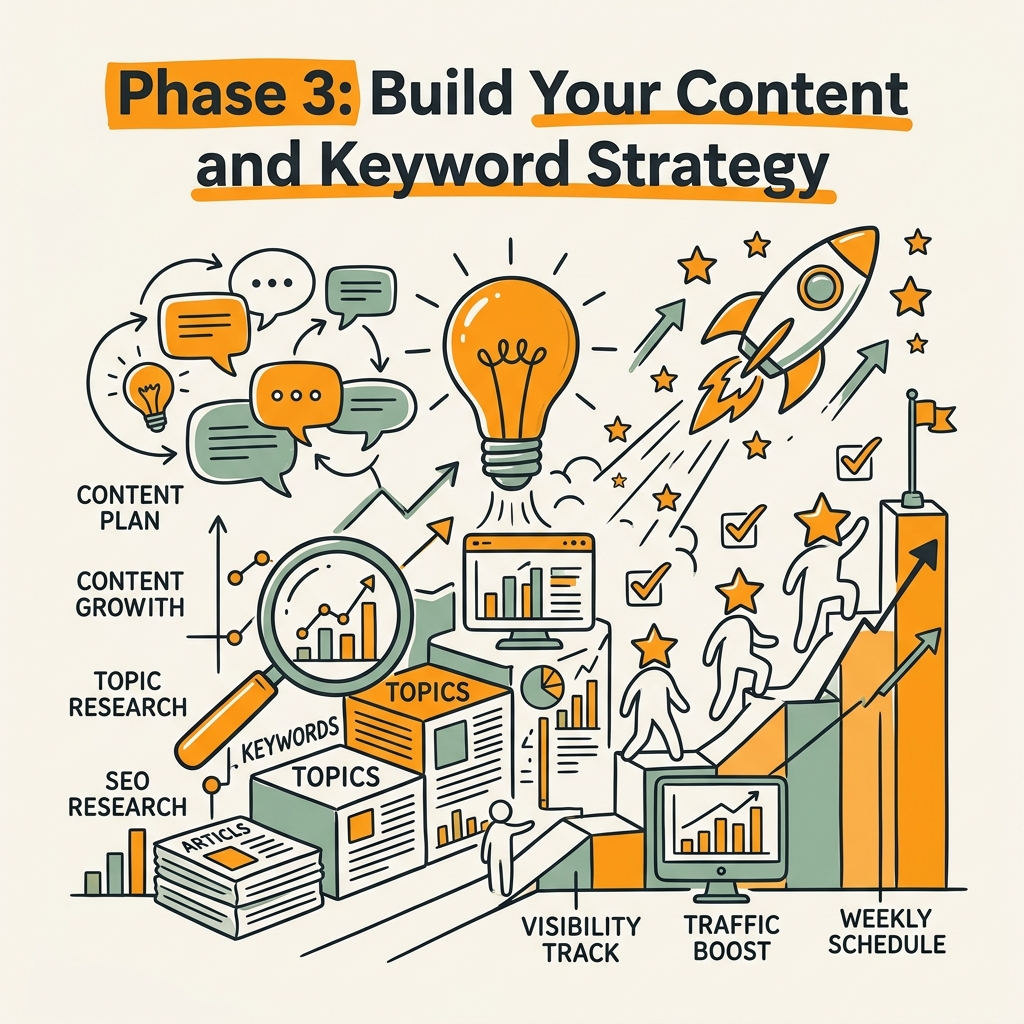
This is where the roadmap becomes concrete. Your keyword strategy should mirror your sales funnel and build topical authority over time.
Align Keywords to Your Sales Funnel
Group target keywords into three buckets:
- Awareness keywords: Broad, high-volume searches that potential customers make early in their journey. Examples: "how to reduce marketing costs," "best project management tools." These attract top-of-funnel traffic and build brand awareness.
- Consideration keywords: Mid-funnel searches that indicate active evaluation. Examples: "[your competitor] vs [another competitor]," "product category + review," "product category + pricing." These convert better than awareness keywords.
- Decision keywords: High-intent, typically branded or product-specific. Examples: "buy [product]," "[product name] pricing," "[product name] + alternative." These drive the highest conversion rates.
Most growing companies obsess over decision keywords—they're easier to measure and convert immediately. But decision keywords alone won't build lasting organic momentum. You need awareness and consideration content to build topical authority and create a funnel that feeds decision-stage pages.
A balanced strategy is 60% awareness, 25% consideration, 15% decision. This ratio attracts volume, builds authority, and converts qualified buyers.
Create a Content Cluster System for Topical Authority
Topic clusters are the modern replacement for siloed, standalone content. A topic cluster consists of a pillar page (broad, comprehensive) and cluster content (specific subtopics), all internally linked to build context and authority.
Example: If your pillar is "Project Management Software," your cluster content might include:
- "Best Project Management Tools for Remote Teams"
- "Agile Project Management Software Comparison"
- "Project Management for Construction: Tools and Workflows"
- "How to Choose Project Management Software: Framework and Checklist"
Each cluster piece is internally linked to the pillar and to related cluster content. This architecture signals to Google that your site is a topical authority, which improves ranking velocity and trust for all pages in the cluster.
When you're ready to scale, building topical authority with structured content clusters allows you to produce comprehensive clusters in weeks instead of months. Jottler's autonomous agents research related keywords, outline cluster content, and build internal linking relationships automatically—turning a manual, months-long project into a repeatable system.
Phase 4: Execute Content Production at Scale
The best strategy fails if you can't execute consistently. Growing companies face a brutal truth: producing 3-5 high-quality SEO articles per month requires 60-80 hours of work (research, writing, optimization, publishing, internal linking). With limited resources, execution stalls after month two.
Set a Realistic Production Cadence
Decide upfront how many articles per month you can sustainably publish. Be honest. If you have 0.5 FTE allocated to content, you can produce 2-3 quality pieces monthly. If you're scaling with AI tools, you can do 5-10.
Consistency beats volume. Publishing 3 solid pieces every month for 12 months (36 articles) beats publishing 20 pieces in month 1 and zero in months 2-6. SEO rewards patience and consistency.
Implement an AI-Powered Content Pipeline
Manual content production is the bottleneck for every growing company. AI-powered content automation solves this, but only with the right guardrails. The pipeline should include:
- Research: Deep competitive and search intent analysis to ensure the content fills a real gap and targets the right audience
- Brief creation: An outline that specifies keywords, sections, data sources, and CTAs so the writer (human or AI) has clear direction
- Writing: Production of first draft with proper keyword integration, citation of real sources, and audience-appropriate tone
- Fact-checking: Verification of all claims and statistics against authoritative sources
- Optimization: On-page SEO (title tags, meta descriptions, headers, schema markup)
- Internal linking: Systematic linking to related content based on your topical authority clusters
- Publishing: Direct CMS integration to eliminate manual upload delays
Most AI content tools handle writing; few handle the full pipeline. Full-stack SEO automation means every step—from research to internal linking to publishing—is orchestrated. Jottler's 12 AI agents handle this entire workflow, publishing 3,000+ words daily while maintaining fact-checking and internal link integrity. For busy founders, this eliminates the execution bottleneck entirely.
Maintain Quality and Avoid AI Trap
The dark side of AI content automation: mass-produced, low-quality pages that rank briefly before Google deprioritizes them. Roughly 60% of searches now generate zero clicks due to AI Overviews and SERP features, which means your content must be genuinely useful, not just keyword-optimized commodity.
Quality safeguards include: (1) limiting AI to 1-2 articles per day per writer, (2) human editorial review before publishing, (3) fact-checking all statistics and claims, (4) original data or sourced case studies (not regurgitated information), and (5) audience-focused intent matching (write for the person searching, not for Google).
Phase 5: Build Internal Linking and Topical Authority
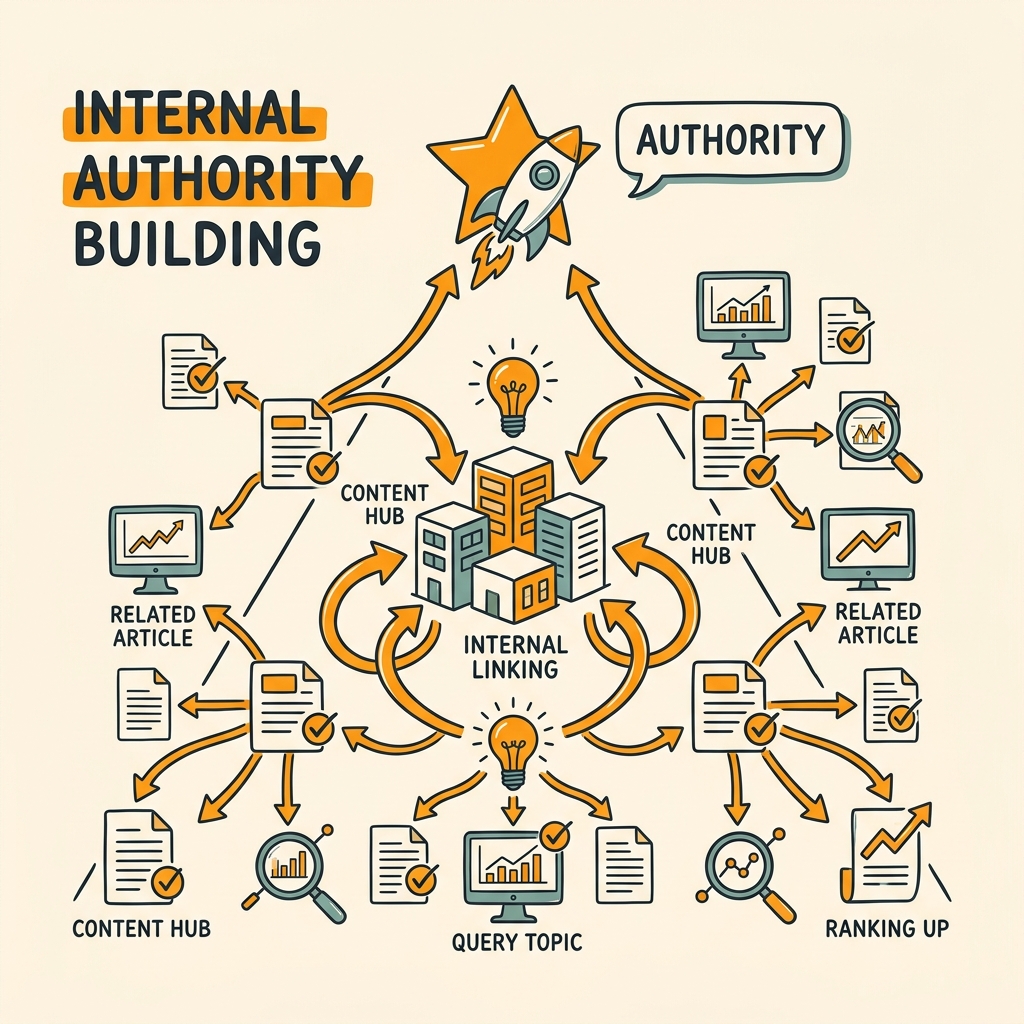
Internal linking is the most underutilized ranking factor. It serves two functions: (1) distributes authority from high-authority pages to newer pages, and (2) establishes topical relationships that help Google understand your content structure.
Link Your Content Strategically
Create a linking plan aligned to your topic clusters. Every piece of content should internally link to:
- Its parent pillar page (1-2 links)
- 2-3 related cluster pieces where topically relevant
- Supporting pages higher in the funnel (e.g., decision-stage content links to consideration content)
Place internal links naturally in prose, not as footnote salads. A link works better contextually placed in a sentence than buried in a sidebar widget.
For growing companies doing this manually, internal linking is a bottleneck that delays publishing by days. Tools that automate linking suggestions based on keyword matches and topical relevance save weeks of labor. Learning how to scale organic traffic without burnout requires automation at the linking level. Jottler's AI agents build internal linking maps automatically, ensuring every new piece links back to your existing content without manual review.
Phase 6: Measure, Report, and Iterate
SEO is not a one-time project—it's a system that improves with data. Set up measurement now or waste months without visibility into what's working.
Set Up Your Measurement Stack
You need three tools working in concert:
- Google Search Console: Shows search impressions, clicks, ranking positions, and search query data. Free and essential.
- Google Analytics 4: Shows on-site behavior: conversion rate, dwell time, pages per session, and goal completions. Essential for measuring conversion impact.
- CRM integration: Track which organic visitors convert to leads, then to customers. This is the critical bridge between SEO metrics and business outcomes.
Build a monthly dashboard (Google Looker Studio is free) that shows: organic traffic by keyword intent (branded vs. non-branded), organic conversion rate, CAC, assisted revenue, and ranking movement on priority keywords. This becomes your source of truth for SEO performance and your leverage for budget allocation.
Monthly Review Cadence
Every month, review three things: (1) new rankings and traffic (what's working?), (2) underperforming content (what's not ranking? what's converting poorly?), and (3) competitive threats (did a competitor rank for our key keyword?). Use these insights to adjust priorities.
Avoid the trap of daily ranking checks. Google's algorithm varies results by location, device, and user history; daily ranking fluctuations are noise. Monthly reviews capture real trends.
Common Pitfalls Growing Companies Make
Understanding what not to do is as valuable as knowing what to do. The most frequent roadmap failures:
- Prioritizing rankings over conversions: A keyword that ranks #1 but converts 0.1% is a waste of traffic. Prioritize keywords where the search intent aligns with your offering.
- Ignoring technical SEO: Content can be excellent, but if the page is slow, has crawl errors, or lacks proper schema, ranking takes months. Fix technical issues first.
- Publishing without a linking strategy: 50 standalone articles rank worse than 10 well-linked pieces in a topic cluster. Structure matters.
- Treating SEO as a one-time project: "Let's hire someone to write 50 articles and then pause." SEO compounds; pausing breaks momentum. Consistency beats intensity.
- Measuring the wrong metrics: Reporting "traffic grew 40%!" to leadership when conversions are flat signals a strategy misalignment. Always tie metrics to business outcomes.
- Betting on AI content without fact-checking: AI hallucinations, misattributed statistics, and outdated information tank credibility. Every fact must be verified.
Scaling Your Roadmap with Automation
As your company grows, manual execution doesn't scale. This is where autonomous SEO agents become non-negotiable.
A manual team publishing 3-5 articles monthly takes 60-80 hours. That same team using content automation tools can maintain 5-10 articles monthly with the same headcount. Tripling output without tripling team size is the definition of scaling leverage.
The trap: automation without strategy produces mass commodity content. The solution: build your roadmap first (research, keyword strategy, content clusters, measurement), then layer automation on top. A well-designed roadmap plus automation is unstoppable.
| Roadmap Phase | Manual Approach | Automated Approach | Time Investment |
|---|---|---|---|
| Keyword research and gap analysis | Spreadsheets, manual SERP analysis | AI-powered keyword clustering and competitive analysis | 4 hours vs. 30 minutes |
| Content research and outlining | Browser tabs, manual note-taking, outline drafting | AI research agents pulling from 14+ sources with auto-outlined structure | 3-4 hours vs. 20 minutes |
| Content writing | Human writer or manual AI prompting | AI generation with fact-checking and source citation | 2-3 hours vs. 30 minutes |
| Fact-checking and editing | Manual verification of claims and sources | Automated fact-checking against verified sources | 1-2 hours vs. 15 minutes |
| Internal linking | Manual linking decisions based on keyword matches | Automated linking based on topical relevance and existing content map | 45 minutes vs. 5 minutes |
| Publishing and optimization | Manual CMS upload, SEO tag entry, schema setup | Direct CMS integration with auto-applied schema and meta tags | 30 minutes vs. 2 minutes |
| Total per article | 11-13 hours | 1.5-2 hours | 85% time savings |
Most growing companies can't afford a 3-person content team. They can afford a 1-person content strategist managing an autonomous agent. That's the leverage automation unlocks.
Conclusion
A formal SEO roadmap is the difference between organic traffic that compounds and organic traffic that flatlines. By aligning SEO with business outcomes, building a keyword strategy that mirrors your sales funnel, executing consistently through automation, and measuring the metrics that matter, growing companies can achieve organic ROI of 748% or more while reducing the time investment required to get there.
The roadmap itself isn't complex: define goals, audit your current state, build a keyword strategy, execute at scale, link your content, and measure what matters. The challenge is execution—which is why automation is non-negotiable for growing teams.
Start with your foundation: clarify business goals, pick your target keywords, and commit to a sustainable publishing cadence. Then layer in automation to eliminate the execution bottleneck. In 6-12 months of consistent, well-structured effort, you'll have an organic machine that generates high-quality leads—a competitive advantage most growing companies never achieve.
Start your SEO agent and let autonomous systems handle research, writing, fact-checking, and publishing. Focus on strategy; let the agents handle execution. Plans start at $29/mo.
FAQs
How long does it take to see results from an SEO roadmap?
Most teams see initial traction (first keywords ranking) within 8-12 weeks with consistent execution. However, meaningful traffic and conversion impact typically emerge at 4-6 months as your content cluster builds authority and internal linking strengthens. The top 1-3 ranking keywords can drive significant volume—focus on quality over speed. SEO is a patience game; teams that publish 1-2 quality pieces weekly see 30-50% traffic growth in the first 6 months, but this requires uninterrupted consistency. Automation accelerates this timeline by removing the execution bottleneck, allowing teams to maintain cadence even during fundraising or product crises.
What's the minimum team size needed to execute an SEO roadmap?
One person. A single marketer can execute a full SEO roadmap if they use automation. The role becomes strategist + QA instead of strategist + writer + editor + publisher. Your marketer spends 2-3 hours per day on research, outline review, and fact-checking while an autonomous agent handles research aggregation, writing, optimization, and publishing. This hybrid model achieves 5-10 quality articles monthly with one FTE, versus 2-3 articles with the same person working fully manual. Without automation, you need 2-3 people to sustain 5+ articles monthly.
What should I do if competitors are ranking for my target keywords?
First, analyze why they rank. Pull the top 3 pieces and audit: content length (usually 3,000+ words for competitive keywords), depth of original research or data, internal linking quality, and freshness. Most of the time, competitors rank simply because they published higher-quality, more comprehensive content. Your content needs to match or exceed their execution—shorter or weaker content won't displace them. Second, look for angle gaps: if all top-3 results are best-practices guides, write a comparative analysis or case study. Third, backlinks matter for competitive keywords; if competitors have significantly more referring domains, you'll need to build authority through topical clustering and internal linking before raw ranking power emerges. Expect 8-12 weeks of publishing before you rank alongside entrenched competitors on high-difficulty keywords.