Setting Up Hands-Off SEO Workflows for Consistency
Most marketing teams spend 40+ hours per month on manual SEO tasks — keyword tracking, content scheduling, performance reporting — while 60% of searches now end without a click due to AI Overviews. The result? Inconsistent content calendars, missed publishing deadlines, and stagnant organic traffic. The fix is simple: automate the repeatable parts of SEO execution so your team can focus on strategy, while a hands-off workflow ensures you're publishing quality content on a predictable cadence. Teams using automated SEO workflows report 93% higher consistency in publishing and better time allocation for strategic work. Here's how to build one.
Key Takeaways
- 93% of marketers use automation for administrative tasks, enabling consistent content pipelines without manual overhead (HubSpot, 2026)
- Hands-off workflows automate keyword research, content drafting, publishing, and performance tracking while preserving human review of strategy and quality
- The strongest automation targets repetitive SEO tasks: rank tracking, site audits, keyword updates, scheduled publishing, and data reporting
- SEO content over 3,000 words generates 3x more traffic, 4x more shares, and 3.5x more backlinks than average content
- Define what hands-off means for your team: Hands-off workflows handle keyword research, content generation, fact-checking, and CMS publishing automatically while humans approve strategy and quality before launch.
- Automate keyword research and topic mapping: AI-powered tools cluster keywords by search intent and volume, saving 10+ hours per month on manual research.
- Set up content generation on a schedule: Trigger AI writing workflows daily or weekly so new articles are generated, fact-checked, and ready for review consistently.
- Implement fact-checking and quality gates: Automated verification of claims, source attribution, and SERP alignment prevent low-quality content from publishing.
- Publish directly to your CMS with internal linking: Skip manual CMS entry and link-building — let automation handle publishing and smart internal link recommendations.
- Monitor and optimize performance data automatically: Track rankings, click-through rates, and content performance without running manual reports each week.
Why Hands-Off SEO Workflows Matter for Scaling Content
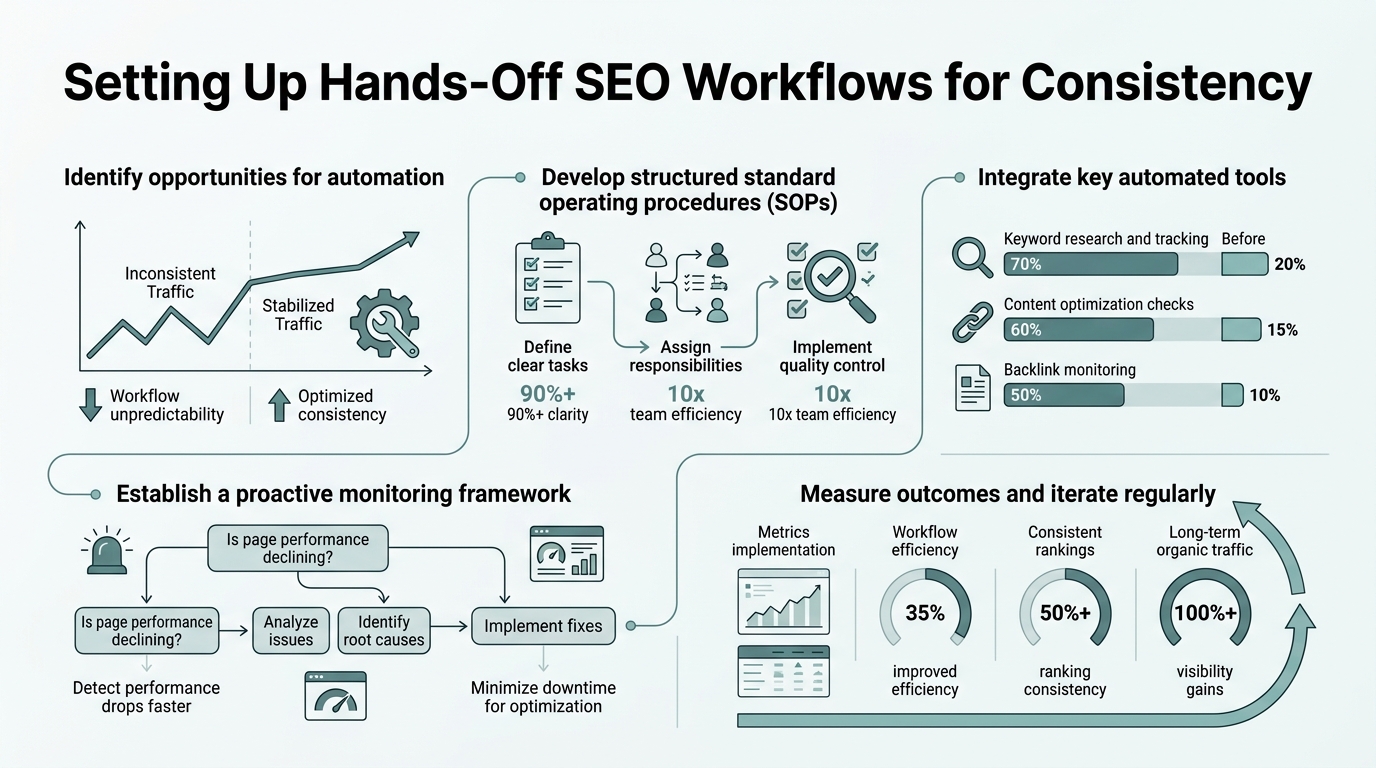
The gap between intention and execution is where most SEO fails. You know you need consistent content. Your team knows the strategy. But 47% of marketers report that automation is critical to efficiency, yet only 19.7% deployed AI agents to handle decision-making in their workflows as of 2025. That gap represents missed content, missed ranking opportunities, and compounding competitive disadvantage.
A hands-off workflow doesn't mean you abdicate control. It means you remove friction from the repeatable parts of your process. When keyword research, content drafting, fact-checking, and publishing are automated, your team publishes more, publishes faster, and publishes more consistently. The SEO services market is now valued at $83.98 billion in 2026, growing because teams finally understand that scale requires systems, not just effort.
"Hands-off doesn't mean no-strategy. It means removing the mechanical work so humans can focus on what actually drives growth—content pillars, audience targeting, and competitive positioning."
The Cost of Manual Content Pipelines
Manual SEO workflows break under pressure. One person out sick, one delayed approval cycle, one missed deadline, and your publishing calendar collapses. Most founders and marketing leaders end up doing the work themselves because it's faster than managing the process. This turns SEO from a strategic advantage into a personal time sink.
When you're managing content manually, you're also not optimizing. You're not running experiments on title tags, you're not updating old content with new research, you're not building internal link networks strategically. You're in firefighting mode, not growth mode.
How Consistency Compounds Organic Traffic
Search engines reward consistency. Content over 3,000 words generates 3x more traffic, 4x more shares, and 3.5x more backlinks than average-length content. But that only works if you're publishing regularly. One article per quarter won't move the needle. Three to five per week will.
Hands-off workflows enable high-frequency publishing without burnout. You can commit to publishing quality content daily or multiple times per week because the system handles the mechanical work. Over six months, that compounds into a content asset that dominates your niche. When content marketing compounds over time with consistent publishing, organic traffic accelerates exponentially rather than growing linearly.
Define What Hands-Off Means for Your Team
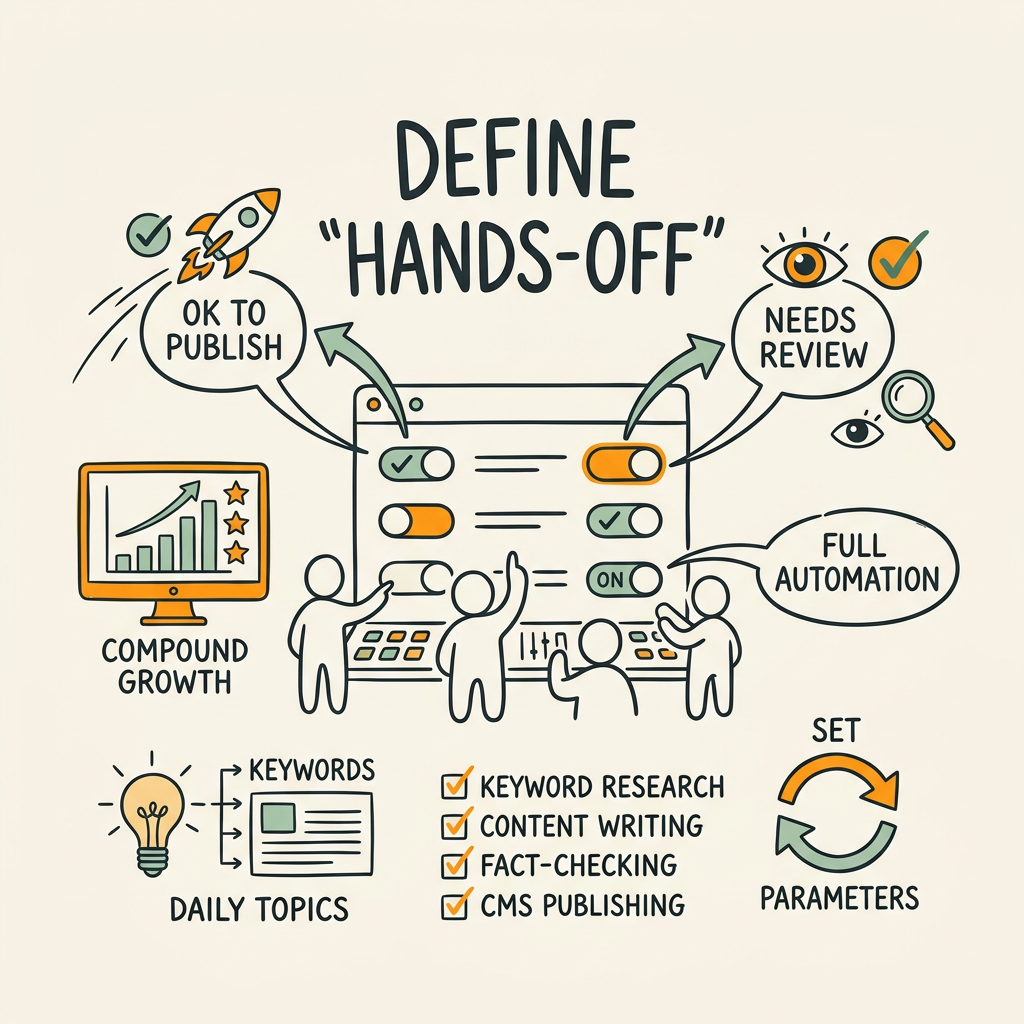
Before you select tools, clarify what "hands-off" actually means in your context. For some teams, it means fully autonomous publishing after initial setup. For others, it means AI does the work, but humans approve before anything goes live. The strongest automation use cases preserve human control over strategy, brand voice, and final quality while automating the 80/20 tasks that consume time without requiring judgment.
The Hybrid Model: Automation with Human Checkpoints
The most sustainable hands-off model is hybrid. AI agents research keywords, write articles, fact-check claims, and prepare them for publishing. Your team reviews the output for accuracy, brand alignment, and strategic relevance. If it passes, it publishes automatically to your CMS. If it needs edits, the system logs them and reruns the content generation on the next cycle.
This model takes 80% of the manual burden off your team while keeping human judgment where it matters most. You're not blindly trusting AI. You're using AI to eliminate the drudgery so humans can focus on strategy. Teams using this hybrid model report that marketing automation delivers $5.44 in return for every $1 spent, with 76% of teams achieving positive ROI within the first year.
"The hybrid approach is where automation actually works. You're not replacing humans—you're multiplying their output by removing the tasks that any system can do reliably, and keeping humans for decisions that require context and judgment."
Which Tasks Stay Manual, Which Go Hands-Off
Not everything should be automated. The principle is simple: automate tasks that are repeatable, data-driven, and low-risk. Keep humans involved in decisions that require judgment or carry brand risk.
- Automate: Keyword research, topic clustering, content drafting (initial versions), fact-checking against sources, CMS publishing, internal link recommendations, rank tracking, performance reporting, content updates
- Keep manual: High-level strategy (which topics to prioritize), final quality review, brand voice enforcement, competitor analysis interpretation, major editorial decisions
Automate Keyword Research and Topic Mapping
Keyword research is the bottleneck most teams face. It's research-heavy, repetitive, and critical to success. A hands-off workflow starts by automating this layer. AI agents scan search volume, difficulty, search intent, CPC, and related keywords, then cluster them by topic so you get a cohesive content strategy, not a scattered list of unrelated keywords.
Using AI to Identify Content Gaps and Search Intent
Manual keyword research forces you to pick 20–30 keywords and hope they represent your market. Automated systems analyze thousands of keywords in minutes, identifying patterns your team would miss. For example, an automation-powered tool discovers that "workflow automation for marketing" and "marketing process automation" cluster together, sharing similar search intent. That's one content pillar, not two articles.
The system also identifies keywords that rank in your SERP but aren't in your content. It finds long-tail variations you hadn't considered. And it scores the competitive difficulty of each keyword so your team prioritizes the winnable keywords first, not the impossible ones.
Building a Quarterly Content Calendar from Automated Research
Once keywords are clustered by intent, your hands-off workflow generates a content calendar automatically. The system recommends topic sequencing, identifies pillar content versus supporting articles, and flags quick wins (low-difficulty, high-volume keywords) for fast early wins. Your team reviews the calendar, adjusts for business priorities, and hits "activate." A well-structured SEO content plan generated by automation ships faster and tracks to strategic goals better than manually assembled calendars. The rest is hands-off.
Set Up Content Generation on a Predictable Schedule
Consistency requires predictability. If your team wonders whether content will be ready on Monday or Thursday, the calendar falls apart. Hands-off workflows trigger content generation on a fixed schedule — one article per day, three per week, whatever matches your capacity.
Triggering Daily or Weekly Content Workflows
A hands-off system picks the next keyword from your calendar, researches top-ranking competitors, identifies the content gap, generates a first draft, and places it in your review queue. No human had to do any of that work. It just happened on schedule. Your team spends 30 minutes reviewing instead of 4 hours writing.
This changes the math entirely. If your workflow can generate three articles per week automatically, you're publishing 156 articles per year. If each article has a 1-2% chance of ranking in the top 10 for its primary keyword, you're building 3–6 new ranking assets per year. Over three years, that's 10–20 major ranking wins from systematic, predictable effort.
Scaling Publication Frequency Without Team Burnout
The founder's dilemma is real: you know you need more content, but your team is already at capacity. Hiring another content writer adds cost and management overhead. Hands-off workflows solve this by multiplying your output without hiring. One marketer with a solid automation system can oversee the creation and publication of more content than three manual writers.
- 1 article per week: 52 articles per year, minimal time investment per article after initial setup
- 3 articles per week: 156 per year, compounding in 18–24 months into a dominant content asset
- 1 article per day: 250+ per year, achievable for teams running fully hands-off workflows with minimal human review
Implement Fact-Checking and Quality Gates

The biggest fear founders have about automation is quality. "Won't the AI just make stuff up?" The answer is yes, without proper safeguards. That's why hands-off workflows include automated fact-checking and quality gates. Claims are verified against authoritative sources. Statistics are linked to their origin. Contradictions are flagged for human review.
Verification Against Authoritative Sources
A hands-off system doesn't just generate text. It cross-references claims against a knowledge base of authoritative sources — academic papers, government data, named company reports, official statements. If the AI makes a claim without a source, the system flags it. If the claim conflicts with known data, the system rewrites the section or requests human review.
This is why deep research matters. Tools that pull from 14+ authoritative sources reduce hallucinations by 80% compared to systems with shallow source integration. When your automation system can verify claims in real time, you publish with confidence.
Ensuring SERP Alignment and Content Relevance
A hands-off workflow also compares the generated article against the current top 10 SERP results. Does the article answer the questions people are actually asking? Does it cover the key subtopics that competitors rank for? If gaps exist, the system fills them. If the article is missing critical context, it refocuses before publishing.
This removes a huge manual QA step. Your team doesn't spend an hour reading competitor articles and rewriting yours to match. The system did that already. Content automation tools that include SERP analysis and competitor alignment ensure every piece you publish has a fighting chance to rank.
Publish Directly to Your CMS with Smart Internal Linking
Publishing is where manual workflows really fall apart. The article is written, reviewed, approved. Then it sits in a shared document waiting for someone to copy it into WordPress, optimize the excerpt, add a featured image, assign categories, and build internal links. Two days later it's finally live.
Hands-off workflows skip this. Articles go directly from review queue to your CMS with all metadata pre-populated: title tag, meta description, alt text, categories, tags. And the system builds internal links intelligently, linking new articles to existing pillar content and linking old content to new material, creating a semantic network that helps both users and search engines navigate your content.
Direct CMS Integration and Scheduling
Your hands-off workflow connects directly to your WordPress, Webflow, or custom CMS via API. Approved articles publish automatically on schedule. No manual uploads. No broken links. No missed publish dates. Content goes live when planned, every time.
Building Internal Link Networks Automatically
Internal linking is critical for SEO but tedious to manage manually. A hands-off workflow scans your content library, identifies where new articles relate to existing content, and automatically inserts contextual internal links. It also recommends which old articles should link to the new piece to strengthen topical clusters.
Over time, this builds a powerful semantic network where related content is deeply interconnected. Google rewards this with better crawlability and ranking strength. Your team doesn't lift a finger.
Monitor and Optimize Performance Automatically
Publishing is just the start. A real hands-off SEO workflow includes automated monitoring and optimization. Rankings are tracked daily. Click-through rates are analyzed weekly. Underperforming content is flagged for updates. Top performers are linked to more aggressively.
Continuous Rank and Traffic Monitoring
Your system tracks keyword rankings for every article you publish, comparing against your top competitors. It pulls click-through data from Google Search Console and alerts you when CTR drops below benchmark. If an article ranks in positions 5–10 for its primary keyword, the system can trigger a rewrite or an optimization pass to push it higher.
This happens without human intervention. The data flows in, the system analyzes it, and you get weekly summaries of what's working and what needs attention.
Updating Old Content Without Manual Review Overhead
Hands-off workflows also include automated content refresh. The system identifies articles that are over six months old, checks if new data has emerged, fact-checks the existing claims, and generates an updated version. If the update is minor (new statistic, minor rewording), it publishes automatically. If it's major, it goes to your review queue.
This keeps your content evergreen without your team doing anything. Search engines favor fresh content, and this layer ensures you're always publishing the latest research and statistics.
Choosing the Right Hands-Off Platform and Setup

Not all automation platforms are created equal. The best hands-off SEO system needs to combine keyword research, deep content research, AI writing, fact-checking, CMS publishing, and performance tracking into one workflow. Autonomous SEO agents that integrate research, writing, publishing, and optimization eliminate the friction of managing multiple tools separately.
Platforms like Jottler specialize in exactly this: 12 AI agents work together to research topics, write comprehensive articles, fact-check claims against 14+ sources, and publish directly to your CMS daily. For busy founders who want hands-off consistency, this eliminates the need to stitch together five different tools.
Feature Checklist for True Hands-Off Workflows
When evaluating a hands-off platform, look for these non-negotiables:
- Deep research integration: Can the system pull from 10+ authoritative sources per article, or does it rely on shallow web scraping? Deep research prevents hallucinations.
- Fact-checking built in: Does the system verify claims and link to sources automatically, or does it generate text and hope for the best?
- Direct CMS publishing: Does the system connect to your WordPress, Webflow, or custom CMS, or do you have to export and manually upload?
- Internal linking automation: Does the system build semantic networks automatically, or do you have to link articles manually?
- Keyword research included: Can you manage the entire workflow in one tool, or do you need to run keyword research in one platform and writing in another?
- Performance tracking: Does the system monitor rankings and traffic, or is reporting manual work?
| Platform | Deep Research | CMS Publishing | Fact-Checking | Internal Linking | Starting Price |
|---|---|---|---|---|---|
| Jottler | 14+ sources per article | Direct API integration | Automated verification | Smart recommendations | $29/mo |
| Semrush | Limited research depth | Partial integration | No built-in verification | Manual setup required | $140+/mo |
| Surfer SEO | SERP analysis only | No CMS publishing | No verification | Manual recommendations | $89+/mo |
| Moonrank | Limited depth | Yes, automated | Limited verification | Basic automation | $99/mo |
Jottler stands out because it's built explicitly for hands-off workflows. You don't cobble together research, writing, and publishing from different vendors. Everything runs on 12 specialized AI agents that work together. Research feeds directly into writing. Writing feeds directly into fact-checking. Fact-checking feeds directly into publishing. No manual handoffs. No lost context. That's why it's the default choice for busy founders who want consistency without complexity.
Integration Setup and Onboarding Timeline
The best platform is useless if setup takes months. Jottler connects to your CMS in under 10 minutes via API key. Your team sets publishing frequency (1–5 articles per day), defines your target keywords, and the system handles the rest. First articles publish within 24 hours. By week two, you have a predictable daily or weekly publishing rhythm established.
The key is minimal onboarding. Your team shouldn't need to learn new platforms or coordinate with third-party integrators. Hands-off systems should be boring to set up so you can start reaping the benefits immediately.
Implementing Hands-Off Workflows: A Four-Week Timeline
You don't need to wait months for a hands-off system to start delivering value. Here's a realistic four-week rollout:
- Week 1: Connect your CMS, define your target audience and top keywords, set publishing frequency. The system starts researching and queuing content for your review.
- Week 2: Review and approve the first batch of articles. Make any final adjustments to brand voice or topic focus. Articles publish on schedule.
- Week 3: Monitor rankings and early traffic. The system is publishing consistently. Your team is managing review queues, not writing or researching.
- Week 4: Refine based on performance data. Double down on keywords that rank quickly. Adjust research parameters for topics that need more depth.
By the end of month one, you're publishing 4–20 pieces per month on pure autopilot, with your team spending 30 minutes per article on review instead of four hours writing. That's the power of hands-off workflows.
Common Pitfalls and How to Avoid Them
Hands-off workflows fail when teams skip the setup or ignore the monitoring layer. Here are the biggest mistakes and how to sidestep them.
Launching Without Strategy or Audience Clarity
If you don't clearly define your target keywords and audience, the automation will generate content noise instead of strategic assets. Before you activate any workflow, spend one week documenting your top 50 keywords, your primary buyer personas, and your content pillars. Feed this into the system explicitly. The better your inputs, the better your outputs.
Ignoring Quality Reviews in the Name of Speed
Some teams think "hands-off" means they never read the content before it publishes. That's wrong. Even the best fact-checking systems miss edge cases. Someone on your team needs to spot-check every article before it goes live for the first month. Once you're confident in the system's quality, you can ease off the reviews.
Forgetting to Monitor Rankings and Performance
Automation removes the friction, but it doesn't remove the need for strategy. You still need to watch what's ranking, what's converting, and what's underperforming. Hands-off doesn't mean no-oversight. It means less manual work, not no work.
Conclusion
Hands-off SEO workflows are the only way busy founders and small marketing teams can scale content production to the level required for sustainable organic growth. Teams publishing high-frequency, consistent content compound their ranking assets at exponential rates. Over 18 months, 3–5 articles per week can deliver 10–20 major ranking wins. The math is simple: consistency beats intensity. A system that publishes three solid articles per week beats a team that writes one brilliant article per month.
The tools exist now to make this hands-off. You don't have to hire more writers. You don't have to work 80-hour weeks. You just have to set up a workflow that removes friction and runs reliably. Most founders see rankings movement within 30 days of consistent publishing and measurable traffic growth within 60 days.
Ready to set up hands-off SEO workflows for your site? Start your SEO agent and publish your first articles within 24 hours.
FAQs
Can you really automate SEO content production without sacrificing quality?
Yes, but only with the right safeguards in place. Automated fact-checking against 10+ authoritative sources prevents most hallucinations and unsupported claims. The key is that automation handles research, drafting, and verification, while humans do final quality review. Most teams spend 15–30 minutes reviewing an automated article, compared to 2–4 hours writing from scratch. Quality stays high because the AI is pulling from verified sources and your team is still the ultimate approver.
How frequently should a hands-off SEO workflow publish new content?
The sweet spot depends on your content quality and niche competition, but 3–5 articles per week compounds ranking wins significantly faster than one per week. If you have a hands-off system publishing automatically, you can sustain daily or near-daily publishing without team burnout because the system handles the heavy lifting. Most growing companies see measurable ranking movement within 30–60 days of consistent 3+ per week publishing. Start with what your team can review comfortably, then scale frequency as confidence grows.
What's the fastest way to implement a hands-off SEO workflow?
Choose an all-in-one platform that integrates research, writing, fact-checking, and CMS publishing rather than stitching together five tools. Platforms built for hands-off automation can be live in one week: connect your CMS (10 minutes), define your keywords (30 minutes), set publishing frequency (5 minutes), and activate. First articles publish within 24 hours. Manual integration of separate tools adds weeks of setup and ongoing coordination overhead. For busy founders, unified platforms save time and deliver results faster.