Sustainable Organic Growth Over 12 Months
Most growing companies chase traffic spikes, then watch it vanish when they shift strategy. Sustainable organic growth delivers 702% ROI for B2B SaaS with a 7-month breakeven point, but only when you stop treating content as a monthly afterthought and start building it as your primary engine. The stakes are high: companies without a structured 12-month organic strategy lose competitive ground every quarter, watching high-intent prospects land on competitor sites instead. The fix isn't complicated. It's compounding: consistent, research-backed content that ranks for the keywords your buyers actually search, paired with the systems and automation that make it repeatable without burning out your team.
Key Takeaways
- Organic content delivers $3 revenue per $1 invested, outperforming paid by 67% (HubSpot, 2026)
- Teams publishing 9+ posts monthly see 35.8% year-over-year traffic growth (BrightEdge, 2026)
- Long-form content (2,000+ words) earns 77.2% more backlinks than short-form, compounding authority (Ahrefs, 2025)
- Content-Led Strategy: High-quality, discoverable content as your primary customer acquisition engine, not a side channel.
- 12-Month Planning Framework: Quarterly targets, consistent publishing velocity, and measurement tied to revenue outcomes.
- Keyword Research & Topic Clusters: Building topic authority rather than chasing random keywords.
- Long-Form Depth: 2,000+ word cornerstone content that ranks for competitive terms and earns backlinks naturally.
- Technical Foundation: Core Web Vitals, metadata optimization, internal linking, and quarterly audits to keep rankings stable.
- Automation & Scaling: Removing manual bottlenecks so consistent publishing doesn't require constant manual effort.
- Measurement & Revenue Alignment: Tracking organic conversion rate and CAC, not just traffic vanity metrics.
What Is Sustainable Organic Growth and Why It Matters for Your 12-Month Plan
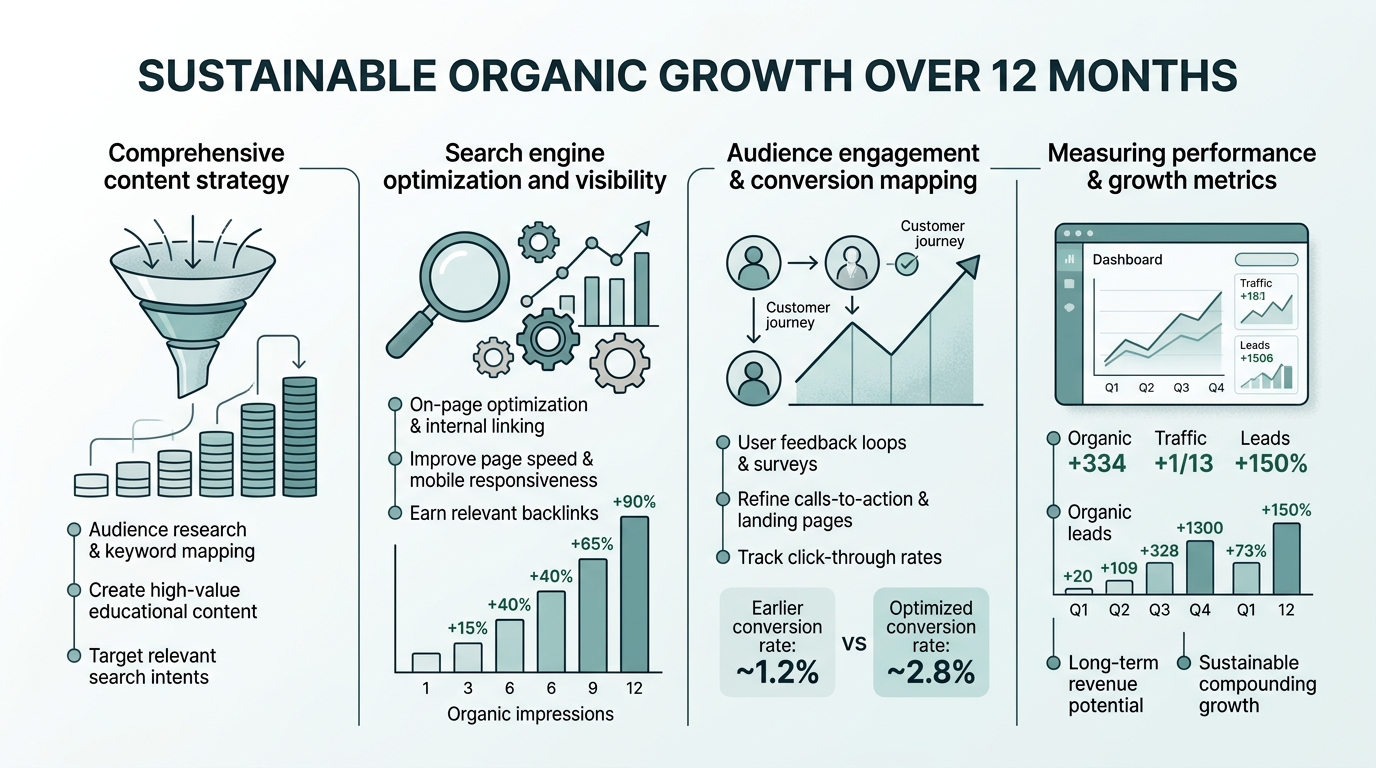
Sustainable organic growth means expanding your organic traffic and leads through consistent, high-quality content that compounds over time, rather than relying on paid campaigns that stop delivering the moment you stop spending. 53.3% of all trackable web traffic comes from organic search, making it the single largest traffic channel for most B2B companies. The 12-month timeline is the minimum viable commitment—SEO doesn't work in quarterly sprints. It works in seasons.
"The difference between sustainable and chaotic organic growth isn't strategy—it's systems. A year-long plan gives you time to test, refine, and scale without panic-driven pivots."
Why 12 months? Because the first 3-4 months are research, publishing, and ranking foundation. Months 5-8 are when compounding starts: pages climb, internal links strengthen topical authority, and early conversions validate your strategy. By month 12, you're hitting predictable metrics because the machinery is running. A year-long plan gives you time to test, refine, and scale without panic-driven pivots.
For busy founders and marketing teams, this is where most strategies fail: they publish sporadically, measure only vanity metrics (traffic, not revenue), and burn out trying to manage the process manually. 62.8% of marketers reported YoY organic traffic growth in 2025, but that growth stopped the moment they abandoned consistency. Jottler removes the friction by automating research, writing, fact-checking, and publishing so your team can focus on strategy instead of execution.
How to Define Your 12-Month Organic Growth Targets and Milestones
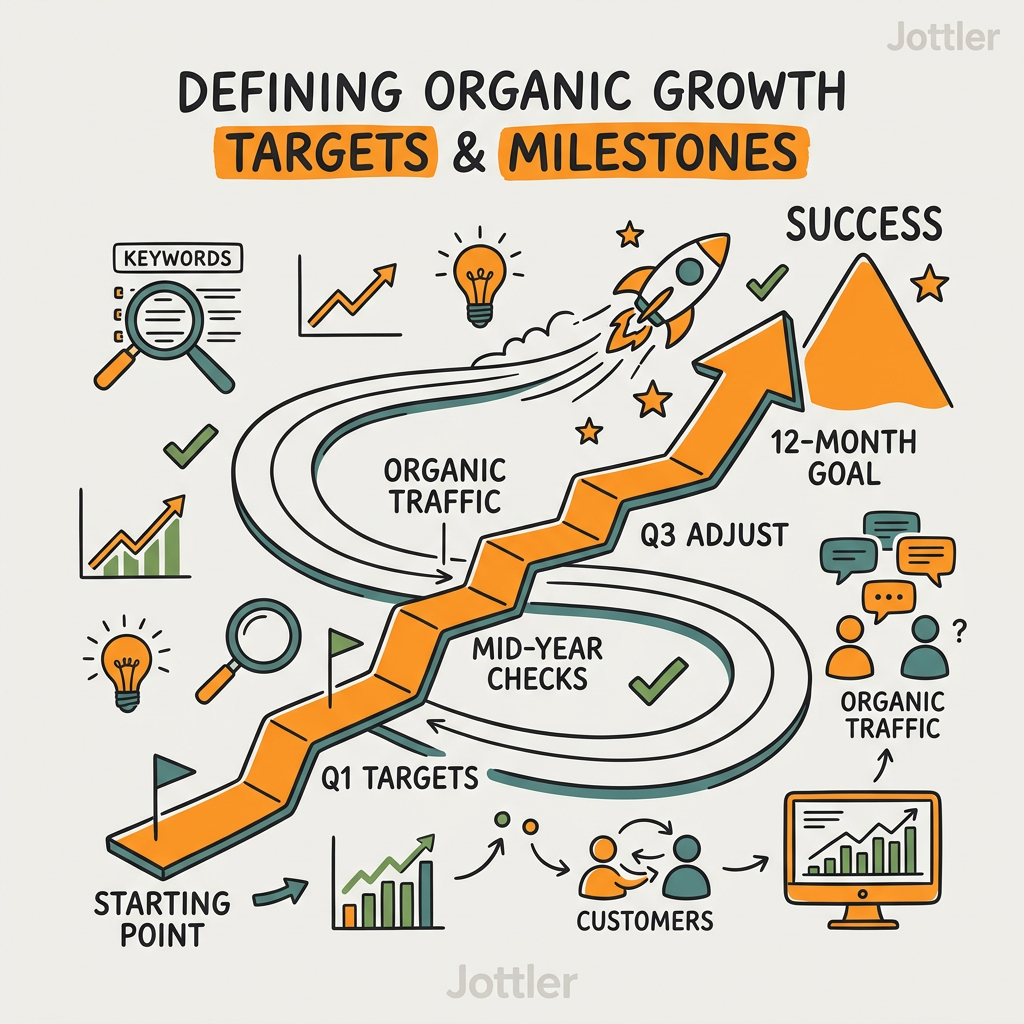
A realistic 12-month plan starts with baseline metrics and backward-engineers targets from revenue, not hope. If you're launching a new organic program, expect conservative early gains: months 1-3 might show minimal traffic uplift while you publish baseline content. By month 6, you should see 15-25% growth YoY. Month 12 targets typically hit 40-60% growth for disciplined teams, depending on your niche competitiveness.
Establish Your Starting Baseline and Revenue Goal
Pull your current organic traffic and conversion rate from Google Analytics 4. If you're generating 5,000 monthly organic sessions with a 2% conversion rate, you're at roughly 100 qualified leads per month. Organic leads cost 62% less than outbound and convert 3x more than cold outreach, so every 10% traffic increase unlocks meaningful revenue compound.
For a 12-month plan, a realistic growth target is 50% organic traffic increase paired with a 10-15% conversion rate improvement (through better page-to-form targeting). That takes you from 5,000 to 7,500 monthly sessions and 100 leads to 170 leads. In annual contract value terms, if each lead averages $15,000 in closed deals, that's $1.05M new ARR from the same team, no paid spend increase.
Break the Year Into Quarterly Milestones
Avoid treating 12 months as one monolithic sprint. Instead, set discrete quarterly outcomes:
- Q1 (Months 1-3): Foundation and Visibility. Audit existing content, map topic clusters, publish 12-15 cornerstone articles. Target: establish presence in 8-12 high-volume keyword clusters. Traffic may stay flat; that's normal.
- Q2 (Months 4-6): Ranking and Authority. Publish 12-15 more articles targeting secondary keywords in your clusters. Refresh top performers with updated data and internal links. Target: 15-20% traffic growth month-over-month by end of Q2.
- Q3 (Months 7-9): Compounding and Optimization. Focus shifts to depth: expand topic clusters, target long-tail variations, optimize pages for conversion. Publish 12-15 articles. Target: sustain 25% growth, improve conversion rate by 8%.
- Q4 (Months 10-12): Scale and Authority Consolidation. Leverage backlinks earned in Q2-Q3, publish proprietary research or case studies. Final 12-15 articles focus on high-intent keywords. Target: hit 50%+ YoY growth and 15%+ conversion lift.
Building Your Topic Cluster Architecture for Authority and Ranking Longevity
The single largest mistake in organic strategy is publishing random articles chasing Google's Keyword Planner suggestions. Topic clusters drive 30% more traffic and rank 2.5x longer than isolated pages, because they teach Google you're an authority in a specific domain, not a one-off content farm. A 12-month plan requires intentional clustering from day one.
Define Your Pillar Topics and Sub-Clusters
Start with 3-5 pillar topics aligned to your product and buyer intent. If you're a B2B SaaS company selling to marketing teams, your pillars might be: "Content Marketing," "SEO Strategy," "Demand Generation," "Analytics," and "Team Scaling." Each pillar becomes a landing page, and each cluster under it contains 8-15 supporting articles linking back to the pillar.
For a 12-month plan publishing 50-60 articles total, that's roughly 10-12 articles per pillar, creating dense topical authority. Google looks at link depth, keyword co-occurrence, and semantic relationships. If all your articles link back to one pillar page and reference related sub-topics, you're signaling to Google: "This site IS the expert in this domain." Pages in well-clustered topics hold rankings longer during algorithm updates because they have contextual support.
Map Keywords by Search Intent and Content Type
Not all keywords deserve the same treatment. A 12-month sustainable strategy categorizes keywords by intent and aligns content type:
- Awareness (High-Volume, Low Intent): "What is SEO," "content marketing basics." These are educational, 1,500-2,000 word explainers ranking in positions 5-15. Purpose: funnel top-of-funnel traffic into your domain.
- Consideration (Medium Volume, Medium Intent): "SEO strategy for SaaS," "how to scale content marketing." These are 2,500-3,500 word guides with frameworks, comparisons, and expert interviews. Purpose: build authority and establish you as a thoughtful resource.
- Decision (Low Volume, High Intent): "Best SEO tools for SaaS," "how to implement content automation." These are tactical, 2,000-3,000 word how-tos with screenshots and step-by-step flows. Purpose: capture high-intent prospects ready to evaluate solutions.
Avoid the trap of only targeting high-intent keywords. A sustainable 12-month plan needs traffic volume + ranking velocity. Awareness keywords get you traffic. Decision keywords get you customers. Interlink them intentionally within your topic clusters.
Creating Long-Form Content That Ranks and Earns Backlinks Naturally
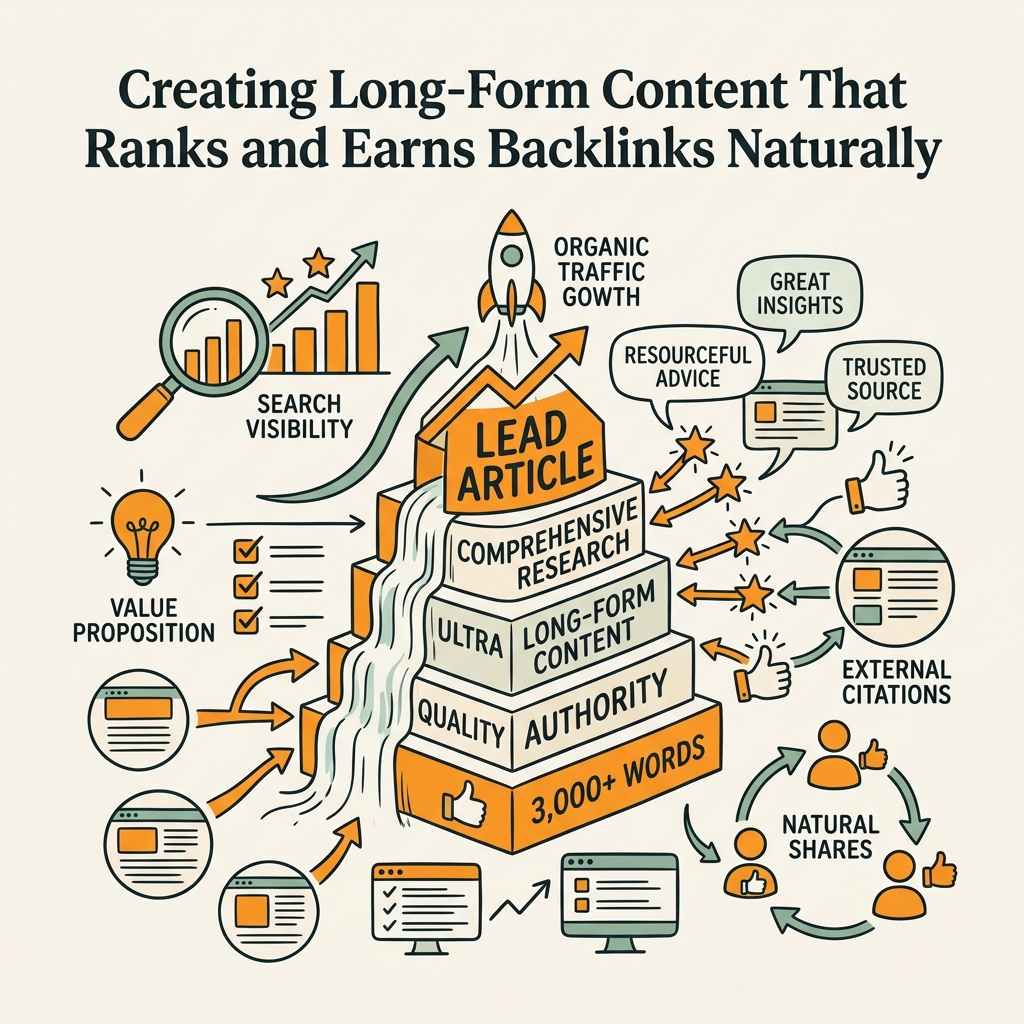
The era of 1,500-word blog posts generating meaningful traffic is over. Long-form content of 2,000+ words earns 77.2% more backlinks than short-form, and proprietary research increases conversions by 64%. For a 12-month sustainable strategy, long-form depth is non-negotiable. You're not competing on word count—you're competing on unique insights, data, and frameworks that other sites want to cite.
Develop Your Unique Data and Original Research Strategy
The most-cited articles aren't the longest; they're the most useful to other writers. If you're publishing articles everyone else is publishing, you're invisible. Original research—surveys, data analysis, proprietary benchmarks—creates the gravitational pull for backlinks and media mentions. For a 12-month plan, aim for 3-4 pieces of original research: one per quarter, or a single larger research project published across multiple articles with complementary datasets.
"Original research becomes a link magnet that drives discovery and citation across the industry. If you're a SaaS company surveying 500 of your customers about their content strategy challenges, you've suddenly become the authority journalists cite."
If you're a SaaS company, that might be: survey 500 of your customers about their content strategy challenges, analyze the results, publish benchmark reports, then create 5-7 supporting articles citing your own data. Suddenly you're the authority journalists and other marketers cite. Research aggregators and content marketing platforms are built on this principle: original findings become link magnets that drive discovery and citation across the industry.
Craft Cornerstone Articles That Serve as Hub Pages
Each pillar topic needs 2-3 cornerstone articles: 3,000-4,000 word comprehensive guides that answer every major question a prospect might have. These are your SEO workhorses. They rank for primary keywords, link internally to supporting articles (sub-clusters), and generate consistent traffic throughout the year without needing updates.
A cornerstone article structure for "SEO Strategy for SaaS" might be:
- Intro + Quick-scan takeaways
- What is SEO strategy and why it matters for SaaS
- Define your target audience and buyer keywords
- Build a keyword and topic cluster strategy
- Create your 12-month content plan and publishing cadence
- Optimize for Core Web Vitals and technical SEO
- Measure results: tracking organic conversion and CAC
- FAQ section (3-5 high-intent questions)
- CTA + resources
This structure serves two audiences: newcomers (who learn foundational concepts) and practitioners (who jump to specific sections). The keyword density is natural because you're answering the question comprehensively, not stuffing terms.
Technical Foundation: Core Web Vitals, Metadata, and Internal Linking Strategy
Content alone doesn't rank. You need the technical foundation to let Google crawl, index, and serve your pages. Core Web Vitals became even more significant in 2025 for ranking, alongside on-page relevance and backlinks. A 12-month plan allocates resources to technical maintenance, not just new content.
Optimize Core Web Vitals and Page Speed
Core Web Vitals measure user experience: Largest Contentful Paint (LCP, <2.5 seconds), First Input Delay (FID, <100ms), and Cumulative Layout Shift (CLS, <0.1). Pages failing these metrics lose ranking positions. For a 12-month sustainable strategy, audit your current vitals in Google PageSpeed Insights or Lighthouse, identify bottlenecks (images, CSS, JavaScript), and fix them before publishing new content.
Common fixes: compress images with WebP, defer non-critical JavaScript, use a CDN, optimize fonts. If you're publishing 50-60 articles over 12 months, ensure your content management system handles these automatically. Platforms like Jottler publish directly to your CMS with optimized formatting and image handling, removing the manual step of fixing Core Web Vitals after publishing.
Strategic Internal Linking and Topic Authority Signaling
Internal links serve two purposes: they guide users to related content (improving session duration and page depth), and they signal to Google which pages are most important in your topical authority structure. Strategic internal linking boosts page authority and session duration by up to 30%.
For every new article, include 8-12 internal links following these rules:
- Pillar-to-Cluster Links: Every supporting article links back to its pillar page with branded anchor text: "Learn more about [Pillar Topic]."
- Lateral Links: Related articles in the same cluster link to each other with keyword-rich anchors: "See our guide on [Related Subtopic]."
- Hierarchical Links: Awareness articles link down to consideration and decision articles as the reader moves through the buying journey.
Tools help visualize these structures and audit them for gaps. Jottler automates this layer by analyzing your existing content and suggesting internal link opportunities, then inserting them automatically when publishing new articles. Over 12 months, this compounds: each new article strengthens the topical authority graph, improving visibility for all related pages.
Quarterly Technical Audits and Metadata Optimization
Every quarter, run a technical SEO audit using tools like Ahrefs or Semrush. Check for crawl errors, broken links, duplicate content, and missing metadata. Ensure every page has a unique title (<60 characters) and meta description (<160 characters) aligned to search intent. Update schema markup for articles (author, publish date, content type) to improve SERP appearance and CTR.
For a 12-month plan, allocate 1-2 full days per quarter to this work. It's not exciting, but it's where 10-20% of your ranking gains come from. Neglect it and you're leaving traffic on the table.
Publishing Cadence and Consistency: The Real Engine of 12-Month Growth
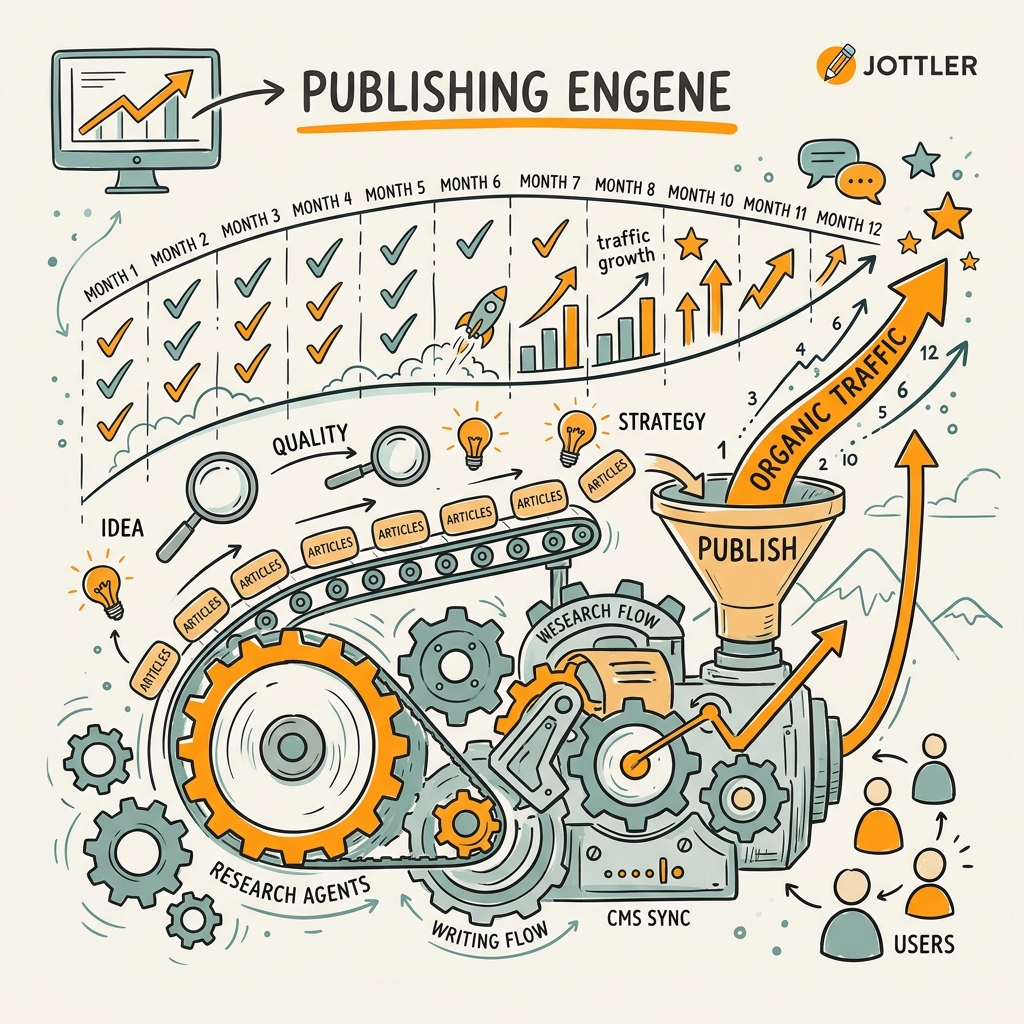
Here's the uncomfortable truth: the keyword research and topic strategy don't matter if you can't stick to a publishing schedule. Teams publishing 9+ posts per month see 35.8% year-over-year traffic growth. Teams publishing 2-3 posts per month see 0-10% growth. Consistency beats perfection.
Design Your Publishing Rhythm Around Your Team Capacity
A sustainable 12-month plan publishes 1-2 articles per week (4-8 per month). Over 12 months, that's 50-100 articles, a portfolio substantial enough to build authority. The trap most teams hit: they commit to 2 articles per week, burn out by month 3, and drop to zero. Instead, design a cadence your team can maintain without exhaustion.
If you're a 2-3 person team, publishing 2 articles per week manually is unsustainable. The solution: automation that handles the bottleneck by researching topics, writing long-form articles, fact-checking against live sources, and publishing directly to your CMS. Your team sets the publishing frequency (1-5 articles per day) and topic pillars, and the platform compounds your content library without requiring constant oversight.
Batch Content Production for Consistency Without Burnout
If you're producing content in-house, batch production is critical. Instead of writing one article per week across the month, block a single week quarterly and produce 10-12 articles, then publish them on schedule over the next 4-8 weeks. This reduces context-switching, improves writer efficiency, and ensures you hit quarterly targets even if Q2 gets chaotic with product launches or sales pushes.
Template-driven writing also helps: develop 3-4 article structures (cornerstone guide, how-to, comparison, case study), reuse the outline, and fill in topic-specific content. Over 12 months, this cuts production time by 40-50% without sacrificing quality.
Measurement, Reporting, and Revenue Alignment for Sustainable Growth
The fastest way to derail a 12-month organic plan is to measure the wrong metrics. Vanity metrics (page views, bounce rate, unique sessions) won't convince leadership to keep investing in content. Revenue metrics will. A sustainable strategy ties organic traffic to actual customer acquisition and revenue impact.
Track Organic Conversion Rate and Customer Acquisition Cost
Set up event tracking in Google Analytics 4 to measure: form submissions from organic traffic, trials or demos booked from organic, and revenue attributed to organic leads. Calculate your organic CAC (total content marketing spend ÷ customers acquired from organic). For SaaS, sustainable organic CAC is typically 40-60% of paid advertising CAC. If paid ads cost $2,000 per customer, organic should be under $1,200 per customer.
Benchmark your organic conversion rate: track what percentage of organic sessions convert to a meaningful action (form fill, trial signup, demo request). A healthy B2B conversion rate is 2-5%, depending on product complexity. Improving conversion rate by just 1 percentage point across 50,000 annual organic sessions generates 500 additional qualified leads per year.
Create a Monthly Organic Performance Dashboard
Pull data from Google Search Console (impressions, CTR, average position), Google Analytics 4 (organic sessions, conversion rate, revenue), and your CRM (leads sourced from organic, closed deals). Build a consolidated dashboard in Looker Studio or Data Studio showing:
- Monthly organic sessions (actual vs. target)
- Organic conversion rate (by page type and pillar)
- Organic CAC and LTV
- Top performing articles by traffic, conversions, and revenue
- Keyword rankings (tracked via Semrush, Ahrefs, or Google Search Console)
Review this dashboard weekly. Use it to identify underperforming content (pages with decent traffic but low conversion rate—usually a targeting or CTA issue) and top performers (articles generating outsized conversions; repurpose them).
Refine and Iterate Based on 3-Month Performance Windows
At the end of Q1, you'll have enough data to see what's working. Some article types (case studies, comparison guides) may convert at 5-8%. Others (awareness content) may convert at 0.5-1%. Use that signal to shift Q2-Q3 production toward high-converting formats.
If a specific topic cluster is outperforming others (e.g., articles about "SaaS Sales" convert better than "SaaS Operations"), shift 20% more articles toward that cluster in Q3-Q4. Data-driven iteration compounds faster than guessing.
Automating Content Workflows to Scale Without Scaling Your Team
The 12-month timeline is relentless: 50-100 articles, quarterly audits, internal link optimization, fact-checking, CMS publishing. If you're managing this manually, someone's working nights. Automation isn't optional for sustainable growth—it's foundational.
Keyword Research and Topic Clustering Automation
Tools like Semrush, Ahrefs, and SE Ranking automate keyword discovery and gap analysis. Instead of manually brainstorming 100 articles, run a competitive gap analysis: audit top competitors' top-ranking articles, identify keywords they rank for but you don't, and feed those into your content calendar. This cuts research time by 60% and ensures you're targeting real demand, not guessing.
| Metric | Manual Workflow | Automated Workflow | Time Saved Per Article |
|---|---|---|---|
| Keyword Research | 90-120 minutes | 15 minutes (tool-assisted) | 75-105 minutes |
| Content Writing & Research | 180-240 minutes | 45-60 minutes (editing AI draft) | 120-180 minutes |
| Fact-Checking & Links | 60-90 minutes | 10 minutes (tool-verified) | 50-80 minutes |
| CMS Publishing & Formatting | 45 minutes | 5 minutes (automated) | 40 minutes |
| Total Per Article | 375-495 minutes | 75-90 minutes | 285-420 minutes (60-75% savings) |
AI-Powered Content Research and Writing
Platforms that automate keyword research, content creation, fact-checking, and CMS publishing reduce production time by 60-75% per article, shifting your writers from execution to strategy. Instead of spending 3-4 hours per article on research (interviews, data gathering, competitor analysis), the automation pulls from authoritative sources, fact-checks claims, and generates a first draft ready to edit and publish. Your writers shift from "How do I research this?" to "How do I make this better?"
Over 12 months, if you're producing 60 articles and saving 2-3 hours per article on research and writing, that's 120-180 hours reclaimed—roughly equivalent to a full-time employee's worth of capacity.
Automated Internal Linking and CMS Publishing
After writing, the bottleneck is linking and publishing. Systems analyze your article against your existing content library, suggest internal links based on topic and semantic relevance, insert them into the article, and publish to your CMS with optimized formatting and images. What used to take 45 minutes (write links, format content, publish, test, verify) now takes 5 minutes.
Conclusion
Sustainable organic growth over 12 months is achievable, but only with deliberate strategy, consistent execution, and measurement tied to revenue, not vanity. Companies adopting content-led growth strategies report 702% ROI with a 7-month payback period, and organic leads generate 3x the volume of outbound leads at 62% lower cost. Over a calendar year, this compounds into a predictable customer acquisition engine that doesn't disappear when you pause spending.
The path is clear: build topic authority through clustered long-form content, publish consistently (1-2 articles weekly minimum), optimize the technical foundation, measure revenue impact, and automate the workflows that drain your team. Most teams fail not because the strategy is wrong, but because they run out of stamina. Removing friction through automation—research, writing, publishing, and linking—makes consistent execution possible.
Start your 12-month plan today. Define your pillars, set quarterly milestones, and commit to publishing cadence. If your team is stretched, let automation handle the volume so you focus on strategy. Start your SEO agent and begin compounding organic traffic from month one, without the burnout.
FAQs
How long does it take to see results from organic growth?
Sustainable organic growth follows a predictable timeline. Months 1-3 are foundation and indexing—you'll publish content but see minimal traffic uplift. Months 4-6 are when compounding starts: expect 15-25% YoY traffic growth as your articles rank and earn initial backlinks. By month 12, disciplined teams typically achieve 40-60% YoY growth. The 7-month breakeven (where revenue from organic exceeds content marketing spend) is standard for B2B SaaS. Impatience is the primary killer of organic strategies. Commit to the full year, measure quarterly, and resist pivoting before month 6.
How many articles do I need to publish to see sustainable growth?
A sustainable 12-month strategy typically requires 50-100 articles, depending on topic competitiveness and cluster depth. Teams publishing 9+ posts monthly see 35.8% YoY traffic growth, while those publishing 2-3 posts monthly see 0-10% growth. The sweet spot for most SaaS teams is 1-2 articles per week (4-8 monthly), which totals 50-96 articles annually. Quality matters: long-form cornerstone articles (2,500-4,000 words) compound faster than thin content. Aim for a pyramid: 5-10 cornerstone articles per pillar, 8-12 supporting articles per cornerstone. Consistency beats perfection—it's better to publish 50 solid articles over 12 months than 10 perfect articles.
What's the easiest way to maintain publishing consistency without burning out my team?
Automation is the only scalable solution. Manual research, writing, and publishing across 50-100 articles will exhaust a small team within 3-4 months. Platforms that automate keyword research, content creation, fact-checking, and CMS publishing reduce production time by 60-75% per article, shifting your writers from execution to strategy. Batch production helps: designate one week per quarter for intensive article production, then publish on schedule across the following 4-8 weeks. This reduces context-switching and ensures you hit targets even during busy product cycles. With automation handling the heavy lifting, your team stays fresh and consistent across all 12 months.