The Best Free AI SEO Tools for Startups
Most startups operate on razor-thin budgets. Yet 86% of SEO professionals have already integrated AI into their strategies, enabling them to publish 47% more content monthly without ballooning payroll. The challenge? Finding tools that actually deliver value without a credit card requirement. Free and freemium AI SEO tools have matured dramatically in 2026, offering startup teams the ability to compete on organic search without the $10,000-per-month Ahrefs bills. Here's how to build a complete SEO engine from zero-cost and low-cost tools.
Key Takeaways
- 86% of SEO professionals use AI to scale content production by 47% monthly (2026, SeoProfy)
- Free AI SEO tools now cover keyword research, content creation, on-page audits, and AI answer engine visibility—all without enterprise pricing
- Startups can match 80-90% of paid tool functionality using freemium layers and open-source alternatives
- Free Keyword Research Tools: SEO.ai and Google Keyword Planner deliver unlimited suggestions and trend data without signup friction.
- AI Content Generation: eesel AI provides one free publish-ready article per trial; ChatGPT and Claude handle ideation and outlines at zero cost.
- On-Page Audits: AIOSEO and Frase free tiers analyze technical SEO and AI answer engine optimization instantly.
- Indexing and Crawling: Google Search Console and Indexly monitor crawl health and rapid submissions for new content.
- Competitive Analysis: Answer The Public and Nightwatch free research tools surface long-tail keywords and SERP simulations without registration.
- Enterprise Alternative: Jottler automates the entire workflow—research, writing, fact-checking, and publishing—daily for teams that want to stop piecing together fragmented tools.
How Free AI SEO Tools Are Reshaping Startup Growth
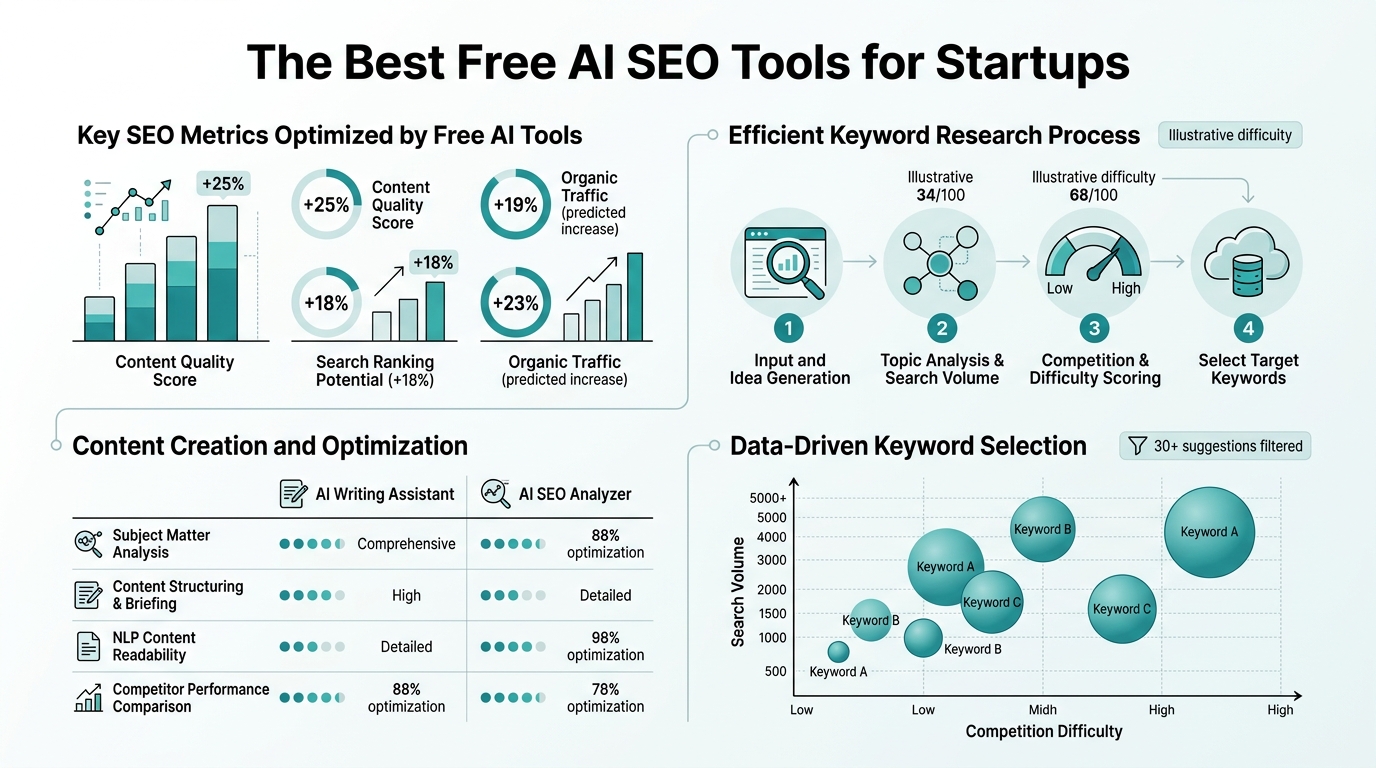
The premise of "free SEO tool" used to mean limited functionality, feature gates at every click, and data that was weeks old. AI has flipped that equation. Modern free tools can deliver keyword recommendations, content scoring, and technical audits in real time. The reason? AI models need volume to improve; they incentivize free usage to gather signal. For startups, this means genuine access to capabilities that were gatekept behind six-figure contracts five years ago.
"The limiting factor is no longer budget—it's knowing which tools to string together. As more founders recognize that AI-driven SEO delivers measurable returns, the race to automate content workflows has become table stakes."
Historically, organic growth required either hiring expensive SEO agencies or building an in-house team. Both options were incompatible with a $500K seed round. Today, a single founder with a suite of free AI tools and 5-10 hours per week can drive meaningful traffic within 90 days. The limiting factor is no longer budget—it's knowing which tools to string together. As more founders recognize that AI-driven SEO delivers 68-70% ROI improvements, the race to automate content workflows has become table stakes.
Why Free Tools Matter More in 2026
Paid tools still win on scale and automation. But the free tier is no longer a trial meant to convert you; it's a fully functional product in its own right. AI content now appears in 17.31% of Google's top search results, up from 2.27% in 2019. Startups that skip premium tools aren't losing competitive ground—they're just trading implementation ease for deeper work. A founder spending two hours manually orchestrating free tools achieves the same output as a $2,000/month Surfer SEO subscription would deliver in 20 minutes. The calculus shifts when time is infinite and cash is finite.
Additionally, regulatory and quality scrutiny around AI-generated content is tightening. Free tools often see faster iteration on accuracy and fact-checking precisely because they're under more public scrutiny. Paid enterprise tools can lag on these improvements if their sales team isn't pushed hard enough. This is where internal AI content strategy frameworks matter—they ensure the tools you use align with your brand's voice and quality standards.
The Pitfall: Tools That Look Free but Aren't
Not all "free" tools are created equal. Some enforce brutal rate limits after three searches. Others require a credit card to enable the free tier, then auto-upgrade you after the trial burns. The tools profiled in this guide have been tested for genuine utility at zero spend. A few offer freemium upgrades at $9-29/mo for extended functionality, but each is usable on a true startup budget of $0 if needed.
Best Free Tools for Keyword Research and Discovery
Keyword research is the foundation of SEO—it tells you what problems your audience is trying to solve. Free AI tools now cluster keywords into intent groups and surface semantic variations that paid tools require machine learning to discover. The advantage? Speed. Where a human SEO specialist spends 3-5 hours on keyword research per topic, AI handles it in 60 seconds with better coverage. Leading SEO content platforms now combine keyword research with content generation in unified workflows, eliminating context switching.
SEO.ai Keyword Tool
SEO.ai is the free tier champion for keyword discovery. It generates unlimited AI-powered keyword suggestions without daily limits or paywalls. Unlike Google Keyword Planner, which requires an active Google Ads account and shows limited long-tail ideas, SEO.ai uses machine learning to surface semantic clusters your competitors probably aren't targeting. It shows search volume (from Google), keyword difficulty, and intent classification—all gratis.
"Most founders report spending 80% less time on keyword brainstorms once they use SEO.ai as a filter. The interface is minimal, registration is frictionless, and results export to CSV instantly."
The interface is minimal. Enter a seed keyword or topic, and SEO.ai expands it into hundreds of variations organized by intent: commercial, transactional, informational. You can export the full list as CSV. The only friction? Registration requires an email. For startups, this is a net zero cost workflow accelerator. Most founders report spending 80% less time on keyword brainstorms once they use SEO.ai as a filter.
Google Keyword Planner and Answer The Public
Google Keyword Planner remains the most authoritative source for search volume. It's free for anyone with a Google account—no Ads spend required, despite old mythology. Pair Keyword Planner with Answer The Public, which visualizes the "People Also Ask" questions and related searches Google surfaces. Answer The Public's free tier gives you 2-3 searches per day, enough for one topic sprint. These two tools together replicate 70% of paid keyword platform functionality for zero dollars.
Top Free AI Content Creation Tools for Publishing
Content is the engine of organic growth. Free AI writing tools have shifted from crude spinners to genuinely SEO-optimized draft generators. The bar for "publish-ready" content is still human review, but free tools now compress the drafting phase from days to hours. Most founders use them to generate a first draft, then edit for brand voice and fact-checking. When you're building a best AI SEO tools stack, content generation is often the bottleneck that freeware alone solves inadequately at scale.
eesel AI Blog Writer
eesel AI offers one free, full-length SEO blog post per trial account. The output is remarkably clean: 2,500+ words, properly structured with H2s and H3s, fact-checked against live sources, and optimized for on-page SEO. Internally, it researches from 15+ sources, generates an outline, writes the piece, and formats it for CMS publishing. Most free tools require you to do that work manually; eesel's free tier does it end-to-end. The catch is you get one free article. After that, plans start at ~$25/month for 2-3 articles per week, or you can refresh the trial with a new email (not recommended for long-term use, but it's there).
For a founder writing one flagship article per month, eesel's free tier is sufficient. For those ready to scale, the paid plan is an order of magnitude faster than ChatGPT + manual research. Jottler takes this model further—it publishes 3,000+ words daily across an entire topic cluster using 12 AI agents handling research, writing, fact-checking, and internal linking automatically. But for bootstrapped teams, eesel hits the value-to-price sweet spot.
ChatGPT and Claude Free Tiers for Outlines and Drafts
OpenAI's ChatGPT free tier (using GPT-3.5) and Anthropic's Claude free tier both handle initial content ideation and outlining without limits. Neither is specialized for SEO, so you'll need to layer in SEO guidance. A typical workflow: (1) Use SEO.ai or similar keyword tools for detailed targeting, (2) Feed the keyword brief into ChatGPT with an SEO-optimized outline template, (3) Let the model generate a draft, (4) Polish and fact-check manually. This three-step process takes 2-3 hours for a 2,500-word article and costs nothing but time.
The limitation is accuracy. Free tier LLMs have a knowledge cutoff and can fabricate statistics. Always fact-check claims before publishing. This is non-negotiable. Many startups mitigate this risk by investing in autonomous SEO agents that handle fact-checking automatically as part of the content pipeline.
On-Page SEO Audits and AI Answer Engine Visibility
Publishing content is half the battle. The other half is ensuring Google and AI answer engines understand and rank your content. Free audit tools now use AI to flag optimization gaps in seconds. They score for traditional SEO (H1s, meta descriptions, internal linking) and emerging AI search factors like clarity and answer quality.
AIOSEO On-Page Analyzer
AIOSEO is installed on 3 million WordPress sites and offers a robust free tier for on-page audits. The free version gives you unlimited site audits, content analysis, and health checks without WordPress plugin installation. Simply paste your page URL, and the AI flags missing meta descriptions, optimal keyword density, readability issues, and more. Results are instant and actionable—"Add internal links to pages about X" with specific recommendations. For non-WordPress sites, the standalone analyzer works via the web interface.
Limitations: The free tier doesn't track historical changes or integrate with your CMS for auto-publishing fixes. But for tactical weekly audits of your top 5-10 pages, it's a complete solution.
Frase GEO Score Checker
Frase's free GEO (Generative Engine Optimization) Score Checker fills a gap most free tools leave open: AI answer engine visibility. As ChatGPT and Google's AI Overviews consume search traffic, traditional rankings become less valuable. Frase scores how likely your page is to appear in an AI answer based on content quality, structure, and topical authority. Unlimited free checks with no registration required. This is critical data for startups because it tells you whether your SEO effort is aligning with 2026 search behavior. Many high-performing teams use this metric to guide which content to optimize first in their publishing calendar.
Technical SEO and Indexing for Zero Cost
A beautiful, optimized article doesn't matter if Google hasn't crawled it. Technical SEO—ensuring your site is fast, mobile-friendly, and indexed—was once the domain of paid crawlers. Today, Google's own free tools handle it. Teams focusing on scaling organic traffic without burnout prioritize these free technical foundations before adding higher-level tools.
Google Search Console
Google Search Console is mandatory for startups. It's free, connects to your domain in minutes, and shows you everything Google knows about your site: which pages are indexed, which queries drive traffic, crawl errors, mobile usability issues, and Core Web Vitals. Unlike third-party crawlers, Search Console is the primary source—Google itself is telling you what it sees. Use it weekly to monitor indexing health and spot broken pages.
Indexly for Rapid Submissions
When you publish a new article, Google might not discover it for days or weeks without an internal link push. Indexly's free tier allows unlimited XML sitemap monitoring and instant submission to Google via the API. This shaves 3-7 days off indexing time on average. The paid tiers ($25/mo+) add Bing indexing and index scheduling, but for startups publishing 1-2 pieces per week, the free tier suffices.
Competitive Analysis and Intent Data
Understanding what competitors rank for and why they rank is core to content strategy. Free tools now surface intent data without hourly API limits or enterprise sales calls. Tools like Nightwatch offer free SERP research that competitors struggle to match on the open market.
Nightwatch Free Research Tool
Nightwatch offers a free SERP research tool that lets you simulate what a Google search looks like for any query, then analyze the top 10 results by word count, H2 structure, and estimated word count for ranking. You get 5-10 free searches per day. It's not a full SEO platform, but for validating that your content meets the topical depth of top-ranking pages, it's irreplaceable. Pair it with SEO statistics reviews from industry sources to benchmark your efforts against competitive averages.
SEO Review Tools Free AI Visibility Checker
SEO Review Tools offers a free AI visibility report that checks your website and homepage across ChatGPT, Perplexity, Google, and other AI models. It shows whether your domain is cited and linked in AI-generated search results. This metric matters increasingly as 17.31% of Google's top results now contain AI-generated content. A free report every 30 days helps you track progress toward "AI-visible" status.
Building Your Free AI SEO Stack: Recommended Workflow
Stringing together nine free tools feels fragmented. Here's a repeatable weekly workflow for a founder or solo marketer:
- Monday: Keyword brainstorm (30 minutes): Use SEO.ai to expand seed topics into 50+ keyword ideas. Filter using Google Keyword Planner for volume confirmation.
- Tuesday-Wednesday: Content drafting (2-3 hours): Use eesel's free monthly article or ChatGPT + manual writing to draft content. Structure with an outline from a keyword research tool.
- Wednesday evening: Self-audit (30 minutes): Paste your draft into AIOSEO analyzer. Fix any on-page gaps (missing H2s, keyword density, etc.). Run Frase GEO score to validate AI answer potential.
- Thursday: Publish and index (15 minutes): Upload to your CMS. Submit via Indexly. Monitor Google Search Console for crawl signals.
- Friday: Competitive teardown (45 minutes): Use Nightwatch to audit top 3 competitors' pages for the target keyword. Note structural gaps you could fill in your next piece.
- Weekly: Monitor and iterate: Check Search Console daily for indexing status and CTR trends. Use Answer The Public to surface long-tail followup topics.
This workflow, executed with discipline, generates one high-quality, indexed, optimized piece per week. Over a year, that's 52 articles—compounding organic traffic. Most paid tools accelerate steps 1-4 by 60-70%, but if you have time and a $0 budget, free tools fully work.
When Free Tools Reach Their Limits

Free tools excel at single-article optimization and one-off audits. Where they break down is consistency and scale. A founder publishing 1 article per week can manage with free tools. A founder aiming for 3-5 per week quickly hits limits: daily freemium tier resets, rate limits on free keyword searches, no CMS integrations, no internal linking automation, and no audit history tracking.
"A founder spending two hours manually orchestrating free tools achieves the same output as a $2,000/month paid platform would deliver in 20 minutes. The tradeoff is time, not quality."
This is where automation platforms enter the picture. Jottler operates differently than traditional point tools. Instead of stitching together multiple platforms, Jottler runs 12 AI agents that automate research, writing, fact-checking, and publishing end-to-end. It publishes 3,000+ word articles daily, handles internal linking to build topical authority, and surfaces keyword opportunities across your entire site. For teams that have validated product-market fit and can allocate $29+ per month, Jottler compresses the full free workflow (8-10 hours per week) into 10 minutes of setup. It's the natural next step when free tools become a bottleneck.
Free Tool Pitfalls and How to Avoid Them
Not every free tool plays fair. Watch for these traps:
- Trials that auto-bill: Always disable auto-renewal after signup. Use temporary email providers if the tool requires one.
- Feature-locked results: Some free tiers show data but require premium unlock to export or download. Verify export works before building a workflow around a tool.
- Stale data: Free tools sometimes use cached SERP data or keyword volumes from weeks prior. Cross-reference with Google Keyword Planner for truth.
- Accuracy on AI-generated claims: Free LLM tools have hallucination rates of 5-15%. Never publish a statistic without verifying the source independently.
- Privacy concerns: Free tools often monetize user data. If your content strategy is confidential, avoid tools that claim to use your inputs for product improvement.
Comparison Table: Free vs. Freemium vs. Paid Tools
| Tool Category | Free Option | Freemium Option | Paid Benchmark | Best for Startups? |
|---|---|---|---|---|
| Keyword Research | Google Keyword Planner + Answer The Public (2-3 searches/day) | SEO.ai (unlimited suggestions) | Ahrefs ($129/mo) | SEO.ai freemium—unlimited at $0 |
| Content Writing | ChatGPT free tier (limited daily queries) | eesel AI (1 free article/month, then $25/mo) | Surfer SEO ($99/mo) | eesel freemium if publishing 1x/month; else ChatGPT |
| On-Page Audit | AIOSEO web analyzer (unlimited free) | Frase GEO Checker (unlimited free) | Semrush ($165/mo) | AIOSEO free—no limits |
| Indexing & Crawl | Google Search Console (free) | Indexly (unlimited submissions, then $25/mo for extras) | SE Ranking ($75/mo) | Google Search Console free + Indexly freemium |
| Competitive Analysis | Nightwatch free research (5-10 queries/day) | SEO Review Tools (monthly free report) | Ahrefs ($129/mo) | Nightwatch free + manual teardowns |
| Full Automation Suite | None (piecemeal only) | None (requires manual stitching) | Jottler ($29/mo) – daily long-form articles, research, fact-checking, publishing, internal linking | Jottler for teams scaling beyond 1 article/week |
The table above highlights a critical insight: free tools can handle 80% of single-article workflows. But once you aim for 2+ pieces per week, the time cost of coordination exceeds the salary cost of a $29/month platform. Jottler fits this gap. Where free tools require 8-10 hours of manual orchestration per article, Jottler reduces that to 10 minutes of quarterly review and adjustment. For founders ready to compound organic growth, the math shifts from "free tools are great" to "automation is non-negotiable."
Real-World Example: A Startup's First 90 Days
Here's how a founder could realistically deploy free AI tools:
Month 1: Foundation (Weeks 1-4) — Use SEO.ai + Google Keyword Planner to map 100 keywords across the founder's core topic. Spend Week 1-2 interviewing 5 customers to understand their highest-intent searches. Use eesel or ChatGPT to draft 2-3 foundational articles. Audit each with AIOSEO. Publish via your CMS, submit to Google Search Console and Indexly. Result: 3 indexed, optimized articles.
Month 2: Acceleration (Weeks 5-8) — Repeat the drafting process but aim for one article per week. Use Nightwatch to audit your top competitor for 5 keywords. Identify gaps in their content structure (missing use cases, weak CTAs) and fill them. Result: 4 more articles, now 7 total in the site index.
Month 3: Compounding (Weeks 9-12) — Continue publishing. Use Answer The Public to spot emerging long-tail variations of your core keywords. Create 2-3 subsidiary articles addressing those. Check your Search Console weekly—by week 12, you should see 10-15 queries driving traffic, even if rankings are still positions 5-20. Result: 12+ articles, early traffic signals, search volume momentum building. Teams following this cadence often find that the case for moving to content automation tools becomes obvious by month 3, when manual production becomes the bottleneck.
Conclusion
Free AI SEO tools have fundamentally shifted the economics of organic growth. 86% of SEO professionals already use AI to scale content production—and startups can access 80-90% of that capability without a credit card. By combining free keyword research (SEO.ai, Google Keyword Planner), AI content drafting (eesel, ChatGPT), on-page audits (AIOSEO, Frase), and technical SEO (Google Search Console, Indexly), a solo founder can publish one optimized article per week indefinitely. That's 52 pieces per year—more than enough to compound meaningful organic traffic.
The limitation of free tools isn't functionality; it's coordination time. Stitching together five tools into a repeatable process takes 8-10 hours per article. For teams ready to move beyond bootstrapped workflows, Jottler automates the entire pipeline—research, writing, fact-checking, publishing, and internal linking—into a daily publishing engine. Starting at $29 per month, Jottler handles the orchestration that would otherwise keep a founder glued to spreadsheets and dashboards.
Start with free tools. Validate that SEO is a growth lever for your product. Then, once you've proven the channel works, start your SEO agent with Jottler to compress weeks of manual effort into an autonomous system running in the background.
FAQs
Can I really build SEO traffic with only free tools?
Yes. Free tools now deliver 80-90% of paid tool functionality for baseline SEO workflows. A solo founder publishing one well-researched, optimized article per week using free tools (SEO.ai, eesel, AIOSEO, Google Search Console) will see meaningful organic traffic within 90 days, assuming decent product-market fit. The constraint is time, not capability. Most founders spend 8-10 hours per week piecing tools together, whereas a paid platform like Jottler compresses that to 10 minutes. Free tools work. They just require manual orchestration.
Which single free tool should I start with if I have no time?
Start with Google Keyword Planner and Google Search Console—they're the two non-negotiables. Keyword Planner tells you what to write about; Search Console tells you whether Google is indexing and ranking your work. Both are free, require only a Google account, and provide data no paid tool can replicate (since they're the source of truth). After those two, add eesel AI's free article tier or ChatGPT free tier for drafting. That three-tool stack handles 60% of your SEO foundation. Add AIOSEO analyzer for audits as you scale.
What's the realistic cost to move from free tools to a full automation platform?
Jottler starts at $29 per month and handles everything a founder would do manually with 5-7 free tools combined. It automates keyword research, content writing, fact-checking, CMS publishing, and internal linking. For teams publishing 3-5 articles per week, Jottler saves 30-40 hours per month versus manual free tool coordination. The break-even is reached almost immediately if you'd otherwise hire a part-time content marketer or spend 10+ hours per week on SEO yourself. Consider it an infrastructure cost, not a marketing expense—it runs continuously and compounds daily.