The Minimal Viable Content Strategy for Early-Stage SaaS
Early-stage SaaS founders face a brutal choice: spend months perfecting a comprehensive content machine, or ignore content altogether and hope sales saves the day. Neither path works. 80% of B2B deals are won by the vendor the buyer researched before first contact, which means your early-stage competitors are already winning deals in the dark. But you don't need a full marketing team to compete. What you need is a minimal viable content strategy — a lean system that compounds without consuming your entire week.
Key Takeaways
- Organizations with documented content strategies generate 3x more leads per dollar spent than those without (Digital Applied, 2026).
- Content marketing produces 3x more leads than outbound at 62% lower cost, making it the highest-ROI early-stage channel.
- Case studies outperform blog posts for SaaS conversions: 49% of SaaS teams cite case studies as highly effective versus 10% for blog posts.
- SEO delivers 702% ROI with a 7-month break-even window — perfect for founders willing to build long-term.
- Early-stage success requires 2–4 posts per month, one proof asset monthly, and customer interviews — not daily publishing.
Quick Scan: The Minimal Viable Content Playbook
- Define Your Core Narrative: One compelling story about the problem you solve, repeated across every piece of content.
- Build a Lean Topic Stack: 4–6 high-intent keywords your buyer actually searches for, ranked by business impact.
- Choose Your Proof Format: Case studies, comparison pages, and testimonials outperform thought leadership posts for SaaS conversions.
- Publish on a Sustainable Cadence: 2–4 posts per month compounds faster than one-off content binges.
- Measure Pipeline, Not Vanity Metrics: Track content's impact on demos, activations, and revenue — not traffic alone.
- Automate What Kills Your Momentum: Let AI handle research and initial drafts so you spend time on strategy, not typing.
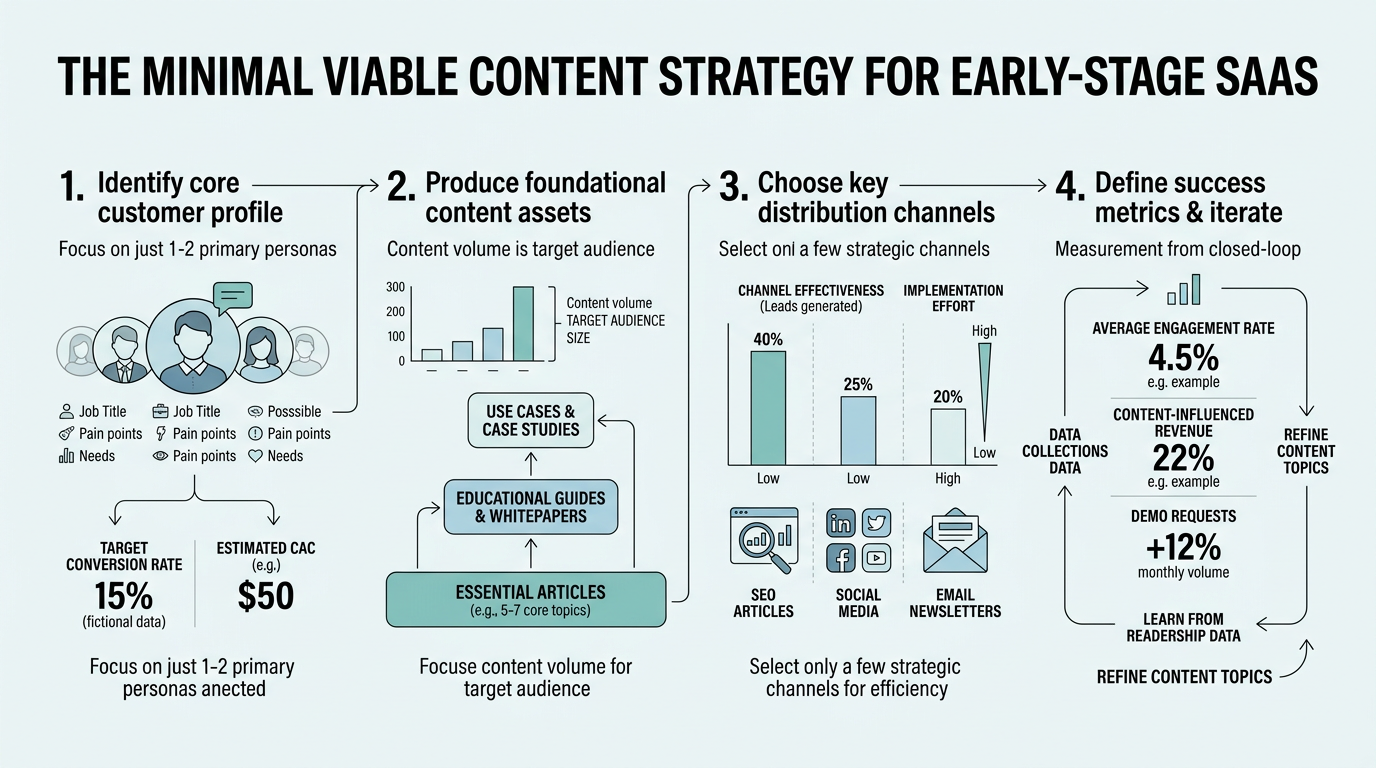
What Is Minimal Viable Content, and Why Early-Stage SaaS Needs It
Minimal viable content is the smallest content system that moves your buyer from problem-aware to purchase-ready without burning you out. It combines three elements: a written strategy, a focused topic list, and proof assets. Early-stage SaaS founders often skip the strategy phase entirely — they publish blog posts hoping something sticks — which creates noise instead of leverage.
87% of B2B buyers conduct their own research before engaging a vendor, meaning your content is competing for attention in that dark phase. A minimal viable approach doesn't try to be everywhere. Instead, it targets the 4–6 highest-intent keywords in your niche and owns them completely through consistency and depth. Building a SaaS content marketing framework before publishing anything changes your success rate dramatically.
"A founder with a focused plan and two posts per month will outperform a confused team with ten. Strategy clarity matters more than publishing volume for early-stage SaaS success." — Digital Applied Content Marketing Study, 2026
Why "Minimal" Beats "More" for Early-Stage Teams
Most early-stage SaaS teams either publish too much mediocre content or nothing at all. Both fail. Publishing 20 generic posts per month buries signal under noise. Publishing nothing means buyers never find you. The minimal viable path: publish 2–4 high-intent posts monthly, each deeply researched and optimized, plus one case study or comparison page. This consistency compounds in six months while remaining sustainable on a founder-driven budget.
The math is clear. Digital Applied's 2026 content marketing study shows that teams with a written strategy generate 3x more leads per dollar than those without. That's not about publishing volume — it's about strategy clarity. A founder with a focused plan and two posts per month will outperform a confused team with ten.
Early-Stage SaaS Buyers Are Still Problem-Aware, Not Solution-Ready
Early-stage SaaS success depends on reaching buyers during their problem-awareness phase, not after they've decided to buy. At that stage, they're not searching for "X software" — they're searching for "how to solve Y problem." Your content needs to educate before it sells. This is where most early-stage teams fail: they write product-focused content to an audience that hasn't yet decided they need a solution. A minimal viable strategy leads with the problem and only hints at the solution until later in the buyer's journey.
Step 1: Define Your Core Narrative and Positioning
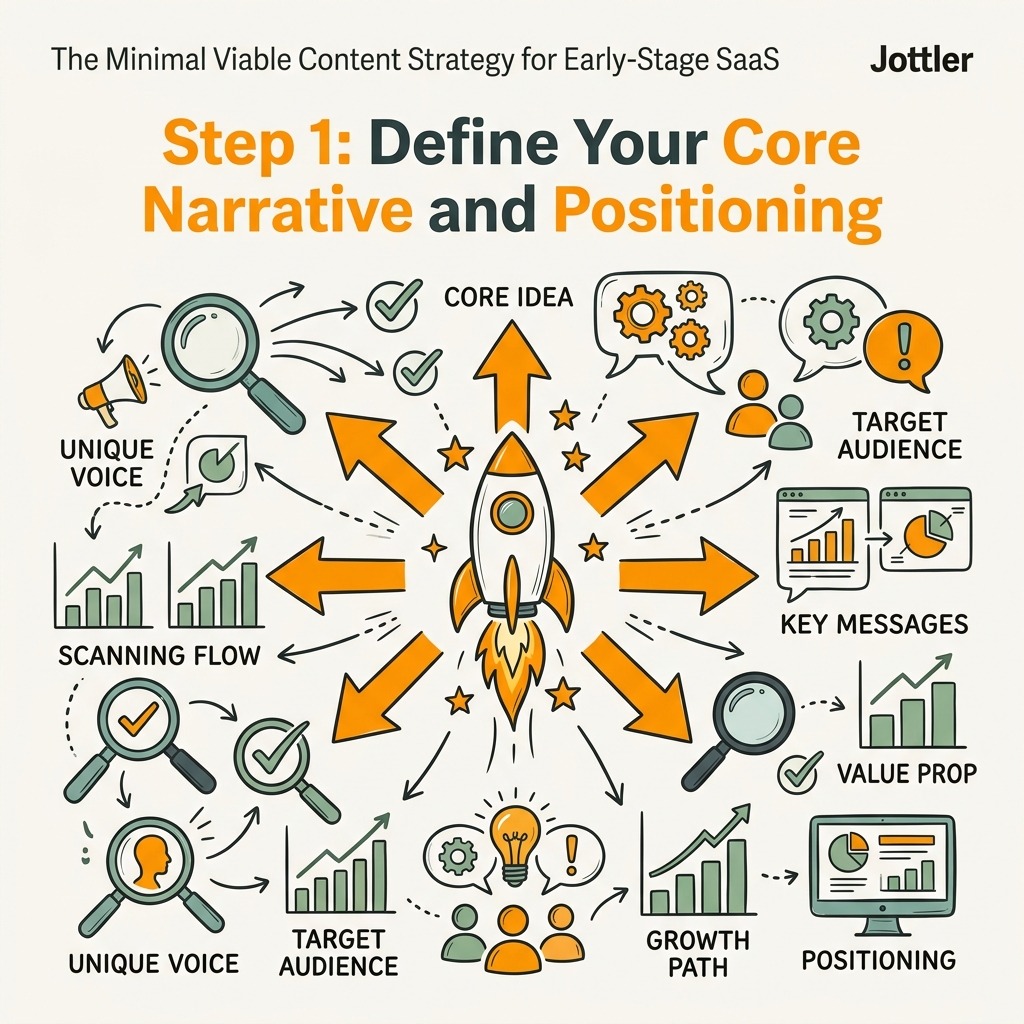
A minimal viable content strategy begins with a single, repeatable story about the problem you solve and why your approach is different. This narrative appears in your homepage, every blog post, your case studies, and your sales emails. Without it, each piece of content feels disconnected — a separate article rather than proof of a larger belief system.
The Three-Part Narrative Framework
Your core narrative should answer three questions: What problem do you solve? Who specifically suffers from it? What is the cost of not solving it? For example, a SaaS time-tracking platform might land on: "Engineering teams waste 6 hours per week tracking time manually. This kills developer productivity and creates tension with finance. Our platform eliminates manual tracking, giving engineers back their time and finance the visibility they need."
That narrative becomes the spine of your strategy. Every blog post explores one aspect of it. Your first content piece might dive into "Why manual time tracking kills productivity" (problem-focused, high-intent). Your second might be "Automated vs. manual time tracking: the hidden cost" (comparison-focused, late-stage awareness). Your third might be a case study showing how a specific team recovered 30 hours per month. Each piece stands alone, but together they tell a cohesive story that positions you as the obvious solution.
How to Extract Your Narrative from Customer Conversations
Don't invent your narrative in a vacuum. Talk to your current customers and prospects. Ask: "What problem were you trying to solve before you found us?" and "Why was that problem so painful?" The language they use — the specific words they choose to describe the pain — becomes your content vocabulary. Early-stage SaaS founders often spend thousands on brand agencies to craft positioning when the answer is already in customer interviews. Set up three 30-minute conversations this week. Write down exact phrases. Use those phrases in your content.
Narrative Elements to Extract from Interviews
- Problem statement: The exact words customers use to describe their pain (e.g., "wasting time," "manual overhead," "spreadsheet hell").
- Impact metrics: Quantifiable costs of the problem (hours lost, revenue impact, team friction).
- Failed solutions: What they tried before that didn't work (spreadsheets, competitor tools, workarounds).
- Aha moment: The specific insight that made them realize they needed to change.
- Success metrics: How they measure improvement after solving the problem.
Step 2: Build Your Lean Topic Stack and Keyword Map
A minimal viable content calendar is not 30 random topics. It's 4–6 high-intent keywords that directly influence your business, ranked by how much buying intent each one carries. This is where Arcade's 2026 SaaS marketing playbook recommends early-stage teams start: by identifying the keywords that prospects search for when they're closest to becoming customers.
"Early-stage SaaS teams should own five narrow topics completely rather than dabble in fifty broad ones. Depth beats breadth at every stage of company growth." — Arcade SaaS Marketing Strategy Guide
Identifying Your Core Keywords and Search Intent
Start with your narrative. If your story is about solving manual time tracking, your keywords might be: "time tracking best practices," "automated time tracking," "time tracking vs project management," "how to implement automated time tracking," "time tracking ROI," and "engineering productivity metrics." These are not brand-new keywords — they're common searches within your niche. Use free keyword research tools (Google Search Console, Ubersuggest, or Semrush's free tier) to confirm monthly search volume and difficulty.
Rank these six keywords by two criteria: (1) search volume (more is better) and (2) buying intent (is this person close to a purchase decision?). A keyword like "automated time tracking cost" shows higher buying intent than "time tracking benefits" because the searcher is comparing options. Focus your first three content pieces on your top three keywords. Once those pages rank and begin driving demos, expand to the next tier. Your SEO content plan should live as a visible document your entire team references monthly.
Why Broad Topics Fail and Narrow Keywords Win
New founders often want to write "The Complete Guide to Time Tracking." This topic is too broad, has no clear buying intent, and competes with dozens of existing articles. Instead, write "Automated Time Tracking vs. Manual: The ROI Breakdown" — narrower, more specific, higher buying intent, and fewer competitors in that exact phrase. A minimal viable strategy chooses depth over breadth. Own five narrow topics completely rather than dabble in 50 broad ones.
Keyword Selection Criteria for Early-Stage Teams
- Search volume: 100–1,000 monthly searches (high enough to matter, low enough to rank).
- Buying intent: Does the searcher appear ready to evaluate solutions? Look for keywords containing "vs," "best," "cost," "ROI," "implementation."
- Business relevance: Does this keyword align with your core narrative and ideal customer profile?
- Competition level: Can you realistically rank in top 10 within 6–12 months? (Use Semrush, Ahrefs, or Moz to check).
- Traffic-to-revenue potential: Will ranking for this keyword actually influence demos or activations?
Step 3: Choose Your Proof Assets Over Thought Leadership

The single biggest mistake early-stage SaaS teams make is publishing opinion pieces instead of proof. "Five Ways to Improve Team Productivity" sounds smart but generates few demos. "How Company X Reduced Time-Tracking Overhead by 14 Hours Weekly" (backed by data) generates demos. For minimal viable content, forget thought leadership for now. Instead, focus on proof assets: case studies, comparison pages, customer testimonials, and data-driven posts.
Case Studies: The Highest-ROI Content Format for SaaS
49% of SaaS teams cite case studies as very effective at generating sales, compared to 10% for blog posts. This gap is massive. A case study shows how a real customer solved a specific problem with measurable results. It builds trust faster than ten opinion pieces because it's verifiable and specific. A minimal viable strategy includes one case study per month or every six weeks.
Your first case study doesn't need to be flashy. Interview a customer who saw clear results: "How much time do you save now?" "What changed operationally?" "Would you recommend us?" Write it up in plain language with real quotes and metrics. You can expand to video case studies and interactive demos later. For month one, a three-paragraph written case study beats no proof asset at all. When you're ready to scale this, tools like Jottler automate the research phase, cutting your time from weeks to hours.
Comparison Pages and Buying-Decision Content
Prospects at the bottom of the funnel search for "X vs Y" comparisons. A comparison page — say, "Automated Time Tracking vs. Project Management Tools" — captures those searches and nudges fence-sitters toward you. These pages require one hour of research and are high-intent for buyers actively evaluating options. In a minimal viable strategy, one comparison page per quarter compounds over time. Building this comparison content is where content automation tools for SaaS teams show their real value — most founders spend weeks gathering competitor intel when they could publish within hours.
Proof Asset Formats Ranked by Effectiveness and Effort
| Format | Conversion Rate | Time to Produce | Best For |
|---|---|---|---|
| Case Study (written) | 49% very effective | 3–5 hours | Bottom-funnel buyers, decision validation |
| Comparison Page | 42% effective | 2–3 hours | Competitive evaluation, fence-sitters |
| Customer Testimonial | 38% effective | 30 minutes | Trust building, homepage/pricing page |
| Data-Driven Post | 25% effective | 4–6 hours | Mid-funnel awareness, thought leadership |
| Opinion Blog Post | 10% effective | 2–3 hours | Brand building (use sparingly for early-stage) |
Step 4: Publish on a Sustainable Cadence That Compounds
The second-biggest mistake early-stage SaaS teams make is publishing inconsistently. They write four blog posts one month, none for three months, then ten in a month. This pattern kills momentum. Search engines reward consistency. Buyers don't engage with outdated content. A minimal viable approach publishes 2–4 posts per month on a fixed schedule — every other Friday, for example — and stops when the founder's bandwidth runs out. Better to publish 10 quality articles over a year than 30 mediocre ones over six months.
The 2–4 Posts Per Month Benchmark
Industry research from the Powered by Search benchmark on B2B SaaS content marketing shows that early-stage teams publishing 2–4 monthly posts see a 7-month break-even on SEO (702% long-term ROI). Publishing fewer than two posts per month shows no meaningful signal to search engines. Publishing more than four per month often trades depth for speed, which tanks ranking quality. Two to four is the Goldilocks zone.
Why Consistency Compounds Faster Than Publishing Sprints
One blog post ranks slowly in month one. Zero impact. But by month four, when you've published 12 consistent posts, the older pieces begin ranking, driving traffic. By month eight, you have 24 articles, and 6–8 of them might be ranking on page one for high-intent terms. This compounding effect only works if you publish consistently. A sprint of four posts followed by silence resets the clock. Your AI content strategy should include publishing consistency as a foundational principle, not an afterthought.
Building a Publishing Calendar for Early-Stage Teams
- Week 1: Topic research and keyword validation (1 hour).
- Week 2: Outline creation and customer interview scheduling (1 hour).
- Week 3: First draft (with AI assistance or outsourced writer) (2–4 hours).
- Week 4: Edit, fact-check, optimize, and publish (2–3 hours).
- Ongoing: Social sharing and internal linking (15 minutes weekly).
Step 5: Structure Content for AI Discovery and Future Ranking Signals

By 2026, search is fragmenting. Google still dominates, but AI systems like ChatGPT, Claude, and Perplexity are becoming primary research tools. Content that ranks in Google but doesn't surface in AI answers is leaving money on the table. A minimal viable content strategy now includes basic optimization for both channels.
Formatting for AI Extraction and Citation
AI systems extract answers from structured content better than from long paragraphs. Use bullet lists, short subheadings, comparison tables, and bold key statistics. AI looks for self-contained, answerable sections. If your article opens with "Automated time tracking saves 14 hours per week," an AI system can extract and cite that claim. If you bury it in paragraph five, it won't. A minimal viable approach means: frontload answers, use lists liberally, include one comparison table per article, and bold key metrics.
Comparison Pages and Review Presence
AI systems increasingly direct traffic to comparison pages and third-party review sites. Ensure your product is listed on review platforms in your category (G2, Capterra, Trustpilot). Create at least one comparison page per month. These formats are AI-optimized by design and drive purchasing intent-driven traffic.
Content Formatting Best Practices for AI and Search Visibility
- Open with your answer: Place the most important insight in the first paragraph or opening bullet point.
- Use semantic HTML: Bold key metrics, use proper heading hierarchy (H1, H2, H3), employ lists instead of paragraphs for criteria.
- Include comparison tables: AI systems cite and extract tabular data more reliably than prose.
- Attribution and sourcing: When citing statistics, always credit the source (e.g., "According to HubSpot's 2026 State of Marketing Report").
- MECE structure: Use mutually exclusive, collectively exhaustive breakdowns so AI systems understand scope and completeness.
Step 6: Measure the Right Metrics and Iterate Monthly
Most early-stage SaaS teams measure content by traffic and pageviews. This is wrong. A blog post might generate 500 monthly visitors with zero demo requests — a total waste. A minimal viable content strategy measures business impact: demos booked, trials activated, and revenue influenced. This shift in measurement changes everything about how you write.
Pipeline Attribution and Deal Velocity
Track which content pieces appear in the browser history of customers who booked a demo. Use UTM parameters to tag your content. Build a simple spreadsheet: Article Title, Publish Date, Demos Influenced, Revenue Influenced. After two months of publishing, patterns will emerge. Your article on "Automated vs. manual time tracking" might influence three demos. Your article on "Five productivity tips" influences zero. Double down on formats and topics that drive demos. Pause the rest.
When to Expand Your Content Stack
Once you have six months of data, you'll know which topics, formats, and keywords drive results. Only then expand your topic stack. If "Automated Time Tracking ROI" drives five demos per month, create five related pieces: "ROI calculator," "ROI by team size," "Implementation timeline," "Cost-benefit analysis," and "ROI for remote teams." This topical clustering approach compounds faster than scattered, unrelated content.
Monthly Measurement Dashboard for Early-Stage Founders
- Traffic generated: Monthly sessions to each article (via Google Analytics).
- Engagement metrics: Average time on page, scroll depth, bounce rate (indicates content relevance).
- Demo influence: Number of demos booked by people who visited this article in the past 30 days.
- Revenue influence: Total ARR from customers whose first touch was this article (via CRM attribution).
- Cost per demo: Total content investment divided by demos influenced (track monthly trend).
- Ranking progress: Position in Google for your target keywords (check monthly).
- AI visibility: Manual checks to see if your articles appear in ChatGPT, Perplexity, or Claude answers for your keywords.
Conclusion
A minimal viable content strategy for early-stage SaaS is not about doing more with less. It's about doing the right things consistently. Organizations with documented content strategies generate 3x more leads per dollar spent, and content marketing delivers 3x more leads than outbound at 62% lower cost. For early-stage teams, this is the difference between visibility and invisibility in the anonymous research phase where most buying decisions are made.
The system is simple: define your narrative, identify 4–6 high-intent keywords, publish proof assets over opinion pieces, maintain a 2–4 posts-per-month cadence, optimize for both search engines and AI systems, and measure business impact monthly. This requires discipline but no budget. Over 12 months, this compounding approach will drive consistent demo requests without requiring a dedicated content team.
For early-stage founders drowning in content tasks while trying to build product, start your SEO agent. Jottler automates the research, writing, fact-checking, and publishing phases — leaving you free to focus on narrative, topic selection, and business measurement. Publish 3,000+ word articles daily, optimized for both search and AI discovery, with zero manual overhead.
FAQs
How do I choose what to write about as an early-stage SaaS founder?
Start with your core narrative — the problem you solve and why you solve it differently. From that narrative, extract 4–6 high-intent keywords your buyer actually searches for. These are not guesses; use Google Search Console (your existing traffic), free keyword tools (Ubersuggest, Semrush), and customer interviews to confirm real volume. Rank them by buying intent (is this person close to a purchase?) and business impact (does this keyword influence your ideal customer?). Focus your first content pieces on your top three keywords. Once those rank, expand downward. This ensures every article you write has a business purpose, not just entertainment value.
What content format converts best for early-stage SaaS?
Case studies convert best. 49% of B2B SaaS teams rate case studies as highly effective for generating sales, far outpacing blog posts (10%) and thought leadership (even lower). Case studies show real results from real customers with measurable outcomes. Your first case study doesn't need to be fancy — a three-paragraph write-up of your best customer's journey to success, with specific numbers and direct quotes, is enough. Comparison pages rank second for converting intent-driven traffic. Opinion pieces and thought leadership rank lowest for early-stage SaaS. Flip your content priorities: case studies first, comparisons second, thought leadership later once you have brand authority.
How often should I publish if I'm a founder with no marketing team?
Publish 2–4 times per month on a consistent schedule. One article every two weeks is the minimum threshold for search engines to recognize your site as active and trustworthy. More than four per month often means sacrificing depth for speed, which kills ranking quality. Pick a realistic schedule — perhaps every other Friday — and stick to it for 12 months. One quality article per fortnight compounds faster than a burst of ten mediocre articles followed by three months of silence. The consistency signal matters more than the volume signal at your stage.