The PESO Model: Integrating Owned, Earned, and Paid Content
Most growing companies treat their marketing channels in isolation. They run paid campaigns, hope for press coverage, post to social media, and publish blog articles—each operating independently with different teams, budgets, and metrics. The result? Fragmented messaging, wasted spend, and missed compounding effects. The PESO model solves this by unifying four media types into one integrated system where each channel makes the next one stronger. Organizations using PESO frameworks report achieving 30–50% increases in qualified leads within six months, largely because owned content (blog, website, knowledge base) becomes a reusable hub that earned media amplifies, paid media scales, and shared media distributes. For busy founders, this means one coordinated strategy that compounds over time instead of four separate marketing budgets competing for attention.
Key Takeaways
- 92% of consumers trust earned media over other advertising formats, making third-party credibility the most valuable asset in your PESO mix (2025, Marketful)
- The optimal PESO budget split is 25–35% paid, 25–35% earned, 15–25% owned, and 10–20% shared—but the sequence matters more than the percentages
- Owned media (your content) is now the strategic foundation: all earned, paid, and shared efforts feed back into strengthening your owned assets and compounding SEO value
- PESO Framework Basics: Four integrated media types that reinforce each other, turning isolated marketing efforts into one compounding system.
- Building Owned Media: Your content hub (blog, guides, case studies) becomes the reusable asset that earned coverage validates and paid budgets amplify.
- Earned Media Strategy: Third-party credibility through press, reviews, and influencer mentions that feeds owned content and attracts organic traffic.
- Paid Media Integration: Scale what already works instead of inventing results; amplify your strongest owned and earned moments with precision budget.
- Shared Media Activation: Use social, community, and UGC channels as distribution and engagement layers that strengthen all three other channels.
- Measurement & Sequencing: Track cross-channel influence, not vanity metrics, and intentionally sequence channels so owned content captures traffic before paid scales.
What Is the PESO Model and Why Does It Matter Now?
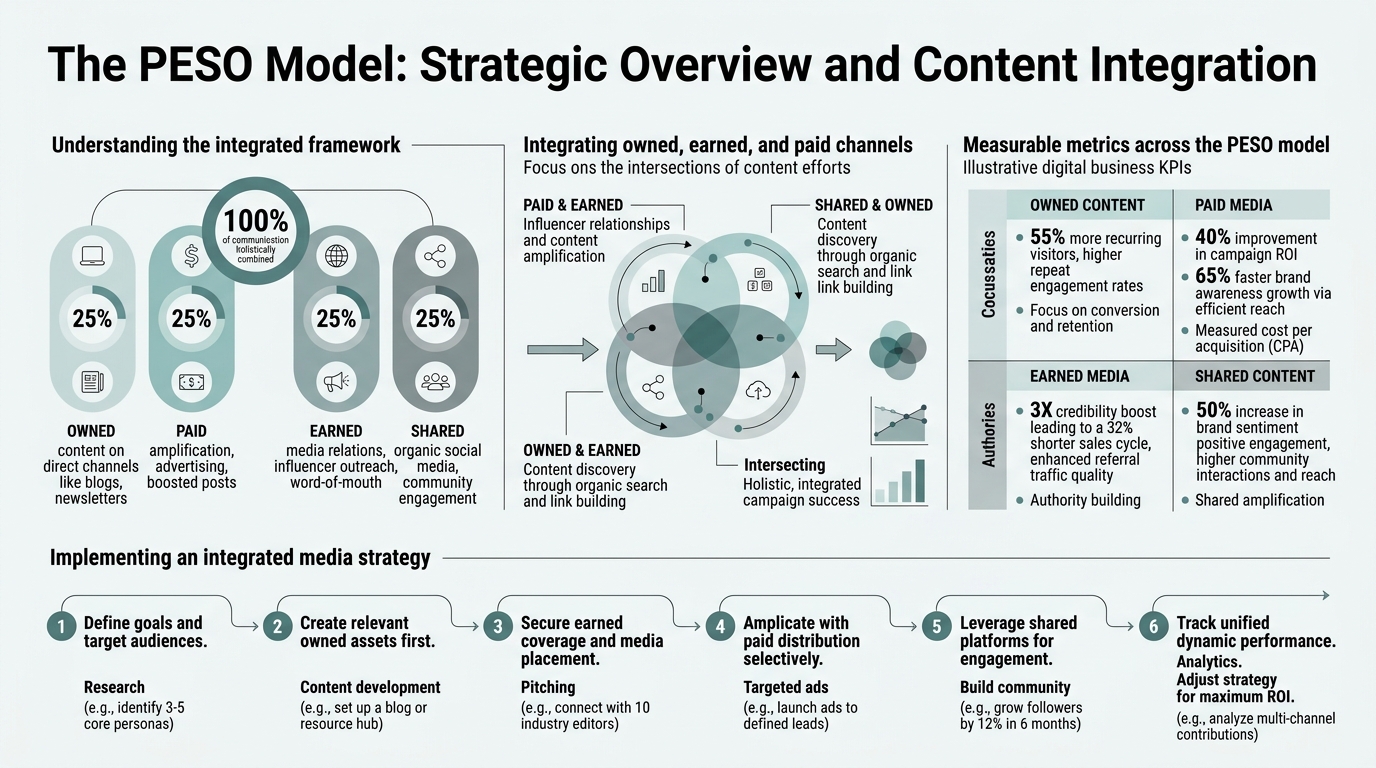
The PESO Model is an integrated marketing operating system that unifies Paid, Earned, Shared, and Owned media into one measurable strategy. Created by Gini Dietrich in 2014, it has evolved from a simple framework into a full operating system where each channel strengthens the next. The power isn't in any single channel—it's in how they reinforce each other.
"PESO forces integration: your paid budget amplifies the content your PR team earned coverage for. Your social distribution validates your owned content and builds authority signals for search. The system feeds itself."
Why does this matter for busy founders? Traditional marketing splits resources across separate channels with separate KPIs. Paid teams chase conversions. Content teams measure pageviews. PR chases mentions. Social measures engagement. Meanwhile, none of these efforts compound. PESO forces integration: your paid budget amplifies the content your PR team earned coverage for. Your social distribution validates your owned content and builds authority signals for search. The system feeds itself.
- Paid Media: Amplify what already works—ads, sponsored content, influencer programs, search, and social campaigns that scale proven moments.
- Earned Media: Third-party credibility through press mentions, reviews, analyst reports, and influencer validation that others vouch for your brand.
- Shared Media: Social posts, community engagement, user-generated content, and collaborative platforms that distribute and validate your message.
- Owned Media: Your website, blog, guides, case studies, and knowledge base—the only assets you fully control and can reuse indefinitely.
For B2B companies, this integration is non-negotiable. 30% of PR professionals increased their reliance on earned media in 2025, yet 98% say it is harder to secure than ever. This creates pressure to earn coverage more efficiently—which happens when you have owned content strong enough to pitch, social proof to reference, and paid reach to activate earned wins immediately. When you implement a content marketing framework that compounds over time, you remove this bottleneck.
How to Build and Leverage Owned Media as Your PESO Foundation
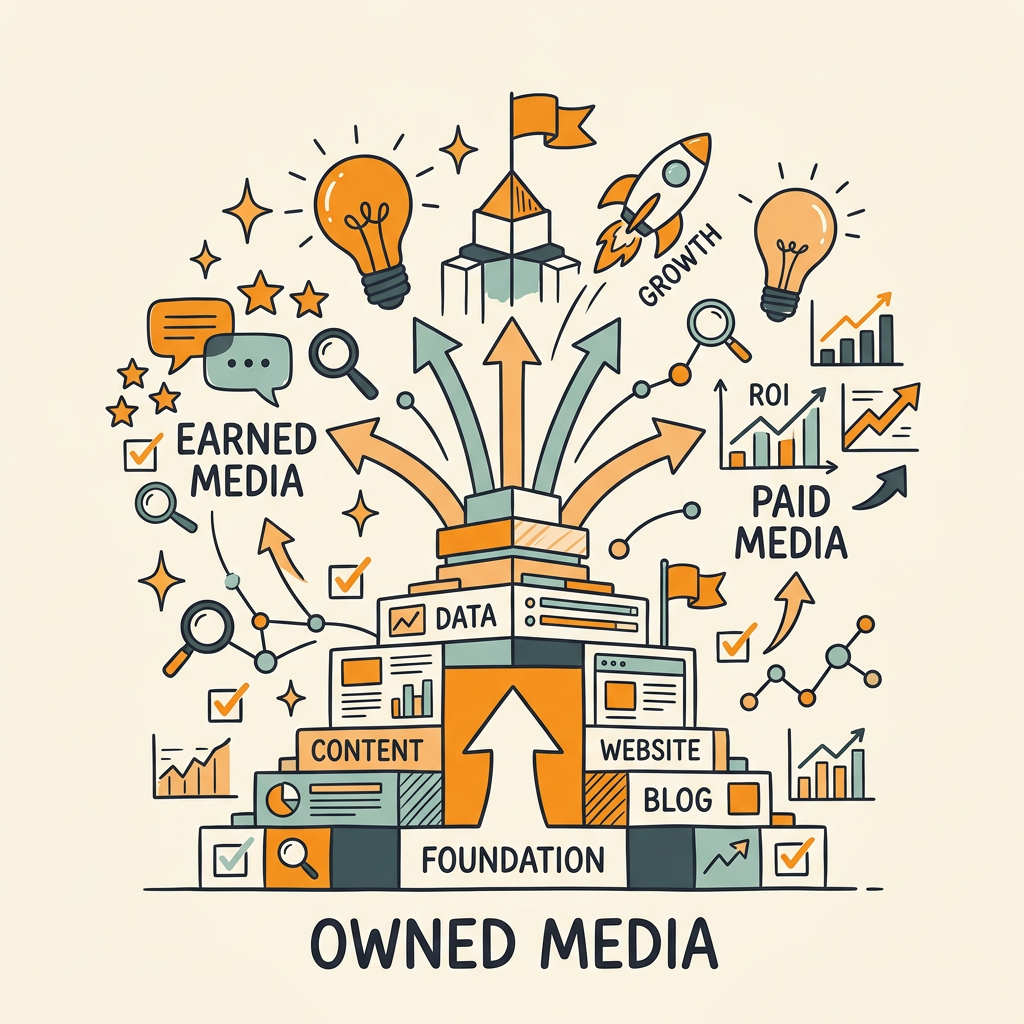
Owned media is not your blog. It's your single most defensible asset: your website, content library, case studies, product documentation, email subscriber lists, and customer data. In PESO, owned media is the foundation because all earned, paid, and shared efforts drive value back to it. Most successful PESO implementations treat owned content as a reusable hub, not a set-it-and-forget-it blog.
"Owned media creation is the bottleneck for most founders. Writing quality articles, case studies, guides, and technical docs takes time. But when automated, it becomes a compounding asset that feeds all other PESO channels."
For busy founders, owned media creation is the bottleneck. Writing quality articles, case studies, guides, and technical docs takes time. This is where automation becomes leverage. Tools that can research, write, fact-check, and publish long-form content at scale turn owned media from a time sink into a compounding asset. Autonomous SEO agents handle the research and writing, freeing your team to focus on earned and paid distribution. Publishing 3,000+ word articles daily sounds impossible for a founder, but it's not—if the research, writing, and publishing are fully automated and fact-checked.
Structure Owned Content for Reusability
The foundation of PESO is modular content. Every piece of owned media should be designed to be repurposed across earned, paid, and shared channels. A long-form guide becomes a press pitch, a webinar, social clips, and email sequences. A case study becomes a client testimonial, a LinkedIn carousel, a featured mention in earned coverage, and a paid retargeting asset.
Format your owned content strategically: use clear headlines, bullet lists, data tables, and expert quotes. This structure makes it easy to extract snippets for social, quotes for pitches, and data points for PR outreach. When your content is AI-ready—clean formatting, authoritative sources, verified facts—it also ranks better in AI overviews and gains more referrals from answer engines. Brandpoint recommends creating content for multi-channel reuse and making it AI-ready with clear headlines and clean formatting.
Make Owned Media AI-Visible and SEO-Strong
Owned content now competes in two visibility channels: traditional search (Google) and AI engines (ChatGPT, Claude, Perplexity). This means your content must be optimized for both. Structure your articles with clear headers, include cited statistics, bold key takeaways, and answer the questions your audience actually asks. When you do this well, your owned content gets surfaced in AI overviews, earning referrals and credibility at scale.
For B2B founders, this is huge. When your guide appears in a ChatGPT response with your brand name and a link, you're earning trust without paying for ads. Combined with earned media mentions (which AI engines cite heavily), your owned content becomes the hub of a self-reinforcing credibility loop.
How to Generate and Leverage Earned Media Without a PR Budget
92% of consumers trust earned media over other advertising formats. This is the single most powerful channel in PESO. Earned media is third-party validation—press mentions, analyst reviews, influencer recommendations, customer testimonials, and UGC. But earning coverage is hard, and it's getting harder. The question for busy founders: how do you secure earned coverage without hiring a full PR team?
"The answer is to treat your owned media as your PR pitch. When you have original research, case studies, insider guides, and expert commentary already published, you have ammunition for earned outreach."
The answer is to treat your owned media as your PR pitch. When you have original research, case studies, insider guides, and expert commentary already published, you have ammunition for earned outreach. Journalists, podcasters, and industry analysts are always looking for original data, fresh angles, and credible sources. If your owned media provides these, you have a pitching strategy. Marketful's earned media guide emphasizes that third-party brand exposure is the most credible form of marketing—but only if you have owned assets strong enough to pitch.
Create Pitch-Worthy Owned Content
Not all owned content is born equal. To generate earned media, you need original research, proprietary data, case studies with quantified results, or expert commentary that media outlets want to cover. A blog post about general best practices won't get picked up. A study showing that founders who implement PESO frameworks report 30–50% more qualified leads will.
This is where owned media strategy meets earned media strategy. Instead of writing general articles and hoping for coverage, write content that journalists will want to cite. Include original data (surveys, analysis, proprietary findings), quote recognized experts, and make claims specific enough to be newsworthy. When your content is strong, earned coverage becomes a side effect of publishing good ideas.
Activate Earned Coverage Immediately with Paid and Shared Media
Here's the PESO insight most teams miss: earned media is most valuable when it amplifies owned content. When you secure a press mention, an analyst interview, or an influencer shout-out, immediately activate it. Share the link on social, email your list, and consider paid amplification to extend its reach. This way, earned coverage drives traffic to your owned assets, which then builds SEO authority, social proof, and conversion opportunities.
Sequence matters. The best practice is to secure earned coverage, let it index and drive initial traffic, then amplify with shared social and paid ads once you have momentum. This avoids the trap of paying for visibility that could be earned.
When and How to Deploy Paid Media to Scale Winning Moments
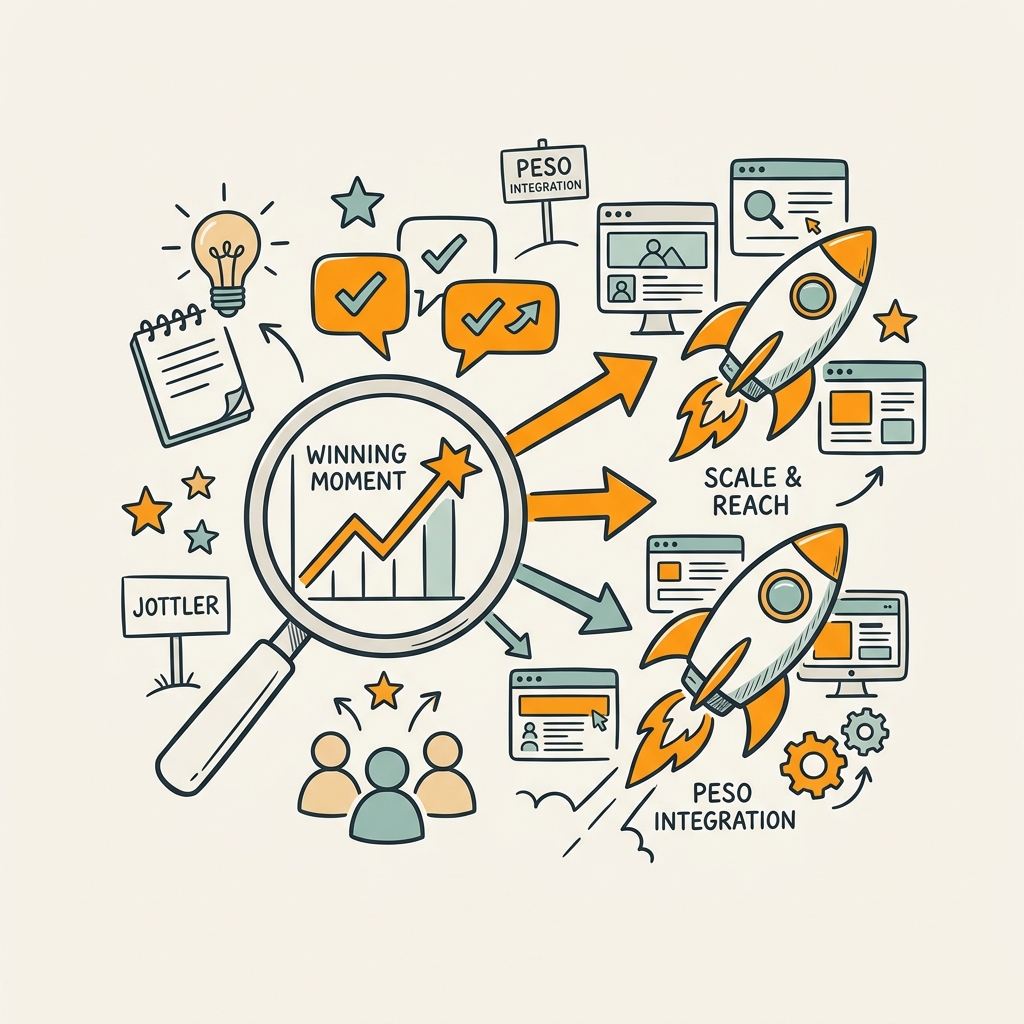
Most teams use paid media to manufacture results. They buy ads, hope something sticks, and measure by clicks and impressions. PESO flips this: paid media amplifies what already works, not what you hope will work. Once owned content and earned coverage show strong signals—high engagement, social shares, positive sentiment—that's when you deploy paid budget to scale.
For founders with limited budgets, this is critical. Instead of splitting spend across 10 experiments, concentrate budget behind the 2–3 moments that earned and owned channels prove are resonating. If a case study gets press coverage and strong social engagement, pay to amplify it. If a guide drives organic traffic and generates leads, pay to accelerate it. If an influencer mentions your product organically, pay them for a formal promotion. When you pair this with content automation tools that consistently feed owned assets into your pipeline, you create a reliable stream of opportunities for paid amplification.
Paid Media as the PESO Amplifier
The PESO model positions paid as the amplification layer, not the foundation. This means your paid strategy should align with signals from earned and owned channels. Use paid to:
- Retarget visitors who engaged with owned content but didn't convert—owned content brought them in, paid closes the loop.
- Amplify earned wins immediately: when you get press coverage or analyst validation, paid ads remind your audience about it.
- Support lead-gen campaigns that your owned guides and webinars already funnel into—paid accelerates what owned already started.
- Test new owned content ideas at low cost before allocating earned or shared resources to them.
The math is simple: if owned content and earned coverage generate $10 in value per visit, paid media that costs $3 per visit to amplify is obviously worth it. But you only know this if you're measuring cross-channel influence.
Paid Budget Allocation: Sequence Before You Scale
A common PESO mistake is to allocate paid budget evenly across all channels. Instead, sequence: start with owned content and earned outreach, measure what works, then concentrate paid budget there. This maximizes efficiency and compounds returns.
For example: publish a guide (owned), pitch it to industry reporters and podcasters (earned), wait for coverage to land and drive organic traffic, then pay to promote the guide + the coverage to a warm audience (paid). You're not creating visibility from scratch—you're amplifying what's already proven.
Using Shared Media to Validate and Distribute Your PESO Mix
Shared media often gets confused with owned or social media. But in PESO, shared media is distinct: it's platforms and channels where you collaborate, engage, and distribute—social media, communities, Reddit, forums, Slack groups, and user-generated content. Shared media doesn't directly drive conversions like owned or direct the credibility of earned. But it amplifies both.
When you post a guide to LinkedIn, you're distributing owned content. When you share an earned media mention (press feature, podcast appearance, analyst report), you're validating credibility. When you ask your audience to share or contribute (UGC), you're turning customers into advocates. All of this is shared media—and it all feeds back to owned and earned channels.
Social as Distribution, Not Publishing
Many founders treat social media as a publishing channel. They write original content for social and call it strategy. PESO inverts this: owned content is primary, shared media is secondary distribution. Write your best ideas on your blog (owned). Extract clips, quotes, and data points for social (shared). This approach is more sustainable because you're leveraging one idea across multiple channels instead of creating new ideas for each platform.
For busy founders, this is crucial. Publishing fresh, original content on LinkedIn, Twitter, and Instagram daily is impossible without a team. But extracting and remixing owned content into social posts is fast—especially if you use templates and native scheduling tools. An AI-powered content strategy built on owned media automation makes this social distribution layer effortless.
Building Community as Shared Media
The newest lever in shared media is community: Slack communities, exclusive forums, membership programs, and customer groups. These spaces are where you engage directly with your audience, gather feedback, and turn users into advocates. When customers advocate for you in their own networks, you've converted shared media into earned media—the most valuable outcome in PESO.
| Media Type | Control Level | Timeline to Results | Best For |
|---|---|---|---|
| Owned | 100% (you control) | Slow (3–6 months for SEO) | Building authority and reusable assets |
| Earned | 0% (earned, not paid) | Fast (days to weeks) | Third-party credibility and trust signals |
| Shared | 50% (you own account, not platform) | Very fast (hours to days) | Distribution and audience engagement |
| Paid | 100% (you control) | Immediate | Amplifying proven wins, lead generation |
Automating Content Creation to Make PESO Feasible for Your Team
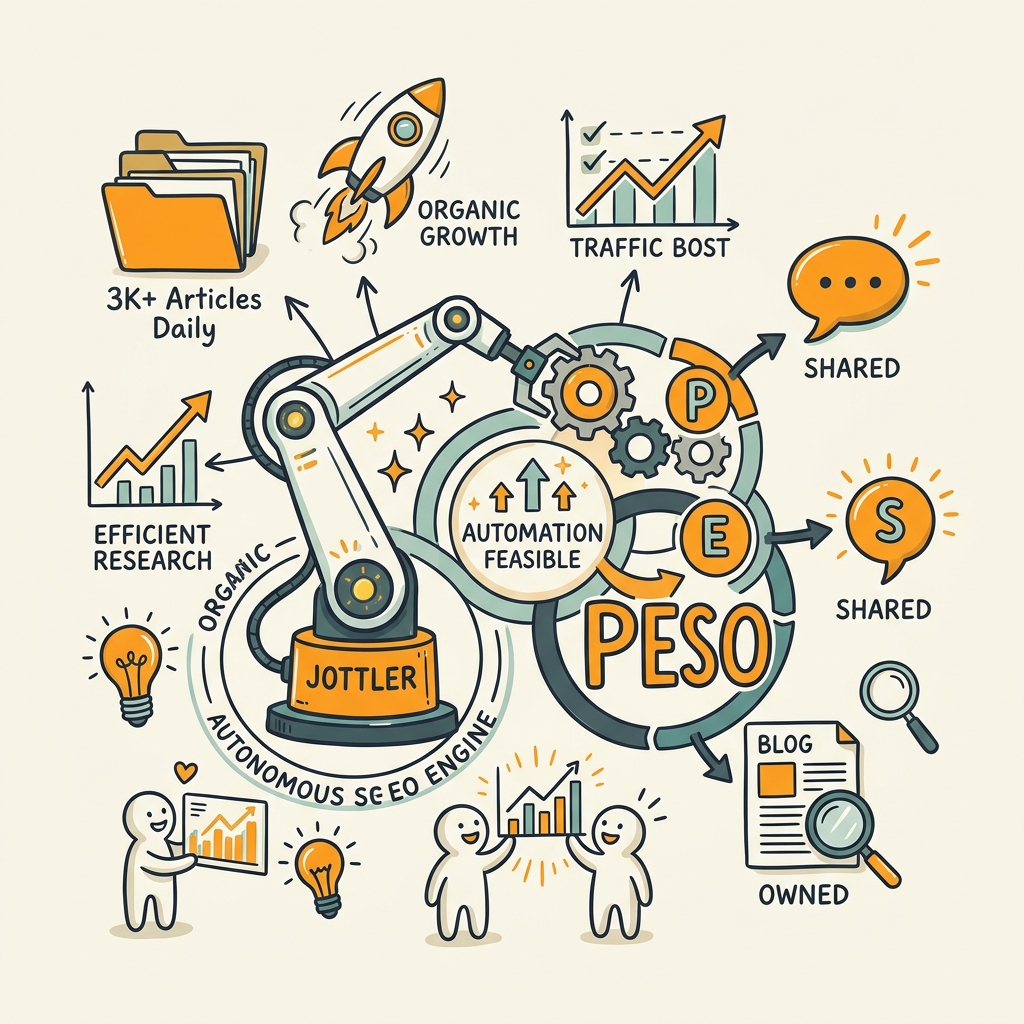
The biggest bottleneck in PESO isn't strategy—it's execution. Building owned media at scale requires constant research, writing, editing, and publishing. Most founders either hire writers (expensive and slow) or do it themselves (impossible with everything else on their plate). This is where automation unlocks PESO for smaller teams.
An autonomous content engine can research a topic, write a fact-checked, SEO-optimized article, and publish it directly to your website—all without manual intervention. If you can publish owned content consistently at scale, you suddenly have the fuel for the entire PESO machine: pitch material for earned outreach, social content to distribute, and assets to amplify with paid budget.
What Makes Owned Content Automation Work
Not all AI content tools are built for PESO. You need a system that:
- Does original research from 10+ authoritative sources per article—journalism-grade depth, not surface-level summaries.
- Fact-checks every claim against sources, so you can confidently pitch and publish without editorial risk.
- Writes for your audience, not generic personas—B2B founders, startup teams, enterprise marketers—with tone and depth that matches your brand.
- Optimizes for AI visibility with structured formatting, cited data, and answer-first writing that performs in ChatGPT overviews and Perplexity searches.
- Publishes directly to your CMS with internal linking and metadata pre-optimized—no manual copying and pasting required.
- Publishes at scale—multiple articles per day if you choose, creating a consistent stream of pitch material and social content.
With automation handling owned content creation, your team shifts to higher-value work: pitching earned coverage, activating paid campaigns, and building community. You're not writing anymore—you're strategizing. For founders with limited teams, this shift in leverage is transformational.
How to Measure PESO Success Without Getting Lost in Vanity Metrics
Most teams measure each PESO channel in isolation. Paid tracks conversions. Social tracks engagement. Content tracks pageviews. This fragmentation hides the real power of PESO: cross-channel compounding. A visitor who learns about you through earned media, engages on social, reads your owned content, and converts through paid—that's a PESO success story. But if you only track each channel separately, you never see it.
Measure PESO holistically with three principles: (1) Track influence, not just direct attribution. Which channels influenced a conversion, even if paid gets the last click? (2) Measure business outcomes, not vanity metrics. Traffic, engagement, and mentions don't matter unless they drive leads or revenue. (3) Look for compounding. Do your owned content pieces rank higher over time? Does earned coverage accelerate? Does paid efficiency improve? If yes, PESO is working.
PESO KPIs by Channel
Instead of generic metrics, measure what each channel is supposed to deliver:
- Owned Media: Search rankings, organic traffic, lead volume, and time on site. These compound over months.
- Earned Media: Referral traffic, backlink growth, brand mentions, and sentiment. These validate credibility.
- Shared Media: Reach, engagement, shares, and audience growth. These amplify reach but shouldn't be your primary conversion metric.
- Paid Media: ROAS (return on ad spend), cost per acquisition, and influence on owned and earned channels. These show efficiency.
The magic metric? Compare the total value generated by your PESO system against the cost of running all four channels. If you're generating $50 in attributed revenue per $1 spent, PESO is working. If you're generating $5, something is broken—usually owned content quality, earned outreach frequency, or paid targeting precision.
Common PESO Pitfalls and How to Avoid Them
Most teams fail at PESO not because the framework is wrong, but because they implement it incorrectly. Here are the biggest mistakes and how to avoid them:
- Treating channels as separate silos: Own content separately from social, paid separately from PR. Solution: Assign one person as the PESO owner. Their only job is integration.
- Starting with paid media: Buying traffic before you have owned content worth visiting. Solution: Sequence. Build owned content and earn coverage first. Pay to amplify later.
- Measuring vanity metrics instead of outcomes: Celebrating viral social posts while ignoring lead quality. Solution: Measure influence and business impact, not engagement.
- Publishing inconsistently: Writing one guide, then nothing for months. Solution: Automate owned content so it's consistent, daily if possible. Consistency is how PESO compounds.
- Skipping earned media work: Assuming earned coverage is too hard without a PR budget. Solution: Create pitch-worthy content first (original data, expert commentary). Earned opportunities come to you.
Conclusion
The PESO Model transforms marketing from four separate channels competing for budget into one integrated system where each channel strengthens the next. For busy founders, this is the difference between constantly chasing growth and building a compounding engine. When you own content (blog, guides, case studies), earn credibility (press, mentions, analyst recognition), share distribution (social, community, UGC), and amplify strategically (paid), your marketing compounds.
Organizations implementing PESO frameworks report 30–50% increases in qualified leads within six months. The most successful implementations share one characteristic: they automate owned media creation so teams can focus on earned and paid activation. 92% of consumers trust earned media, but earned media means nothing without owned assets to drive traffic and shared channels to amplify the signal. The sequence is critical: publish owned content, pitch for earned coverage, activate with shared media, and amplify with paid budget.
For growing companies, PESO isn't optional—it's the framework that separates winners from those stuck grinding. Start today by auditing your current media mix. Is paid your only scalable channel? Is earned media inconsistent? Is owned content treated as an afterthought? If any of these are true, PESO is your roadmap. Start with owned media automation, earn coverage by pitching your best work, and let paid budget amplify what's already proven. Start your SEO agent and take the first step toward a PESO strategy that compounds. Most founders find that automating owned content creation removes their biggest bottleneck—making PESO execution finally feasible.
FAQs
What is the difference between earned and owned media in PESO?
Owned media is content and assets you control entirely—your blog, guides, website, case studies, and email lists. Earned media is third-party validation you don't pay for: press mentions, analyst reports, influencer recommendations, customer reviews, and social shares from others. Earned media is more credible because it comes from external sources, but earned coverage is worth little without owned assets to drive traffic to. The PESO model treats earned as validation that amplifies owned content, not as a standalone channel.
How much should I spend on each PESO channel?
A common starting framework is 25–35% paid, 25–35% earned, 15–25% owned, and 10–20% shared. But percentages matter less than sequencing and results. Start by building owned media and pitching for earned coverage without spending anything. Once you see what works (high engagement, strong earned mentions, social traction), concentrate paid budget behind those proven wins. This approach typically outperforms even splits because you're amplifying what's already resonating instead of guessing.
Can I implement PESO as a solo founder without a marketing team?
Yes, but only if you automate owned media creation. A solo founder can't write, edit, and publish multiple high-quality articles per week while also pitching for earned coverage and running ads. The solution is to use autonomous content automation to handle owned media research and writing, freeing you to focus on higher-leverage work: outreach for earned coverage, testing and optimizing paid campaigns, and building community. This shift in leverage makes PESO feasible for small teams and solo founders.