The Pillar Content Strategy for Topic Authority
Search engines are moving away from rewarding isolated keyword rankings toward recognizing true expertise. Sites using pillar-cluster architecture see a 40% average increase in organic traffic within the first year, according to 2025 SEO industry benchmarks. For busy founders and marketing teams, the cost of staying stuck with scattered, disconnected content is real: lost rankings, missed compounding growth, and competitors eating your lunch in your core topics. The pillar content strategy solves this by creating a structured framework where one authoritative "pillar page" acts as the hub, with supporting "cluster pages" diving deep into subtopics. Here's a quick summary of how to build topic authority effectively: define your core topic, research demand and competitive landscape, create a 3,000–5,000 word pillar page, publish 8–12 cluster articles, and link them strategically to build topical authority signals.
Key Takeaways
- Pillar-cluster strategies deliver 40% organic traffic growth in year one and establish topical authority far faster than traditional keyword targeting (2025 SEO guides)
- Optimal pillar pages are 3,000–5,000 words with 8–12 supporting cluster articles of 1,500–2,500 words each to achieve meaningful authority gains
- Strategic validation before building—checking audience alignment, search volume, competition level, and SME expertise—prevents wasted effort on topics that won't rank
- Topic Authority Definition and Why It Matters: Topical authority signals to Google that your site comprehensively covers a subject, replacing the old domain-authority-first model.
- Pillar Page Architecture and Structure: The core hub covers the broadest topic angle with encyclopedia-style depth, anchoring all cluster pages with strategic internal links.
- Cluster Page Strategy and Content Depth: Supporting articles target specific long-tail queries while pointing back to the pillar, compounding ranking velocity for the entire topic.
- Strategic Validation Before Launch: Four criteria—audience alignment, search opportunity, competitive landscape, and content expertise—determine whether a pillar-cluster investment will pay off.
- Scaling Pillar Strategies with Automation: Modern content platforms eliminate manual bottlenecks, enabling teams to publish sustainable cluster content cadences without burnout.
What Is Topic Authority and Why Google Values It Now
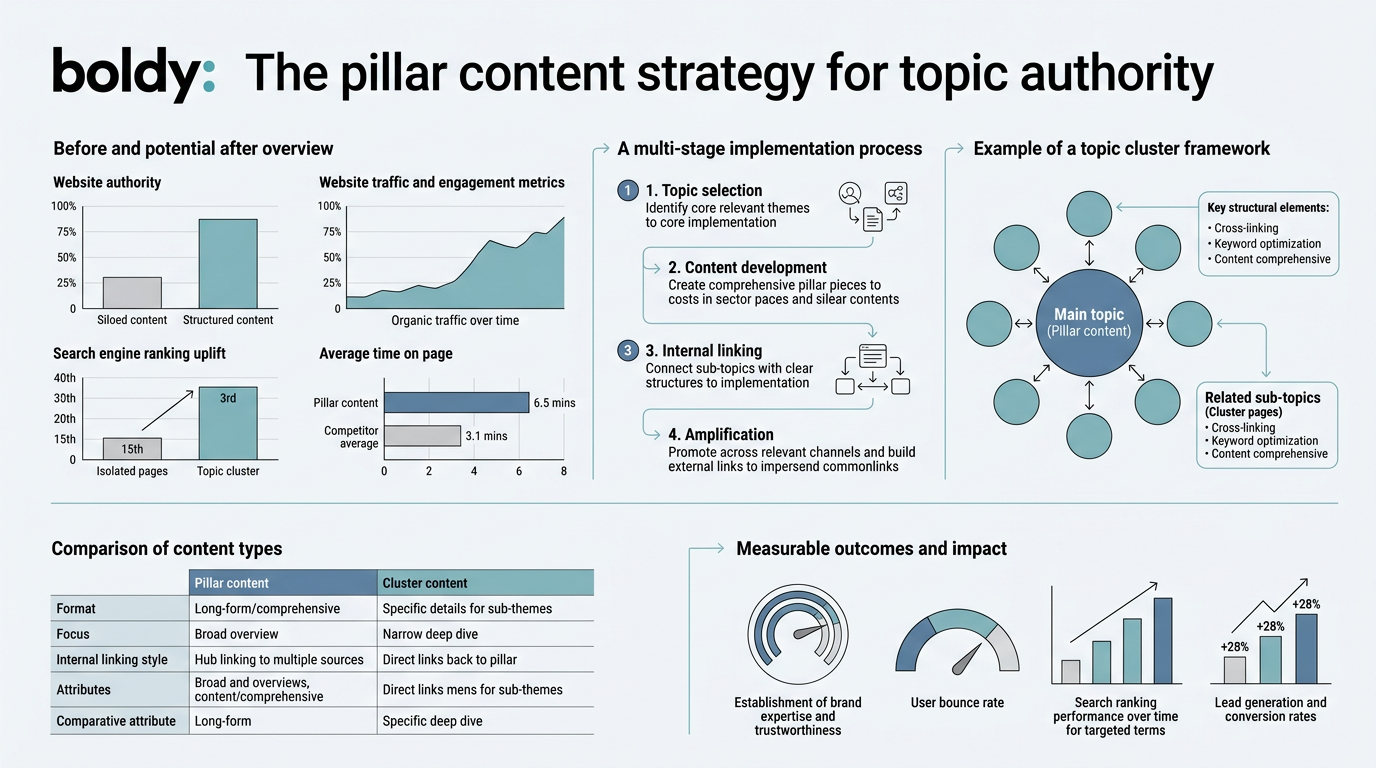
Topic authority is a ranking signal that reflects how comprehensively your site covers a specific subject across multiple, interconnected pages. By 2026, topical coverage depth is projected to supersede traditional domain authority in ranking specialized B2B and creator tool searches, marking a fundamental shift in how Google evaluates expertise. The pillar-cluster framework builds this authority by creating internal link density around a central topic, signaling to the algorithm that you're not just touching on a keyword—you're establishing genuine expertise. According to Digital Applied's 2026 topical authority guide, this shift is already underway in competitive niches.
"The days of ranking for isolated keywords are ending. Google now recognizes sites that comprehensively cover a topic through pillar-cluster architecture and rewards them with exponentially faster ranking velocity. Topic authority is no longer a competitive advantage—it's table stakes."
— Digital Applied, 2026 SEO Research
The Shift from Keyword Targeting to Topic-First Thinking
Traditional SEO focuses on ranking for individual keywords in isolation. "SEO tips," "technical SEO guide," "link building strategies"—all separate content islands with no connective tissue. This approach works, but it leaves traffic on the table. A topic-first approach, by contrast, says: "I'm going to own the entire topic of SEO," then builds one authoritative pillar page covering SEO holistically, with cluster pages exploring each subtopic in depth. Users looking for "how to do technical SEO" land on the cluster, but the internal linking structure and content architecture convince Google that your entire site is an SEO authority—not just a site that happened to rank for one keyword.
The difference in results is measurable. High-performing pillars show a median improvement of 3 positions across all supporting cluster pages within 3 months (2025 SEO research), while traditional scattered content may take 6+ months to accumulate similar authority signals.
"We built a pillar on SaaS content marketing with 10 supporting cluster pages. Within 90 days, our pillar keyword moved from position 8 to position 2, and 7 of the cluster keywords entered the top 10. The compounding effect is real—each cluster page strengthens the pillar, and the pillar strengthens every cluster."
— InfluenceFlow 2025 Case Study
How Search Engines Detect and Reward Topical Authority
Google's algorithms now monitor several signals to determine topical authority:
- Internal link density: How many relevant, contextual links connect cluster pages back to the pillar and to each other—not random linking, but strategic cross-referencing that mirrors how an encyclopedia works.
- Aggregate cluster ranking velocity: The speed and consistency with which all pages in the cluster move up in rankings indicates sustained topical relevance to the algorithm.
- Content depth and comprehensiveness: Pillar pages under 2,000 words lack the content density to outrank competitors; 3,000–5,000 words is the recognized minimum for authority signaling.
- Semantic keyword distribution: Cluster pages targeting long-tail variations of the pillar topic reinforce topical relevance without keyword stuffing.
When these signals align, search engines recognize your site as the go-to resource for that topic, and rankings compound. This is why pillar strategies often see 5–10+ head terms rank in the top 10 within 6 months (InfluenceFlow 2025 guide)—the authority transfers across the entire topic cluster.
How to Structure a Pillar Page for Maximum Authority Impact
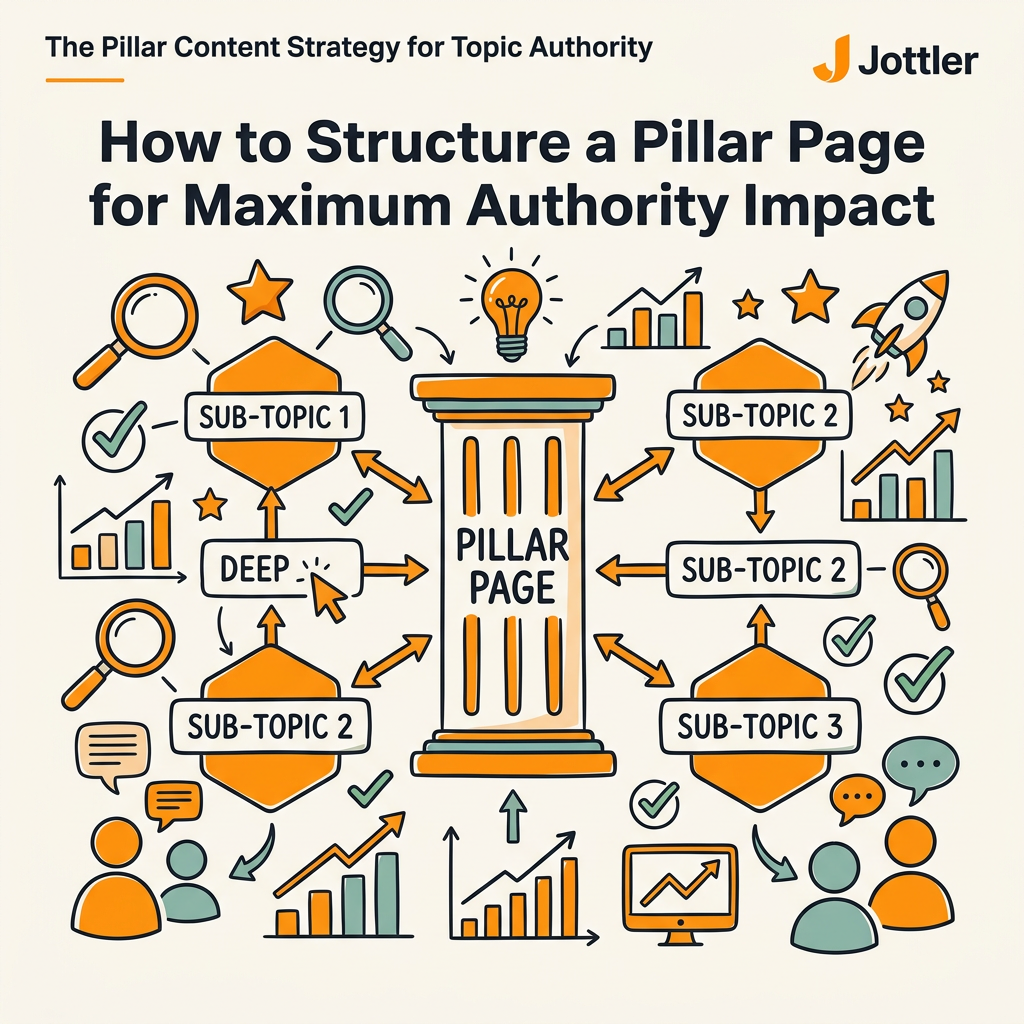
A pillar page is not a standard blog post. It's an encyclopedia-style reference article that covers a broad topic comprehensively, then funnels readers to deeper, more specialized cluster content. The architecture matters as much as the content itself. Building a pillar page correctly means understanding what information belongs on the pillar versus what belongs on supporting cluster pages, and how to link them for maximum SEO and user value.
Pillar Page Content Requirements and Word Count
The pillar page must demonstrate authority through depth and comprehensiveness. Pillar pages should be 3,000–5,000 words minimum, with optimal authority-building pages reaching 5,000–8,000 words (Digital Applied 2026 guide). This is not padding—each section should cover a major subtopic at a high level, with internal links pointing to cluster pages that dive into those subtopics further. The structure mirrors an encyclopedia entry: you learn enough to understand the subject, then follow cross-references for expertise in any specific area.
For example, a pillar page on "SaaS content marketing" would cover:
- What SaaS content marketing is and why it differs from B2C approaches
- The buyer's journey and content alignment (awareness, consideration, decision)
- Content pillar strategy and topic clustering fundamentals
- Distribution channels (blog, social, email, webinar)
- Measurement and ROI tracking
- Common mistakes and how to avoid them
Each of these sections is 300–500 words on the pillar, with an internal link to a cluster page that goes 1,500–2,500 words deep on that subtopic alone. This structure serves two audiences: new readers who want a complete overview, and experienced readers drilling down into one area of expertise.
Strategic Internal Linking from Pillar to Clusters
The linking structure is the nervous system of the pillar-cluster strategy. Best practice calls for reciprocal hub-and-spoke linking: link from pillar to cluster in the intro or relevant section, and link cluster pages back to the pillar near the top—both above the fold (Search Engine Land, 2025). This signals to Google that the pages are topically related and reinforces the pillar as the central authority hub.
Each cluster page should have:
- One primary link to the pillar in the opening paragraph, using anchor text like "[Broad Topic]" or the exact pillar page title.
- Cross-links to 2–3 related cluster pages within the body where context allows—don't force links, but naturally guide readers through the topic ecosystem.
- A "Learn more" link back to the pillar in the conclusion, inviting readers to explore the full topic.
The pillar page, in turn, should link to 10–15 cluster pages using descriptive anchor text with target keywords. For example: "Learn how to create high-converting SEO content plans" (linking to the cluster page on content planning), not generic "click here" text. This descriptive anchoring tells search engines exactly what topics support the pillar.
Building Your Cluster Pages: The Depth Layer of Topic Authority
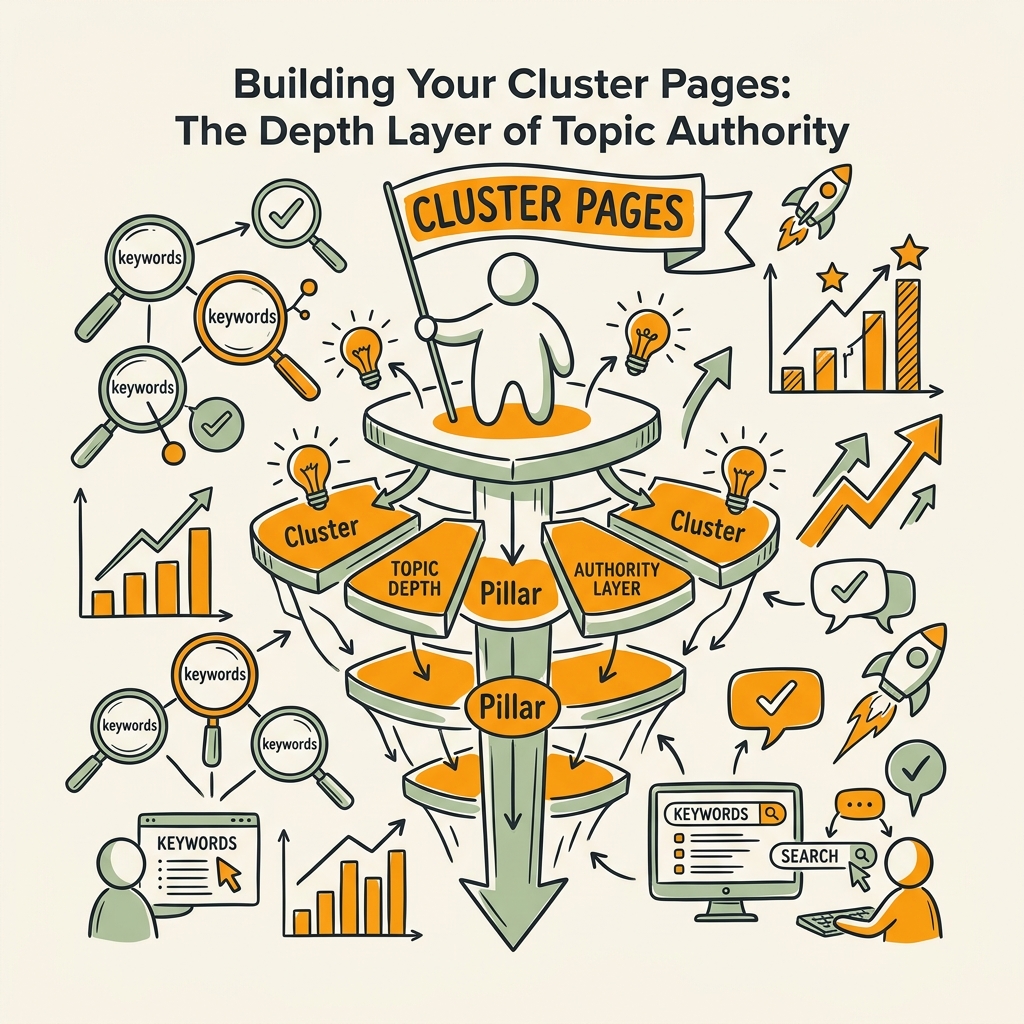
Cluster pages are where the real topical authority compounds. While the pillar provides the overview, cluster pages dive deep into specific questions or subtopics that your audience actually searches for. A well-executed cluster strategy converts broad, competitive keywords (like "content marketing") into a network of rankable long-tail keywords (like "how to measure content marketing ROI" or "SaaS content calendar templates") while reinforcing the pillar's authority across all of them. This is where measuring content marketing ROI becomes essential to validate your investment.
Cluster Page Specifications and Target Audience
Each cluster page targets one specific search query or question, typically a long-tail variation of the pillar topic. Cluster pages should be 1,500–2,500 words, focused on one specific question or aspect (Digital Applied 2026). They are narrower and more actionable than the pillar—while the pillar says "Here's SaaS content marketing," a cluster page says "Here's how to build a 12-month SaaS content calendar."
Cluster pages work best when they:
- Target a specific long-tail keyword: Something with 100–500 monthly searches, less competitive than the pillar keyword, but relevant to the same topic.
- Answer a single, specific question: Not "Everything about link building" (that's the pillar), but "How to build backlinks for a new SaaS company" (that's the cluster).
- Include real examples or case studies: Cluster pages often outrank pillar pages on narrow queries because they're more specific and actionable than a general overview.
- Link back to the pillar and related clusters: This reinforces topical relevance and keeps readers moving through your content ecosystem.
A sustainable publishing cadence is crucial here. Even 2 high-quality cluster pages per month compounds meaningfully over 12–18 months (InfluenceFlow 2025 guide), turning a modest publishing effort into a full topical authority. The key is consistency—publishing sporadically creates gaps in your topic coverage and lets competitors edge in.
How Many Cluster Pages Do You Actually Need
8–12 cluster pages are required for meaningful topical authority gains in competitive topics; 5–7 suffice for narrow niches (IndexCraft 2026). Start with a pillar plus 5–6 clusters, then expand based on ranking velocity. If your pillar and initial clusters are ranking and moving up, continue building. If they're stalled, audit your content quality, internal linking, and keyword difficulty before investing in more clusters.
A practical framework for identifying cluster topics:
- Mine Google's "People Also Ask" section for questions people ask about your pillar topic.
- Use Search Engine Land's topic cluster guide to identify subtopic gaps in competitor coverage.
- Review your own website analytics—what questions drive the most traffic already? Build clusters around those.
- Validate search volume for each cluster keyword—aim for 50+ monthly searches minimum to justify the effort.
This validation prevents wasted effort on low-demand clusters that look good on paper but deliver no traffic.
Strategic Validation: Choosing the Right Topics for Pillar Investment

Not every topic deserves a pillar. The most successful strategies begin with honest validation: Is this topic worth the 3,000+ word pillar plus 8–12 cluster articles? Do I have genuine expertise? Is there search demand? Can I compete given my domain authority? Running through four validation criteria before committing resources separates high-ROI pillar strategies from vanity projects that burn time and deliver no rankings.
The Four Validation Criteria
Before building a pillar, score the topic against these four questions:
- Strategic alignment: Does this topic attract your ideal customer and align with your business goals? A pillar on "video production trends" might have search volume, but if you're a SaaS company selling project management software, the audience won't convert.
- Search opportunity: Is there combined search volume across the pillar and cluster keywords to justify the investment? Aggregate the monthly searches for your pillar keyword (1,000+ ideal) plus 10–15 cluster keywords (100–500 each). Total opportunity should be 3,000+ monthly searches.
- Competitive landscape: Can you compete? Analyze the top 10 rankings for your pillar keyword. Are they established authority sites (Forbes, HubSpot, Gartner) or smaller niche players? Smaller competitors in the top 10 signal opportunity; wall-to-wall enterprise dominance might mean a longer road to ranking.
- Content expertise: Do you have (or can you easily develop) genuine expertise on this topic? Can you write an authoritative pillar page, or will you be assembling generic information from 10 other sources? Topics where you have firsthand expertise or SME access rank faster and hold better.
High scores on all four = immediate next pillar. Low on any single criterion = long-term bet or deprioritize. This framework takes the emotion out of topic selection and grounds strategy in data.
Measuring Topic Authority Gains and Adjusting Strategy
Publishing a pillar and clusters is only half the work. The second half is measuring results and adjusting. Track these KPIs to understand your topical authority progress:
- Organic traffic growth: Successful pillar strategies should grow organic traffic 20–40% quarterly (InfluenceFlow 2025). If you're flat or declining after 3 months, audit content quality, link velocity, and keyword difficulty.
- Top 10 rankings: Expect 5–10+ head terms to rank in the top 10 within 6 months (InfluenceFlow 2025). If only 1–2 terms are ranking, your pillar or clusters lack authority signals—check internal linking and content depth.
- Scroll depth: Aim for 50%+ of readers reaching the bottom of the pillar page (InfluenceFlow 2025). Low scroll depth suggests the pillar is too long, poorly structured, or not answering reader questions—reorganize sections or break into more cluster pages.
- Cluster traffic attribution: Track traffic to each cluster page via UTM parameters or GA4 segment analysis. If one cluster consistently underperforms, update its content or reassess the keyword targeting.
Use these metrics to iterate. Double down on high-performing topics; pause or retool low performers. Topic authority is built over months and years, not weeks—consistency and iteration matter more than perfection on day one.
Scaling Pillar Strategies Without Burnout: Automation and Cadence
The greatest barrier to pillar-cluster success is not strategy—it's execution at scale. Researching topics, writing authoritative pillar and cluster pages, managing internal links, and publishing consistently requires a publishing cadence most small teams can't sustain manually. The solution is smart automation that keeps the human expertise in strategy while removing the repetitive work. Automation platforms eliminate manual bottlenecks and enable sustainable cluster publication cadences without sacrificing quality.
Sustainable Publishing Cadence and Scaling
The pillar-cluster model is only profitable if you can sustain publication. Most teams start with high energy—write the pillar, publish 5 clusters in month one—then hit a wall. The answer is a sustainable cadence of 2 cluster pages per month (or your capacity equivalent), which compounds meaningfully over 12–18 months without burning out. Doubling that cadence with automation still takes time, but now it's feasible because the heavy lifting (keyword research, fact-checking, internal linking, optimization) is happening in parallel rather than sequentially.
For example, content strategy platforms for 2025 pillar-cluster mapping show that teams using automation handle research, writing, fact-checking, and publishing concurrently. A team that would spend 20 hours per week on cluster content can now shift that effort to strategy—identifying which topics to build pillars around, validating cluster opportunities, and measuring authority gains. The content keeps flowing without the person working nights and weekends.
Choosing Tools and Platforms for Pillar Architecture
If you're building pillar-cluster content manually, expect this timeline per cluster page: 4–6 hours for research and outline, 2–3 hours for writing, 1–2 hours for internal linking and optimization. Multiply that by your target cluster count (8–12 pages), and you're looking at 80–200 hours per pillar strategy. For a founder or solo marketer, that's 2–5 months of full-time work.
Automation platforms designed for AI content strategy compress that timeline significantly. Platforms like Jottler research cluster topics from 14+ sources, write optimized content aligned to your pillar strategy, fact-check every claim, and publish directly to your CMS with smart internal linking. A cluster that would take 8–12 hours manually now takes 30 minutes to brief and 2–3 hours to review. The mathematical difference is enormous: instead of 2–5 months, you have a full pillar strategy live in 6–8 weeks.
"Manual content production will not scale. Teams trying to publish 3+ clusters per month while maintaining day-job responsibilities inevitably burn out or compromise quality. Automation handles the research and drafting while you focus on strategy and validation. That's how modern teams win at topical authority."
— Content Automation Best Practices 2026
The trade-off is not quality for speed. Automation platforms that focus on SEO content (not generic AI writing) are built to produce publication-ready work. They research deeply, avoid hallucinations through fact-checking, and link strategically. The founder's role shifts from "write every sentence" to "validate strategy, review output, approve publishing"—which is where strategic value actually lives anyway.
| Metric | Pillar-Cluster Strategy | Traditional Scattered Content |
|---|---|---|
| Organic Traffic Growth (Year 1) | 40% average increase | 10–15% typical |
| Top 10 Rankings Achieved | 5–10+ head terms in 6 months | 1–3 terms in 12+ months |
| Quarterly Growth Rate | 20–40% sustained | 5–10% variable |
| Ranking Position Improvement | Median +3 positions in 3 months | +0.5–1 position in 6 months |
| Content Depth (Pillar) | 3,000–8,000 words | 1,000–2,000 words |
| Supporting Cluster Pages | 8–12 linked articles | None or scattered links |
| Manual Effort per Strategy | 80–200 hours (5–6 weeks with automation) | 40–60 hours ongoing |
Conclusion
The pillar content strategy has moved from "nice to have" to "non-negotiable" for scaling organic traffic. Sites using pillar-cluster architecture achieve 40% average organic traffic growth in the first year, with 5–10+ head terms ranking in the top 10 within 6 months, and 20–40% quarterly traffic growth once the strategy matures. The structural approach—one authoritative hub connected to 8–12 deep cluster pages—compounds ranking velocity far faster than scattered content ever could. By validating your pillar topics against search opportunity, competitive landscape, expertise, and business alignment before committing resources, you avoid costly mistakes. The real breakthrough comes when you remove the manual execution bottleneck through automation, freeing your team to focus on strategy, measurement, and iteration instead of endless writing cycles.
The difference between a founder publishing one blog post per month and one publishing three per day is not time management—it's tooling. Start your SEO agent today and let autonomous research, writing, and publishing handle the cadence while you focus on authority building.
FAQs
How long does it take to see results from a pillar content strategy?
Most pillar-cluster strategies show measurable results within 3–6 months. Median ranking improvements of 3 positions across cluster pages appear within 3 months, while 5–10+ head terms typically rank in the top 10 by month 6. However, timing depends on domain authority, keyword difficulty, and publishing cadence. A new domain with low authority may take 9–12 months to see meaningful top-10 rankings, while an established domain publishing consistently can rank within 2–3 months. The key variable is consistency—sporadic publishing extends the timeline significantly.
Do I need to hire a content writer or can I use AI to build my pillar strategy?
AI-powered content platforms designed for SEO can produce publication-ready pillar and cluster content without hiring a full-time writer, but the approach depends on your resources and expertise. If you have strong in-house SEO knowledge and can validate AI output, automation platforms dramatically reduce cost and timeline. If you're starting from scratch on SEO strategy, consider pairing an automation platform with a freelance SEO strategist (10–15 hours/month) to validate topics, review output, and guide strategy—still far cheaper than hiring a full-time writer. Generic AI writing tools often produce lower-quality, fact-checked content; platforms built specifically for SEO content handle research, validation, and optimization better.
What happens if my pillar page starts ranking but my cluster pages don't?
This is a common scenario and usually signals one of three issues. First, audit your internal linking structure—cluster pages must be linked from the pillar and from each other using descriptive anchor text with target keywords. Second, review cluster content quality and keyword difficulty; if clusters target keywords harder than the pillar, they won't rank despite strong internal links. Third, check for duplicate or cannibalistic content—if a cluster page competes with the pillar or another cluster for the same keyword, Google gets confused about which page to rank. Fix internal linking and keyword targeting, then give pages 2–3 months to respond before major content rewrites.