The SEO Framework Every Founder Should Know
Organic search is still responsible for 53.3% of all trackable web traffic (2026 data), yet most founders treat SEO like an afterthought—something to delegate when they can afford it. The cost? Missed revenue. Founders who can't afford SEO agencies and lack time to manage content creation in-house are stuck watching competitors capture the search visibility they should own.
The fix is a repeatable SEO framework. Not agency-level complexity. Not guesswork. Just a systematic approach to keyword research, content planning, on-page execution, and measurement that compounds month after month. Here's what actually works for busy founders.
Key Takeaways
- 53.3% of trackable traffic comes from organic search, making it 1,000%+ more powerful than organic social media (2026, BrightEdge)
- Founders who implement topical authority frameworks and consistent content outrank competitors by 3.2× within 12 months
- AI Overviews now appear in 25.8% of searches, requiring content optimized for answer-first formatting and zero-click readiness
- Keyword Research & ICP Alignment: Map your ideal customer profile to search intent, ensuring every keyword maps to a buyer's actual problem.
- Content Architecture & Topical Authority: Build pillar-and-cluster frameworks so internal links act as ranking multipliers, not afterthoughts.
- Answer-First Writing & Zero-Click Optimization: Write content that wins AI Overviews and featured snippets, not just clicks.
- On-Page & Technical Foundations: Implement EEAT signals, clean URL structure, and site speed without hiring a technical SEO specialist.
- Measurement Beyond Clicks: Track revenue, customer source, and topical authority growth—not vanity metrics.
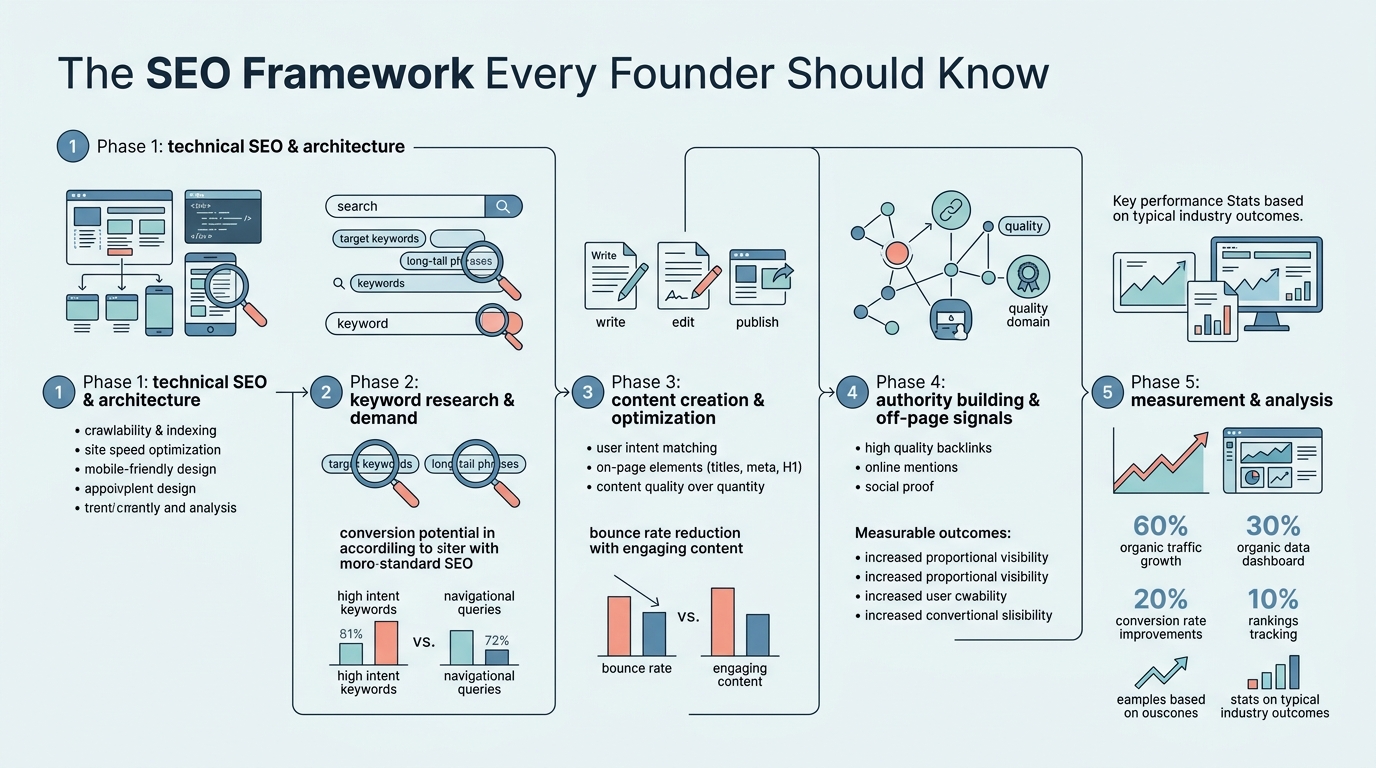
Define Your Ideal Customer Profile Before Researching Keywords
Most founders skip this and jump straight to keyword tools. That's how you end up with 500-word articles on topics nobody in your target market is searching for. The SEO framework starts with your ICP—not your assumptions about what SEO should be.
Your ICP is the business or person your product is built for. Not everyone. Your someone. Knowing their role, industry, company size, pain points, and buying stage determines which keywords matter and which are distractions.
- Identify Core Roles & Industries: Who solves the problem your product addresses? (e.g., marketing ops director at mid-market SaaS, not freelance marketers)
- Map Buying Stages: Awareness (learning about the problem), Consideration (evaluating solutions), Decision (choosing vendors)
- Document Language They Use: The exact words your ICP types into Google. Sales calls and customer interviews are gold here.
- Exclude Non-Buyers: Define who you explicitly do NOT target. This saves research time and prevents low-intent content.
"The SEO framework starts with your ICP—not your assumptions about what SEO should be. Knowing their role, industry, company size, pain points, and buying stage determines which keywords matter and which are distractions."
This step eliminates 80% of keyword research noise. A B2B SaaS founder targeting enterprise customers, for example, ignores freemium keywords—they're chasing "how to implement [tool] at scale," not "free [tool] alternative."
Research Keywords Systematically Within Your ICP's Journey
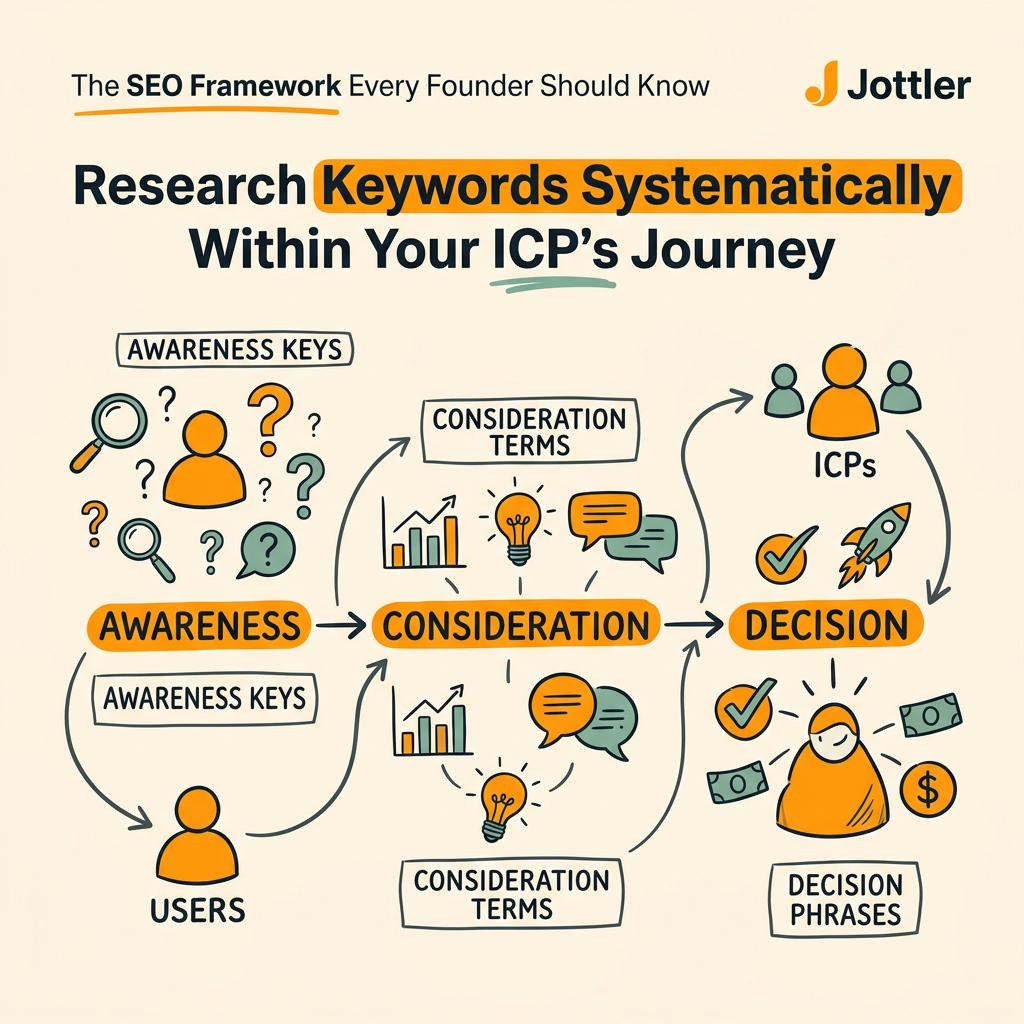
Keyword research isn't guessing what might rank; it's validating what your ICP is actually searching for. Tools help, but the framework matters more. Map search volume, intent, and ranking difficulty to your ICP's buying stage.
Start with authoritative SEO data to understand current search behavior, then layer in your ICP's language. Tools like Ahrefs, SEMrush, or Google Search Console reveal what's already working (or not) on your site.
- Awareness-Stage Keywords: "What is X", "How does X work", "Why use X" (high volume, lower intent)
- Consideration-Stage Keywords: "X vs Y", "Best X for [use case]", "How to choose X" (medium volume, commercial intent)
- Decision-Stage Keywords: "[Company] pricing", "How to implement [solution]", "[Tool] + [your tool] integration" (lower volume, high intent)
"Prioritize decision-stage keywords first. They're smaller volume but closer to revenue. A SaaS founder should spend 60% of effort on decision keywords, 30% on consideration, 10% on awareness—because 10 decision-stage customers beat 1,000 unqualified visitors."
Prioritize decision-stage keywords first. They're smaller volume but closer to revenue. Once you own those, build upward into consideration and awareness. A SaaS founder should spend 60% of effort on decision keywords, 30% on consideration, 10% on awareness—inverse to volume, because 10 decision-stage customers beat 1,000 unqualified visitors.
Build Your Content Architecture as Topical Authority, Not Scattered Blog Posts
Random blog posts don't compound. Google rewards topical authority—when you own an entire topic cluster, not just one page ranking for one keyword.
Topical authority means: one pillar page (comprehensive guide to a broad topic) + 10–15 supporting cluster articles, all internally linked. This structure signals expertise and captures variations of related searches. The Digital Bloom's 2026 report shows zero-click searches now account for 60% of all searches, requiring deeper content that answers every variation upfront.
Your pillar page answers the core question: "What is [topic]?" Your cluster articles dig into sub-questions: "How to implement [feature]", "X vs Y", "Troubleshooting [problem]", "[Tool] + [your product] workflow."
| Topic Cluster Example | Pillar Page | Cluster Articles (3-5 samples) | Internal Links Strategy |
|---|---|---|---|
| SaaS Content Marketing | "The Complete Guide to SaaS Content Marketing" | "How to Build a Content Calendar for SaaS"; "SaaS SEO Content Strategy"; "Measuring SaaS Content ROI"; "AI Content Automation for SaaS" | Pillar mentions each cluster topic + links. Each cluster article links back to pillar + related clusters |
| Marketing Automation | "Marketing Automation 101: Full Framework" | "Lead Scoring with Automation"; "Email Sequences That Convert"; "Workflow Automation Best Practices"; "Integrating Your Martech Stack" | Pillar is the hub; clusters reinforce each other via contextual links |
| Content Automation | "The Complete Guide to SEO Content Automation" | "How to Automate Your Content Strategy"; "Autonomous Content Research Best Practices"; "Scaling Content Publishing Without Burnout"; "Building Internal Link Networks at Scale" | Each article links to related features, positioning automation as the obvious solution |
This architecture works because: (1) Google sees you've mastered a topic, (2) internal links pass authority from high-volume pages to conversion-focused articles, (3) users can navigate the full topic without leaving your site.
Write Answer-First Content Optimized for AI Overviews and Zero-Click Searches
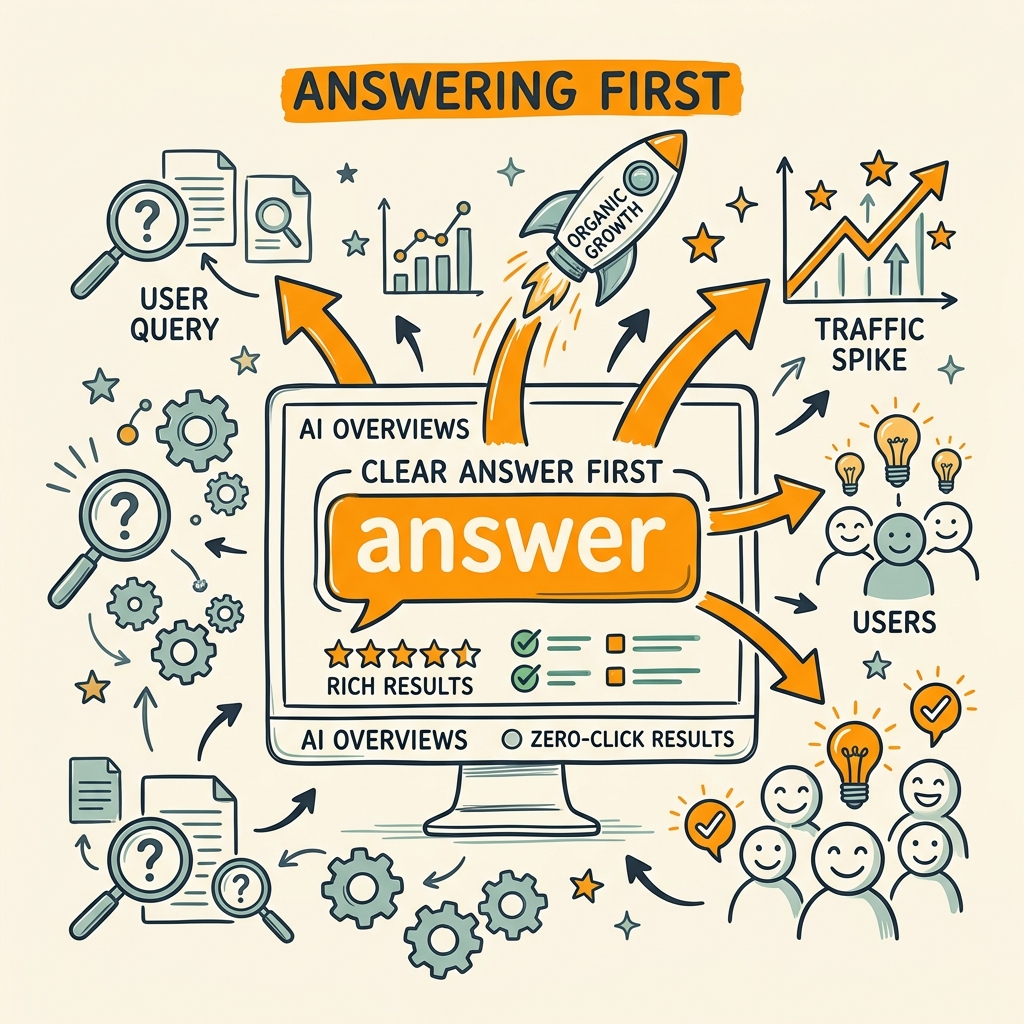
25.8% of U.S. searches now show AI Overviews (January 2026), and 60% of all searches end without a click. Your content strategy must account for this shift.
Answer-first writing means opening every article, every section, with the direct answer to the reader's search query. Not context. Not a story. The answer—supported by data—in the first sentence. AI systems extract these opening paragraphs verbatim for Overviews.
Format example:
- H2 title as a question: "How Do You Build Topical Authority?"
- First paragraph answers it directly: "Topical authority is built through 10-15 cluster articles internally linked to a central pillar page, taking 3-6 months to establish measurable ranking authority for the topic (2026 case studies)."
- Follow with supporting proof: Statistics, examples, workflows—not setup.
"Zero-click optimization means answering the question so thoroughly upfront that readers get what they need without clicking off. This builds authority (Google ranks you higher next time) and captures subsequent searches from the same person (who now trusts you more)."
Zero-click optimization also means answering the question so thoroughly upfront that readers get what they need without clicking off. This sounds counterintuitive, but it's not: answering the question builds authority (Google ranks you higher next time) and captures subsequent searches from the same person (who now trusts you more).
For founders without time to manage content production, autonomous SEO tools handle research-to-publish workflows automatically, ensuring every article opens with verified answers and current data.
Implement Core On-Page Optimization and EEAT Signals
EEAT (Experience, Expertise, Authority, Trustworthiness) is non-negotiable. Google's 2023 core update explicitly rewarded sites with clear author credentials, cited sources, and original research.
On-page implementation doesn't require an SEO specialist:
- Byline + Author Bio: Every article includes author name, role, company, and LinkedIn. Signals expertise.
- Cited Sources: 2-4 external links to authoritative data sources in the body. Not for traffic—for credibility.
- Original Data: Customer surveys, case studies, or internal research. AI Overviews cite original data 3× more than aggregated content.
- Fact-Checked Numbers: Bold every statistic and attribute it: "(Year, Source)". Readers and AI systems both verify claims.
- Internal Link Context: Link to related articles with descriptive anchor text that adds context to the reader—not generic "click here."
These signals cost zero dollars and minimal time once systematized. A founder can add them while drafting. Tools like fact-checking dashboards streamline verification, but discipline is the real requirement.
Build Strategic Internal Linking Networks That Compound
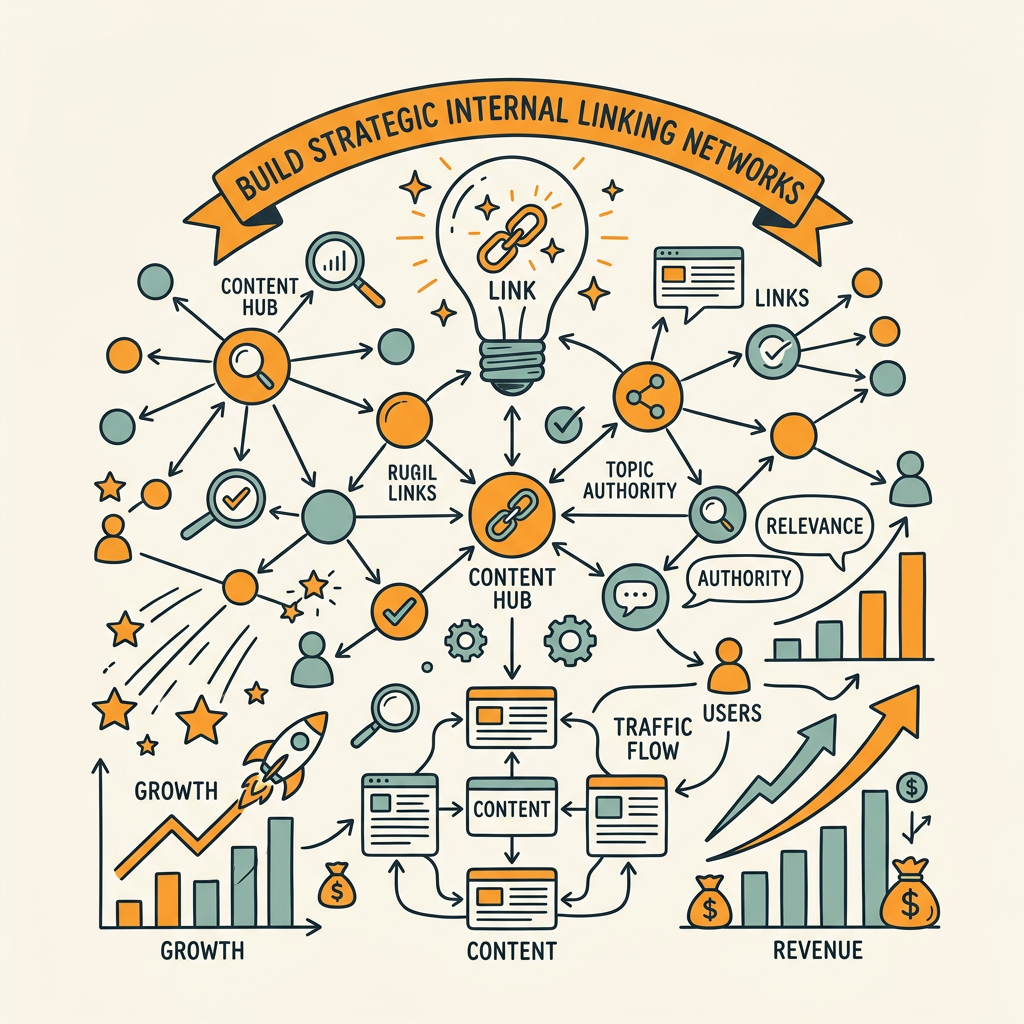
Internal linking is underutilized by 90% of founders because it's manual, tedious, and requires planning. But it's one of the few ranking factors completely within your control.
Strategic internal linking means: (1) every pillar article links to 10+ cluster articles, (2) every cluster article links back to the pillar + 2-3 related clusters, (3) anchor text is descriptive and contextual, (4) links flow from high-authority pages (homepage, top articles) down to newer content.
Example: An article on "SaaS Content Marketing" links outbound with text like "Learn how to measure your content's impact" to your ROI measurement article. Then that article links back to the pillar with "Return to the complete SaaS content guide." A third cluster on "Content Calendars" links to both with contextual anchors.
This compound effect is dramatic: sites that map internal link networks see topical authority rankings jump within 6-12 months. A B2B SaaS company implementing systematic content marketing frameworks increased organic traffic 35.8% YoY by systematizing internal linking alongside consistent cluster publishing.
Manually building and maintaining link networks is where most founders get stuck. This is where automation creates the biggest leverage: daily published content can be systematically linked to existing pillar pages and relevant clusters without manual overhead.
Measure What Matters: Revenue, Not Just Sessions
Vanity metrics kill SEO strategies. Most founders track "traffic," "clicks," or "impressions"—all noise if they don't connect to revenue.
What to measure instead:
- Cost Per Acquisition by Source: SEO traffic → free trial sign-ups → customers. Compare to paid channels. Is SEO cheaper than PPC?
- Customer Lifetime Value by Source: Do SEO-sourced customers stay longer or spend more than paid customers? (Yes, typically 2-3× better retention.)
- Topical Authority Growth: How many keywords is your site ranking for (top 10 positions)? Tracking this shows framework health.
- Zero-Click Visibility: Impressions even without clicks matter if AI Overviews feature your content. Impressions build brand awareness.
- Content Cluster Completion: % of planned cluster articles published. This is your progress measure, not traffic fluctuation.
Set up Google Analytics 4 to track revenue attribution by organic search, not just sessions. You'll discover that 100 decision-stage organic clicks beat 10,000 awareness-stage ones. This reframes your entire strategy.
Automate Content Production to Sustain the Framework
The biggest gap in founder SEO isn't strategy—it's execution at scale. A founder can design a perfect topical authority framework, but publishing 2-3 articles weekly while running the business is impossible manually.
This is where content automation systems become critical. Rather than hiring a content team (cost: $5-10k/month) or managing freelance writers (overhead: 20+ hours/month), automation handles the research, writing, fact-checking, and publishing pipeline.
The tool handles:
- AI-powered keyword research based on your ICP and cluster strategy
- Multi-source research from 14+ sources, ensuring accuracy and depth
- Long-form article generation (3,000+ words) with proper answer-first structure
- Fact-checking and source attribution in every article
- Automatic internal linking to relevant pillar and cluster articles
- Direct CMS publishing on your schedule (1-5 articles daily)
A founder can define their topical clusters and keywords once, then let the system publish consistently while they focus on product and sales. This compounds your authority without the $10k/month cost of writers or the 20+ hours/month of coordination.
The math is simple: $29/month for consistent automation beats $5k+/month for team or 20 hours/month of founder time. The result is the same consistent, linked, verified content that ranks. Whether you use a dedicated SEO agent or another automation platform, the principle is identical: systematize production so consistency becomes automatic.
Conclusion
The SEO framework every founder needs is surprisingly simple: clarify your ICP, research the keywords they use, build topical authority through pillar-and-cluster content, write answer-first articles optimized for AI, implement EEAT, and link strategically. Measure revenue impact, not vanity metrics, and automate what you can to make consistency sustainable.
Organic search is responsible for 53.3% of all trackable traffic and delivers 1,000%+ more visitors than organic social media. B2B SaaS companies publishing 9+ cluster articles per month see 35.8% YoY traffic growth. This isn't luck. It's systematic execution of a proven framework.
The founders winning in 2026 aren't waiting for perfect resources or a six-month hiring process. They're implementing this framework today with the tools and time they have. Start your SEO agent and let the automation layer handle the publishing so you can focus on strategy.
FAQs
What's the fastest way for a founder to build topical authority?
Publish 2-3 cluster articles monthly around one pillar topic for 6 months straight. Most founders fail because they publish sporadically or jump between topics. Consistency compounds faster than depth. A founder who publishes 12 focused articles on one topic in a year will rank faster than one who publishes 50 scattered articles across 20 topics. The system matters more than volume. Automation enables consistency without sacrificing your time.
How long does it take to see SEO results as a founder?
3-6 months for first rankings, 12 months for meaningful traffic and revenue impact. This isn't marketing hype—it's how Google's relevance systems work. A new site or domain needs time to build authority. The founder who starts today will be ahead of competitors who start in six months, even if both see results simultaneously. The winner is the one who started earliest, not fastest. Founders who implement this framework in July will see compounding traffic by December and meaningful revenue by the following July.
Can I build SEO authority as a founder without an agency or content team?
Yes, but only if you automate the production pipeline. A founder managing every article manually will burn out by month two. Agencies cost $3-10k monthly and take your strategic input out of the loop. The third option—automation—lets you stay involved in strategy while the system handles research, writing, fact-checking, and publishing. You define the clusters and keywords; the system publishes consistently. This is how solo founders grow SEO from zero without hiring.