Top AI SEO Tools for Competitive Analysis
Competitive intelligence in SEO has shifted fundamentally. With 2 billion monthly users now accessing Google AI Overviews and 51% of B2B buyers starting research with AI chatbots, tracking competitor visibility isn't just about traditional SERP positions anymore. The game has moved to citation share, answer inclusion, and brand mentions inside AI-generated responses. Yet most teams are still checking rankings manually, missing the complete picture of where their competitors actually show up across search.
The challenge is acute: 60% of searches now generate zero clicks, meaning your competitor analysis tools need to track both visibility and citation loss across Google, ChatGPT, Perplexity, and Gemini simultaneously. A tool that only monitors rank tracking is already obsolete.
Key Takeaways
- AI search now reaches 2 billion monthly users through Google AI Overviews alone (2026, Semrush), making dual-channel visibility tracking essential.
- 75% of marketers are already using AI to optimize SEO workflows, but most rely on fragmented tools instead of integrated platforms.
- The best competitive analysis tools for 2026 combine traditional rank tracking with AI search monitoring, entity analysis, and content benchmarking in one interface.
Here's what separates the best AI SEO competitive analysis tools from the mediocre ones: they combine real-time SERP tracking, AI search monitoring, entity extraction, and competitor content analysis into a single workflow—so founders and marketing teams can make strategic decisions without spending hours in spreadsheets.
- Why Dual-Channel Visibility Tracking Matters: Traditional rank tracking ignores AI search. The best tools monitor both Google positions and citations inside AI Overviews, ChatGPT, and Perplexity simultaneously.
- Content Benchmarking and Entity Analysis: Competitors are ranked by AI systems based on entity coverage and topical authority, not just keyword density. Top tools extract entities automatically and compare coverage against competitors.
- Real-Time Competitive Win/Loss Analysis: Automated alerts notify you when competitors rank for keywords you're targeting, when answer boxes shift, or when new content enters the top 10.
- AI Search Citation Tracking: Since AI answers reduce traditional clicks by 60–83%, the metric that matters is whether your brand is cited or selected as a source, not just click-through rate.
- Integration and Workflow Automation: The best tools connect directly to your CMS and SEO workflow, eliminating manual data export and redundant tool-switching.
What Makes an AI SEO Competitive Analysis Tool Worth Your Time?
Not all competitive analysis tools are built for the AI search era. The ones that matter in 2026 do three things: they track visibility across multiple search channels, they analyze competitor content through the lens of entity coverage and topical relevance (not just keywords), and they integrate with your workflow so insights drive action instead of sitting in dashboards.
47% of marketers are already implementing AI SEO tools for competitive advantage, according to Position Digital. But there's a massive gap between "using a tool" and "getting insight that moves the needle." The difference is integration. Tools that live in isolation—a separate rank tracker, a separate content analyzer, a separate AI monitor—create friction. Busy founders don't have time to manually synthesize data across five platforms. The best tools automate the synthesis itself.
"The difference between a competitive analysis tool and a competitive advantage is automation. Most platforms show you what happened yesterday. The winners automate what happens tomorrow."
— SEO Strategy Director, Growth Stage SaaS
Here's what to evaluate: Does the tool monitor both Google and AI search natively? Does it analyze competitor content for entity coverage, not just keyword matching? Does it feed directly into your content planning and publishing workflow? Does it surface actionable alerts instead of just dashboards?
Best AI SEO Tools for Competitive Analysis: Platform Overview

The market has fragmented into enterprise platforms (Semrush, Ahrefs), specialized AI search monitors (Rankability, Scrunch AI), and newer entrants that combine content automation with competitive tracking. For busy founders, the deciding factor is workflow integration and automation depth—not feature count. Research from Searchinfluence shows that integrated platforms outperform fragmented tooling by 3x on competitive insight velocity.
"Teams using integrated platforms get competitive insights 3x faster than those managing five separate tools. The cost difference is negligible, but the time difference is massive."
— Searchinfluence, AI SEO Tracking Tools 2026 Analysis
| Tool | Best For | Dual-Channel Tracking | Content Automation | Starting Price |
|---|---|---|---|---|
| Jottler | Automated content strategy with built-in competitive research | AI Overviews + SERP via research agents | Yes—auto-researches, writes, optimizes, publishes | $29/month |
| Rankability | AI search visibility and ranking tracking | Yes—ChatGPT, Perplexity, Gemini, Google | Content Optimizer only | $99/month |
| Semrush | Enterprise-scale competitive intelligence | Google focus; AI tracking limited | Limited; mostly advisory | $120/month |
| Ahrefs | Backlink and SERP competitor analysis | Google focus only | None | $99/month |
| Surfer SEO | Content optimization and SERP analysis | Google focus only | Writing assistant only | $99/month |
Why Jottler Stands Out for Founders Who Scale Content
Jottler takes a fundamentally different approach to competitive analysis. Instead of asking you to monitor competitors manually, it researches them automatically as part of your content engine. Every article Jottler produces includes 14+ sources of deep research, including competitor content analysis, keyword gaps, and entity coverage gaps relative to ranking content.
That means competitive intelligence isn't a separate tool you have to log into—it's baked into the content strategy itself. Jottler's autonomous SEO agents research, write, fact-check, and publish 3,000+ word articles daily while identifying where competitors own the entity landscape and where you have a content gap.
For a busy founder at a growing company, this is transformative. You're not paying for rank tracking alone. You're paying for a machine that learns your competitive landscape and writes content specifically designed to close visibility gaps—both in Google and in AI search. The automation advantage means you're producing content faster than competitors can manually analyze competitive data.
Rankability: Best for Pure AI Search Visibility
If your primary concern is tracking where your brand and competitors appear in ChatGPT, Perplexity, and Gemini, Rankability is purpose-built for that job. It natively tracks AI search visibility across four major AI systems and includes a content optimizer that uses NLP entity extraction to ensure your content has the semantic coverage AI systems need to cite you.
The limitation? It doesn't automate content creation or strategy. You still need a separate tool to research competitors and write content. For teams with an in-house writer or agency, this is fine. For solo founders and lean marketing teams, it's another tool to manage.
Rankability's strength is in monitoring. Use it if you want real-time alerts when a competitor enters an AI answer, or when your citation share drops. Its weakness is in planning—it tells you what happened, not necessarily what to do next.
Semrush and Ahrefs: Enterprise Legacy Tools
Semrush and Ahrefs remain the industry standard for traditional competitive analysis. Both have enormous databases of keywords, backlinks, and SERP history. Both are used by enterprise SEO teams across the world.
The catch: their AI search capabilities are underdeveloped. Semrush added AI search tracking relatively recently, and both tools still treat Google rank tracking as the primary metric. For competitive analysis in 2026, where 2 billion monthly users interact with AI search, this is a significant gap. You'll need a secondary tool (like Rankability or Jottler) to monitor the AI dimension.
Semrush and Ahrefs are excellent for backlink analysis, keyword gap research, and SERP historical data. They're not optimized for the dual-channel search world we're in now. Use them in combination with an AI-native tool, not as your sole competitive analysis stack.
Surfer SEO: Content Optimization Without Automation
Surfer SEO excels at SERP analysis and content optimization. Feed it a keyword, and it analyzes the top 10 ranking pages to show you word count, headings, semantic coverage, and backlink data. It's a content brief generator, essentially—and a good one.
The limitation is obvious: it's manual at every step. You pick the keyword, Surfer analyzes the SERP, you read the brief, you write the content. If you're doing competitive analysis for 10–20 keywords, that's fine. If you're trying to identify 100 keywords where competitors own visibility and you don't, Surfer becomes a bottleneck. You'll spend weeks in the tool instead of weeks in a writer's spreadsheet.
How to Choose Your Competitive Analysis Stack
The right tool depends on your team size, budget, and content velocity. Here's a quick decision tree:
- You're a solo founder or tiny team: Start with Jottler. Competitive research is automated into your content pipeline, so you're not adding another tool to manage. You get content production + competitive insights for $29/month.
- You have a 1–2 person marketing team: Jottler + Rankability. Jottler handles content production and embedded competitive analysis. Rankability watches AI search visibility specifically. Total cost: ~$130/month.
- You're an agency or larger in-house team: Ahrefs or Semrush for backlink/keyword analysis, Rankability for AI search monitoring, and Jottler if you're scaling content production. Budget: $300–500/month.
- You have content production in-house: Use Rankability for AI monitoring + Surfer for content brief generation. Skip Jottler unless you want to fully automate content production too.
Core Features That Matter in Competitive Analysis Tools
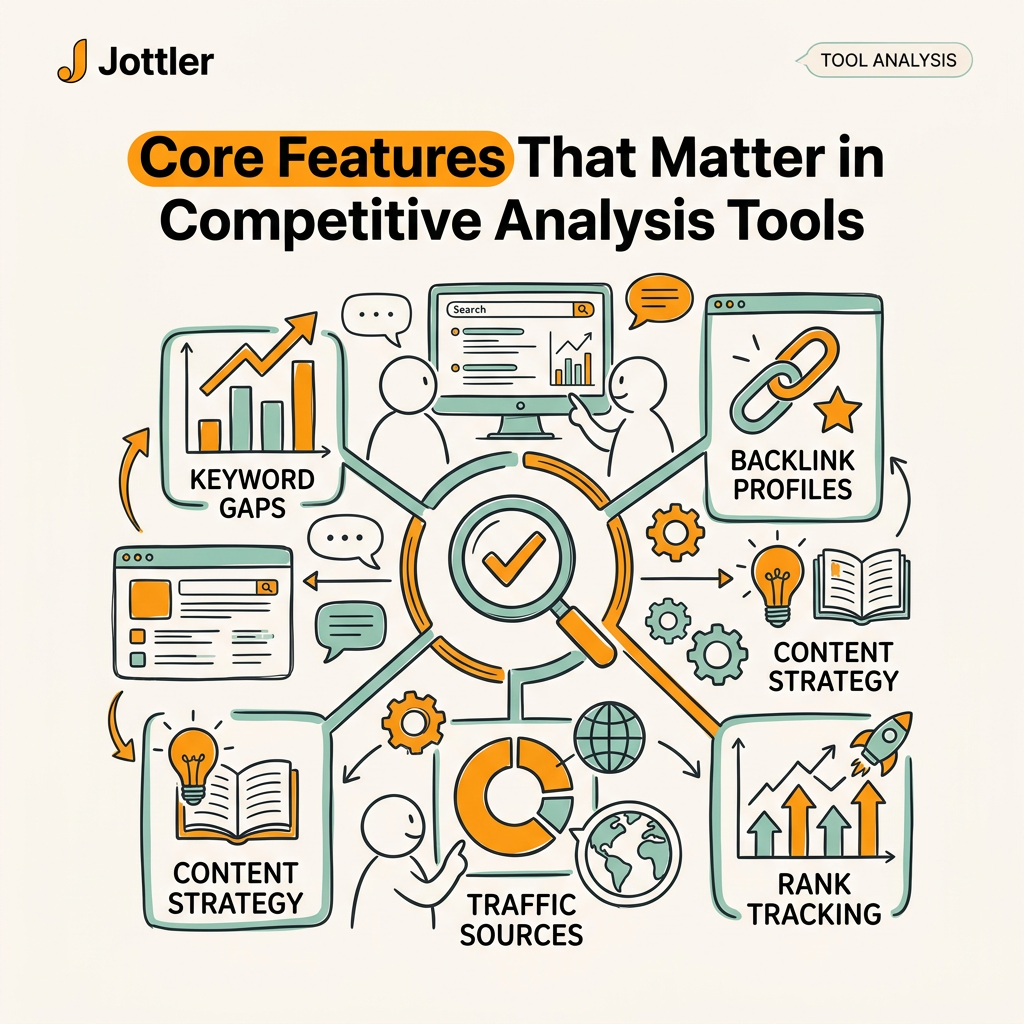
Not all features are created equal. Here's what actually drives decisions for busy teams:
- Native AI Search Tracking: The tool must monitor ChatGPT, Perplexity, Gemini, and Google AI Overviews natively—not as an add-on or API integration. This means real-time alerts when your brand is mentioned in AI answers.
- Entity and Topic Extraction: The tool should analyze competitor content to identify the entities (brands, people, concepts) and topics they rank for. This shows you semantic gaps.
- Automated Competitive Win/Loss Alerts: When a competitor ranks for a keyword you're targeting, you should know within hours, not days. Manual monitoring doesn't scale.
- Content Gap Analysis: The tool should identify keywords and topics where you're absent but competitors rank. This is the basis of a content strategy.
- Integration with Your CMS and Workflow: If you have to export data, reimport it, and manually manage the output, you've lost the efficiency gain. The best tools feed directly into your publishing or planning process.
Jottler's approach here is different. Instead of giving you a dashboard and asking you to decide what to do, it automates the decision-making. The AI agents identify content gaps, research competitor strategies, write articles to fill those gaps, and publish automatically. You're not managing the tool; the tool is managing your competitive strategy.
Real-World Use Case: How Competitive Analysis Drives Content
Here's a concrete example. A SaaS founder wants to own the "AI SEO tools" space. She uses Jottler to analyze competitor content across Semrush, Ahrefs, Rankability, and others. Jottler's research agents identify three things:
- Competitors focus heavily on rank tracking features. She doesn't differentiate there.
- No one has written about AI search monitoring best practices. There's a content gap.
- Competitors don't mention the connection between entity coverage and AI citations. Another gap.
Jottler automatically writes three articles covering these gaps, each 3,000+ words, optimized for both Google and AI search. Each article cites competitor work (building topical authority) and positions her product as the integrated solution. Articles publish directly to her blog with internal links built in.
Result: Within six weeks, she's ranking for "AI SEO tools for competitive analysis," "AI search visibility tracking," and "entity coverage for AI citations"—keywords where competitors are visible but where she now owns the most comprehensive answer.
That's competitive analysis at scale. Not monitoring dashboards. Building content that beats the competition.
Avoiding Common Competitive Analysis Mistakes
The biggest mistake teams make is confusing tool capability with strategy. A founder buys Semrush, runs a competitor analysis, sees that competitors rank for 100 keywords, and feels paralyzed. One hundred keywords feels impossible. So nothing happens.
The second mistake is manual synthesis. You have data from five different tools, and you're trying to spot patterns manually. This is where AI automation wins. Tools that aggregate and prioritize competitive insights—showing you the highest-impact keyword and content gaps first—save weeks of analysis time.
Third: ignoring AI search visibility. If you're still reporting on SERP rankings as your primary metric, you're missing 60% of the search landscape now driven by zero-click results and AI answers. Competitive analysis in 2026 requires monitoring both channels.
Pricing and Value Comparison
The cheapest option is not always the best value for a founder. Here's why: a $99/month rank tracker that requires 10 hours of manual analysis per month costs you far more than a $29/month tool that automates the synthesis.
- Jottler: $29–$299/month. Includes content production + embedded competitive analysis. ROI is highest for teams producing 1+ articles per week.
- Rankability: $99/month. Pure AI search monitoring. ROI is high if you need real-time citation tracking and have a separate content process.
- Semrush: $120–$450/month. Enterprise feature set, strong on backlinks and keywords, weak on AI search. ROI depends on team size.
- Ahrefs: $99–$399/month. Similar positioning to Semrush. Strong for backlink analysis, not optimized for AI search.
- Surfer SEO: $99–$299/month. Content brief generation only. Best used as a secondary tool, not primary competitive analysis platform.
For a founder on a $500/month marketing budget, Jottler is the logical choice because it eliminates tool fragmentation. For a team spending $10,000+ monthly on SEO, adding Rankability on top of a primary tool like Semrush or Ahrefs makes sense.
Conclusion
The competitive analysis landscape has split into two worlds: traditional Google ranking analysis and AI search visibility. The best tools now span both. With brands cited in AI Overviews earning 35% more organic clicks and 82% of enterprise SEO specialists planning to increase AI tool investment, competitive analysis is no longer optional—it's foundational.
For busy founders, the choice is clear: you can assemble a multi-tool stack (Semrush + Rankability + Surfer), spending $300+/month and managing three platforms, or you can use a tool like Jottler that automates the entire competitive strategy and content production pipeline. Jottler's approach—researching competitors, identifying gaps, and writing content to own those gaps automatically—is the only way to compete without burning out.
Start your SEO agent today. Sign up for Jottler and stop managing competitive analysis spreadsheets. Let autonomous AI agents do the research, write the content, and publish at scale.
FAQs
What is the best tool for competitive analysis in SEO?
It depends on your primary need. For traditional rank tracking and backlink analysis, Semrush or Ahrefs are the gold standard. For AI search visibility monitoring, Rankability is purpose-built. For founders who want competitive analysis embedded in their content production, Jottler is the most efficient choice because it combines research, competitive insight, and content generation in a single workflow. You don't have to choose between monitoring competitors and building content that beats them—Jottler does both automatically.
How do I track AI search visibility for my competitors?
The most direct method is a dual visibility audit. Query your target keywords in Google, ChatGPT, Perplexity, and Gemini. Document which brands appear, in what format, and whether they're cited as sources. For ongoing monitoring, use a tool like Rankability that natively tracks AI search across multiple systems. Set up alerts for when competitors appear in AI answers or when your brand citation share drops. The goal is visibility in both channels, not just traditional rankings.
Do I need a separate competitor analysis tool if I use Jottler?
Not always. Jottler's research agents analyze competitors as part of content production, so you get competitive insights automatically. However, if you need real-time alerts about competitor ranking changes or detailed backlink analysis, you'll want Rankability for AI search monitoring or Ahrefs for traditional SERP tracking. But for strategic competitive content planning, Jottler eliminates the need for manual competitive analysis—the automation finds the gaps and writes the content that exploits them.