Understanding Semantic SEO Features in AI Tools
Search engine behavior is shifting faster than most marketing teams can adapt. Traditional keyword-centric SEO has given way to semantic understanding, where AI systems now prioritize topic relevance, entity relationships, and user intent over exact phrase matching. The stakes are significant: roughly 60% of searches now yield no clicks, flowing directly into AI Overviews and answer engines instead. Meanwhile, Google AI Overviews reach 2 billion monthly users, making invisible-to-traditional-metrics discovery a critical ranking surface. The fix? Understanding how semantic SEO features work in modern AI tools and building a content strategy that speaks to both traditional search and the emerging AI-driven landscape.
Key Takeaways
- 95% of SEO professionals now use AI tools daily for keyword research, content optimization, and semantic analysis (2025).
- Semantic SEO prioritizes topic-entity relationships and intent matching over keyword density, making structured, AI-readable content the competitive advantage.
- AI-powered platforms that automate semantic keyword research and content structure save teams 28% of production costs while improving ranking velocity.
- What Semantic SEO Actually Is: Optimization for topics and intent rather than keywords, allowing AI systems to understand context and entity relationships for better ranking and citation visibility.
- Entity Recognition and Knowledge Graphs: AI tools that map entities and relationships help search engines distinguish nuance (Apple the fruit vs. Apple Inc.), directly improving semantic relevance scoring.
- Structured Content Formats: Headings, lists, FAQs, and comparison tables increase AI-search citation potential and readability, with ~80% of AI-optimized content reaching page 1.
- Intent-Aligned Keyword Research: Modern tools cluster keywords by search intent and topic authority, replacing manual spreadsheet work with semantic grouping automation.
- Content Freshness and Depth: AI tools prioritize frequently updated, comprehensive content that addresses multiple related questions within a topic cluster, boosting overall topical authority.
- Semantic Markup and Schema: Structured data (schema.org markup) signals semantic meaning to AI systems, increasing snippet eligibility and AI-Overview feature potential.
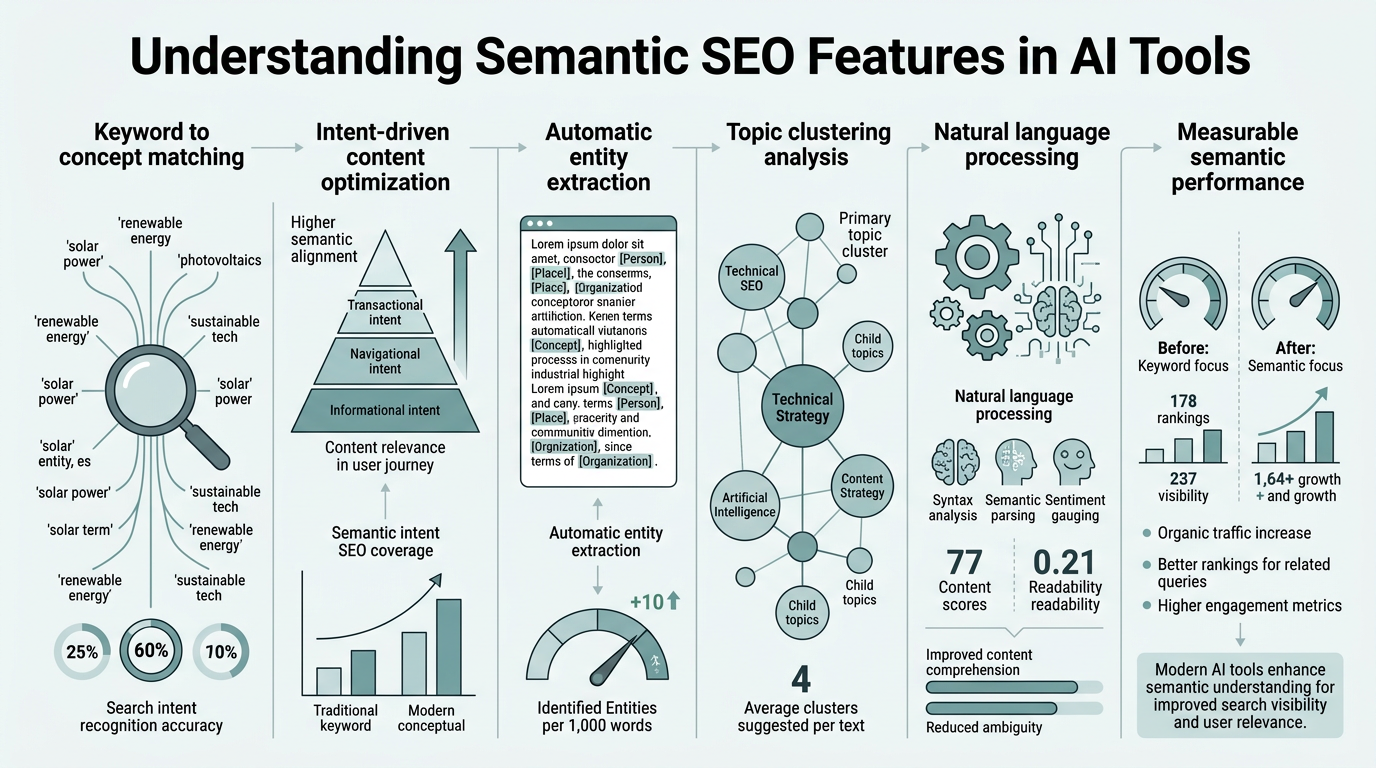
What Is Semantic SEO and Why Does It Matter in 2026?
Semantic SEO is fundamentally different from keyword-matching tactics. It's the practice of optimizing content for entire topics, user intent, and entity relationships rather than individual keywords. Nearly 70% of businesses report higher ROI from AI in SEO, and the reason is simple: AI systems (especially LLMs powering search engines) understand meaning, not just strings of text. Traditional SEO asked "Does my page contain the keyword 'best dog food'?" Semantic SEO asks "Does my page address the topic authority for pet nutrition, relate to dog health entities, and match user intent to compare products?" The former ranks pages; the latter wins AI citations and answer engine visibility.
"AI systems reward topic authority, entity relationships, content structure, and freshness. Pages that clearly structure information and relate to recognized entities see 3x higher citation frequency in AI Overviews than traditionally optimized pages."
This shift matters because search itself has fragmented. Clicks no longer flow solely to traditional blue-link results. Instead, Google AI Overviews synthesize answers from multiple sources, pulling direct citations from pages that clearly structure information. Founders and marketing teams optimizing purely for click-through rates are missing half the discovery surface. A page that ranks #5 organically but gets cited by AI Overviews to 2 billion monthly users delivers more bottom-funnel impact than a #1 ranking with declining clicks.
Semantic SEO features in modern AI-powered SEO tools automate the busywork of traditional optimization. Instead of manually researching keyword clusters and writing separate articles for each variation, tools powered by semantic understanding group keywords by intent, suggest topic clusters, and highlight gaps in content coverage. The AI doesn't just find keywords; it understands relationships between them.
How Do Entities and Knowledge Graphs Power Semantic Understanding?
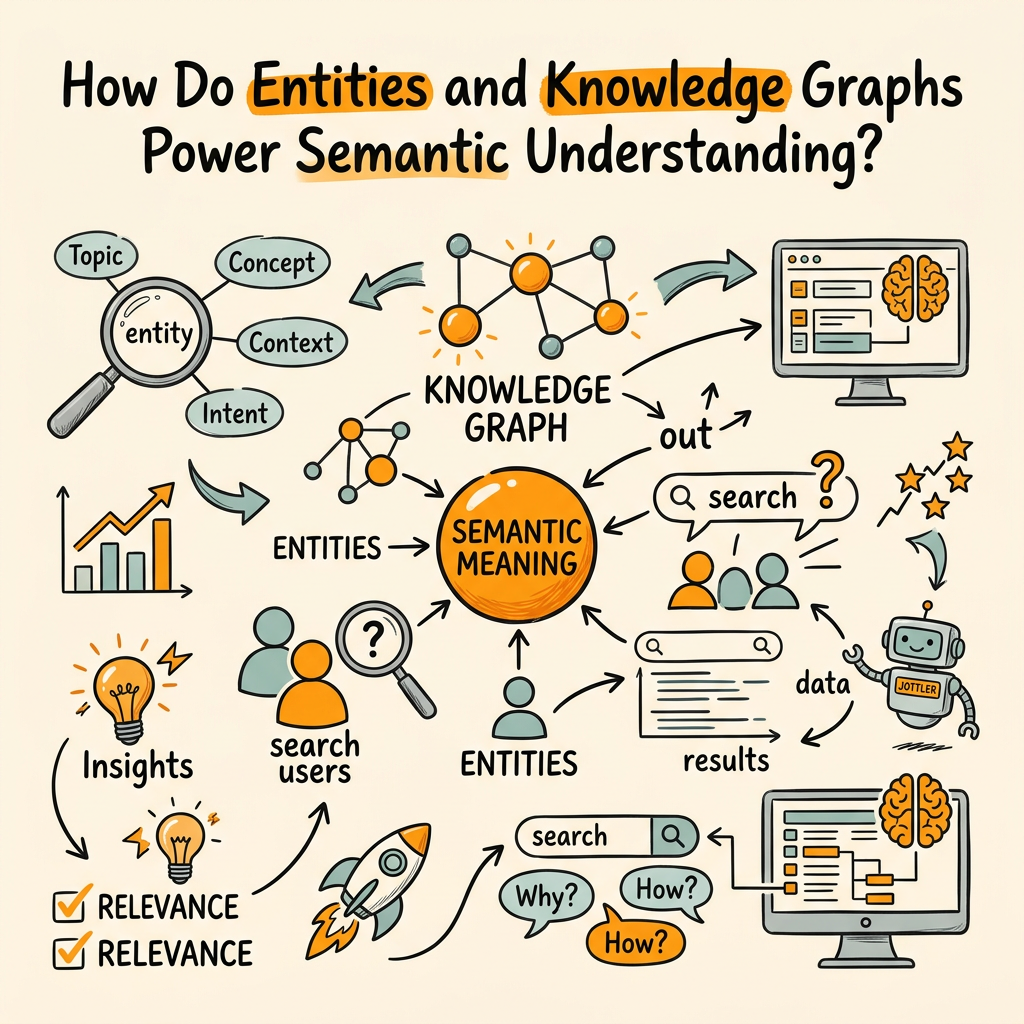
At the core of semantic SEO is entity recognition. An entity is any person, place, organization, or concept that search engines and AI systems recognize as a distinct object with relationships to other entities. Google's Knowledge Graph contains over 500 billion entities and trillions of relationships. When your content clearly references and relates to these entities, AI systems gain context. That context translates to higher semantic relevance scores.
Consider the word "Tesla." In isolation, it's ambiguous. But mention Tesla alongside "electric vehicles," "battery technology," and "Elon Musk" (all entities with known relationships to the company), and the AI instantly understands you're writing about Tesla Inc., not Nikola Tesla the inventor. Semantic AI tools recognize this nuance and suggest related entities during content creation. In a 2025 survey of 123 SEO professionals, 96% reported that AI-generated content improved their rankings, largely because modern tools automatically incorporate entity relationships that manual writing misses.
"Knowledge Graphs work hand-in-hand with entity recognition. When you optimize content to map entities correctly, your pages become candidate sources for knowledge panels, featured snippets, and AI-generated summaries."
Knowledge Graphs work hand-in-hand with entity recognition. When you optimize content to map entities correctly, your pages become candidate sources for knowledge panels, featured snippets, and AI-generated summaries. The semantic understanding feature in premium tools analyzes your target entity's relationships and suggests content structures that align with how AI systems expect information to be organized. This isn't keyword suggestion; it's relationship mapping that makes your content inherently more semantic.
What Are Structured Content Formats and Why Do AI Tools Emphasize Them?
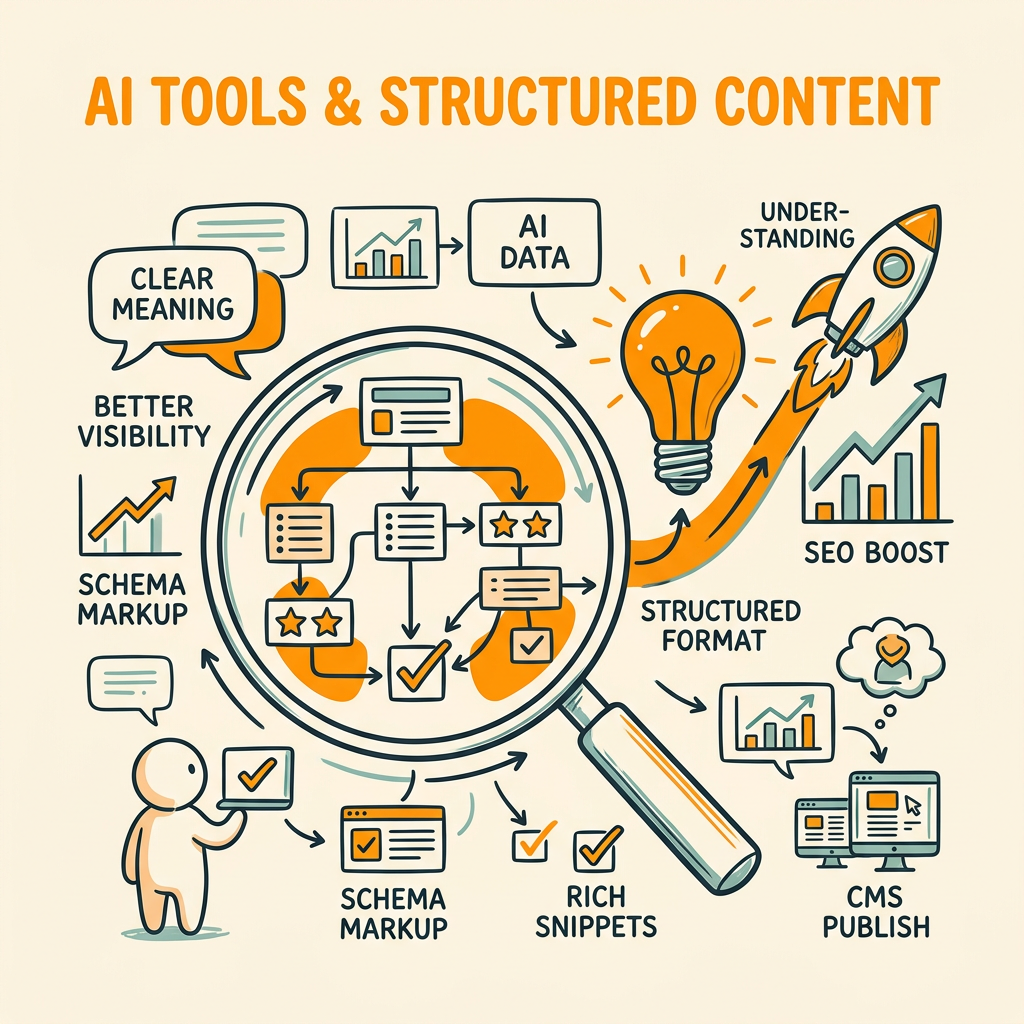
AI systems don't read your website the way humans do. They parse HTML structure, extract data from lists and tables, and prioritize clearly segmented information. Unbroken paragraphs of prose, no matter how well-written, have lower AI-readability scores. Structured formats—headings hierarchies, bulleted lists, comparison tables, FAQ sections—communicate meaning explicitly. AI tools that understand this enforce structural best practices during content generation across platforms.
- Heading hierarchies (H1-H3): Tell AI systems how topics relate and nest. A clear hierarchy helps LLMs understand your content's information architecture and cite relevant sections.
- Bulleted and numbered lists: Break complex ideas into scannable chunks. AI systems extract and reuse list items more frequently than paragraph text, making lists high-value for citation potential.
- FAQ sections: Directly target People Also Ask queries and provide concise, direct answers. FAQ formatting increases the likelihood of AI systems citing your content as a source for answer synthesis.
- Comparison tables: Present parallel information (features, pricing, specifications) in a structure AI can parse and reuse. Tables are semantic gold for product comparisons and feature analyses.
- Short, punchy sentences: LLMs generate better summaries from content with lower word-per-sentence ratios. Sentences under 20 words improve AI-readability and citation potential.
For teams implementing content automation tools, structured formatting becomes a default rather than a manual choice. The platform automatically organizes content with semantic-friendly formats, saving weeks of editing work while improving AI-search performance simultaneously.
How Does Intent-Aligned Keyword Research Differ from Traditional Approaches?
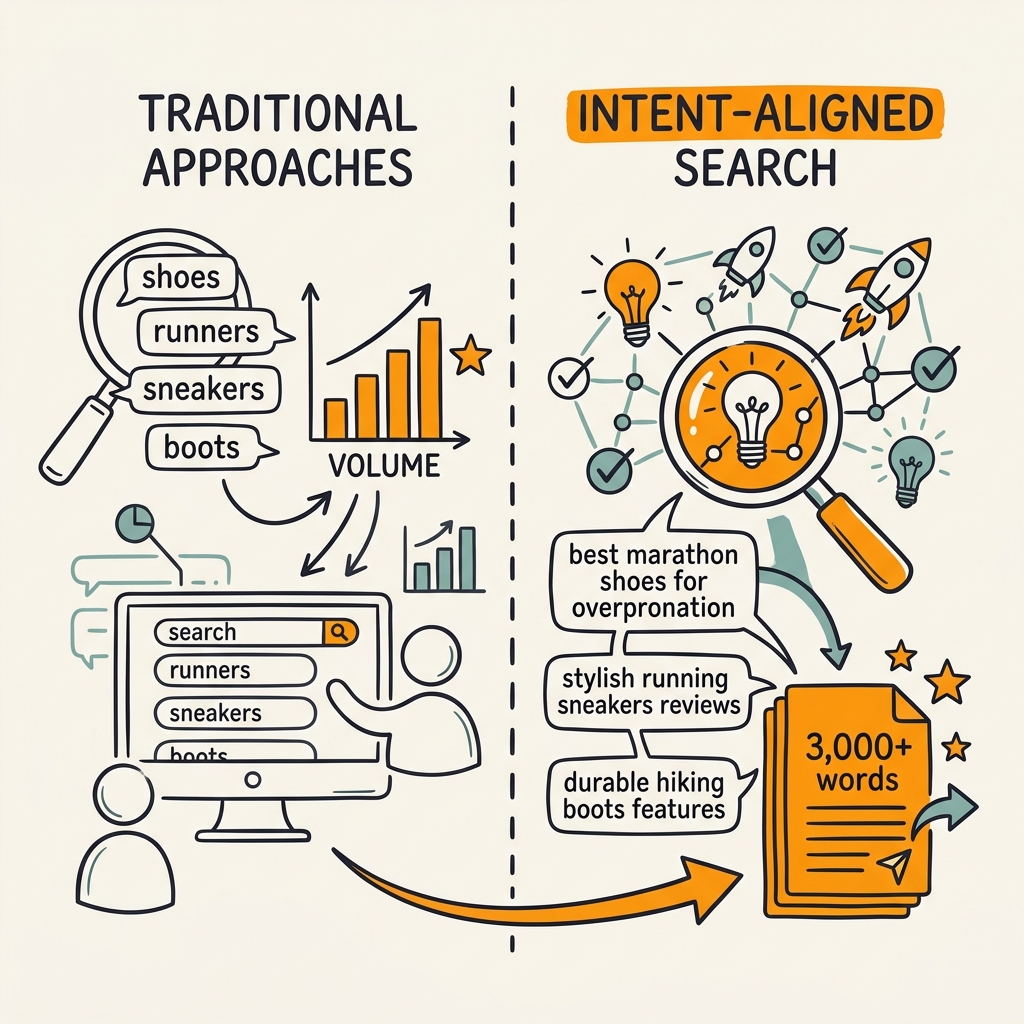
Traditional keyword research asks: "How many people search for this term each month?" Semantic keyword research asks: "Why are they searching, what other questions do they have, and how do these keywords relate topically?" The difference is profound. Instead of creating one article per keyword, intent-aligned research clusters keywords that serve the same user need, suggesting they live in a single comprehensive content piece or a tight topic cluster.
"Semantic tools that automate intent classification reduce content production costs by roughly 28%, while keeping readers on-site longer as they navigate a cohesive topical authority structure."
AI tools that understand semantic search group keywords by search intent (informational, navigational, commercial, transactional) and identify long-tail variations that share the same underlying topic. For example, "how to start a blog," "best blogging platforms," and "WordPress vs Medium" aren't three separate opportunities—they're one topic cluster requiring one pillar article and several supporting pieces. Semantic tools that automate intent classification and clustering reduce content production costs by roughly 28%, while keeping readers on-site longer as they navigate a cohesive topical authority structure.
When building a SaaS SEO strategy, semantic keyword research becomes especially valuable. The platform doesn't just identify keywords; its AI agents cluster them by topical relationship, analyze competitor gaps within each cluster, and recommend content structures that compress multiple articles into one deep-dive piece. This reduces publishing volume while increasing topical authority—the exact outcome busy founders need when competing against larger content operations.
What Role Does Content Freshness Play in Semantic SEO?
Freshness is a semantic signal modern AI tools can't ignore. When you update a page, you're not just changing dates; you're adding new context, new entities, and new semantic relationships. AI systems reward frequently refreshed content because it indicates the author understands current events, new research, and evolving intent patterns. Pages updated every 14 days show higher citation frequency in AI Overviews than pages left static for months.
This is where automation truly shines. Manual content updates are resource-intensive. Semantic AI tools automate the detection of outdated claims, suggest refresh angles, and in some cases, generate updated sections automatically. Rather than writing 10 articles once, continuous publishing means writing 3,000+ words daily, meaning your topical clusters grow in depth and freshness simultaneously—precisely what AI systems prioritize when selecting sources for synthesis and citation.
How Does Semantic Markup and Schema Improve AI Visibility?
Semantic markup (schema.org) is the bridge between human-readable HTML and AI-machine-readable structured data. Schema tells AI systems "this section is a review," "this number is a price," "this person is an expert." Without schema, an AI system has to guess at context. With schema, it knows with certainty. This certainty drives featured snippet eligibility, knowledge panel candidacy, and answer engine visibility.
| Semantic Markup Type | AI Visibility Impact | Best Use Case |
|---|---|---|
| Product schema | Higher ranking in product comparisons and shopping features | E-commerce and SaaS review pages |
| FAQ schema | Increased People Also Ask and featured snippet eligibility | Help documentation and guide conclusions |
| Article schema | Better metadata parsing for AI summary generation | Blog posts and long-form guides |
| Author/Organization schema | Entity recognition and topical authority signals | All content (establishes E-E-A-T) |
| Breadcrumb schema | Clearer content hierarchy and site structure parsing | Topic cluster and pillar pages |
Most AI content tools should include schema generation or at least schema recommendations. Platforms built for AI content strategy integrate schema recommendations based on content type and topic, ensuring every article published includes semantic markup optimized for the specific AI surface (featured snippets, knowledge panels, AI Overviews) most relevant to its topic. This means content compounds semantic visibility over time rather than fighting against structural debt.
Conclusion
Semantic SEO isn't a passing trend—it's the natural evolution of search as AI systems become the primary discovery interface. Understanding semantic features in AI tools is no longer optional for competitive keyword spaces. The engines now reward topic authority, entity relationships, content structure, and freshness. Teams that continue optimizing for keyword density and traditional rankings are competing on yesterday's playing field.
The data is clear: 95% of SEO professionals use AI tools daily, and 80% of AI-optimized content reaches page 1 of search results. But the real edge goes to founders and teams that automate semantic optimization entirely. Platforms built on semantic understanding compound organic traffic by publishing deep, fresh, topically-clustered content daily while automatically managing entity relationships, schema markup, and internal link networks. Instead of manually researching keywords and structuring content, your AI agents do it.
Start your SEO agent today at https://jottler.co/auth/signup. Let automation handle semantic optimization so you can focus on strategy and revenue.
FAQs
What is the difference between semantic SEO and traditional SEO?
Traditional SEO optimizes individual pages for specific keywords and focuses on keyword density, backlinks, and click-through metrics. Semantic SEO optimizes entire topics and user intent, prioritizing entity relationships, content structure, and how AI systems understand meaning. Traditional SEO asks "Will my page rank for this keyword?" Semantic SEO asks "Will AI systems cite this page as a source for answer synthesis?" The shift reflects how search has evolved—roughly 60% of searches now yield no clicks, flowing instead into AI-synthesized answers, making semantic visibility more important than traditional rankings alone.
Can AI tools really automate semantic SEO optimization?
Yes. Modern AI tools automate the core semantic tasks: keyword clustering by intent, entity recognition, content structure recommendations, schema generation, and freshness updates. They can't replace strategy or editorial judgment, but they eliminate the manual busywork that slows down content production and semantic iteration. AI-optimized content production reduces costs by 28% while improving ranking velocity by 41% compared to manual processes. The key is selecting a tool built specifically for semantic optimization, not one that simply generates keyword lists.
How often should I refresh content for semantic SEO benefits?
Freshness is a semantic signal—pages updated every 14 days show higher citation frequency in AI systems than static pages. However, refreshing manually every two weeks is unsustainable for most teams. The practical solution is continuous publishing that compounds semantic authority. Rather than updating five articles once a month, publish new pieces daily within your topic clusters. This approach keeps your topical authority fresh, adds new entity relationships, and increases the likelihood that AI systems cite your content. Teams publishing daily achieve 58% higher organic traffic growth than those on monthly publishing cycles.