Account-Based Marketing SEO for SaaS: Combining ABM and Organic Traffic for Revenue Growth
Most SaaS teams treat ABM and SEO as separate initiatives. But 94% of B2B marketers now use account-based marketing, while organic search drives 26% to 53% of SaaS website traffic depending on the vertical. When you integrate them, something unexpected happens: your target accounts find you organically, your SEO content speaks directly to their buying committee, and your deal size increases by 20% on average. The challenge is that combining ABM with SEO requires rethinking content strategy, keyword prioritization, and measurement. Here's how to align them without burning out your team.
Key Takeaways
- 94% of B2B marketers use ABM, and top performers allocate 18% of budget to it versus 14% for others (2025, Huble). ABM combined with owned channels like SEO compounds that advantage.
- SEO shows 702% ROI in B2B SaaS with a 7-month break-even—making it the perfect owned-acquisition layer beneath ABM campaigns.
- Content marketing generates 3x as many leads while costing 62% less than traditional marketing, giving ABM teams the reach they need on tight budgets.
- Map your ICP and buying committee first: Target account selection is everything—know exactly which accounts to pursue before you optimize keywords.
- Use intent data to prioritize SEO topics: Focus on keywords your target accounts are already researching to align organic content with active buying signals.
- Create account-level content experiences: Tailor landing pages, case studies, and guides to each account segment's pain points and buying stage.
- Measure by account, not just traffic: Track engagement at the account level and tie organic visitors directly to pipeline and revenue impact.
- Automate content production at scale: Generate content for multiple account segments and topics without manual overhead—tools like Jottler handle research, writing, and publishing daily.
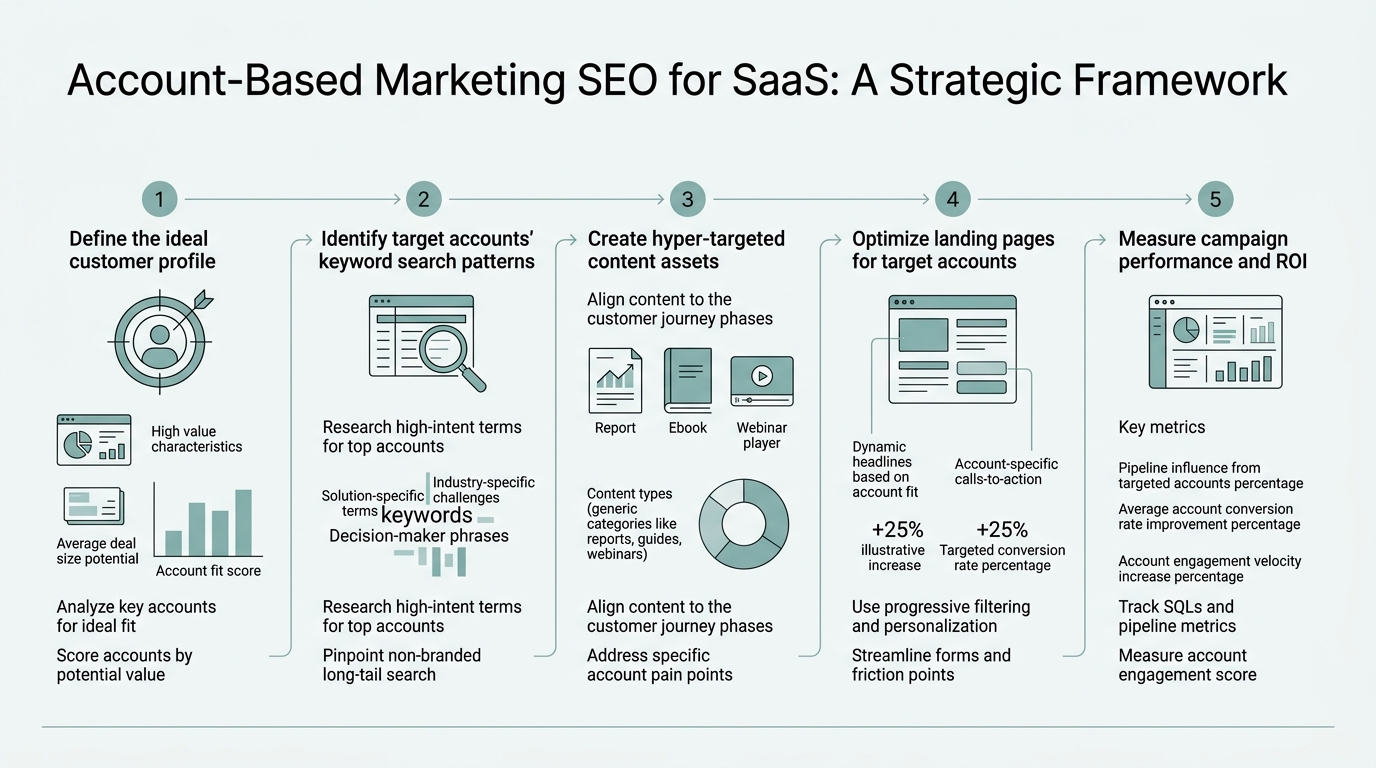
What Is Account-Based Marketing and How Does It Differ From Demand Generation?
Account-based marketing flips the traditional funnel on its head. Instead of casting a wide net to generate leads, ABM identifies a list of high-value accounts first, then builds personalized campaigns to engage each decision-maker within those accounts. The goal is to move specific accounts through the sales cycle, not to maximize lead volume. This is fundamentally different from demand generation, which prioritizes reach and MQLs.
In traditional demand generation, success is measured by cost-per-lead and lead volume. In ABM, success is measured by account engagement, pipeline creation, and deal size. Studies show ABM delivers higher ROI than any other marketing approach, with 87% of B2B marketers confirming this. The result is longer sales cycles but larger, more predictable deals.
Why Traditional Demand Gen Falls Short for Enterprise Targets
Demand generation works well for bottom-of-funnel, product-led growth motions where you want high-volume sign-ups. But when you're selling mid-market or enterprise SaaS—products with long sales cycles, multiple stakeholders, and high contract values—traditional demand gen leaves money on the table. You generate 500 qualified leads but only 5 of them are actually your ideal accounts.
ABM solves this by flipping the prioritization: identify the 50 accounts you truly want to win, then invest in personalized engagement across all decision-makers within each one. ABM programs see a 20% increase in average deal size precisely because you're focusing sales and marketing resources on accounts with real revenue potential.
"When you're selling mid-market or enterprise SaaS, traditional demand gen leaves money on the table. ABM solves this by focusing resources on accounts with real revenue potential, delivering 20% larger deal sizes on average." — Account-Based Marketing Best Practices
How ABM and SEO Create a Multiplier Effect
The secret to ABM + SEO success is that organic traffic becomes a lead-capture lever rather than just a top-of-funnel awareness channel. When your target accounts are actively researching solutions in your space, they land on your SEO-optimized content organically. You're not interrupting them with ads—they found you. That changes their perception of you and increases trust before ever speaking to sales.
For busy founders and marketing teams, this matters enormously. Organic search drives enough of total SaaS website visits that investing in SEO creates a durable competitive moat. Implementing strategic SEO approaches ensures that when organic traffic is guided by account-level targeting, conversion rates spike because the content is solving the exact pain points your target buying committee is researching.
How to Build Your Ideal Customer Profile and Target Account List for ABM SEO
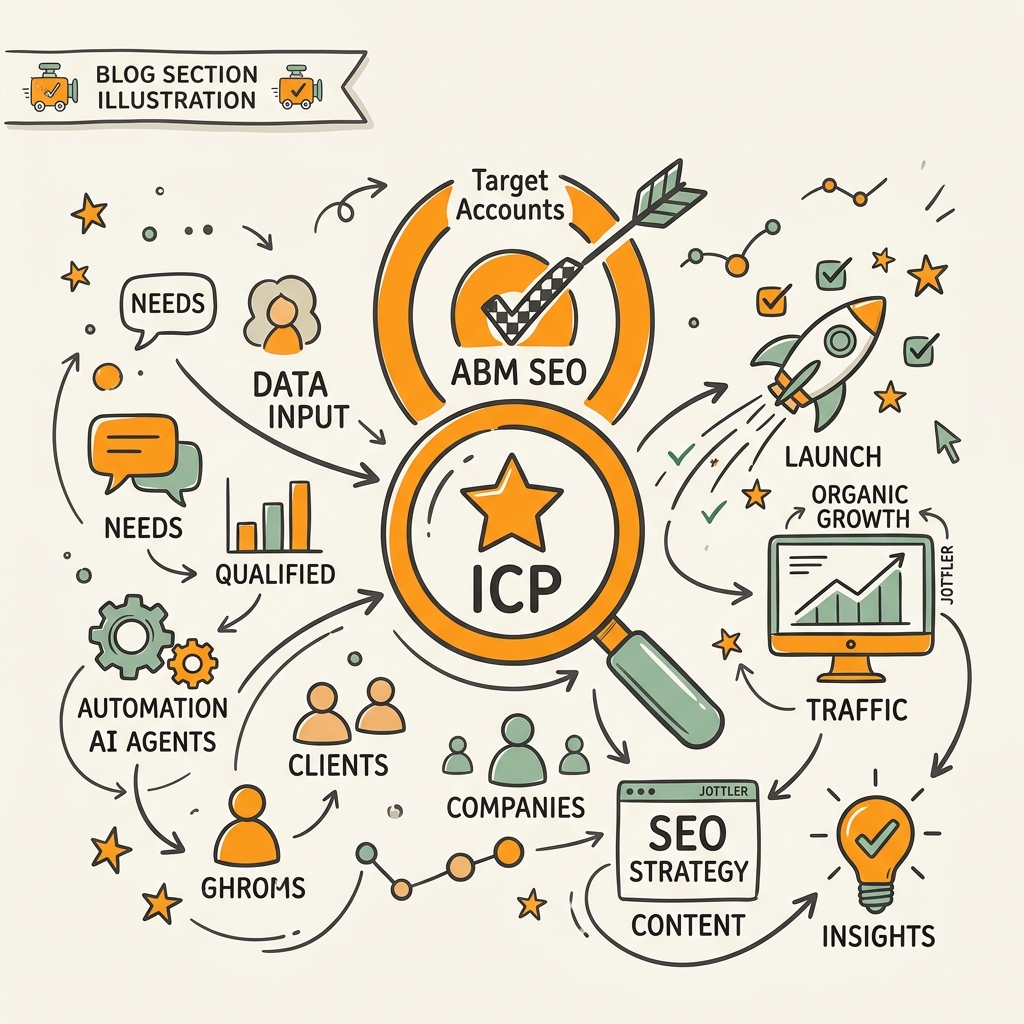
The foundation of ABM + SEO is a tightly defined ICP and a prioritized list of target accounts. Without this, you're back to writing generic SEO content that doesn't drive revenue. Your ICP should capture the account characteristics that correlate with high revenue, strong product-market fit, and long-term retention. A solid content marketing framework will guide account selection and messaging alignment.
Key ICP Components for SaaS ABM
Your ICP should define who you're targeting at three levels: company characteristics, buying committee roles, and use-case signals. At the company level, consider annual revenue, employee count, industry vertical, geography, and technology stack. Within the buying committee, identify the primary stakeholders—typically a VP of Engineering, VP of Marketing, or CFO depending on your product category.
Use-case signals tell you which companies are actively researching solutions like yours. These might include:
- Recent funding rounds or Series announcements
- Expansion into new geographic markets
- Specific tool acquisitions or migrations
- Public job postings indicating growth or new department launches
- Press releases announcing partnerships or strategic initiatives
Build your ICP from actual customer data: analyze your top 10 revenue-generating customers and reverse-engineer what they have in common. This is far more effective than guessing based on market positioning.
At this stage, many teams turn to tools to automate ICP mapping and account selection, but before doing that, ensure you understand the ICP manually. Jottler can help you produce the research and content needed to support ABM campaigns once your ICP is locked, but the ICP itself must come from your sales and customer success teams' lived experience.
Building Your Target Account List (TAL)
Once your ICP is locked, create a Target Account List (TAL) of the specific companies you want to pursue. Most effective ABM teams start with 50–100 target accounts depending on sales capacity. This number is crucial: too few and you're not building enough pipeline; too many and your personalization erodes and you're back to generic marketing.
Rank your TAL by fit and engagement potential using these criteria:
- ICP Match Score: How closely does the account align with your defined ICP dimensions (company size, industry, revenue, tech stack)?
- Purchase Intent: Based on website behavior, content engagement, and inbound signals, how likely is this account to buy in the next 6–12 months?
- Sales Team Assessment: Does your sales team have relationships with key stakeholders? Are they actively pursuing this account?
- Competitive Position: Are you the incumbent, a challenger, or completely unknown to this account?
- Account Value: What's the lifetime value potential of this account if won?
Account scoring models that combine these signals are standard practice. Use tools that integrate CRM data, web analytics, and intent signals to surface the accounts most likely to move.
How to Conduct Intent-Driven Keyword Research for Target Accounts
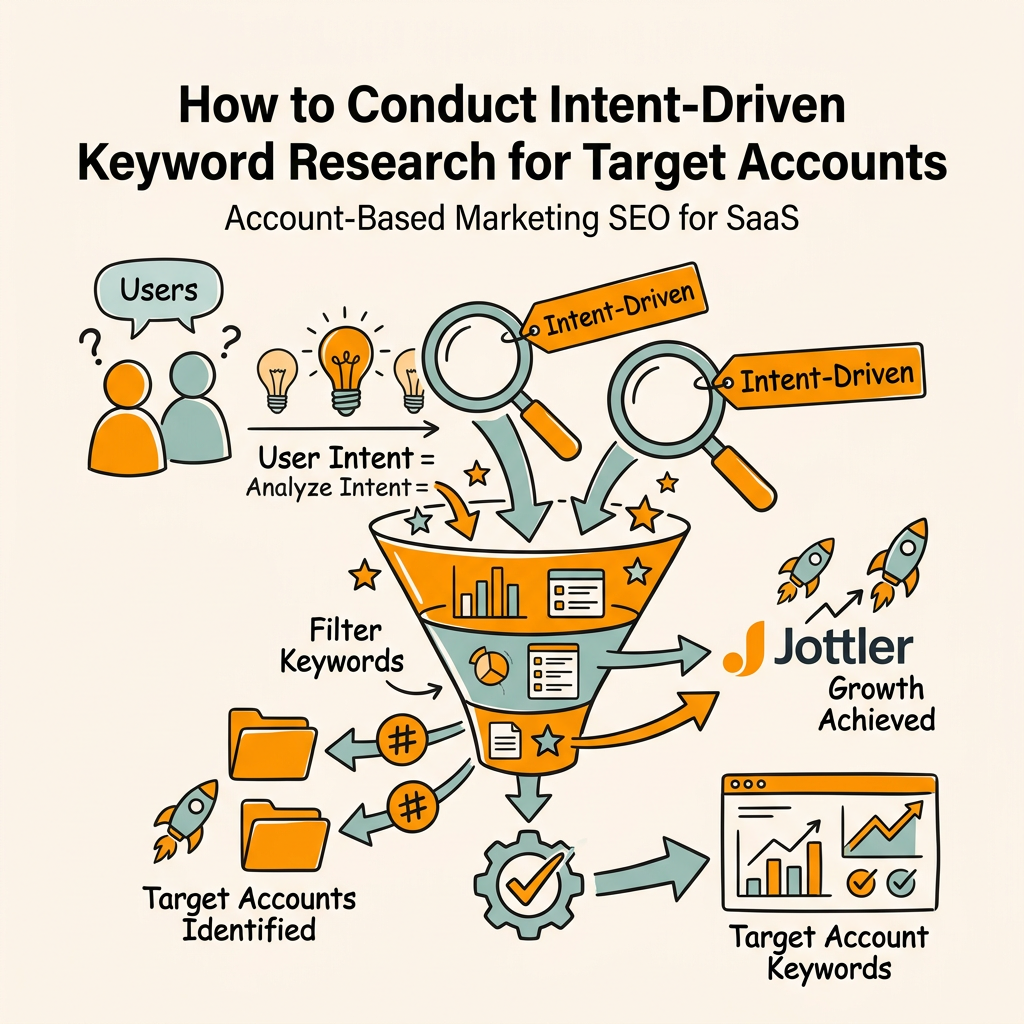
Once you know which accounts to pursue, the next step is understanding what problems they're researching. This is where ABM and SEO converge. Traditional SEO targets keywords by search volume and difficulty. ABM-focused SEO targets keywords by relevance to your specific target accounts' buying journey. Platforms that combine AI content strategy with account-level targeting unlock this advantage at scale.
Identifying Keywords Your Target Accounts Are Searching
Start by documenting the main pain points that define your target accounts. If your ICP is mid-market SaaS companies managing distributed teams, your pain points might include "remote team productivity," "asynchronous communication," "cross-timezone collaboration," and "onboarding distributed sales teams." These pain points become the foundation for keyword research.
From each pain point, expand to three keyword categories:
- Problem-Aware Keywords: Searches made when prospects feel the pain but haven't identified a solution category yet (e.g., "how to improve team productivity with remote work," "why remote teams lose productivity")
- Solution-Aware Keywords: Searches made when prospects are actively evaluating solution categories (e.g., "best remote team collaboration tools," "asynchronous communication software for sales teams")
- Product-Specific Keywords: Searches for your product by name or direct competitor comparisons (e.g., "X vs Y," "X pricing," "X implementation")
Map these keywords to your target account segments. If you have three distinct ICP segments—e.g., sales teams, engineering teams, and product teams—your keyword strategy should reflect the specific pain points and buying triggers for each. This is where generic keyword research ends and ABM-specific content planning begins.
Using Purchase Intent Signals to Prioritize Topics
Not all keywords are equally valuable for ABM. Prioritize keywords that show high purchase intent within your target accounts. Purchase intent includes explicit signals (company is searching for you by name, researching competitor comparisons) and implicit signals (they've visited your website, engaged with your ads, downloaded resources).
"When you notice target accounts searching for 'SaaS sales stack 2026,' that's a signal they're in evaluation mode and likely looking at multiple point solutions. Content that guides them through your product category positions you to capture their attention before they narrow to finalists." — ABM Content Strategy Insights
Second-order intent matters too: if you notice your target accounts searching for "SaaS sales stack 2026," that's a signal they're in evaluation mode and likely to be looking at multiple point solutions. Creating content that guides them through your product category and educates them on evaluation criteria puts you in position to capture their attention before they narrow to finalists.
This is where content automation becomes critical for busy teams. Generating content around 10–15 primary themes for each target account segment, plus 30–50 supporting topics, would take a small content team weeks to plan and months to execute manually. Automation tools like Jottler handle keyword research, topic clustering, and content generation across multiple segments daily, compounding your coverage without burning out your team.
How to Create Account-Tailored Content That Drives Pipeline
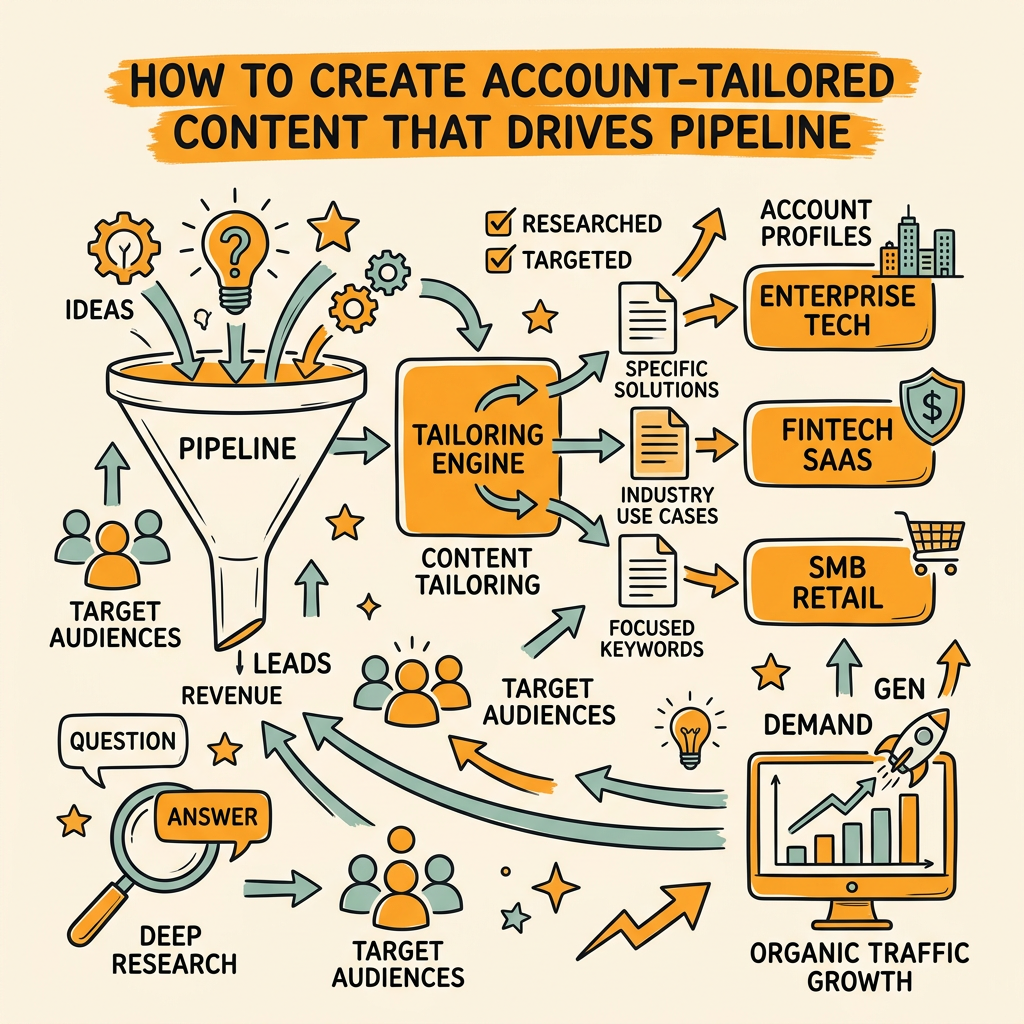
Now comes the execution layer: creating content that speaks directly to your target accounts at each stage of their buying journey. This is where ABM-focused SEO yields its highest ROI—when your content is so aligned with their pain points and buying context that it becomes a natural part of their research process. Building topical authority around your target accounts' core concerns accelerates this process.
Segmented Content Strategies for Different Account Types
Build three content frameworks: one for Tier 1 accounts (your highest-value targets requiring maximum personalization), one for Tier 2 accounts (solid targets requiring good fit but not white-glove treatment), and one for Tier 3 accounts (broader ICP fit, scalable content).
Content approaches by tier:
- Tier 1: Account-specific case studies, competitive comparison guides tailored to their exact use case, ROI calculators for their business model, implementation roadmaps for their scale. These are resource-intensive but deliver outsized engagement and move deals forward.
- Tier 2: Vertical-specific guides, industry best-practice resources, benchmarking content for their company size, solution guides addressing their primary pain points. Good fit without single-account customization.
- Tier 3: Scalable evergreen content on core topics (foundational problem guides, trend reports, how-to resources) that attracts broad ICP fit without personalization. High-volume, repeatable content that builds topical authority.
The key is consistency and volume. SaaS companies that publish content regularly see measurable improvements in lead quality and sales cycle velocity. But scaling manual content creation for three segments across dozens of topics is unsustainable for lean teams. Jottler solves this by generating 3,000+ words of multi-segment content daily, allowing you to cover all account tiers and topics without staff expansion.
Content Topic Matrix: Mapping Keywords to Buying Stages
Create a content matrix that maps your core keywords to buying stages within your target accounts. Map top-of-funnel content (awareness, problem recognition) to your broadest, intent-neutral keywords. Map middle-of-funnel content (solution evaluation) to problem-aware and solution-comparison keywords. Map bottom-of-funnel content (decision) to high-intent commercial keywords and competitive keywords.
| Buying Stage | Content Type | Target Keywords | Engagement Goal |
|---|---|---|---|
| Awareness | Trend reports, industry insights, thought leadership | "Best practices for X," "trends in Y," "how to improve Z" | Establish credibility with target accounts |
| Consideration | Comparison guides, ROI calculators, webinars, technical guides | "A vs B," "cost of X," "how to implement Y," "features of Z" | Drive consideration and evaluation of your solution |
| Decision | Case studies, competitor comparisons, implementation guides, customer testimonials | "X pricing," "X vs competitors," "X implementation," "X reviews" | Tip the decision in your favor and reduce objection handling load on sales |
This matrix is your content production roadmap. Once it's locked, you know exactly what content you need to produce and in what volume. For 50 target accounts across three tiers with coverage of 5 buying-stage themes, you're looking at 75–150 pieces of content to fully round out your ABM content motion. Traditional content teams would estimate 6–12 months of work. Automated content generation can execute this in weeks.
How to Measure ABM SEO Success at the Account Level
Most SaaS marketing teams measure SEO by traffic, rankings, and generic conversion rates. ABM requires a different measurement approach. Success isn't a 10% increase in traffic; it's your top 50 target accounts engaging with your content, moving through the buying journey, and converting to revenue.
Account-Level Engagement Tracking
Set up account-based analytics by integrating your CRM account list with your analytics platform. This allows you to see which target accounts are visiting your site, which content they're consuming, how long they're spending on each piece, and whether they're progressing through your buying-stage content sequence.
Track these account-level KPIs:
- Percentage of TAL visiting your site monthly: What % of your 50–100 target accounts visit your website in a given month? This should trend upward as content scales.
- Average pages per account per visit: How deeply are target accounts engaging with your content? Higher page depth indicates stronger fit and interest.
- Content-path progression: Are accounts moving from awareness content to consideration to decision content? Track how many accounts progress through each buying stage.
- Conversion rate by account: Which target accounts convert to leads or trials? Conversion rate by account reveals which segments respond best to your content.
- Time-to-first-touch for top accounts: How long between first site visit and sales outreach? Shorter timeframes mean better sales alignment with marketing signals.
- Engagement score by account: If a target account visits 3+ pieces of content in a month, or spends 5+ minutes on your site, they're showing buying intent.
Connecting Content Engagement to Pipeline and Revenue
The ultimate ABM SEO metric is pipeline attribution. When a target account engages with your SEO content, then sales reaches out and opens an opportunity, that's an ABM win. Attribution isn't perfect—it's rarely clear whether SEO drove the sale or just supported it—but directional patterns are valuable.
Many ABM teams use a simple engagement score: if a target account visits 3+ pieces of content in a month, or spends 5+ minutes on your site, trigger a sales alert. This keeps sales aligned with marketing and ensures follow-up happens while the account is actively researching.
Finally, track revenue impact: opportunities sourced from target accounts who engaged with your ABM content, average deal size for those opportunities, and win rate. This is where you prove ROI to leadership and justify continued investment in ABM + SEO.
How to Build an Integrated ABM and SEO Tech Stack
ABM + SEO requires coordination across content production, CRM, analytics, and advertising platforms. Here are the core layers: account identification and scoring, content production and management, analytics and measurement, and sales alignment tools.
Core ABM + SEO Tech Stack Components
Start with your CRM as the source of truth for target accounts. Use account-based analytics tools (like Terminus, 6sense, or Demandbase) to layer purchase intent, web engagement, and account scoring on top of your CRM data. For content, you need a platform that integrates SEO optimization with account-level publishing and tracking. For many fast-growing teams, content automation tools are becoming essential—both to produce the volume of account-segmented content needed and to handle the research, optimization, and publishing overhead.
Your ABM + SEO tech stack should include:
- CRM Platform (Salesforce, HubSpot, Pipedrive): Source of truth for target accounts and pipeline tracking.
- Account-Based Analytics (Terminus, 6sense, Demandbase, or Clearbit): Purchase intent scoring, account engagement tracking, and enrichment.
- Content Production & Automation (Jottler): Keyword research, SEO content generation, publishing, and internal linking automation for multiple account segments.
- Analytics Platform (Google Analytics 4, Mixpanel, Amplitude): Website behavior tracking and account-level analytics.
- Content Management System (WordPress, HubSpot CMS, or custom): Publishing, editorial calendar, and asset management.
- Paid ABM Platform (6sense, Demandbase, or LinkedIn): Retargeting and ad personalization for target accounts.
Tools like Jottler sit in this content production layer. They automate keyword research specific to your target account segments, generate optimized long-form content for each segment, and publish directly to your CMS while handling internal linking to tie your content hub together. This removes the manual bottleneck that slows most ABM programs: the content itself.
Finally, integrate your analytics platform (Google Analytics, Mixpanel, or Amplitude) with your CRM and account-based analytics tools so you can see account-level site engagement and pipeline correlation in one dashboard.
Conclusion
Account-based marketing and SEO are no longer separate initiatives for SaaS teams scaling beyond $5M ARR. The best performers combine them: targeting their highest-value accounts, producing SEO content around the exact problems those accounts are researching, and measuring success by account engagement and revenue impact rather than vanity metrics.
The shift from demand generation to ABM requires rethinking content strategy, but the upside is substantial. Top-performing ABM programs allocate 18% of budget to ABM versus 14% for average performers, and those teams see 20% higher deal sizes and 20-30% faster sales cycles. When you layer in SEO, you add a durable owned-acquisition channel that compounds over time, reducing reliance on paid media and building a sustainable growth engine.
For busy founders and marketing leaders, the challenge is execution at scale. Combining ABM with consistent, high-quality SEO content production requires either hiring a large content team or automating the process. Most scaling SaaS teams choose the latter. Start your SEO agent today and generate account-tailored content across multiple segments daily—automating the research, writing, and publishing that would otherwise take your team weeks to execute.
FAQs
How do I define my ideal customer profile for ABM and SEO?
Start by analyzing your top 10 paying customers. Document their company size, industry vertical, revenue, employee count, technology stack, and how they use your product. Then identify common patterns—these are your ICP dimensions. Layer in use-case signals like recent funding, hiring sprees, or tool acquisitions that indicate buying intent. The strongest ICPs come from customer data, not market assumptions. Once you've reverse-engineered patterns from real customers, validate that those patterns exist in your target market before scaling your ABM motion.
What's the fastest way to scale ABM content production without hiring?
Manual content production doesn't scale for ABM. You need to cover multiple account segments, multiple buying stages, and dozens of topics consistently to move the needle. Content automation tools are the practical solution. Platforms like Jottler handle keyword research tailored to your account segments, generate 3,000+ word articles daily, optimize for SEO and your target keywords, and publish directly to your CMS. This removes the research and writing bottleneck, letting one marketer produce content that would take a three-person team months to execute manually.
How long does it take to see ROI from ABM and SEO combined?
SEO typically breaks even in 7 months for B2B SaaS, but ABM accelerates that timeline. When your content is aligned with target account buying signals, you see engagement and pipeline contribution much faster—often within 3–4 months. The key is volume and consistency. If you publish 2–3 pieces of content per week tailored to your target accounts, you'll see measurable pipeline contribution within a quarter. If you publish sporadically, expect 6–12 months. Automation compounds this advantage by ensuring consistent output without team burnout.