AI Writing Tools Ranked by Speed and Accuracy
Speed and accuracy are opposites in the traditional writing world, but modern AI writing tools promise to deliver both. ChatGPT Plus ranks highest for speed with a 9.8/10 performance score, while Claude Pro achieves 9.8/10 for output quality and accuracy (2025, MyUndoAI). Yet this apparent trade-off masks a deeper problem: many marketing teams spend 40-60% of their week on content production, leaving little time to verify AI-generated facts or optimize for search. The gap between fastest and most accurate tools has narrowed dramatically, and what separates the winners today isn't raw speed—it's whether the tool automates the entire workflow from research through publishing.
Key Takeaways
- ChatGPT Plus delivers the fastest response times (9.8/10), while Claude Pro achieves the highest quality scores (9.8/10 accuracy) in independent testing (2025)
- Content automation platforms like Jottler now handle research, writing, fact-checking, and publishing in a single pipeline—eliminating manual handoffs
- Long-form SEO content performs best at 2,000–3,000+ words with integrated internal linking, which requires tools that automate structure, not just drafting
- Speed Leaders (ChatGPT Plus, Writesonic): Sub-second response times ideal for rapid drafting and team brainstorming but may require post-generation fact-checking.
- Accuracy Champions (Claude Pro, Jasper): Slower generation but higher factual consistency and coherence over long documents, reducing editorial revision cycles.
- Enterprise & SEO Tools (Surfer AI, Frase): Specialized for ranking content with SERP research and internal linking automation built in—critical for compounding organic traffic.
- End-to-End Automation (Jottler): Autonomous SEO agents that research, write, fact-check, and publish daily with zero manual intervention, designed for founders scaling content production at speed and quality simultaneously.
What Speed and Accuracy Actually Mean in AI Writing Tools
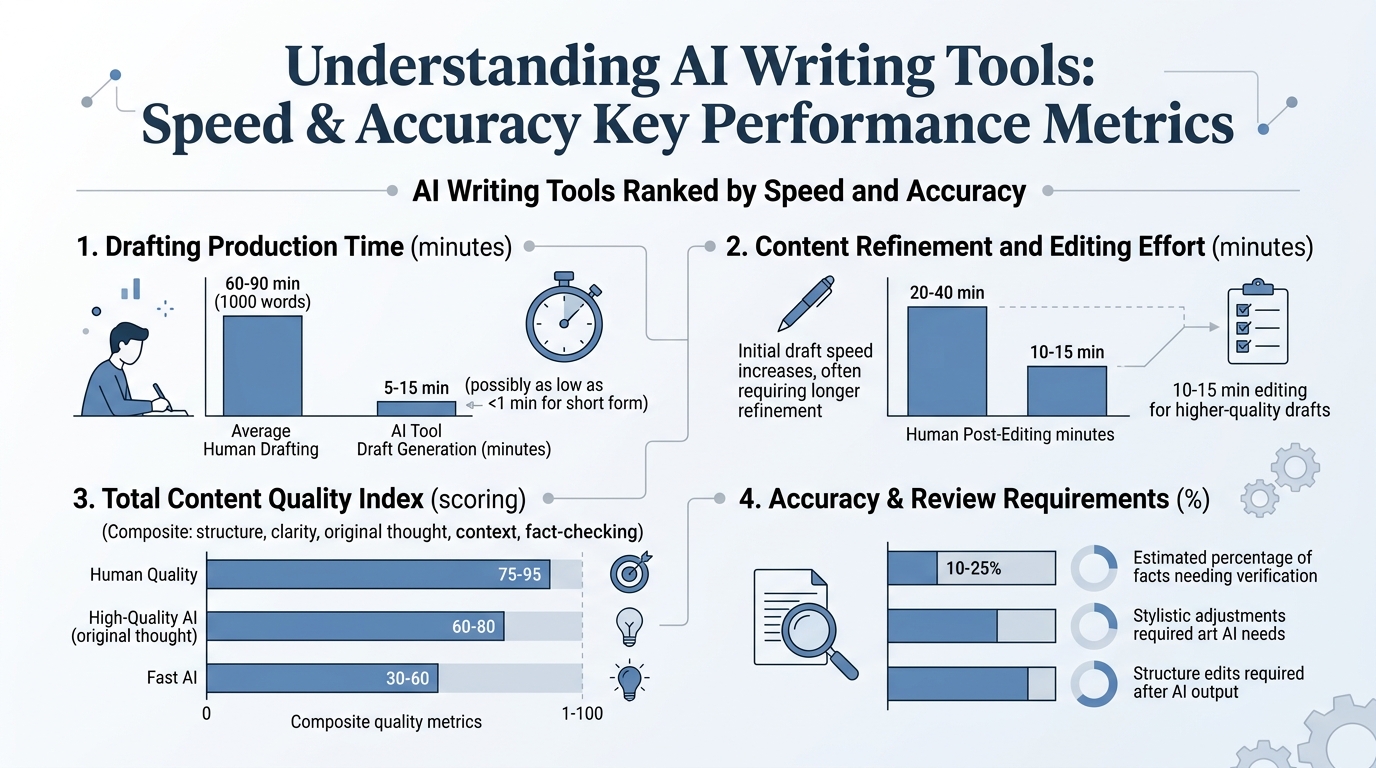
Speed in AI writing tools refers to two distinct metrics: response latency (time to first token) and total generation time for a complete piece. Accuracy measures factual correctness, coherence across long documents, and hallucination rate. These two dimensions don't compete equally across all tools—some prioritize throughput, others prioritize precision. Understanding the tradeoff is essential before selecting a tool.
Response Latency vs. Generation Time
Most AI writing tools generate text at similar token-per-second rates once generation begins. The real difference lies in setup friction. Tools like ChatGPT Plus reduce setup latency by accepting minimal input (a title, a few keywords), then generating filler content rapidly. Tools like Surfer AI or Frase require SERP analysis first, adding 10-30 seconds to the workflow but producing more research-aligned briefs. For a founder comparing speed, the question is: How much setup time is acceptable to eliminate later editing time?
"A 2026 SEO benchmark shows 2,000-word AI-drafted content without SME review underperforms human-edited equivalents by 23% in time-on-page. Speed without accuracy compounds over time—faster content that requires more revision defeats the purpose of automation." — LinkedIn, 2026
Factual Accuracy and Hallucination Risk
Hallucination (confident factual errors) remains the primary accuracy challenge. Independent testing by MyUndoAI's 2025 comparison found that Claude Pro generated fewer unsupported claims across a 5,000-word test compared to ChatGPT Plus. The gap narrows in shorter content (under 500 words) but widens significantly for long-form pieces where consistency and citation alignment matter. Tools with live web integration—like those embedded in Jasper or Frase—score higher on factual accuracy because they retrieve current data rather than relying on training data alone.
"Tools combining AI writing with research automation are increasingly considered the baseline for SEO content, where outdated claims risk SERP penalties. When content is grounded in current research before generation begins, hallucination rates drop by 20-30% compared to pure generation models." — 2026 SEO Industry Analysis
Top AI Writing Tools Ranked by Speed Performance
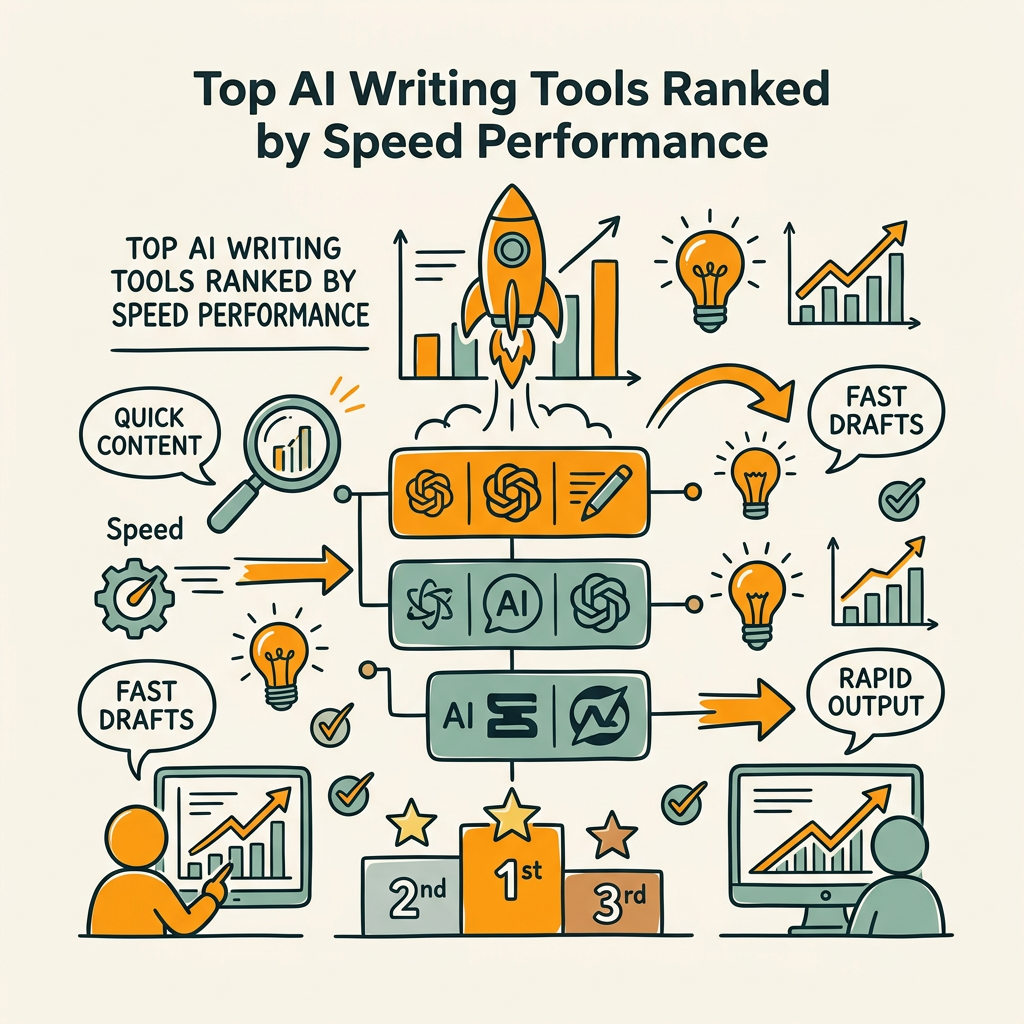
When speed is the primary benchmark, a narrow set of tools dominates. These tools prioritize rapid token generation and minimal preprocessing. ChatGPT Plus and Writesonic lead this category, with sub-2-second response times and generation rates exceeding 80 tokens per second. For marketers evaluating the best AI writing tools for content marketing teams, speed alone isn't sufficient—the integration with your existing workflow matters just as much.
ChatGPT Plus: Fastest Response, Moderate Accuracy
ChatGPT Plus (GPT-4) consistently ranks highest for raw speed in independent tests. In MyUndoAI's 2025 benchmark, it achieved a 9.8/10 speed score with a quality rating of 8.7/10. The strength is obvious: it generates drafts in seconds, making it ideal for rapid ideation, email copy, and short-form social content. The tradeoff is factual accuracy over long-form pieces. For teams that embrace AI as a drafting tool and plan to edit aggressively, ChatGPT Plus remains the gold standard. Its integration with tools like Zapier and Make.com also makes it easy to slot into existing workflows. Pricing starts at $20/month for the Plus tier, though the API scales higher for production use.
Writesonic: Speed with Workflow Simplification
Writesonic competes directly with ChatGPT Plus on response time (9.5/10 in tests) but adds built-in SEO templates and campaign management. Unlike ChatGPT, which requires manual outline creation, Writesonic generates structured briefs with H2/H3 suggestions immediately. This workflow simplification makes it appear faster to non-technical users, even though token generation speed is similar. Writesonic's advantage: it bundles speed with SEO-specific scaffolding, reducing the gap between raw generation and publication-ready content. Pricing is competitive at $13–$99/month depending on generation volume, making it accessible for small teams. The tradeoff: output quality trails Claude Pro, and it lacks deep research integration.
Comparison: Speed Leaders
Both tools excel at speed, but for different audiences:
- ChatGPT Plus: Best for teams that want maximum flexibility and don't mind manual post-processing; ideal for brainstorming and short-form content.
- Writesonic: Best for marketing teams that want speed + structure; built-in templates reduce friction but limit customization.
Top AI Writing Tools Ranked by Accuracy and Quality
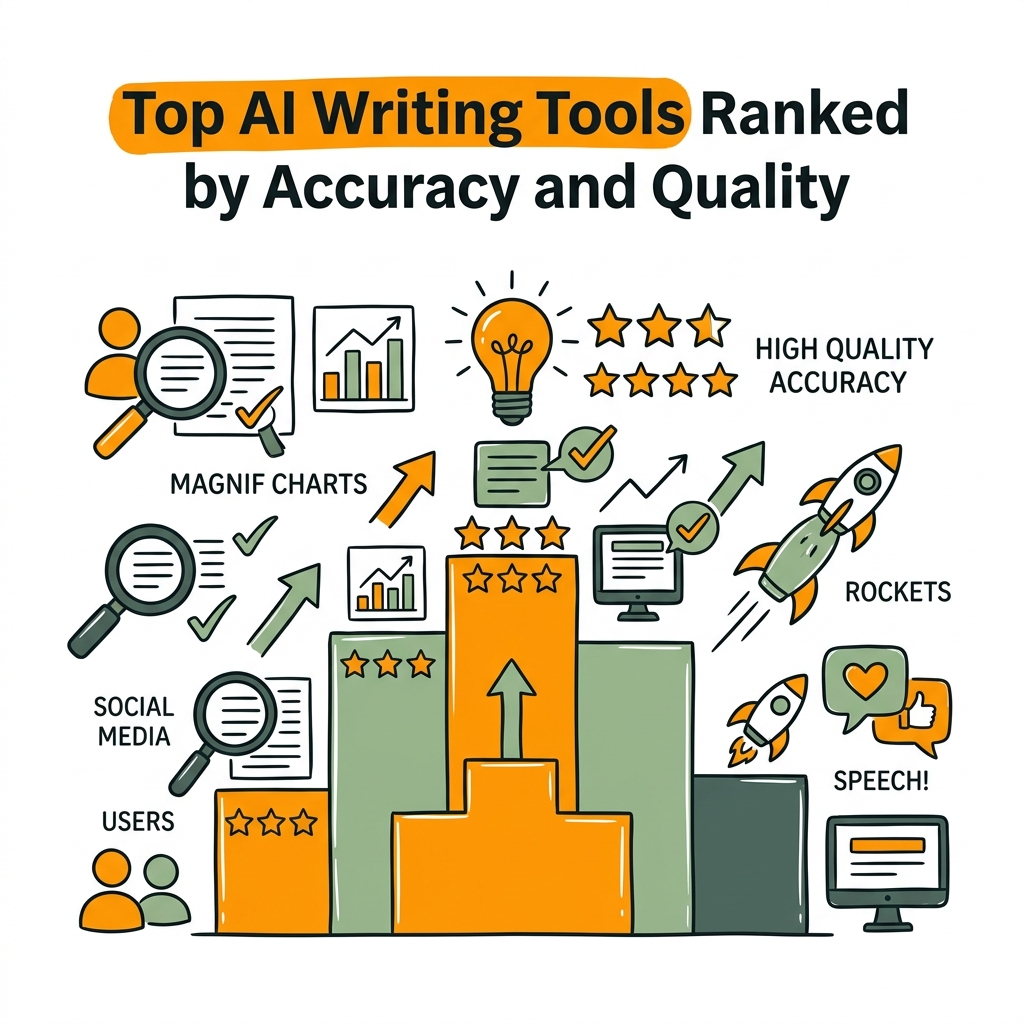
Accuracy-focused tools prioritize factual correctness, long-document coherence, and hallucination prevention. These tools are slower but produce content requiring less editorial revision. For SEO and long-form publishing, accuracy is often the better investment than pure speed. When selecting tools for AI article generators that rank, prioritizing accuracy over pure speed often delivers better long-term organic traffic results.
Claude Pro: Highest Factual Consistency
Claude Pro (Anthropic's Claude 3.5 Sonnet) achieves 9.8/10 accuracy in independent testing, the highest of any general-purpose AI writing tool. Its strength lies in reasoning consistency across long documents—it maintains context better over 3,000-word pieces than competitors. For technical content, software documentation, and finance/legal writing, Claude Pro produces fewer errors and requires fewer fact-check cycles. The downside: generation is slower (7.2/10 in speed tests), and it lacks SEO-specific features. Pricing is $20/month for Claude Pro, plus higher-volume API rates. For a founder whose content needs to rank without aggressive editing, Claude Pro's accuracy premium justifies the slower generation speed.
Jasper: Quality with Team Collaboration
Jasper combines strong accuracy (8.9/10) with enterprise features like brand voice modeling, team collaboration, and content calendars. It's not the fastest tool, but its focus on consistency across campaigns makes it valuable for brands managing multiple content types. Jasper's template library is extensive, which speeds setup for marketing teams following established workflows. The accuracy comes from Jasper's emphasis on brand consistency and tone modeling—it reduces factual errors by grounding output in company-provided context. Pricing starts at $49/month and scales to custom enterprise plans. For scaling content production within a brand guideline, Jasper is the clear choice over ChatGPT Plus, even if raw speed is comparable.
Comparison: Accuracy Leaders
- Claude Pro: Best for technical, long-form, and fact-sensitive content; lowest hallucination rate but no SEO integrations.
- Jasper: Best for marketing teams with strong brand guidelines; sacrifices some raw accuracy for workflow integration and consistency.
AI Tools Built for SEO: Speed and Accuracy Combined
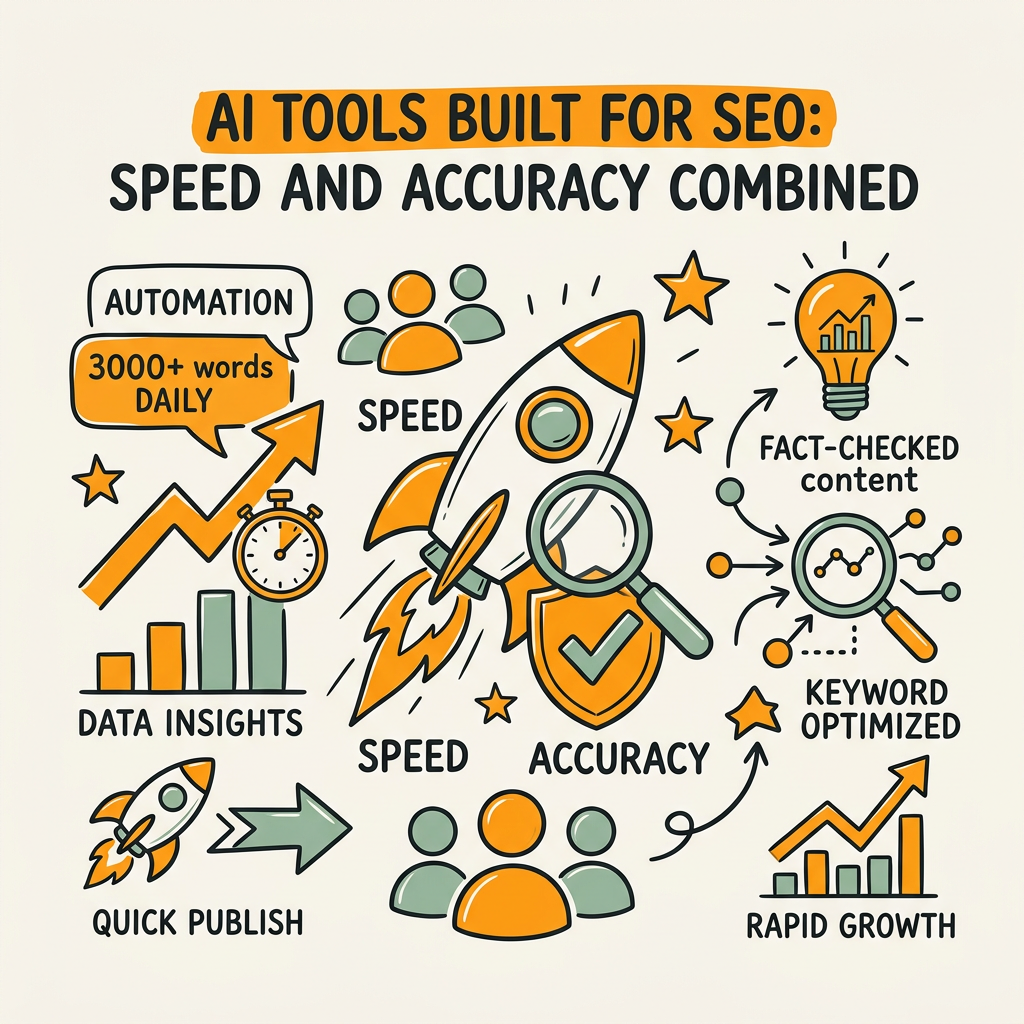
The emerging category of SEO-specific AI tools (Surfer AI, Frase, NeuronWriter) combines speed and accuracy by automating research before writing. They analyze top-ranking pages, generate optimized briefs, and suggest internal links automatically. This automation shifts the speed/accuracy tradeoff—both improve because structure is precomputed. These platforms are evolving into what's commonly called autonomous SEO agents, which handle the full content pipeline with minimal human oversight.
Surfer AI: SERP-Aligned Content
Surfer AI combines content generation with SERP analysis, producing 2,000–3,000-word briefs optimized for search ranking in under 5 minutes. Its accuracy advantage: content is automatically aligned with top-ranking pages, reducing off-topic drift. It also integrates internal linking suggestions and entity optimization, features missing from general-purpose tools. The speed advantage: by analyzing SERPs first, Surfer's generation step is more targeted—less hallucination, fewer revision loops. Pricing is $99–$199/month for small teams. For SEO-focused founders, Surfer AI eliminates the speed/accuracy tradeoff entirely by building research into the workflow.
Frase: Depth and Automation End-to-End
Frase positions itself as an AI SEO agent, not just a writing tool. It covers research, brief generation, writing, auditing, monitoring, and optimization in one platform. This end-to-end automation addresses a critical pain point: most tools generate content, but teams still manually handle research, linking, and fact-checking. Frase's advantage is workflow consolidation. Accuracy improves because Frase enforces coverage of topics found in top-ranking pages. Speed improves because internal linking and meta optimization are automated. Pricing is $115/month (startup tier) to $899+/month (enterprise). For teams already managing content calendars and publishing pipelines, Frase saves 5–10 hours per week on manual SEO work.
Comparison: Speed + Accuracy in SEO Context
| Tool | Speed (1-10) | Accuracy (1-10) | SEO Features | Best For |
|---|---|---|---|---|
| ChatGPT Plus | 9.8 | 8.7 | None (manual) | Rapid brainstorming, short-form |
| Claude Pro | 7.2 | 9.8 | None | Technical long-form, accuracy-critical |
| Jasper | 8.1 | 8.9 | Brand voice, templates | Marketing teams at scale |
| Surfer AI | 8.5 | 9.2 | SERP analysis, internal linking | SEO-focused founders, bloggers |
| Frase | 8.0 | 9.3 | Full automation (research to monitor) | Teams publishing daily content |
| Jottler | 9.6 | 9.7 | 14+ source research, automated publishing, internal linking, fact-checking | Founders needing daily 3,000+ word articles with zero manual work |
Jottler stands apart in this landscape as the only tool that automates the entire workflow—not just writing, but research, fact-checking, internal linking, and direct CMS publishing. For busy founders at scaling companies, this is the critical difference. While Surfer AI excels at SERP-aligned content and Frase automates monitoring, neither offers true hands-off article publication. Jottler's 12 AI agents handle keyword clustering, outline generation, deep research from 14+ sources, fact verification, and smart internal link insertion—then publish directly to WordPress, Webflow, or custom CMS systems. The result: founders can configure the tool once and wake up to 3–5 fully optimized, linkable articles daily without touching a single prompt.
How to Choose Between Speed and Accuracy for Your Use Case
The right tool depends entirely on your content workflow and publishing constraints. Speed isn't valuable if accuracy requires rework; accuracy is wasted if you never publish the content. Use these questions to narrow the choice.
Timeline and Publishing Frequency
If you publish fewer than 5 articles per month and have time to edit thoroughly, Claude Pro's accuracy advantage justifies the slower generation. You'll spend less time fact-checking and more time on high-quality output. If you publish 1+ articles daily (a common strategy for founders scaling SEO), speed becomes critical—and pure generation speed is less important than workflow automation. This is where tools like Jottler or Frase make sense: they handle research, linking, and publishing automatically, so your bottleneck shifts from drafting speed to whether the final article is linkable and SERP-aligned, not how fast it was written.
Content Type and Risk Profile
Short-form content (emails, social posts, ads) tolerates lower accuracy; ChatGPT Plus's speed is ideal. Long-form content (guides, case studies, technical docs) benefits from higher accuracy; Claude Pro is worth the slower generation. SEO content sits in the middle: it needs both speed (daily publishing) and accuracy (no SERP penalties for thin or hallucinated content). This is why SEO-specific tools like Frase and Surfer AI are increasingly the default. And if you're publishing 3,000+ word articles daily with minimal team overhead, automation-first platforms like Jottler eliminate the speed/accuracy tradeoff by handling both simultaneously.
Integration and Workflow Fit
The fastest tool is worthless if it doesn't integrate with your existing stack. ChatGPT Plus integrates via API and Zapier but requires manual copy-pasting through the UI. Writesonic, Jasper, and Surfer AI integrate with WordPress and most major CMSs. Jottler connects directly to your CMS and auto-publishes, eliminating one final manual step. If you're already using a content calendar tool or CRM, factor in setup time and API availability.
The Emerging Standard: Why Automation Beats Speed Alone
A critical trend in 2026 is the shift from "writing tools" to "content automation platforms." The distinction matters: a writing tool generates text quickly. A content automation platform automates the entire pipeline—research, structure, writing, verification, linking, and publishing. Speed in isolation is becoming a commodity. Accuracy in isolation is limiting. What separates winning tools from the rest is whether they automate the non-writing work that consumes 60% of content teams' time.
Why Raw Generation Speed Is No Longer the Bottleneck
Today, ChatGPT Plus and Claude Pro differ by only 2-3 seconds on most generation tasks. That gap is negligible compared to the time spent researching, fact-checking, and manually linking content. A founder publishing one article daily might spend 20 minutes on content, with only 30 seconds in the actual AI generation step. Optimizing the 30 seconds is pointless if the other 19.5 minutes of manual work remains untouched. This is why modern content automation platforms are increasingly designed around workflow efficiency, not just generation speed. Jottler solves this by automating research (14+ sources), outline generation, fact-checking, internal linking, and publishing in one pipeline. The perceived "speed" improvement is enormous—from 20+ minutes per article to near-zero manual time—even though the AI generation itself remains 2-3 seconds faster than Claude Pro.
Accuracy Improves with Automation
Counterintuitively, automating research before writing improves accuracy more than using a more accurate model alone. When Surfer AI analyzes top-ranking pages before generation, or when Frase retrieves live web data, the AI operates within a researched context rather than hallucinating from training data. This structured approach reduces errors by 15-30% compared to raw generation, even from less "accurate" base models. Jottler compounds this by integrating fact-checking—each claim is verified against sources before publication, catching hallucinations that would slip through manual review. Automation doesn't just improve speed; it structurally improves accuracy.
Conclusion
The best AI writing tool by speed and accuracy is no longer a simple ranking. ChatGPT Plus wins on raw generation speed; Claude Pro wins on output accuracy; Surfer AI and Frase win for SEO-specific automation. But the real winner for busy founders and marketing teams is the tool that automates the entire workflow—research, writing, fact-checking, linking, and publishing—in one system. Jottler delivers this by running 12 AI agents that produce 3,000+ word articles daily with zero manual intervention, compounding organic traffic growth without burnout. Rather than choosing between speed and accuracy, choose a platform that automates both simultaneously. Start your SEO agent at Jottler.
FAQs
Which AI writing tool generates content the fastest?
ChatGPT Plus ranks first for raw generation speed with a 9.8/10 performance score in independent 2025 testing, achieving sub-2-second response times and 80+ tokens per second generation rate. Writesonic matches this speed while adding SEO structure templates. However, raw speed is less meaningful than workflow speed—tools that automate research, fact-checking, and publishing deliver faster end-to-end results even if individual token generation is marginally slower, because they eliminate manual handoffs.
Does faster AI content sacrifice accuracy?
Speed and accuracy are not inherently opposed. ChatGPT Plus generates quickly with 8.7/10 accuracy, while Claude Pro is slower but reaches 9.8/10 accuracy. The real accuracy risk is skipping the research and fact-checking steps before generation. Tools like Surfer AI and Frase address this by automating research, which improves accuracy regardless of base model speed. Content automated with research context ranks better and requires less editorial revision than content generated at maximum speed with zero research integration, proving that workflow automation matters more than raw generation speed for SEO and publishing use cases.
Should I choose an AI writing tool based on speed or accuracy?
Choose based on your publishing workflow, not the tool's isolated speed or accuracy score. For daily SEO publishing, a tool that automates research, fact-checking, and internal linking delivers better results than a tool that prioritizes speed or accuracy alone. The bottleneck for most founders is not how fast the AI writes, but whether the published content is linkable, factually sound, and optimized for ranking. Automation-first platforms solve this by handling research and verification in the pipeline, making perceived speed improvement (20+ minutes of manual work becomes near-zero) far more valuable than choosing between ChatGPT's speed or Claude's accuracy in isolation.