Automating Content Distribution for Maximum Reach
Most content teams spend 75% of their time on logistics, not strategy. Chasing approvals through email, reformatting assets for different platforms, manually scheduling posts across channels—this coordination chaos kills productivity before any content hits a reader. Meanwhile, 60% of marketers use automation tools for content creation and distribution, and those who do report 20-30% engagement lift per social post alongside a 30% reduction in content-creation time. The solution? Automating content distribution doesn't mean sacrificing quality—it means reclaiming your team's focus and compounding your organic reach across every channel simultaneously.
Key Takeaways
- 60% of marketers automate distribution, achieving 20-30% higher engagement per post and 30% faster content creation (SQ Magazine, 2026)
- Automated email generates 320% more revenue than manual campaigns, with email ROI at 4,200% overall (Digital Applied, 2026)
- Teams automating SEO tasks see 20-30% organic traffic gains through keyword tracking and smart internal linking (SQ Magazine, 2026)
- Multi-Channel Orchestration: Publish once, distribute simultaneously to blogs, social, email, and RSS feeds without manual reformatting—cutting coordination overhead by 70%.
- Intelligent Scheduling by Audience Timezone: Post when your audience is most active, not when you remember to publish—capturing 20-30% more engagement per post.
- Automated Internal Linking: Build topical authority by automatically linking new content to existing assets, improving SEO by 20-30% without manual discovery work.
- Performance-Triggered Amplification: Automatically boost top-performing content with paid social promotion, only spending where ROI justifies it.
- Centralized Approval Workflows: Route drafts to editors and stakeholders in sequence without email threads, cutting review cycles in half.
How Does Multi-Channel Content Distribution Automation Work?
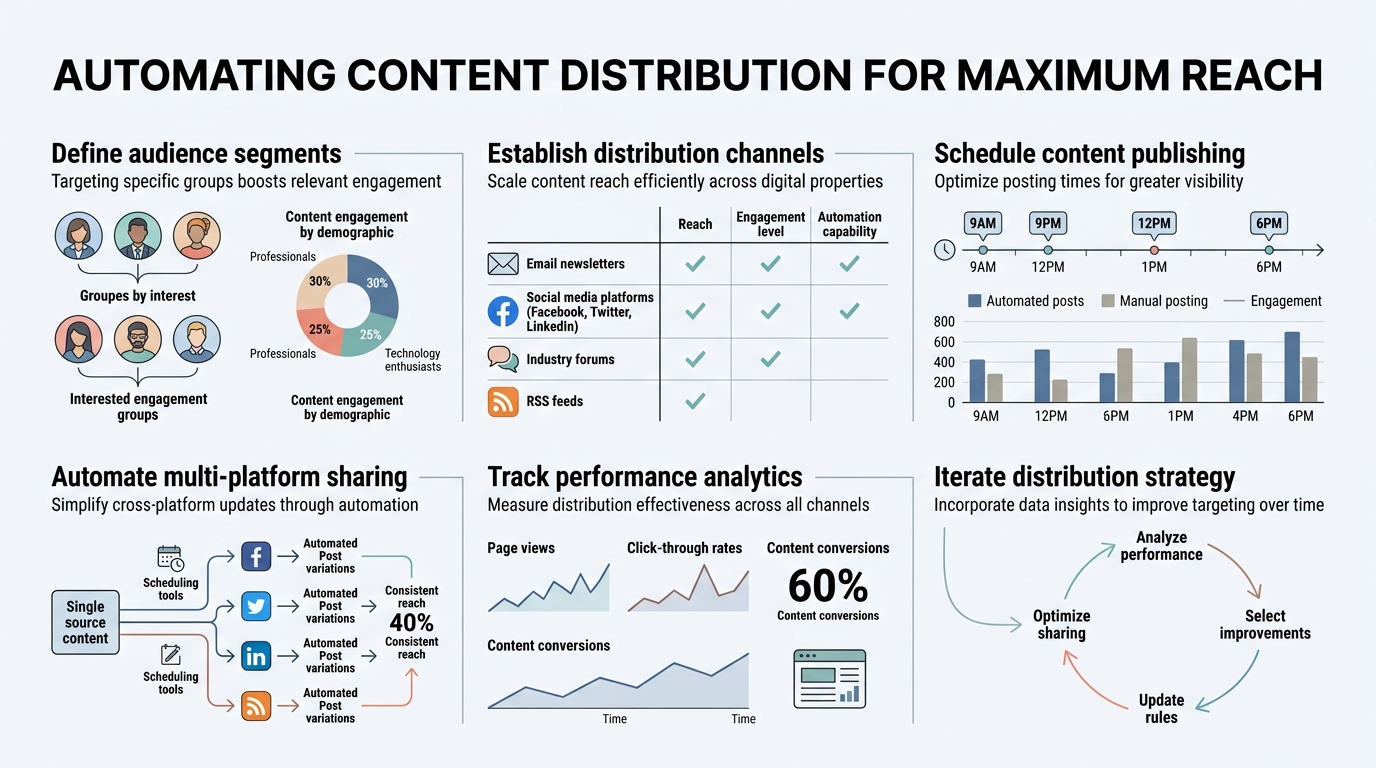
Multi-channel distribution automation connects your content creation pipeline to publishing infrastructure, so a single piece can reach readers across organic and paid channels simultaneously. Instead of manually uploading to WordPress, reformatting for LinkedIn, resizing for Twitter/X, and scheduling each one separately, automation handles the entire workflow in parallel. 82% of content marketers use social media for distribution, making channel sync non-negotiable—and that's exactly where centralized automation wins. The system works by ingesting a finalized piece of content (blog post, newsletter, social snippet), detecting the optimal distribution channels based on content type and audience, formatting it for each platform's specifications, and queuing it for scheduled publication according to your audience's peak engagement windows.
Unified Publishing to Multiple Channels Without Reformatting
The manual approach burns time: write a blog post, export it as Word, paste into WordPress, create a LinkedIn post version, resize images for Twitter, schedule on Buffer, add to your email newsletter, and upload the transcribed version to Medium. Each step requires manual QA. Automation inverts this workflow. You define your distribution channels once (blog, LinkedIn, Twitter, email, RSS, Medium, Dev.to, etc.), and the system automatically adapts your content to each channel's format, character limits, image dimensions, and CTA placement. A 2,500-word blog post becomes a carousel post for LinkedIn, a series of tweet threads, an email summary with a blog link, and an RSS entry—all generated in seconds from a single source document. Most automation platforms include smart templating, so your brand voice stays consistent across formats.
"The time saved is remarkable—teams report cutting distribution time by 70%, freeing 6-8 hours per week per person for strategy work instead of manual formatting and scheduling."
Intelligent Scheduling Across Time Zones and Platforms
Posting at the right time matters—B2B audiences are most active Tuesday-Thursday, 8 AM-10 AM in their local time. Manual scheduling forces you to either pick one global time or stay late to post in multiple zones. Automation platforms analyze your audience engagement data (when followers click, like, comment) and recommend optimal posting windows per channel. For a SaaS company with audiences in US, UK, and APAC regions, the system distributes posts across 16 hours of coverage without a single manual post. Additionally, 47% of marketers use paid amplification for top-performing content, often automated on social channels to maintain momentum. The system can detect when organic reach peaks and automatically trigger a paid boost, or schedule secondary posts at staggered intervals to capture multiple audience segments. Result: consistent presence across zones and channels without overtime.
Real-Time Performance Tracking and Channel Optimization
Automation platforms feed performance data back into the system, allowing you to learn which channels and content types drive the most traffic, conversions, and social engagement. Tools like Jottler connect content publishing directly to your CMS, building performance datasets that inform future distribution decisions. A blog post on SEO fundamentals might perform well on LinkedIn (high engagement, low direct traffic) but drive significant organic search clicks—triggering automatic amplification on that channel and reducing spend on lower-ROI channels. Over time, your distribution system becomes self-optimizing, reallocating budget to channels that convert while deprioritizing vanity metrics. Teams tracking AI-powered KPIs report 2.4x better ROI than those focusing on volume alone, so performance-driven automation is foundational to scaling without wasting budget.
What Are the Core Benefits of Automating Content Distribution?
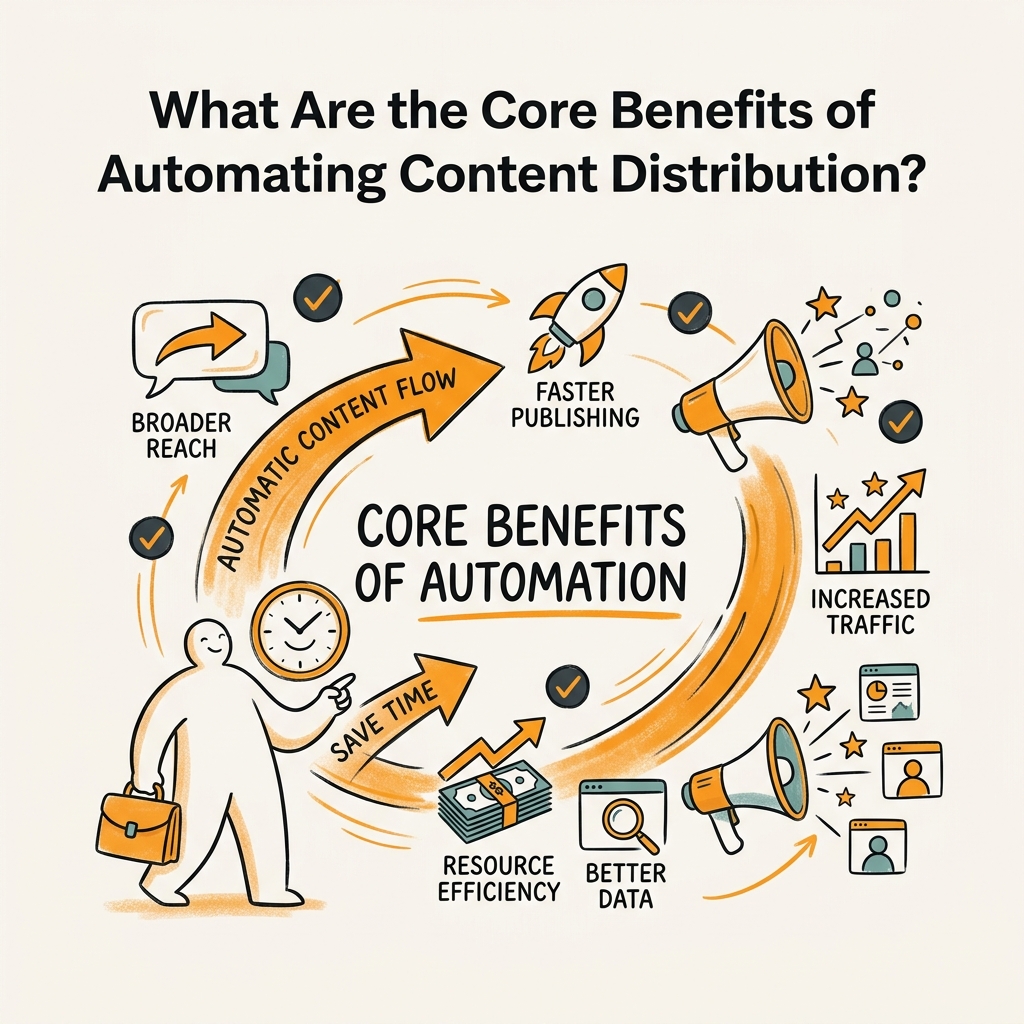
The ROI of distribution automation compounds across three dimensions: speed, consistency, and reach. Teams automating social media posting report 14.5% higher productivity and 12.2% lower marketing spend, according to McKinsey research cited by industry benchmarks. Those numbers hold up in practice because automation eliminates context-switching and coordination delays. But the real advantage is reach multiplication—posting the same piece across 5-10 channels manually would take 4-6 hours. Automated, it takes 5 minutes. That time difference, repeated 3-5 times per week, adds up to 60-80 reclaimed hours monthly. For a team of 3-5 people, that's equivalent to hiring a full-time coordinator just to handle distribution.
Consistent Posting Schedule With Zero Manual Effort
Founder-led marketing teams often publish in bursts—three blog posts one week, nothing for two weeks. Algorithms punish inconsistency, so your reach flatlines. Automation enables a predictable schedule (e.g., 2 blog posts per week, 5 social posts per day, 1 email per week) without requiring daily attention. Jottler, an autonomous SEO engine for busy founders, automates this by publishing 3,000+ words daily using 12 AI agents that handle keyword research, fact-checking, and CMS publishing. Instead of scrambling to produce content, teams connect their site and set a publishing frequency—the system handles the rest. Consistent output compounds over months and years, building organic traffic momentum that irregular publishing can't achieve. 72% of marketers say automation scales content production for distribution, and consistency is the hidden driver of that scaling.
"Consistent content output creates compounding returns: 72% of marketers achieve distribution scaling through automation, with irregular publishing unable to match the organic momentum of predictable schedules."
Reduced Manual Coordination and Approval Bottlenecks
In most teams, content goes: Writer → Editor → Designer → Stakeholder Review → Revision → Social Copy Writer → Scheduler. Each handoff introduces delay and loss of context. Email threads sprawl, versions diverge, and by the time a post publishes, the moment has passed. Automation creates a linear workflow where drafts route to reviewers in sequence, with one-click approvals and automatic version control. Stakeholders see a preview exactly as it will appear across channels, comment directly on the content, and approvals trigger the next stage. Tools like Monday.com offer visual approval boards where the entire distribution process is transparent. Teams using this approach cut review cycles from 5 days to 1-2 days, dramatically improving time-to-publication.
Amplified Organic Reach Through Smart Internal Linking
67% of businesses use automation for SEO tasks, particularly keyword tracking and internal linking, improving organic traffic by 20-30% on average. Manual internal linking is tedious—you finish a blog post on lead qualification, then manually search your content library for related articles to link to. Automated systems crawl your entire content archive, identify thematic relevance using semantic analysis, and suggest internal links that make sense contextually. Jottler's approach goes further: it builds topical authority networks by automatically linking new articles to existing pillar content, creating thematic clusters that Google rewards with higher rankings. The system learns your content structure, identifies gaps, and recommends which pieces to link based on search intent. Result: each new piece pulls traffic from related older content, compounding organic reach across your entire library.
Which Content Distribution Channels Should You Automate First?
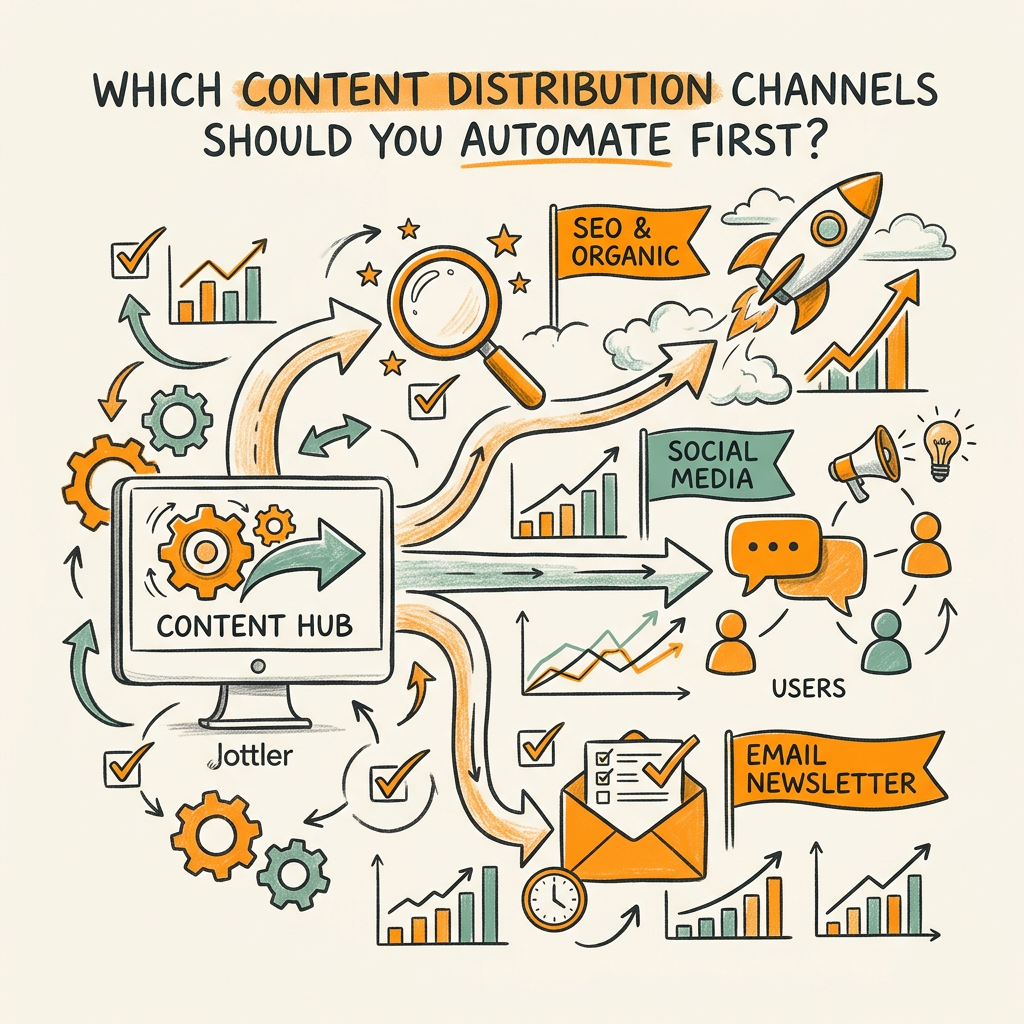
Not every channel deserves equal automation investment. ROI varies wildly by audience, format, and business model. Email marketing delivers 4,200% ROI overall, with automated emails generating 320% more revenue than non-automated campaigns, making email the highest-leverage channel for automation. Social media is second—it reaches 82% of content marketers' audiences but requires constant feeding. Organic search (blogging + SEO) is the long-term compounding play. The framework: automate high-ROI channels first (email + SEO distribution), then add social amplification as your team scales. This creates a clear cascade of impact.
Email Distribution and Lead Nurture Automation
Email is where automation generates the fastest, most measurable ROI. When you publish a new blog post, automated email workflows can immediately segment your audience (by industry, engagement history, past content interests) and send a personalized version of the content to each segment. Existing subscribers get the full article link with a personalized intro. Inactive subscribers get a shorter summary with a "re-engage" CTA. New sign-ups on that topic get a nurture sequence starting with that article. Teams using automation-powered personalization see engagement lift up to 74%, turning email into a lead conversion engine rather than a broadcast channel. Tools like HubSpot and ActiveCampaign automate this entire workflow—you publish, and the system segments and sends. The math: if a single email generates 2-5 qualified leads per 1,000 subscribers, automating distribution to your full list on day 1 (vs. manually sending to a subset later) is the difference between 10 and 50 leads per piece.
- Segment audiences by industry, engagement history, and content interests
- Deliver personalized content versions to different subscriber cohorts
- Trigger automated nurture sequences based on signup source
- Achieve engagement lift up to 74% through personalization
Social Media Posting and Scheduling Across Platforms
Social media requires high-frequency posting across multiple platforms to stay visible. Buffer, Later, and Hootsuite automate scheduling, but the next-gen approach combines scheduling with AI-powered copy variants. Instead of writing one Twitter post and one LinkedIn post per article, automation generates 3-5 variations optimized for each platform's culture and audience, tests them, and publishes the highest-performing version. 47% of SMBs use marketing automation for social media management, saving up to 6 hours per week on content and ads. For distributed teams, automation is a force multiplier—publish once in your content hub, and your LinkedIn, Twitter/X, Instagram, and TikTok accounts post simultaneously in native formats. Jottler's approach extends to smart scheduling: new content is distributed not just on publish day, but recycled across future weeks, keeping top-performing pieces visible without manual resharing.
- Auto-generate 3-5 platform-specific post variants from one source
- Test variations and publish highest-performing versions
- Schedule simultaneous posting across LinkedIn, Twitter, Instagram, and TikTok
- Recycle top-performing content across future weeks without manual resharing
- Save 6+ hours per week on social scheduling and content adaptation
Organic Search Amplification and Topical Authority Building
The SEO distribution game is about clustering thematic content, building topical authority, and maximizing internal link equity. Manual internal linking and cluster building is labor-intensive—you'd need someone to read every piece, identify related topics, and add contextual links. Automation handles this at scale. Tools automating SEO distribution improve organic traffic by 20-30% through keyword tracking, on-page optimization suggestions, and intelligent internal linking. When you publish a new piece on "conversion rate optimization," the system automatically identifies older content on CRO sub-topics (A/B testing, landing pages, copywriting) and links to them, signaling to Google that you have topical depth. Over time, these interconnected clusters rank higher than isolated articles. This is where platforms like Jottler differentiate—they combine content publication with topical authority building, automating the entire SEO distribution strategy so your content compounds over time.
"Topical authority automation compounds over time: interconnected content clusters rank higher than isolated articles, with 20-30% organic traffic improvements through automated keyword tracking and intelligent internal linking."
What Tools and Technology Power Content Distribution Automation?
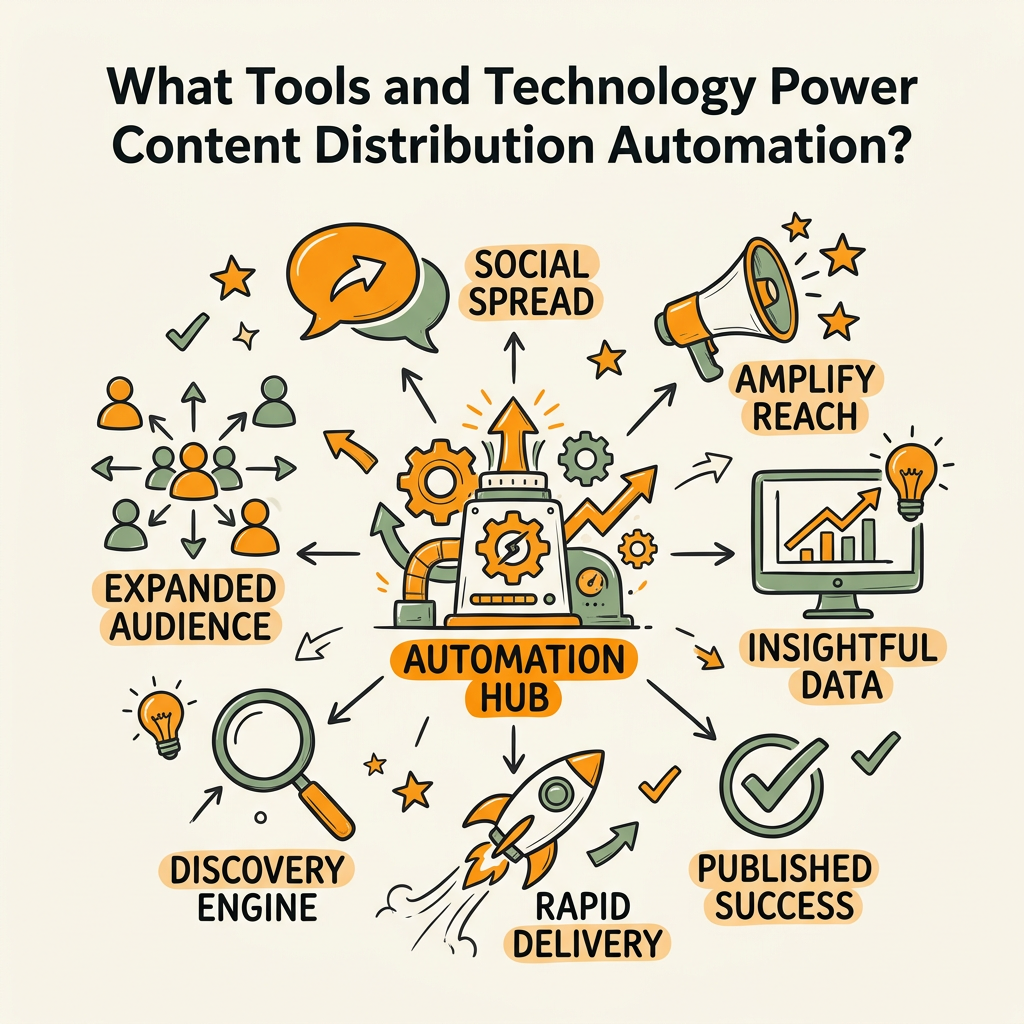
The automation stack breaks into three layers: content creation platforms, distribution orchestrators, and analytics integrations. A complete system requires at least one tool from each layer, though integrated platforms like Jottler consolidate this to a single interface, reducing setup friction and data silos. Most teams start with a distribution scheduler (Buffer, Hootsuite), add email automation (HubSpot, ActiveCampaign), then layer in SEO tools (Semrush, Ahrefs) for optimization. The next evolution is unified platforms that handle creation-to-publication in one system.
All-in-One Platforms vs. Modular Stacks
There are two architecture patterns. The modular approach uses best-of-breed tools: WordPress for publishing, HubSpot for email, Buffer for social, Semrush for SEO, and Zapier to tie them together. Pro: deep specialization in each tool. Con: data silos, integration overhead, and complex workflows. The all-in-one approach uses a single platform like Jottler, Monday.com, or HubSpot that handles content creation, publishing, scheduling, and analytics in one place. Pro: unified workflows, centralized performance data, and faster setup. Con: less specialization in any single function. For busy founders, the all-in-one model is often superior—you configure once, set publishing frequency, and the platform automates research, writing, fact-checking, and distribution without jumping between tools.
| Platform Type | Best For | Time to ROI | Learning Curve |
|---|---|---|---|
| Modular Stack (HubSpot + Buffer + Semrush) | Large teams with specialized workflows | 8-12 weeks | High (integrations, training per tool) |
| All-in-One (Jottler) | Founders and small teams scaling content | 1-2 weeks | Low (publish frequency, done) |
| Social-First Stack (Buffer + Hootsuite) | Social-heavy brands (DTC, personal brands) | 2-4 weeks | Low (scheduling focus) |
| Enterprise Orchestration (Monday, Adobe) | Fortune 500 teams with complex workflows | 12+ weeks | Very High (customization, IT setup) |
For a busy founder with 1-3 team members, Jottler's autonomous approach is the clear win. It publishes 3,000+ words daily with minimal oversight—you set your target topics and publishing cadence, and the AI agents automate keyword research, fact-checking, internal linking, and CMS publishing. No need to juggle HubSpot, Buffer, and Semrush separately. This cuts your distribution overhead by 90% compared to a modular stack.
Key Features to Look for in Distribution Automation Tools
Not all automation platforms are equal. The critical differentiators are: (1) Multi-channel publishing without reformatting, (2) Audience-based intelligent scheduling, (3) Built-in SEO optimization and internal linking, (4) Integrated analytics that connect content to business outcomes, and (5) Minimal setup friction. Tools lacking #1 or #3 force manual work that defeats automation's purpose. Tools lacking #4 leave you guessing at ROI. The best-in-class platforms combine all five with AI-powered content generation, so you're not manually feeding the system—it researches, writes, publishes, and optimizes continuously. Jottler is built on this philosophy: autonomous agents handle the entire funnel so your team focuses on strategy.
- Multi-channel publishing without manual reformatting for each platform
- Audience-based intelligent scheduling across time zones
- Built-in SEO optimization and automated internal linking
- Integrated analytics connecting content performance to business outcomes
- Minimal setup friction and onboarding time
- AI-powered content generation to reduce manual feeding
How Do You Implement Content Distribution Automation Successfully?
Implementation fails when teams try to automate everything at once or choose tools before defining workflows. The right approach is incremental: define your distribution strategy, pick high-ROI channels first, select tools, integrate them, and then scale. Most teams can operationalize basic automation in 2-4 weeks. Moving to advanced automation (AI-powered content + multi-channel distribution) takes 8-12 weeks but is worth the time investment.
Step 1: Audit Your Current Distribution Workflow and Identify Bottlenecks
Before buying tools, understand what's actually broken. Document your current process: How long does it take from final approval to publication across all channels? Where do delays happen? Which steps are manual and repetitive? For most teams, the answer is email chains about formatting, manual scheduling on 3-5 platforms, and scattered performance data. A two-week audit where you track every distribution step (by hour) reveals the true cost. Most teams discover they spend 15-20 hours per piece on distribution alone—that's your ROI baseline. Any automation saving 50% of that time is immediately valuable.
Step 2: Select Distribution Channels by ROI and Audience Presence
Not all channels deserve equal effort. If your audience is LinkedIn users (B2B SaaS), automate LinkedIn first. If you're DTC and TikTok is where customers hang out, prioritize TikTok. 82% of content marketers use social media, 14% use email, but email's 4,200% ROI makes it a must-automate regardless of volume. A quick prioritization matrix:
- List all your current distribution channels
- Map audience presence (% of target audience active on each)
- Weight by ROI per lead or conversion
- Rank by impact (email and organic search typically rank high)
- Automate in tiers: Tier 1 (email + primary social) in month 1, Tier 2 (secondary channels) in month 2
Step 3: Choose Tools That Integrate Natively or Support Your Tech Stack
Integration friction kills adoption. If you use WordPress, pick tools with native WordPress plugins. If you use HubSpot, choose distribution tools that integrate via API. The best move for founders? Use a platform that handles creation to distribution in one place—Jottler is purpose-built for this. It publishes directly to WordPress, Webflow, or Shopify, tracks metrics in your CMS, and enables automatic internal linking without external tools. This eliminates Zapier complexity and data delays.
Step 4: Build Workflows for Approval, Publishing, and Performance Review
Document your approval process: Who reviews drafts? Who approves final copy? Are there stakeholder sign-offs? Build this into your automation tool's workflow features (many have visual approval boards). For publishing, define your cadence and channel matrix—e.g., blog 2x per week, social 5x per day, email 1x per week. For performance review, set up a weekly dashboard review: Which pieces drove traffic? Which drove conversions? Use these insights to refine topic selection and distribution channels.
Step 5: Test, Measure, Iterate, and Scale
Start with a single piece of content and push it through your automation workflow end-to-end. Measure: time spent, channels published, engagement per channel, traffic generated. Identify friction points and fix them. Once you've optimized the process with 5-10 pieces, scale to your target publishing frequency. Most teams report a 30-40% time savings in month one, which grows to 50-60% by month three as workflows become muscle memory.
What Are Common Pitfalls When Automating Content Distribution?
Automation is powerful, but misapplied it can tank quality or waste budget. The most common failures are: automating without strategy (publishing low-quality content at scale), choosing the wrong channels (pushing B2B content to Reddit), setting overly aggressive schedules (posting so often that engagement collapses), and ignoring performance data (continuing to amplify under-performing content). The antidote is simple: automate workflows, not judgment. Automation should handle tedious logistics (scheduling, reformatting, internal linking, approval routing). Strategy and content quality remain human decisions. A good rule: if a task doesn't require creative or strategic thinking, automate it. If it requires judgment, keep it human-driven but supported by automation (e.g., AI-powered content suggestions you then review).
Automating Before You Have a Content Strategy
Publishing 5 blog posts per week without a topic strategy is a recipe for weak rankings and low engagement. Automation amplifies whatever you feed it—good content reaches millions, bad content reaches nobody at scale. Before automating distribution, nail your content strategy: Who is your audience? What are their questions? Which topics align with your business goals? Which channels work for that audience? Only then should you automate the logistics of distribution. Jottler handles this by automating keyword research—its AI agents identify high-intent topics your audience is actually searching for, ensuring that automation amplifies strategy-driven content, not random posts.
Ignoring Channel-Specific Norms and Audience Expectations
Automating a LinkedIn post to Twitter/X without modification will perform poorly. LinkedIn audiences expect professional, thought-leadership content. Twitter audiences expect quick, punchy takes. TikTok expects personality and entertainment. Good automation tools adapt content to channel norms (tone, length, format, hashtags). Tools that force a one-size-fits-all approach produce poor results. Always preview auto-generated posts before publishing, especially early on. Some teams hire a social media specialist just to monitor and adjust automated posts for brand voice—that's a sign the tool isn't doing enough adaptation.
Setting Unrealistic Publishing Frequency and Burning Out Your Content Team
Automation makes publishing faster, not free. If your team can sustainably produce 2 blog posts per week with manual distribution, automating distribution doesn't mean you can suddenly publish 10 per week—you'll run out of ideas, quality will drop, and burnout sets in. Realistic target: automate to remove distribution overhead, increasing publishing by 25-50% (2 per week → 3 per week) while reclaiming team time for strategy. For founders using Jottler, the AI agents write content daily, so the bottleneck shifts from creation to strategy and fact-checking. Your founder still needs to set direction and review content for accuracy, but the time investment drops from 40 hours to 5-10 hours per week.
Conclusion
Automating content distribution is no longer optional for scaling companies—it's the multiplier that separates fast-growing brands from those stuck in coordination chaos. The platforms that deliver maximum ROI combine creation and distribution in a unified system, automating not just scheduling but keyword research, fact-checking, and smart internal linking. Within 90 days, you'll reclaim enough team time to hire for strategy instead of logistics, and your reach will compound as automation ensures consistent, multi-channel publication.
The path forward: Start with a distribution audit to quantify your current bottleneck. Identify your highest-ROI channels (email and organic search typically lead). Choose a tool that requires minimal setup—platforms like Jottler are designed for exactly this, automating the entire pipeline from research to publication in minutes. Then measure what works and iterate.
Ready to automate your content distribution? Start your SEO agent with Jottler and publish 3,000+ words daily with AI agents handling keyword research, fact-checking, and smart internal linking. Let your content scale while your team focuses on strategy.
FAQs
How much time can automating content distribution actually save?
Automating distribution saves 6-8 hours per week per team member on average. A single blog post takes 4-6 hours to manually distribute across 5-10 channels (WordPress, LinkedIn, Twitter, email, Medium, etc.). Automation handles this in 5 minutes. For a three-person team publishing 3-5 pieces per week, that's 60-80 hours monthly reclaimed. Most teams reinvest this time into strategy, SEO optimization, and audience research rather than hiring more coordinators. The time savings compounds—after three months, most teams are publishing 40-50% more content in the same total hours because automation removes the coordination overhead.
What's the best tool for automating content distribution to multiple channels?
The answer depends on your team size and tech stack. For modular stacks, HubSpot combines email and social scheduling, and Zapier connects to WordPress and other platforms. For all-in-one simplicity, Jottler automates the entire creation-to-publication pipeline—publish to WordPress, Webflow, or Shopify automatically, with built-in SEO optimization and smart internal linking. For social-heavy teams, Buffer or Hootsuite excel at scheduling and analytics. The trade-off is setup friction: modular stacks take weeks to integrate but offer deep tool specialization; all-in-one platforms like Jottler go live in days and handle everything natively. Most busy founders choose all-in-one because they don't have bandwidth for integration management.
Can automation handle brand voice consistency across different channels?
Good automation platforms use AI-powered templates and style guides to maintain voice while adapting format. Instead of manually rewriting every post for each channel, automation tools like Jottler apply your brand voice rules (tone, vocabulary, CTA style) and adapt them to channel norms. You define voice once—professional, conversational, concise—and the system applies it to LinkedIn posts, tweets, email, and blog content while respecting each platform's unique culture. Always preview the first 5-10 automated posts before going live; this trains the system on your exact voice preferences. After that, consistency improves significantly, with only occasional manual tweaks needed for nuance.