Building a Sustainable AI Content Calendar
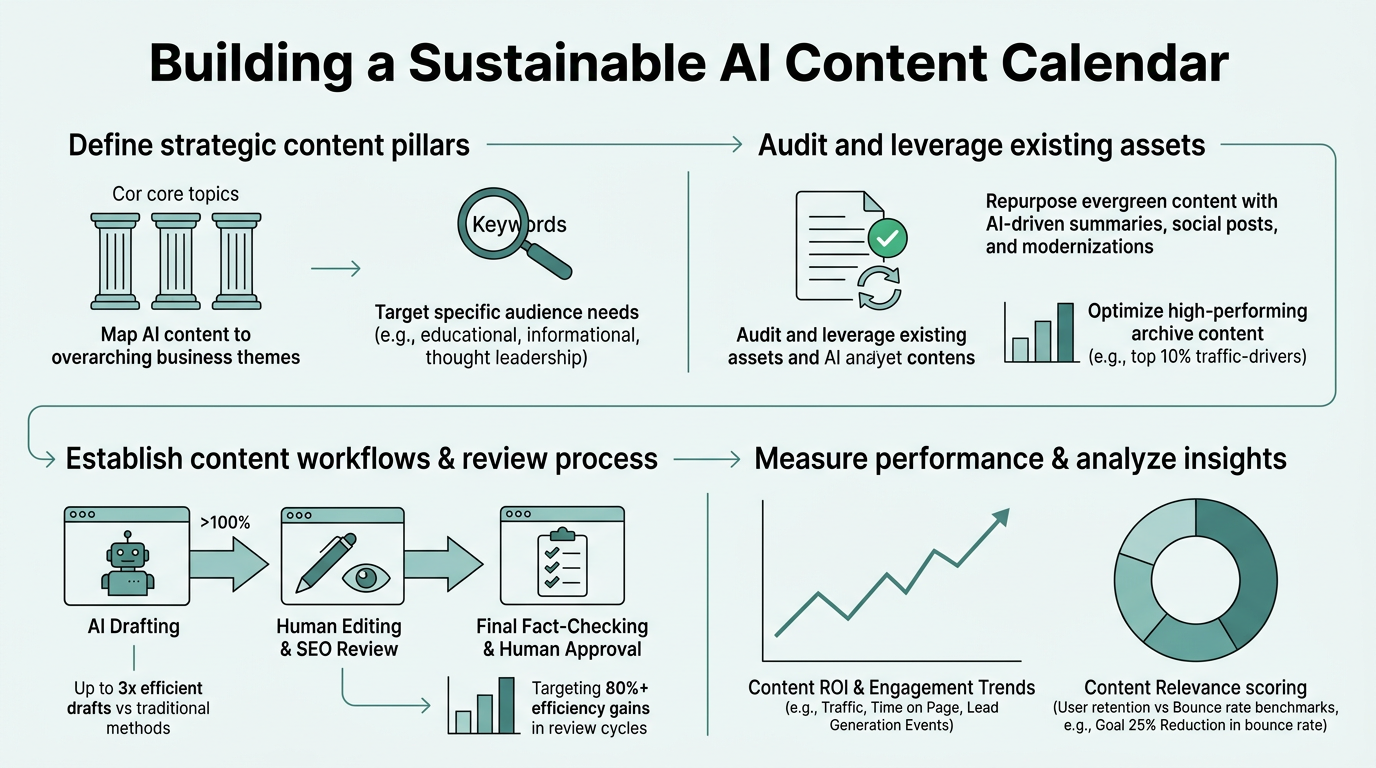
Most founders and marketing teams attempt to scale content production but hit a wall: manual calendaring is labor-intensive, inconsistent, and doesn't compound over time. The reality is stark. 92% of marketers now use a content calendar, yet 78% of businesses still struggle to integrate AI tools for predictive analytics and automated scheduling. Without a system that automates the heavy lifting, teams waste weeks on planning, research, and publishing instead of focusing on strategy. The solution isn't more templates or spreadsheets—it's building a calendar powered by AI that handles research, optimization, and distribution automatically while you focus on direction.
Key Takeaways
- 92% of marketers use a content calendar, and 78% now integrate AI tools for scheduling and predictive analytics (2026, BlogHunter)
- Content marketing delivers $7.65 ROI for every $1 spent, provided teams follow a sustainable, repeatable framework with clear KPIs
- Sustainable calendars prioritize evergreen assets, focused planning, and efficient repurposing—not volume production
- Why Sustainable Calendars Matter: A repeatable system prevents wasted effort and compounds organic traffic over time through focused, data-driven planning.
- AI-Powered Planning Automation: Automate keyword research, topic ideation, and scheduling to save 6+ hours per week and ensure consistency.
- Pillar-Cluster Architecture: Organize assets into topical authority structures that strengthen internal linking and search visibility.
- Content Auditing and Refresh Cycles: Update evergreen assets every 3–6 months and consolidate underperforming content to maintain quality.
- Multi-Channel Repurposing: Transform one core asset into multiple formats (blog, video, social, email) to maximize ROI and reach.
Why a Sustainable AI Content Calendar Beats Manual Planning
A sustainable AI content calendar automates the research, writing, and distribution workflow so teams can scale without burning out. 87% of marketers now use generative AI in at least one workflow, up from 76% in 2025. Yet many teams still manually plan topics, research keywords, and schedule posts—work that AI can handle instantly. The difference between a sustainable calendar and a chaotic one boils down to systems: do you want to spend 3 hours per week on admin tasks, or 3 hours per month while the AI handles the rest?
The Burnout Problem in Traditional Content Calendars
Traditional calendars—whether in Excel, Google Sheets, or basic calendar tools—require manual input at every stage. Your team spends weeks planning, researching, writing, and scheduling content. Marketers save an average of 6.1 hours per week when they switch to AI-assisted workflows, according to Digital Applied's 2026 AI Marketing Statistics. That's nearly a full workday recovered per week. For a small team, that's the difference between shipping 4 articles per month and 12. The compound effect is enormous: over a year, that's 96 extra pieces of optimized, search-friendly content that drives organic traffic. Sustainability comes from removing the manual friction, not from working harder.
"Marketers save an average of 6.1 hours per week when they switch to AI-assisted workflows. That's nearly a full workday recovered per week. For a small team, that's the difference between shipping 4 articles per month and 12."
How AI Changes the Content Calendar Game
AI-powered calendars automate the parts of content production that eat time: keyword research, topic generation, competitive analysis, internal linking recommendations, and publishing. Instead of a founder or marketer spending 2 hours manually researching a topic, the AI researches 14+ sources, extracts statistics, checks facts, and generates an outline in minutes. Tools like Jottler go further—they generate full 3,000+ word articles daily, auto-optimize for SEO, fact-check claims, and handle CMS publishing with smart internal linking built in. The calendar becomes less of a planning tool and more of a production engine that compounds your content library automatically. You set the frequency (1–5 articles per day) and direction; the AI handles execution.
Sustainability Through Automation, Not Just Planning
Sustainable doesn't mean "slow" or "less content." It means building systems that don't degrade with scale. A sustainable AI content calendar lets you publish more frequently—3, 5, or even 10+ articles per week—without your team working longer hours. The sustainability comes from automating the repetitive, time-consuming parts. When you remove the bottleneck of manual research and writing, your team can focus on the high-leverage activities: strategy, topic selection, competitor monitoring, and content repurposing. That's how you scale without burnout. An effective AI content strategy treats automation as a multiplier, not a shortcut.
Define Your Content Pillars and Core Topics
Before your AI calendar can deliver, it needs a clear roadmap. Effective sustainable calendars start with 5–10 core topics tied directly to revenue goals, not arbitrary keyword lists. This focused approach prevents the scatter that kills most content strategies. When your AI engine knows your pillar topics, it can generate related content clusters that build topical authority rather than random blog posts.
Identifying Pillar Topics That Drive Revenue
Start by asking: What problems does your product solve? What search intent directly precedes a purchase decision? For a SaaS company selling SEO automation, the pillars might be "SEO automation," "AI content generation," "organic traffic scaling," and "content marketing ROI." Each pillar becomes an anchor for a cluster of 10–20 related articles. A pillar-cluster architecture signals to Google that you're an authority on the topic, which improves rankings for the entire cluster. Tools like Jottler make this systematic: configure your pillars in the dashboard, and the AI automatically maps keyword research to pillar topics, ensuring every article it generates strengthens topical authority rather than diluting focus.
"A pillar-cluster architecture signals to Google that you're an authority on the topic, which improves rankings for the entire cluster. Every article strengthens topical authority rather than diluting focus."
How to Build a Pillar Without Overthinking It
You don't need a 40-slide deck to define pillars. Ask your sales team: What questions come up in the sales process? What are the biggest objections? What outcomes do customers care most about? Write down 5–10 core themes. That's your pillar list. Your AI calendar should then map all keyword research and topic generation to these pillars. This ensures every article feeds into your topical authority strategy, not just random traffic. Once pillars are set, your AI engine can generate keyword variations, competitor gaps, and seasonal angles automatically—all tagged to the pillar. The result: a calendar that feels intentional and builds authority instead of a random collection of blog posts.
How Does AI-Powered Keyword Research Drive Calendar Planning?
Traditional keyword research means hours in SEO tools, manually recording volumes and difficulty scores, and debating which keywords to target. AI-powered research streamlines this to minutes. 93% of marketers say their primary reason for using AI is to create content faster, and keyword research is where that speed advantage is most visible. An AI calendar system researches hundreds of keywords automatically, clusters them by intent and topic relevance, and feeds them directly into your publishing schedule.
Automated Keyword Discovery and Intent Classification
AI systems can analyze search volume, keyword difficulty, user intent, and competitor gaps in real-time. Instead of manually reviewing 50 keywords to pick 10 to target, you configure your pillars and difficulty threshold (e.g., "Target keywords under KD 50"), and the AI does the rest. It discovers long-tail variations, question-based searches, and comparison keywords that align with your funnel. More importantly, it classifies intent automatically: Is this a "how-to" intent, a product comparison, or a commercial query? Once intent is clear, the calendar schedules content in the right sequence—educational content early in the funnel, comparisons in the middle, and product-specific content later. This alignment with user intent is what drives both rankings and conversions.
Building a Rolling Keyword Calendar That Adapts
The best calendars aren't static—they adapt to new data. Monthly, your AI research system should identify emerging keywords, seasonal spikes, and competitor gaps. Then it automatically proposes new topics and adjusts your calendar. A sustainable approach means treating your keyword calendar as a living document that evolves with search trends, not a fixed annual plan. Tools like Jottler continuously monitor your topic space and recommend new content angles, so your team stays ahead of demand instead of chasing old trends. This rolling research approach means you're always publishing on topics that matter right now, not guessing what will matter in three months.
Structure Your Calendar Using Pillar-Cluster Architecture
The pillar-cluster model is the dominant structural pattern in 2025–2026 SEO strategy. Instead of publishing isolated blog posts, you organize content into topical clusters around pillar pages. Each pillar (e.g., "AI content generation") anchors 10–30 cluster articles (e.g., "AI blog post generators," "AI SEO content writers," "AI article generators that rank"). Internal links flow from cluster articles back to the pillar, signaling topical authority to search engines. This architecture is more effective for organic rankings than traditional blog structures, and it's perfectly suited to AI-powered calendars. An integrated SaaS content marketing framework builds this structure automatically across your publishing schedule.
Designing Your Pillar and Cluster Hierarchy
Start with your core pillar topics. For each pillar, identify 3–5 sub-topics that break down the larger concept. Then, create cluster articles around each sub-topic. For example, the pillar "Content Marketing Automation" breaks into sub-topics like "Email automation," "Social media scheduling," "AI-powered content creation," and "Publishing workflows." Under "AI-powered content creation," you might create cluster articles: "Best AI content generators for long-form," "How to use AI to write SEO content," "AI vs human writers," and "Content automation tools comparison." Each cluster article links back to the pillar, creating a web of topical authority. Your AI calendar should organize this hierarchy automatically: when you configure your pillars and sub-topics, the system generates and schedules cluster articles in logical order, with internal linking built in. This prevents the scattered, disconnected feel of random blog posts.
Linking Strategy: Tying Content Together Automatically
A sustainable calendar isn't just about publishing articles—it's about weaving them together. Internal linking is critical for both SEO and user experience, but manual linking is error-prone and time-consuming. AI-powered calendars handle this automatically. When you publish a cluster article on "AI content writers," the system automatically identifies which other cluster articles should link to it, which should link back to the pillar, and what anchor text makes sense. Over time, this creates a dense topical network that Google recognizes as authoritative. You're not just publishing 100 articles; you're publishing a coherent, interconnected knowledge base that drives more organic traffic with each new addition.
Automate Content Creation While Maintaining Quality
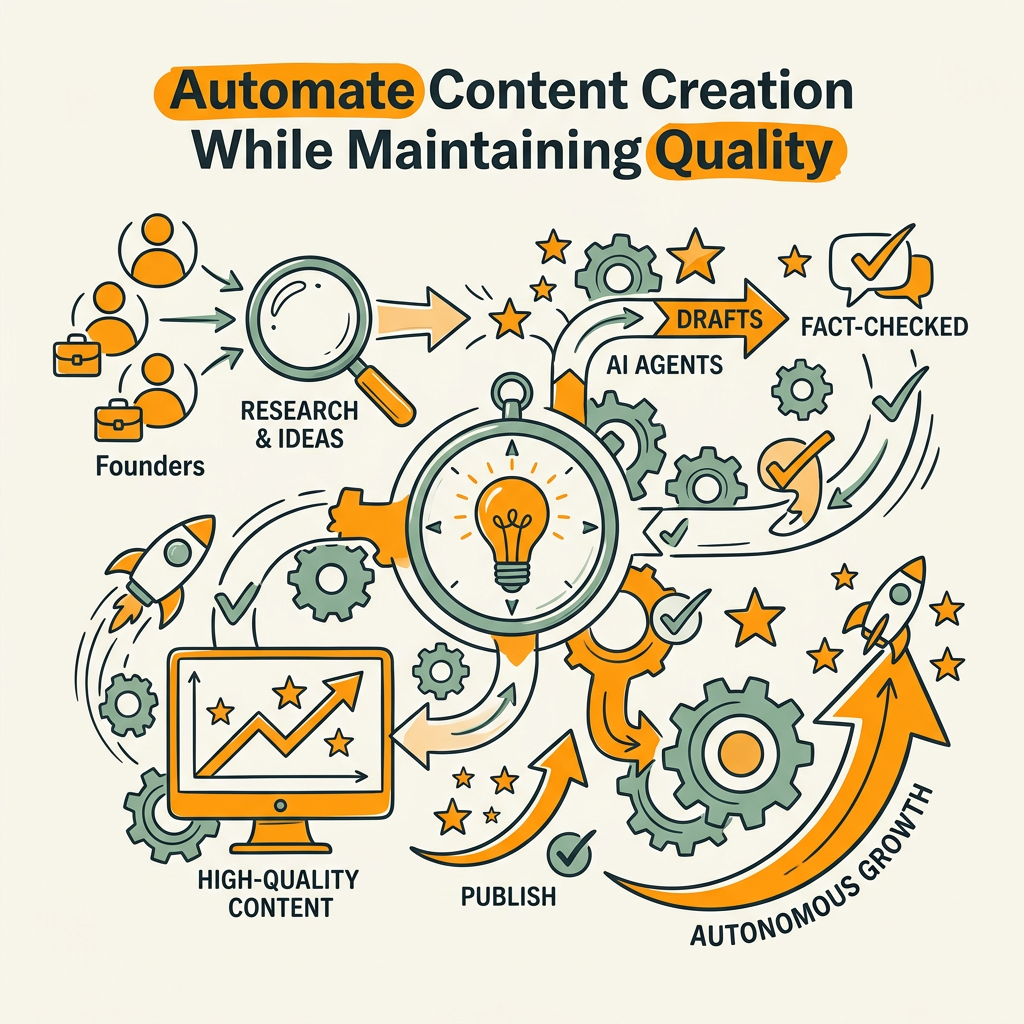
The biggest concern founders and marketers raise about AI content calendars: "Will the quality suffer?" The answer is no—if you structure the process correctly. 80% of marketers use AI for content creation in 2026, and the ones who see strong ROI are the ones who treat AI as an accelerant, not a replacement. The AI handles research, drafting, and optimization; your team provides direction, fact-checking, and final review. This hybrid model maintains quality while freeing your team from the writing bottleneck. Using content automation tools correctly means setting clear editorial standards before AI generation begins.
Fact-Checking and Verification in AI-Generated Content
AI can generate fluent, SEO-optimized prose, but it can hallucinate statistics or misrepresent sources. The best AI calendars include built-in fact-checking. When the system generates content, it cross-references claims against authoritative sources, flags potentially inaccurate statements, and provides citations. Jottler's approach: every article is researched across 14+ sources, fact-checked for accuracy, and cited with real links. The AI doesn't invent statistics. This approach takes slightly longer than raw generation, but it delivers articles you can publish with confidence. For a busy founder, this means fewer embarrassing retractions and stronger authority with readers and search engines.
"Every article is researched across 14+ sources, fact-checked for accuracy, and cited with real links. The AI doesn't invent statistics. This delivers articles you can publish with confidence."
Balancing Automation With Editorial Voice
AI-generated content can feel generic if you let it. The solution is editorial templates and brand guidelines. Before your calendar generates articles, define your tone, target depth, and brand voice in clear guidelines. For example: "All how-to articles must include at least one real case study and end with a clear CTA." "All comparison articles must reference three real competitors and explain trade-offs honestly." With these guardrails, the AI generates content that matches your voice while remaining efficient. Your team can then spend 15 minutes reviewing and refining rather than 2 hours writing from scratch. The calendar becomes a collaborative system: AI handles the heavy lifting, humans provide judgment and polish.
Scaling Content Output Without Quality Degradation
Sustainable calendars scale output through volume AND quality. Content marketing ROI averages $7.65 per $1 spent when executed consistently with clear KPIs. The teams achieving this ratio aren't publishing one perfect article per month—they're publishing 10–20 solid articles per month, each optimized for SEO and conversion. An AI-powered calendar makes this sustainable. You go from publishing 3 articles per month (your manual capacity) to 15 per month (your AI-assisted capacity) without adding headcount. Each article is researched, fact-checked, and optimized the same way. The quality doesn't drop; it becomes consistent at scale.
Implement a Content Refresh and Audit Cycle
Publishing new content is only half of sustainability. The other half is maintaining and improving existing content. 40–50% of content budget should go to optimizing and improving existing assets rather than creating new ones, according to top performers. A sustainable calendar includes a refresh schedule: update evergreen articles every 3–6 months, consolidate thin or duplicate content, and eliminate non-performers. This keeps your content library fresh, authoritative, and high-performing. Measuring content marketing ROI means tracking refresh performance as closely as new content publication rates.
Quarterly Content Audits and Performance Analysis
Set a quarterly audit schedule. Pull a report of all published articles ranked by performance: organic traffic, conversion rate, average time on page, and backlinks. Articles in the top 25% (your stars) get refreshed with new data, expanded sections, and stronger CTAs. Articles in the middle 50% (your solid performers) get optimization updates: SEO tuning, updated statistics, and internal link additions. Articles in the bottom 25% (your laggards) either get consolidated with stronger articles or removed. This is not heartless—it's maintenance. A piece that ranked well 18 months ago might be outdated or outranked by competitors. Refreshing it takes 30 minutes and can revive its performance. Removing it prevents thin content from diluting your domain authority. Your AI calendar should flag these candidates automatically, highlighting which articles are due for refresh based on publish date and performance trend.
Consolidation and Repurposing Strategy
As your calendar grows, you may end up with duplicate or near-duplicate content. Two articles on the same topic can confuse search engines and dilute authority. The sustainable approach: consolidate. Merge the two articles into a stronger single piece that covers both angles comprehensively. Redirect the weaker URL to the stronger one. This single action can recover 30–40% of the traffic the weaker article was getting. Similarly, repurpose top-performing articles into new formats. If your best-performing article is a 3,000-word guide, turn it into a video script, a podcast episode, an infographic, and a series of LinkedIn posts. One research investment feeds four channels. This multiplier effect is how sustainable calendars deliver consistent growth without proportional increase in effort.
Create a Cross-Channel Distribution and Repurposing Plan
A calendar that only publishes to your blog is underutilizing your content. Sustainable calendars treat each article as a source for multiple formats and channels. 40–50% of marketing budgets now go to video and podcasts in 2026, the highest-ROI formats. Your AI calendar should automatically generate distribution variants: social teasers, email snippets, video scripts, and paid ad copy from each article. This multiplies impact with minimal extra effort.
Automating Social and Email Distribution
When your calendar publishes a blog article, it should automatically generate social media posts for LinkedIn, Twitter, and other platforms. Different posts for different platforms: LinkedIn gets the professional angle, Twitter gets a hot take, and Reddit might get a candid perspective. Email lists get a formatted summary with a CTA. Video platforms get a script or transcript. This isn't just duplicating the same message everywhere—it's translating the core insight into each channel's format and audience. An AI calendar handles this automatically. Configure your distribution channels once, and every article generates platform-specific variants. This ensures consistency, prevents the "forgotten" channels problem, and maximizes reach per piece of content.
Video and Podcast Extraction From Written Content
Your strongest blog articles should become video scripts, podcast episodes, or YouTube Shorts. The process can be automated: AI systems can extract key points from an article, structure them as a video script, and generate speaker notes. You record the video, edit it, and publish. Or you hire a voice artist and publish a podcast episode. One article becomes 3–5 content pieces across channels. For a sustainable calendar, this repurposing is not optional—it's the strategy. Written content is your SEO engine; video is your social distribution engine. Podcasts build authority and reach a different audience. Together, they compound your brand visibility and traffic exponentially.
Set Up Intelligent Scheduling and Publishing Automation
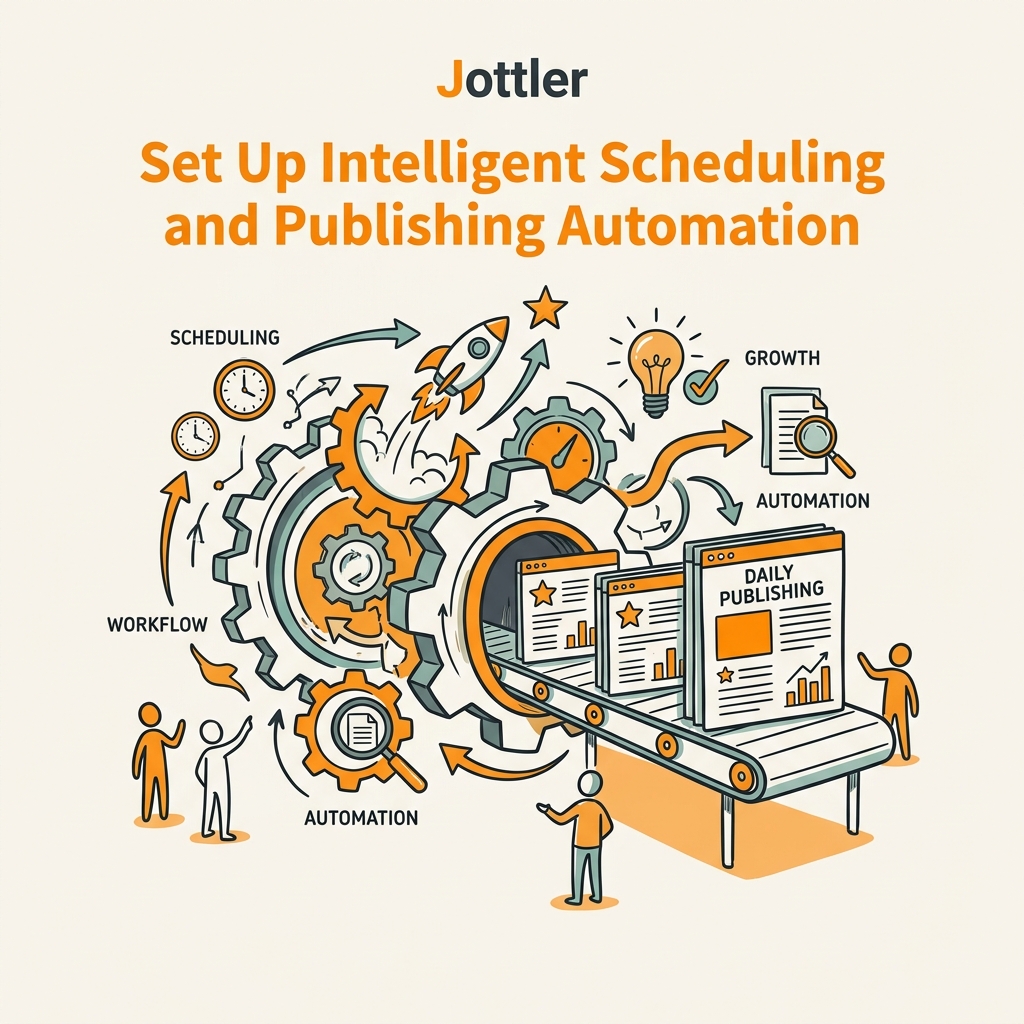
Manual scheduling—logging into WordPress, selecting publish time, checking preview—adds up to hours per week. An AI calendar should automate publishing entirely. When your AI system completes an article, it should be published directly to your CMS with proper formatting, featured image selection, internal links, and metadata. No manual intervention needed. Your team just needs to configure the publishing workflow once.
Intelligent Scheduling Based on Performance Data
The best times to publish vary by audience and channel. An intelligent calendar analyzes your traffic data to determine when your audience is most active, then schedules articles for maximum visibility. Maybe your audience is reading at 6 AM before work, or on Wednesday afternoons. The calendar learns and schedules accordingly. For social distribution, it can schedule posts for different times on different days, testing frequency and timing automatically. Over weeks and months, it gets smarter about what works for your specific audience. Manual schedulers can't do this; only AI-driven systems can learn and optimize in real-time.
CMS Integration and Auto-Publishing
The manual publishing workflow—copy-paste content into WordPress, format, add meta, set featured image, set internal links—is ripe for automation. Your AI calendar should integrate directly with your CMS. When an article is ready, the calendar publishes it directly with correct formatting, meta tags, featured images, and internal linking automatically applied. For Jottler users, this happens seamlessly: configure your CMS integration once, set your publishing frequency (1–5 articles per day), and the AI handles publishing directly. Your content goes live without human intervention, saving hours per week and eliminating formatting errors. This is the difference between a calendar tool and a true content production engine.
Track KPIs That Matter: From Vanity Metrics to Revenue Impact
A sustainable calendar is measured by business impact, not vanity metrics. Teams that achieve a 33% increase in marketing ROI all have one thing in common: clear KPI tracking tied to executive-level metrics. Page views don't matter. Conversions, lead quality, and revenue-influenced deals do. Set up tracking that connects content performance to business outcomes.
Defining Your Content KPI Framework
Start by mapping each content pillar to a business goal. If your pillar is "AI content generation," the goal might be driving trial signups. Then define KPIs: organic traffic to AI-related content, conversion rate from content to trial signup, and average deal size influenced by that content. Track these weekly. If organic traffic is up 30% but conversions are flat, your content is reaching more people but attracting the wrong people. That's actionable insight. Your calendar should surface these trends automatically. Vanity metrics—traffic, pageviews, time on page—are noise. Revenue-connected metrics are signal.
Building Feedback Loops Into Your Calendar
Every week, your calendar should tell you: What content performed best this week? Why? What content underperformed? Why? Then, the system should recommend actions: "This topic drove high-quality leads; create 5 more articles in this cluster." "This keyword has spike traffic but low conversion; reoptimize the CTA." "This competitor is ranking for 10 keywords you're not targeting; create content to close the gap." An AI-powered calendar isn't just a publishing tool—it's a feedback engine. It learns from performance data and guides your team toward what works. This closes the loop between publishing and measurement, a critical part of sustainability.
Choose the Right Tools and Platforms
Your AI content calendar is only as good as the tools you build it on. The market offers many options: basic calendar tools like Asana or Monday, editorial platforms like StoryChief, and dedicated AI content engines like Jottler. The key differentiator is integration: how tightly does the tool connect research, writing, optimization, publishing, and measurement? A comparison of top solutions:
| Platform | AI Writing | Keyword Research | Fact-Checking | CMS Publishing | Price Starting |
|---|---|---|---|---|---|
| Jottler | Native, 3000+ words/day | Built-in, semantic clustering | 14+ source verification | Direct integration | $29/month |
| Jasper | Yes, template-based | External tool required | Limited | Manual copy-paste | $49/month |
| StoryChief | AI assist, basic | External tool required | Limited | Yes | $99/month |
| Asana / Monday | No | No | No | Workflow only | $10–60/month |
Jottler stands apart because it's built as an autonomous SEO engine: research, writing, optimization, fact-checking, and publishing are unified. You don't lose data or quality in translation between tools. For busy founders, this integrated approach eliminates the complexity of gluing together 5 separate tools. One workflow, one dashboard, one source of truth. The cost difference ($29 vs. $99+) also matters when you're scaling—at 5 articles per day, Jottler's approach costs less than piecing together other tools, and the setup is instant rather than weeks of integration work.
Establish a Content Editorial Process and Governance
Even with a fully automated calendar, you need an editorial process. Who approves topics? Who fact-checks? Who optimizes final copy? Who's accountable for performance? Document this clearly. A simple governance model for small teams:
- Topic approval: Founder or marketing lead approves pillar topics and monthly keyword targets. Takes 1 hour per month.
- AI generation: System generates articles automatically on schedule. No approval needed unless customization is requested.
- Spot-check QA: Sample 10% of articles per week for quality, accuracy, and brand fit. Takes 1–2 hours per week.
- Publishing: System publishes directly; no approval gate (you've already spot-checked).
- Monitoring: Weekly KPI review. If an article underperforms within 2 weeks, flag for CTA optimization or consolidation.
This governance is lean but clear. It prevents chaos (no wild AI generation), maintains quality (spot-checking works), and scales efficiently (no bottleneck on approval). For larger teams, you can add a dedicated content manager to the process. The key is not letting governance become a bureaucracy that slows publishing.
Scale Sustainably: From Monthly to Daily Publishing
Most teams start with 1–2 articles per week. With an AI calendar, you can scale to 5–10 per week or even 1+ per day without adding headcount. This is the compound growth engine founders dream about. Each new article is another organic traffic source. Over a year, publishing 5 per week instead of 2 per week means 156 extra articles in your content library, each with organic reach.
Gradual Scaling Without Quality Drop
Don't jump to 10 articles per day immediately. Start with your current manual capacity (e.g., 2 per week), then add 1 more per week as your AI calendar proves itself. Week 1–4: publish 2 per week. Weeks 5–8: 3 per week. Weeks 9–12: 4 per week. By month 4, you're at 4 per week without any burnout. The AI is handling the research and writing; your team is spot-checking and optimizing. At this cadence, your blog doubles in size every quarter. Over 12 months, you go from 100 articles to 300+. That's a 3x increase in organic traffic potential, with no team growth.
Maintaining Topic Diversity and Avoiding Repetition
As you scale, the risk is that your AI starts recycling the same topics. Counter this with clear topic mapping: every month, your system should identify 50+ new keyword targets not yet covered. Prioritize them by search volume and fit. Schedule them in your calendar spread across the month. Topic diversity prevents Google from flagging your site as thin or repetitive. It also prevents your calendar from boring your audience. At 5 articles per week, your readers see variety—different angles, different formats, different topics. This keeps them coming back.
Conclusion
A sustainable AI content calendar is the operational foundation of compounding organic growth. By automating research, writing, optimization, and publishing, you free your team to focus on strategy and analysis instead of manual tasks. The gap between teams using manual calendars and teams integrating AI tools is massive: the AI-integrated teams are publishing more content faster, with higher consistency and better ROI. Teams tracking clear KPIs report significantly higher marketing ROI, and sustainable AI calendars make this tracking automatic.
The playbook is simple: define your pillars, set up AI-powered keyword research, structure content in pillar-cluster architecture, automate publishing and distribution, and track revenue-connected KPIs. Within 90 days, you'll feel the compound effect. Your blog grows faster, your organic traffic rises, and your team works fewer hours on content operations. Jottler makes this end-to-end: autonomous research across 14+ sources, AI writing with fact-checking built-in, smart internal linking, and direct CMS publishing. Start with Jottler at $29/month and scale to daily publishing as your growth demands it. The time to build your sustainable AI content calendar is now—before your competitors do.
FAQs
How often should I update content in my AI-powered calendar?
The best approach is a rolling refresh cycle: update evergreen assets every 3–6 months based on performance and freshness. Articles in the top 25% of traffic should get refreshed with new statistics, expanded sections, and stronger CTAs. Articles in the middle 50% benefit from SEO optimization and internal link updates. Bottom 25% underperformers should be consolidated with stronger content or removed. A sustainable calendar automates this flagging process—your system identifies which articles are due for refresh based on publish date, traffic trend, and ranking position, so you're maintaining your library proactively rather than reactively.
Can AI-generated content really rank in search results?
Yes, but only if it's fact-checked, well-researched, and properly optimized. The difference between AI content that ranks and AI content that doesn't is research depth and verification. Generic AI writing without sources won't compete. Content backed by original research, real statistics, and fact-checked claims consistently outranks thin AI content because Google rewards authority and accuracy. The best approach is using AI to accelerate research and drafting, while fact-checking and citation happen as part of the process, not after. Tools that research from 14+ sources, verify claims, and link to sources build the authority Google rewards. This is why semantic, research-first AI generation outperforms generic AI writing every time.
What's the fastest way to implement a sustainable content calendar?
Start with platform choice and integration setup. If you choose a unified AI calendar engine like Jottler, implementation takes days instead of weeks because research, writing, fact-checking, and publishing are all built-in. Define your 5–10 core pillar topics, connect your CMS, set your publishing frequency (1–5 articles per day), and let the AI research and publish automatically. A traditional approach—calendar tool + separate AI writing tool + keyword research tool + fact-checking process + manual publishing—takes 3–4 weeks to set up and coordinate. A unified system takes 1–2 days. For founders who want quick implementation without complexity, unified platforms save months of setup and integration headaches, letting you focus on strategy instead of tool configuration.