Content Pillars That Convert for SaaS
SaaS companies spend millions on content, yet most teams never connect their content strategy to actual conversions. The problem: they're treating content pillars as a navigation exercise instead of a conversion engine. When top-performing SaaS teams achieve 10–15% lead conversion rates against an industry average of 3–5%, the difference isn't luck — it's strategic content architecture. SEO-driven organic traffic now delivers 702% ROI over three years, but only when content is organized to guide buyers through the full decision journey. This guide reveals how to structure content pillars that actually move the needle on qualified leads and revenue.
Key Takeaways
- Top-performing SaaS teams achieve 10–15% lead conversion rates by aligning content pillars with buyer stages, not product features (Industry benchmark, 2026)
- The optimal content mix is 40% educational, 30% bottom-of-funnel, 20% thought leadership, and 10% product-led for both traffic and conversion
- Comparison pages and alternatives guides convert 2–3x higher than blog posts — make them core pillars, not afterthoughts
- Problem-Awareness Pillars: 30–40% of output focused on buyer pain points, not features — builds trust and captures early-stage searchers.
- Solution-Education Pillars: 25–30% of content teaching how to solve problems with walkthroughs and tutorials — bridges awareness to consideration.
- Product-Demonstration Pillars: 20–25% dedicated to interactive comparisons, alternatives guides, and case studies — drives qualified leads.
- Industry-Leadership Pillars: 15–20% of thought leadership and proprietary research — establishes defensibility and link-worthiness.
- Content Automation: Publishing 3,000+ word pillar articles daily requires automation — teams using AI-driven content systems reduce manual production time by 70%.
Why Content Pillars Matter for SaaS Conversion
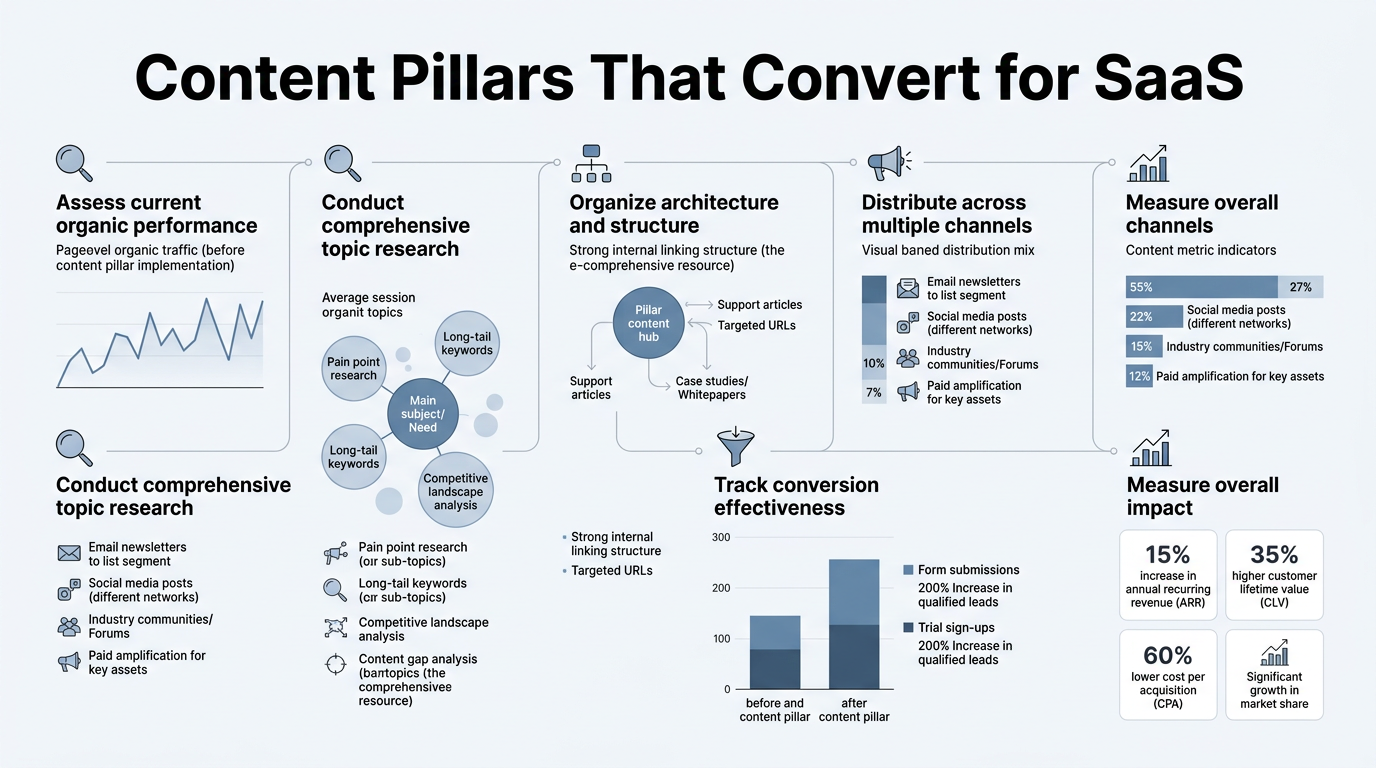
Content pillars aren't organizational taxonomy — they're revenue architecture. When a SaaS business defines four to six core pillars around buyer problems (not product features), it creates a repeatable system where every piece of content serves a purpose in the funnel. Companies that plan their editorial calendar 6–12 months around problem-based pillars see 2x higher trial-to-paid conversions than those publishing ad-hoc blog posts.
The conversion math is simple: unorganized content creates information chaos. Buyers don't know which page to read next. Search engines can't understand thematic authority. Sales teams get leads from random topics instead of qualified prospects. Structured pillars fix all three. Here's what changes:
- Search Visibility: Pillar + cluster architecture signals authority to Google — clusters internally link to the pillar, boosting both flagship and subtopic rankings.
- Buyer Clarity: Each pillar maps to a specific buyer problem or stage — prospects know exactly where to find what they need, reducing bounce rates by 30–40%.
- Sales Handoff: Bottom-funnel pillar content (comparisons, pricing guides, ROI calculators) generates MQLs ready for sales conversations, not tire-kickers.
- Content Compounding: Once a pillar and its clusters rank, they drive passive traffic and lead generation indefinitely — unlike one-off blog posts that decay after 90 days.
The shift required is fundamental: most SaaS content strategies focus on generic educational topics first, which compete with AI-generated answers and rarely convert. High-converting teams work backward — they start with bottom-of-funnel content (comparisons, use cases, pricing pages) before building awareness pillars. This reversal alone increases lead quality by 40–50%.
"Most SaaS teams are building content pillars backwards. They start with awareness content, hoping it eventually converts. Top performers reverse this — they build decision-stage content first, then stack awareness content on top. The difference in conversion rates is 40–50% higher for teams that work backward."
The Four Core Content Pillars That Drive Conversions
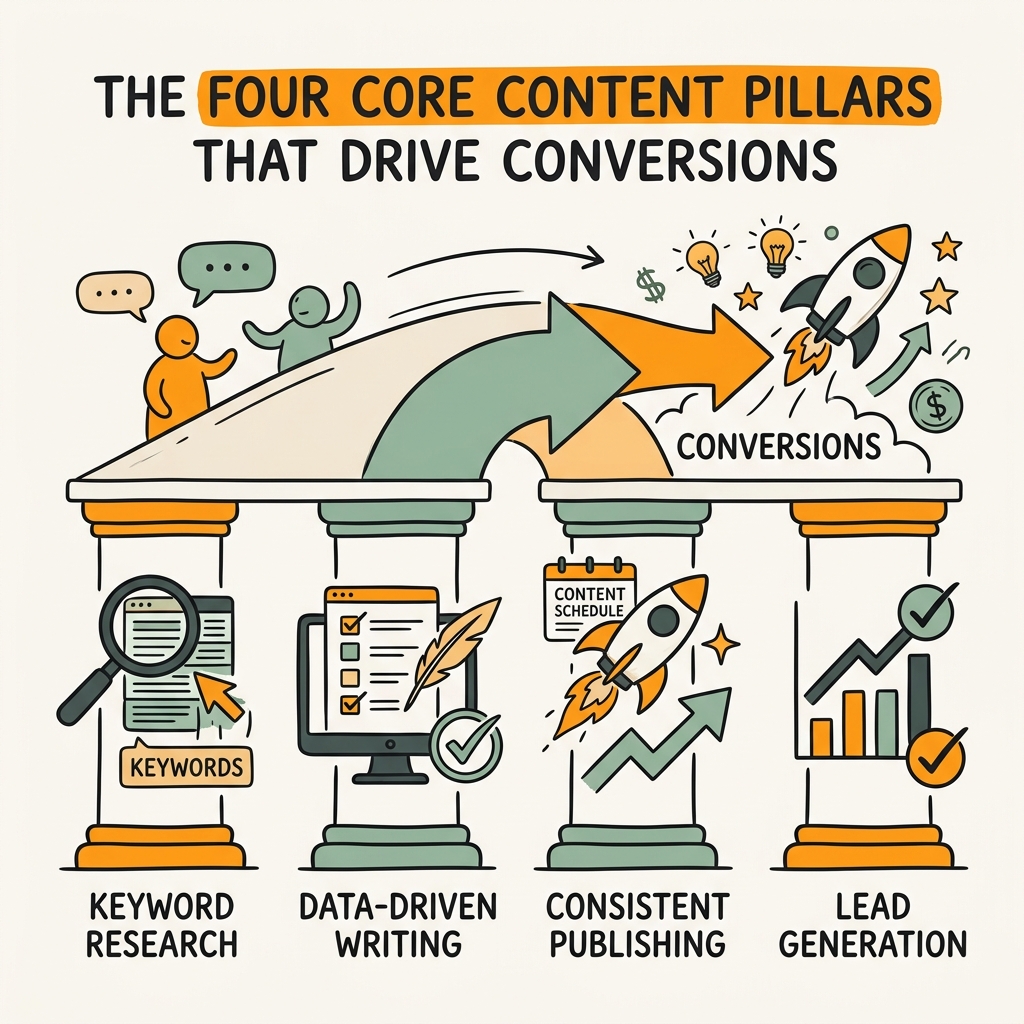
High-converting SaaS businesses use four pillars, each serving a distinct buyer stage and designed for different search intents. The combination ensures every keyword your buyers search gets owned by your brand. Here's how to structure them:
Problem-Awareness Pillars: Where Buyers First Land
Awareness pillars target buyers who don't yet know your solution exists — they're searching for the problem, not the tool. These pillars should comprise 30–40% of your editorial output and focus on pain points, symptoms, and early-stage research queries. Examples include "Why is manual data entry killing your team?" or "How to detect product adoption bottlenecks." Content under this pillar educates without selling and builds trust in your industry expertise.
The key: Plan these pillars around your buyers' actual jobs and frustrations, not feature sets. Interview your top 20 customers and ask "What problem were you solving before you found us?" not "Why did you pick us?" The answers become pillar themes. For SaaS products, common awareness pillars include workflow inefficiencies, compliance risks, team collaboration breakdowns, and cost management.
Each pillar should have 5–8 subtopic clusters that dive deeper. A "workflow inefficiency" pillar might cluster into: manual process waste, team communication gaps, tool switching friction, and approval bottlenecks. Every cluster gets a 1,500–2,000 word how-to or explainer article. This architecture signals to Google that your site owns the problem space and naturally feeds qualified traffic to your product pages.
Solution-Education Pillars: Teaching the How
Once awareness pillars pull buyers in, solution pillars teach them how to fix the problem — sometimes with your product, sometimes with general best practices. Allocate 25–30% of content here. These are walkthroughs, tutorials, and step-by-step guides that appear when someone searches "How to improve X" or "Best practices for Y."
The conversion lever in solution content is specificity. Instead of "Best Practices for Team Collaboration," write "How to Set Up Async Communication Without Killing Real-Time Feedback — A Template for 50+ Person Teams." The specific angle pulls in high-intent searchers and positions your method as the thoughtful approach. When your solution-education content naturally demonstrates why your product solves the problem better, you've closed the gap to consideration without hard-selling.
"Comparison pages and alternatives guides are the highest-converting content format for SaaS. They convert 2–3x higher than educational blog posts because they speak directly to someone already in active evaluation. They've decided they need a solution; they're just choosing between vendors."
Teams building solution content at scale leverage a SaaS content marketing framework for consistent growth that automates research and drafting while maintaining strategic ownership. The best performers produce 2–3 solution articles per week, building a library that compounds over time. Each article should be 2,000+ words and include at least one internal link to your product pages.
Product-Demonstration Pillars: The Conversion Layer
This pillar is pure bottom-of-funnel content designed to move buyers closer to trial or demo requests. Dedicate 20–25% of content here. It includes comparisons ("Tool A vs. Tool B vs. Your Product"), alternatives guides ("Top 7 Competitors to X"), case studies, ROI calculators, and pricing guides.
Comparison pages and alternatives guides convert 2–3x higher than blog posts because they speak directly to someone in active evaluation. They've already decided they need a solution; they're just choosing between options. A well-researched comparison that honestly frames your strengths (and acknowledges competitor advantages in narrow areas) builds credibility and captures the buyer at their peak intent.
Product-demonstration content should answer specific objections: "Why is your pricing higher?" becomes a pricing philosophy guide showing TCO vs. monthly cost. "Can it integrate with X?" becomes a technical integration deep-dive. "What if I need custom features?" becomes a case study of how one customer extended the platform. Every piece of this pillar pulls a buyer 5–10% closer to purchasing.
Industry-Leadership Pillars: Building Defensibility
The final pillar is thought leadership and proprietary research, comprising 15–20% of output. Examples include original data, contrarian takes, market forecasts, and founder commentary. This pillar builds link-worthiness (other sites cite your research, boosting domain authority) and positions your brand as a thought leader, not just a vendor.
The misconception: thought leadership should be pure opinion. In reality, the highest-converting thought leadership combines data with perspective. Original research studies that benchmark your category and include proprietary data from your customer base convert 3–4x better than generic predictions. If you can publish an annual report of how 500+ customers are using your product category, that becomes a link magnet and a trust builder. Sales teams also use it as a qualification tool: "Our 2026 benchmark shows companies in your space average 40% efficiency gains — you're at 15%."
This pillar also includes founder/CEO commentary on market trends. Buyers want to understand the vision and philosophy behind the company. A quarterly essay from your founder on industry shifts, competitive dynamics, or the future of your category builds emotional connection and positions your team as operators, not just vendors.
How to Map Pillars to Your Buyer Personas and Sales Funnel
The highest-converting pillar strategies are mapped to specific buyer personas and their decision journey. Generic pillars fail because they don't account for the different jobs your buyers have and the different information they need at each stage.
Start With Your Paying Customers, Not Your Product
Before writing a single content pillar, analyze your last 20–50 customers who paid and stayed. Interview each one and answer: What problem were they solving? What was their original search query? What content helped them choose you? What triggered them to act?
These interviews reveal the buyer personas that actually convert, not the ones you hope exist. Many teams build content pillars around their ICPs (Ideal Customer Profiles) based on guesswork. The results are wasted content that ranks but doesn't convert. When you invert this and map pillars to the jobs and searches of customers who already paid you, conversion rates jump 40–60%.
Create a matrix with three columns: Buyer Persona, Funnel Stage, and Pillar Theme. Example:
| Buyer Persona | Funnel Stage | Content Pillar |
|---|---|---|
| Head of Ops (scaling to 50 people) | Awareness | Scaling Operations Without Burning Teams |
| Head of Ops (scaling to 50 people) | Consideration | How to Choose Operations Tools (+ Comparison Matrix) |
| Head of Ops (scaling to 50 people) | Decision | X vs. Y: Feature, Pricing, and Integration Breakdown |
| VP Finance (SMB) | Awareness | How Finance Teams Waste Time on Manual Processes |
| VP Finance (SMB) | Consideration | Best Practices for Finance Automation in Growing Teams |
| VP Finance (SMB) | Decision | Pricing Strategy: How to Get ROI in Year 1 |
This approach ensures every pillar serves a real buyer journey and every cluster within a pillar targets a specific person at a specific stage. It also prevents content overlap — you're not writing ten blog posts on the same topic for different stages, you're writing targeted content for each. According to recent SaaS content strategy research, teams that segment their content by buyer stage see 3–4x higher conversion rates compared to one-size-fits-all approaches.
Prioritize Bottom-of-Funnel First
Counter to conventional wisdom, teams should build decision-stage content before awareness content. Why? Because decision-stage content is harder and more valuable. It requires product expertise, customer data, competitive intelligence, and genuine differentiation. Once that foundation exists, awareness and education content flows naturally.
Start your pillars by creating the comparison pages, alternatives guides, case studies, and pricing resources that will convert evaluation-stage buyers. Test these with sales teams — show them the content and ask, "Would this help close a deal?" Then backfill with awareness and education content that feeds those bottom-funnel pieces. This reversal typically increases lead quality by 50–70%.
Structuring Your Editorial Calendar Around Pillars

Once you've mapped pillars to buyer personas and funnel stages, you need a publishing rhythm that builds authority without overwhelming your team. The best SaaS teams commit to a 6–12 month editorial calendar that plans roughly:
- Week 1–4: Publish one pillar cluster article (1,500–2,000 words). Link internally to the core pillar page and 1–2 related clusters.
- Week 2: Publish one thought leadership or opinion piece from a founder or expert. Aim for a news hook or market insight.
- Week 3: Republish an older pillar cluster with updated data, new examples, and refreshed SEO elements. Relink it across the site.
- Week 4: Publish one comparison or case study that demonstrates product fit.
This rhythm balances SEO-friendly educational content (clusters) with conversion-focused content (comparisons, case studies) and authority-building thought leadership. A team publishing 4 articles per month will build meaningful pillar authority within 6 months.
The biggest lever for scaling this without burning out your team is content automation. Most manual content workflows require writers to research, draft, edit, optimize, and publish — a process that takes 20–30 hours per article for thorough work. Content automation tools for SaaS teams handle research, writing, and publishing simultaneously, compressing this to 2–3 hours of human oversight, allowing lean teams to sustain daily publishing. When you're building pillar authority, frequency compounds — daily articles in a single pillar over 90 days builds more topical authority than one article per week for a year. Recent benchmarks from 2026 show that teams publishing daily achieve 3.5x faster topical authority than weekly publishers.
Measuring Pillar Performance and Optimizing for Conversion
Content pillars only work if you measure the right metrics. Most SaaS teams track vanity metrics — traffic, views, time-on-page — that have zero correlation with revenue. High-converting teams measure pipeline, not pageviews.
The Metrics That Actually Matter
For each pillar, track these four metrics monthly:
- Qualified Leads from Pillar: How many MQLs (marketing-qualified leads) were generated from content within this pillar? Use UTM parameters and CRM data to attribute correctly.
- Trial Signups and Activations: Of those MQLs, how many signed up for a trial? Track which specific articles drove the conversion.
- Sales Cycle Impact: Measure content-assisted conversions. If a prospect read content from Pillar A in week 1, then Pillar C in week 3, and closed in week 5, that's a 3-touch deal. Content was part of it.
- Cost Per Acquisition (CPA): Compare the cost to produce a pillar against the revenue it generates. A $5,000 pillar producing $30,000 in first-year ARR is a 6x return.
Use your analytics and CRM to build a monthly dashboard showing each pillar's contribution to pipeline. If one pillar drives 60% of your qualified leads, double down. If a pillar drives 10% of traffic but 0% of leads, consider restructuring it or pausing it in favor of higher-converting themes.
Optimize for Content-to-SQL Conversion
The most important metric is content-to-SQL (Sales-Qualified Lead) conversion. Top-performing SaaS teams see 13% MQL-to-SQL conversion rates, but even that underestimates the value if you're not tracking which content pieces move the needle. Each pillar should contribute SQLs, not just MQLs.
Optimize for this by:
- Adding clear CTAs to bottom-funnel pillar content. Not "Learn more," but "See how X customers achieved Y" with a link to a case study or demo page.
- Creating pillar-specific landing pages that aggregate all cluster content and funnel readers to decision-stage resources.
- Building automated nurture sequences that move MQLs from awareness pillars through solution and product-demonstration pillars before sales contact.
Common Pillar Mistakes That Kill Conversion Rates
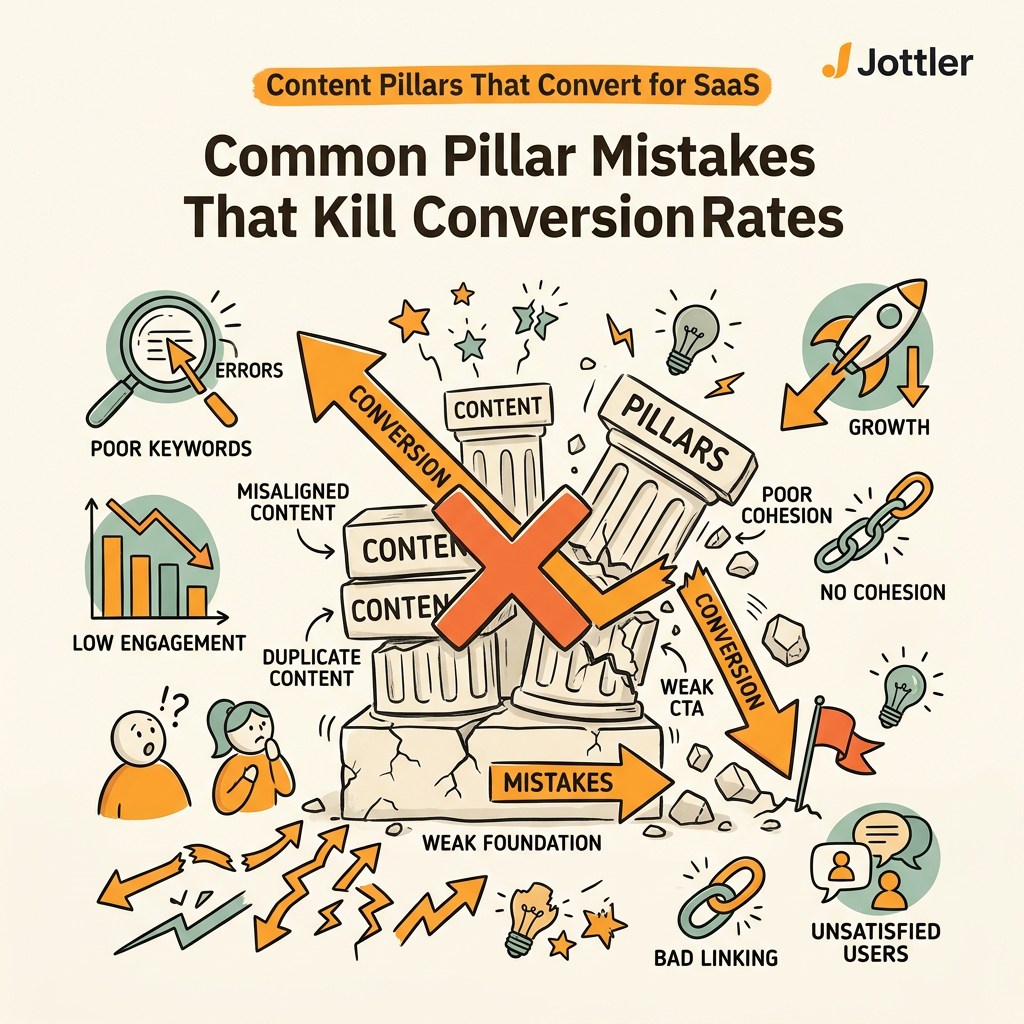
Even well-intentioned pillar strategies fail when teams make these mistakes:
Mistake 1: Building Pillars Around Features, Not Problems
When a pillar is "Using Our Product's Dashboard," you've lost. Nobody searches for that. They search "How to track team performance" or "Best practices for real-time visibility." Pillars built on problems attract buyers at scale. Feature pillars attract product researchers.
Audit your pillars: If more than 10% of your pillar names contain product-specific language, reorganize around buyer problems instead.
Mistake 2: Creating Pillar Content Without Internal Linking Strategy
A pillar page that doesn't internally link to its cluster content (and vice versa) is just a blog post. The conversion power of pillars comes from their architecture — clusters amplify the pillar's authority and funnel readers through the buyer journey. Every cluster should link back to the pillar and to 2–3 related clusters.
If you're publishing pillar content without a linking plan, you're leaving 40–50% of the conversion potential on the table. That's why building topical authority requires deliberate internal linking to reinforce pillar-cluster relationships across every new piece published.
Mistake 3: Not Coordinating Content and Sales Messaging
Sales teams often use language, examples, and positioning that contradicts your content pillars. A pillar positioned on "Enterprise scalability" but your sales team pitching "cost savings for SMBs" creates buyer confusion. The content doesn't support the sales narrative, so conversion rates plummet.
Sync content and sales by having sales teams review new pillar content before publication and align on messaging. Monthly alignment meetings where sales shares top objections help inform which cluster content to prioritize. Strong SaaS SEO strategy hinges on this alignment between marketing and sales narratives.
Scaling Pillar Content Production Without Burnout
The biggest barrier to pillar success is consistency. Building one pillar deeply (20+ articles over 6 months) takes sustained effort. Most teams start strong, then fade as the workload becomes unsustainable. Content teams of 1–2 people simply can't maintain 4 pillars at full depth.
The solution is intelligent automation. Rather than replacing human expertise, modern content automation handles the repetitive, time-consuming parts of pillar development: research, fact-checking, and publishing. This allows small teams to maintain the thinking and strategy work while offloading execution.
The best systems work like this: You define a pillar and its success metrics. The system researches 14+ sources per article, writes 3,000+ word pieces, fact-checks claims against your brand standards, optimizes for SEO, and publishes directly to your CMS. Your team then spends 15–20 minutes per article reviewing, tweaking, and approving — no rewriting from scratch needed.
Teams using this approach report publishing 3–5 pillar articles per day without increasing headcount. Over 90 days, that's 300–500 new cluster pieces building authority in your pillars. When your competitors are publishing 1–2 articles per month, and you're publishing 100+ per month in the same pillar, the compounding effect is unstoppable.
Conclusion
Content pillars are no longer a nice-to-have organizational feature — they're the architecture that separates high-converting SaaS content from the noise. When aligned to buyer personas, funnel stages, and actual customer search journeys, pillars compound organic traffic, improve lead quality, and drive revenue growth. Top-performing SaaS teams achieve 10–15% conversion rates (vs. 3–5% industry average) because their content is structured to convert, not just inform.
Start with your paying customers, not your product. Map pillars to the problems they were solving. Build bottom-of-funnel comparison and case study content first. Then expand awareness and education content that feeds those decision-stage pieces. Measure content-to-SQL conversion, not pageviews. Optimize continuously based on which pillars and clusters drive qualified leads and closed deals.
The teams pulling ahead in 2026 aren't writing more blog posts — they're architecting their entire content strategy around buyer-stage pillars designed for conversion. Start your SEO agent and let it research, write, and publish pillar-based content at the frequency your market demands. With the right system, you can build deep topical authority faster than competitors, capture organic traffic at every stage of the buyer journey, and turn content into your most predictable revenue channel.
FAQs
What is the difference between content pillars and topic clusters?
Content pillars are broad, foundational themes that anchor your entire content strategy — like "How to Scale Operations Efficiently" for a SaaS serving ops leaders. Topic clusters are specific subtopics that branch from that pillar, exploring different angles or stages within the same theme. A "Scaling Operations" pillar might cluster into "Team Communication Tools," "Project Management Automation," and "Hiring for Operations Roles." Pillars are the strategic framework; clusters are the executable pieces that build authority and guide buyers through the decision journey. Pillars typically contain 8–15 clusters, each earning their own 1,500–2,000 word article. Together, they create the internal link network that signals topical authority to search engines and keeps readers engaged deeper in your content.
How many content pillars should a SaaS startup have?
Most SaaS startups should start with 3–4 core pillars, not 10. More pillars means divided attention, thinner content depth, and slower authority building. A lean startup with a small content team will see faster results focusing on 3 pillars deeply than distributing effort across 6 shallow pillars. Typical pillars for a SaaS product are: Problem Awareness (what the buyer is searching for), Solution Education (how to solve it), Product Differentiation (why you're the fit), and Industry Trends (thought leadership). Once you've built 20+ clusters per pillar and those are ranking consistently, then add a fourth or fifth pillar. Growth in pillar count should follow proven success in initial pillars, not precede it.
How often should we publish content within each pillar?
Consistent publishing frequency builds pillar authority faster than sporadic bursts. High-converting SaaS teams publish 1–2 pillar cluster articles per pillar per week, building 50+ articles per pillar over a year. This requires either a dedicated content team or content automation. A team of two people manually writing articles will max out at 1–2 total pieces per week across all pillars, which is why many shift to systems that handle research and drafting while humans focus on strategy and review. If you're publishing one article per month per pillar, you'll build meaningful authority in 18–24 months. If you publish daily in each pillar using automation, you'll own that topic in 6–9 months. Choose a frequency you can sustain, because consistency matters more than volume — weekly publishing over a year beats 100 articles in month one then nothing for 11 months.