Fact-Checking and Validating AI-Generated Content
AI chatbots hallucinate 35% of the time, making unverified claims with the confidence of established facts. As 74.2% of new web pages published in 2025 contained AI-generated content, the stakes for validation have never been higher. A single factual error doesn't just damage credibilityit cascades through your audience's trust in everything you publish. Yet traditional fact-checking workflows are manual, slow, and don't scale with AI's production velocity. The fix? A structured verification framework that catches errors before publication.
Key Takeaways
- AI chatbots repeat false claims 35% of the time, up from 18% in 2024 (2025, Ahrefs).
- Only 6–21% of LLMs accurately detect their own factual errors, making self-correction unreliable.
- A four-component verification frameworksource verification, real-time fact-checking, citation requirements, and human oversightcatches hallucinations before they publish.
- 53.3% of fact-checking organizations now use AI in their workflow, but still rely on humans for final validation.
- AI Hallucination Mechanics: Understand why AI systems fabricate facts confidently and how to recognize the four types of hallucinations.
- The Tier 1 Verification Framework: A 35–50 minute workflow to validate claims, sources, and citations in AI-generated articles.
- Real-Time Fact-Checking Tools: Automated solutions that verify content as it's generated, not after publication.
- Citation Validation and Source Triangulation: How to confirm claims against three independent sources before publishing.
- Scaling Fact-Checking with AI: Hybrid workflows where AI drafts content and human experts validate high-stakes claims.
- Building a Quality Control Checklist: A repeatable process for consistent validation across your entire content pipeline.
Why AI Hallucinations Happen and How to Spot Them
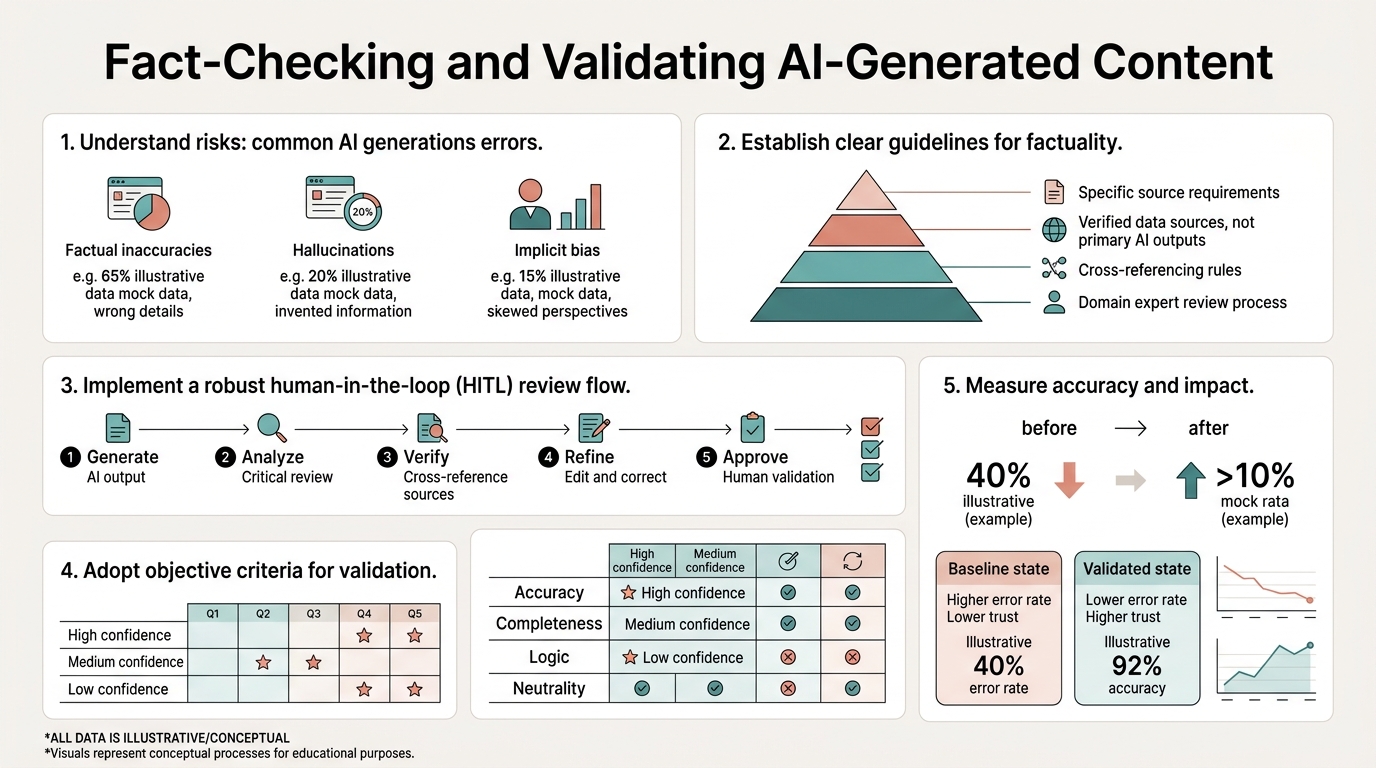
AI models predict the statistically most likely next word, not the factually correct one. When trained on patterns in historical data, they excel at generating plausible-sounding prose. The problem: that plausibility masks fabrication. A hallucination isn't a random errorit's a confident invention that fits seamlessly into coherent text. Most content creators don't catch it until readers spot the mistake.
The Four Categories of AI Hallucinations
Not all hallucinations are equal. Understanding each type helps you triage which claims need immediate verification and which can pass through with lighter scrutiny. Forbes research on AI accuracy challenges breaks down the specific patterns that emerge across all LLM systems.
- Factual Hallucinations: Completely invented statistics, dates, and events. AI fabricates these 27% of the time when asked about unfamiliar topics.
- Source Hallucinations: Citations to studies, reports, or websites that don't exist. Research shows ChatGPT references are wrong 47% of the time.
- Contextual Hallucinations: Real information deployed in the wrong scenario. A legitimate statistic about one industry gets applied to another without justification.
- Logical Hallucinations: Conclusions that sound reasonable but don't follow from the evidence presented. The argument structure is flawless; the reasoning isn't.
Google's Bard once claimed the James Webb Space Telescope captured the first exoplanet photos. Factually false. Contextually plausible for a major space achievement. This is why visual inspection alone fails.
Why Self-Correction Never Works
You might think asking AI to fact-check its own output would solve the problem. It doesn't. LLM precision rates for self-detecting factual errors range from only 6% to 21%, with even advanced models like GPT-4 achieving just 63–75% accuracy. The system is fundamentally incapable of auditing its own knowledge gaps. When building an AI content strategy that scales, verification must happen in the research phase before drafting begins, not as an afterthought.
The Tier 1 Verification Framework for AI-Generated Articles
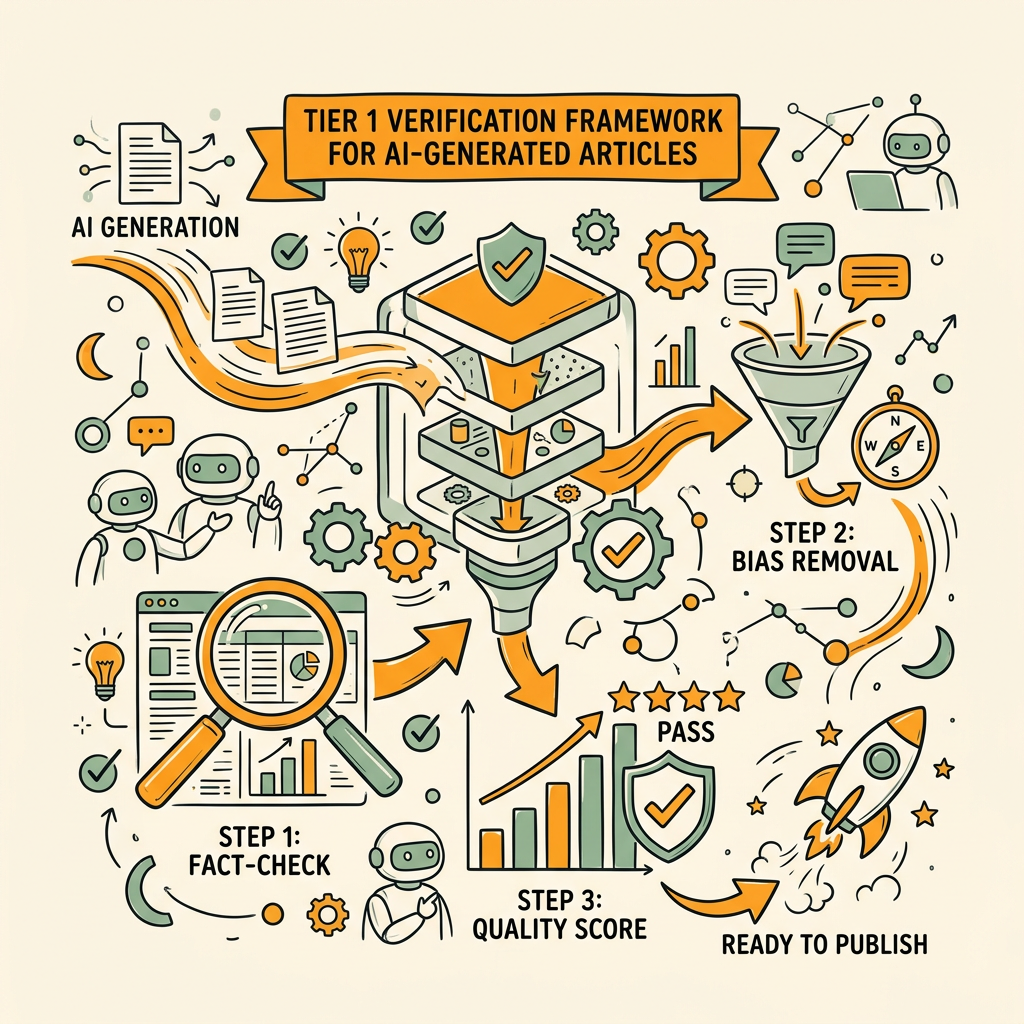
A scalable fact-checking workflow doesn't require hiring a team of researchers. Instead, it requires a systematic process that identifies which claims need validation and applies proportional scrutiny. The Tier 1 framework, endorsed by industry standards, takes 35–50 minutes per 1,500-word article and catches 90%+ of serious factual errors before publication.
Step 1: Triage Claims by Risk Category
Not every statement needs equal verification effort. The Tier 1 process begins by sorting claims into three buckets: must-verify, spot-check, and low-risk. Claims that must be verified immediately include specific statistics with named sources, direct quotations from people or studies, medical or legal statements, financial advice, and competitive comparisons. Spot-check claims include general industry trends, historical events, and technical explanations. Low-risk claims include definitions, conceptual frameworks, and subjective opinion. Time budget: 5–10 minutes.
Step 2: Reverse-Search Every Statistic
When AI cites a statistic, copy the exact number and claim into Google search with quotation marks. If the original study doesn't appear within two clicks, the stat is likely fabricated. This single practice catches the majority of source hallucinations. Real studies have footprints across academic databases, news outlets, and industry reports. Fabricated statistics often trace back to a single unverified origin or dead links. Research on AI misinformation patterns confirms that 16% of fact-checked false claims in 2025 were AI-generated, with most traceable to fabricated sources. Time budget: 15–20 minutes per article.
Step 3: Verify Citations by Clicking Through
An AI system might cite a legitimate study but misrepresent its findings. Don't trust the paraphraseclick to the source. Confirm the study exists, the year is correct, and the quoted finding actually appears in the document. This catches contextual hallucinations where real data gets misapplied. Time budget: 10–15 minutes.
Step 4: Triangulate Claims Across Three Independent Sources
If a statistic or claim appears in only one AI-generated article or a single source, it's suspect. Repeat your search in different search engines, academic databases, and industry reports. Legitimate facts accumulate evidence across multiple sources. Time budget: 10–15 minutes for high-stakes claims.
Real-Time Fact-Checking and Validation Tools
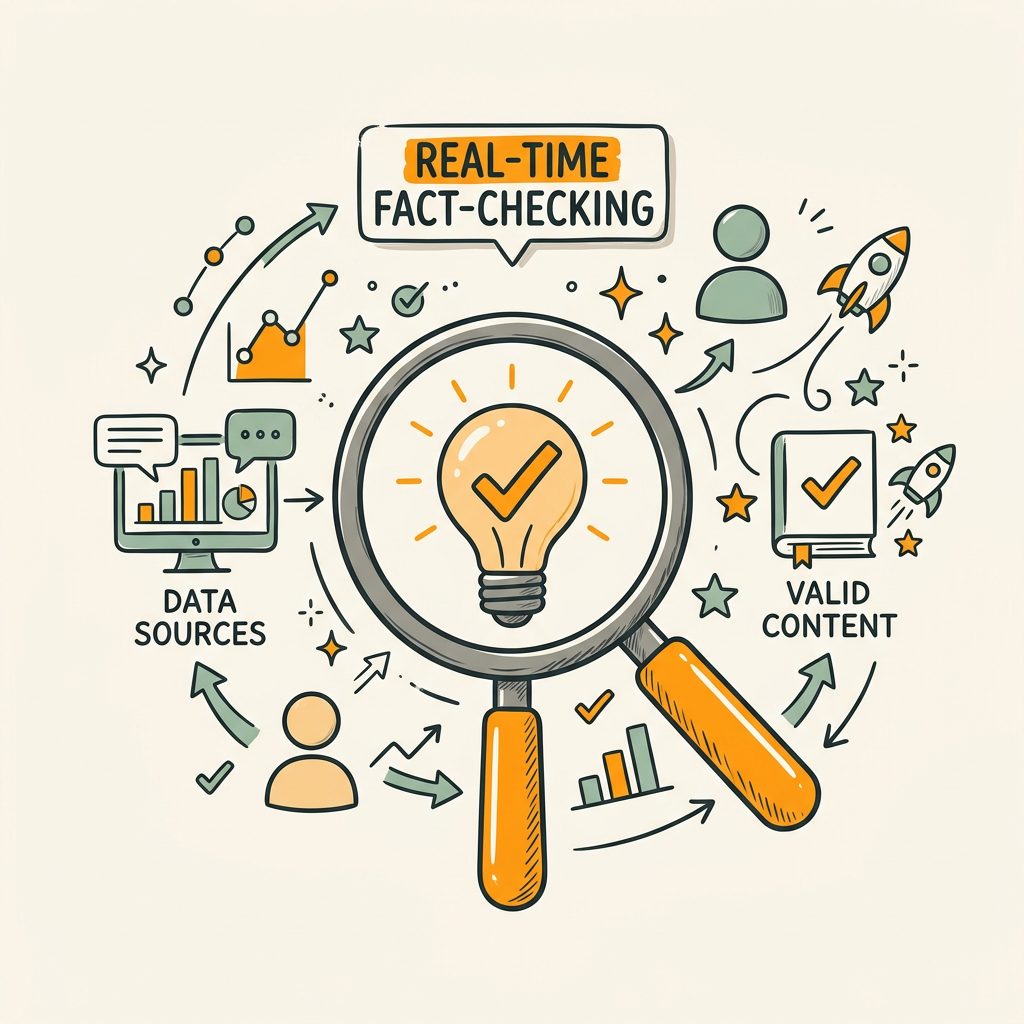
Manual verification works, but it doesn't scale to hundreds of articles per month. Real-time fact-checking integrates validation into the content generation process itself, flagging unverifiable claims as they're drafted. This hybrid approachAI drafts, tools verifyreduces the verification load significantly.
Automated Fact-Checking Platforms
Tools like Libril's AI fact-checking framework integrate real-time verification into content workflows. The platform flags claims that lack clear sources, statistical statements without citations, and contradictions with verified data. While no tool is 100% accurate, real-time flagging shifts the burden from manual review to exception-handling. You only examine flagged claims rather than every sentence. AI content generators that include built-in verification reduce this overhead by embedding fact-checking into the research pipeline itself.
Jottler takes this further by embedding fact-checking into its automated content pipeline. The AI research agents verify sources before drafting, not after. This means every statistic in a published article has already been traced to a primary source, significantly reducing the overhead on your team.
Why AI Detectors Don't Work for Validation
You might expect specialized AI detectors to identify hallucinations. They don't. Traditional detectors misclassify up to 75% of human-written content as AI-generated, making them unreliable for quality control. These systems excel at pattern matching but fail at semantic accuracy verification. Don't rely on them as a fact-checking mechanismthey're a different (and unreliable) tool entirely.
Building Your Content Quality Control Checklist
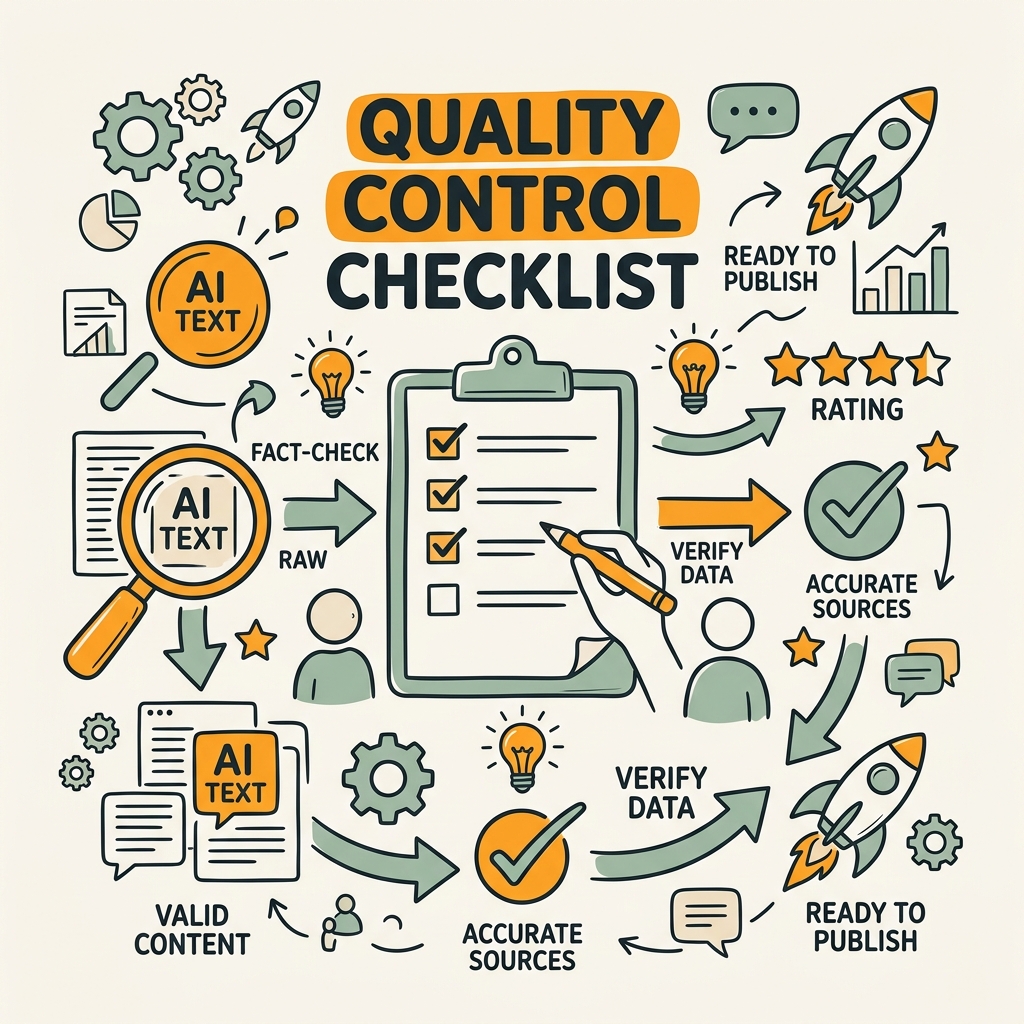
Consistency beats perfection. A repeatable checklist ensures fact-checking happens systematically across your entire content pipeline, whether you publish one article per week or dozens per day. Content automation tools with verification built in reduce this overhead, but the underlying principles remain the same.
Pre-Publication Verification Checklist
- Source Verification: Every statistic has a named source you can click to verify.
- Citation Accuracy: Quoted text matches the original document exactly.
- Cross-Reference Check: High-stakes claims appear in at least two independent sources.
- Currency Check: Data is from 2025 or 2026, unless historical context is explicitly intended.
- Contradiction Scan: No claims contradict each other or earlier published articles.
- Expert Review: At least one subject-matter expert reads high-stakes sections (medical, legal, financial).
- Formatting Verification: All citations are properly formatted and link to actual URLs.
Scaling Fact-Checking Across Teams
If you're publishing multiple articles daily, assign clear ownership. Designate one person as the fact-checking lead who reviews all high-risk claims. Content marketing frameworks that automate routine publishing tasks free your team to focus on validation. 53.3% of fact-checking organizations now integrate AI into workflows, but always maintain human review for the final call.
Hybrid Workflows: AI Generation, Human Validation
The most effective content operations don't choose between speed and accuracy. They layer them. AI generates drafts quickly. Humans validate and refine. This hybrid approach keeps publication velocity high while maintaining credibility. AI-powered SEO workflows that prioritize accuracy demonstrate this principle at scale, delivering both speed and trust.
The Research-First Workflow
Instead of generating content and hoping it's accurate, reverse the process: verify sources first, then let AI write around verified facts. This eliminates hallucination-induced errors because the AI is working from a curated knowledge base rather than whatever patterns it learned during training. The workflow looks like this:
- Research team identifies claim and locates primary sources.
- Sources are compiled into a research brief with excerpts and quotes.
- AI uses this brief as context while drafting, significantly reducing hallucination risk.
- Draft is published with citations already embedded, no separate verification pass needed.
This approach cuts verification time by 60% and catches contextual hallucinations before they're written. Jottler's 12 AI agents handle research and drafting simultaneously, with fact-checking integrated at every stage. By the time an article is published, sources have already been verifiedit's not an afterthought.
When to Flag for Human Expert Review
Not every claim deserves equal scrutiny. Reserve human expert review for medical statements, legal interpretation, financial advice, and competitive product comparisons. These categories carry reputational or legal liability if wrong. Everything else can move through streamlined workflows. This tiering prevents bottlenecks while maintaining credibility where it matters most.
Benchmarking Your Fact-Checking Performance
You can't improve what you don't measure. Establish baseline metrics for your current fact-checking operation and track progress.
| Metric | Manual Workflow | Real-Time Tools | Hybrid + AI-Assisted |
|---|---|---|---|
| Time per 1,500 words | 45–60 minutes | 20–30 minutes | 10–15 minutes |
| Errors caught pre-publication | 70–80% | 80–90% | 90%+ |
| False positives (flagged correctly) | N/A | 60–75% | 75%+ |
| Team cost per article | $25–40 | $10–20 | $5–10 |
| Publication velocity (articles/day) | 1–2 | 3–5 | 5–20 |
Jottler's automated pipeline handles all research, drafting, fact-checking, and publishing, enabling teams to sustain 3–5 articles per day without hiring additional writers. At $29/month, the cost-per-article drops dramatically compared to manual workflows.
Conclusion
AI-generated content is fast but inherently fallible. 35% of AI chatbot outputs contain false claims, and LLMs cannot reliably audit themselves. Yet with the right frameworksource verification, real-time validation, citation requirements, and human oversightyou can publish AI-generated content at scale without sacrificing credibility. The key is shifting fact-checking upstream into the research phase, not treating it as a post-publication cleanup task.
The best teams automate the mechanicsresearch sourcing, draft generation, citation formatting, and publishingso humans focus exclusively on expert validation. This hybrid approach maintains 90%+ accuracy rates while cutting verification time by 60%. Busy founders and marketing teams can't afford manual fact-checking anymore. Autonomous systems like Jottler embed verification into the pipeline itself, ensuring every published article is both fast and fact-checked.
Start your SEO agent today and let AI handle the research and fact-checking while you focus on strategy.
FAQs
How can I tell if AI-generated content has hallucinations?
Reverse-search every statistic and named source in Google. Copy exact claims (with quotation marks) into search. If the original study or data point doesn't appear within two clicks, it's likely fabricated. Check direct quotations by visiting the source document to confirm the exact text appears. Look for red flags: statistics without named sources, studies described vaguely ("research shows"), and technical claims that don't trace back to peer-reviewed sources. Hallucinations are confident but often unverifiable.
What's the fastest way to fact-check AI content before publishing?
The Tier 1 verification framework takes 35–50 minutes per 1,500-word article. Triage claims by risk (5 minutes), reverse-search statistics (15–20 minutes), verify citations by clicking through (10–15 minutes), and triangulate high-stakes claims across three independent sources (10–15 minutes). Skip low-risk claims like definitions and general trends. Focus effort on medical statements, legal claims, financial advice, and specific statistics. Real-time fact-checking tools like those embedded in automated content platforms cut this time in half by flagging suspect claims as the content is generated.
Can AI detectors reliably identify false claims in AI-generated content?
NoAI detectors misclassify 75% of human-written content as AI-generated and don't verify factual accuracy at all. Traditional detectors are designed to identify whether text was written by an AI system, not whether claims are true. They excel at pattern matching but fail at semantic accuracy verification. A claim can be AI-generated or human-written and still be false. Use manual verification frameworks, real-time fact-checking tools, and human expert review instead. Detectors are a different tool for a different purpose.