How AI Writing Tools Generate Social Media Content
87% of marketers now use generative AI in at least one workflow in 2026. Yet most still don't understand how AI writing tools actually generate social media contentthe mechanics, the quality trade-offs, and the specific prompts that work. The gap between AI capability and effective deployment is where most teams fail. Here's what's really happening under the hood, and how to harness it for consistent, high-performing content.
Key Takeaways
- 89.7% of social media marketers use AI daily or multiple times per week, with 71.1% reporting measurable time savings (Sociality AI Report, 2026)
- AI-assisted social content produces 3.8x higher output than manual workflows, with 44.7% of marketers confirming AI content performs better than non-AI posts
- Teams applying moderate-to-extensive human editing (78.4%) maintain brand authenticity while capturing AI speed advantages
- Content ideation and brainstorming: AI generates 10-50 post variations instantly, ranked by engagement patterns and platform intent.
- Prompt-to-post generation: AI models use language patterns, brand voice training, and audience data to output ready-to-edit first drafts in under 60 seconds.
- Multimodal content creation: Text, image, and caption generation happen in parallel, with AI-visual tools producing 71-79% of all social media images shared today.
- Content repurposing at scale: Long-form blog posts convert into 5-10 platform-specific social posts automatically, maintaining message consistency.
- Personalization and segmentation: AI tailors posts to audience segments, time zones, and behavioral triggers without manual campaign setup.
What Is AI Content Generation, Exactly?
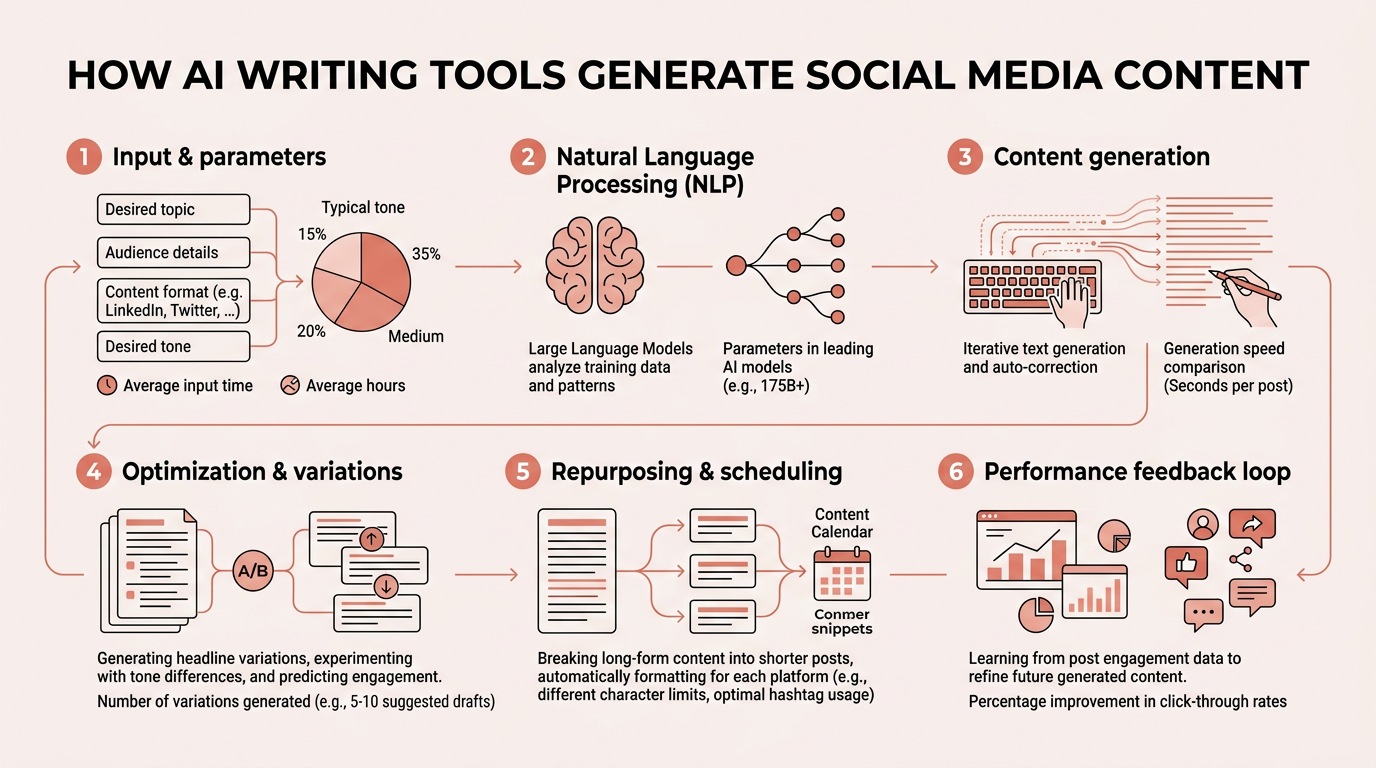
AI writing tools generate social media content by ingesting training data, learning patterns from human-written posts, and predicting the next most statistically likely word or phrasemillions of times, in sequence. The result reads like human writing because it's learned from billions of human texts. But the process is fundamentally mathematical, not creative. Understanding this distinction matters because it affects how you brief the AI, edit the output, and maintain your brand voice.
Large language models (LLMs) like GPT-4, Claude, and specialized social media tools operate on transformer architecture. They don't "think" about contentthey calculate probability distributions. Feed them a prompt (your content instructions), and they output tokens (word fragments) one at a time, each one predicted to best match the context of everything before it. Doing this 500 times creates a coherent 200-word Instagram caption. Doing it 10,000 times creates a full blog post. The quality depends entirely on:
- Training data quality: Models trained on published, high-engagement posts generate better social content than those trained on all internet text.
- Prompt specificity: Vague prompts ("Write a Facebook post") generate mediocre output. Detailed prompts with tone, audience, and call-to-action instructions generate professional-grade first drafts.
- Fine-tuning: AI trained specifically for social media (not general writing) understands platform-specific conventions: character limits, hashtag strategies, caption length norms.
- Retrieval augmentation: The best tools pull real data (your website, recent campaigns, trending topics) into the generation process, reducing hallucinations and improving relevance.
The Multi-Stage Pipeline: How Content Gets Generated

Professional AI content generation isn't a single button press. It's a coordinated pipeline of AI agents working in sequenceresearch, ideation, drafting, fact-checking, and publishing. Understanding these stages reveals why some tools produce better content than others, and where human oversight matters most. According to SQ Magazine's AI in Social Media Tools Statistics, 60% of U.S. companies use generative AI to maintain a 24/7 social media presence, proving that well-orchestrated pipelines are now table stakes.
Stage 1: Research and Intent Detection
Before writing, AI tools scan your brand context, recent posts, audience demographics, and trending topics in your industry. This stage is critical for relevance. Tools that skip this stage produce generic, tone-deaf posts. Quality tools use AI agents to:
- Identify trending topics in your niche using news feeds, social APIs, and search volume data
- Analyze your past posts to detect voice patterns, posting frequency, hashtag strategy, and content themes
- Profile your audience by examining engagement metrics, comments, and follower demographics
- Set content intent for the post: awareness, engagement, conversion, or community building
Stage 2: Prompt Construction and Template Filling
Once research is complete, the tool constructs a detailed system promptessentially, detailed instructions for the AI model. This prompt contains:
- Brand voice guidelines: Tone (professional, casual, witty), vocabulary preferences, key phrases to avoid
- Platform specifications: Character limits, ideal post length, hashtag density, optimal posting time
- Audience context: Target personas, pain points, interests, buying stage
- Content pillars: Topics and themes the brand focuses on (e.g., "productivity tips," "customer stories," "product updates")
- Call-to-action templates: Predefined CTAs that drive the desired action
The actual generation happens next. The AI model receives the full prompt and generates text token-by-token, constrained by the parameters. Better tools use temperature and top-k sampling to control creativity: lower temperature yields safer, more predictable output; higher temperature increases variety and risk.
Stage 3: Multimodal Content Synthesis
Top-tier tools don't stop at captions. They generate images, videos, or design suggestions in parallel. 71-79% of all social media images are now AI-generated or AI-edited (2026 data), using tools like Midjourney, DALL-E, or proprietary vision models. The pipeline here:
- Text prompt generates a detailed image description
- Image generation model (diffusion model) creates 3-5 visual options matching the caption
- Image selection AI ranks options by brand alignment and predicted engagement
- Final post bundles caption + image + hashtags + optimal posting time
Integrated tools like Jottler's AI content generator handle this coordination automatically, ensuring visual and textual content stay aligned without manual handoff.
Stage 4: Fact-Checking and Brand Safety
This stage is where most generic AI content falls shortand where careful tools excel. Fact-checking agents verify:
- Accuracy: Claims match your published data, case studies, and brand statements
- Compliance: Posts comply with platform guidelines and industry regulations
- Consistency: Messaging aligns with ongoing campaigns and brand promises
- Tone fit: Language matches your brand voice and audience expectations
This is non-negotiable. AI hallucinationsconfident-sounding false claimsare a brand liability. Teams that skip this step often publish contradictory or factually wrong posts, damaging credibility.
How Prompt Engineering Drives Output Quality
The difference between mediocre and excellent AI-generated posts is almost entirely in the prompt. A weak prompt yields generic, tone-deaf content. A strong prompt produces posts that perform. Research from Digital Applied's AI Marketing Statistics 2026 shows that teams with structured prompt libraries see 3.2x ROI from AI-driven content drafting, compared to single-prompt approaches. Here's how expert prompt engineering works:
The Anatomy of a High-Performing Prompt
A professional social media generation prompt contains six elements, each critical for output quality. Skip any one, and the post suffers. Here's what each does:
- Role definition: "You are a SaaS marketing expert writing for busy founders." Sets the voice and expertise level.
- Context: "Our product helps teams automate content marketing. We target scaling companies with 20-50 employees." Ensures relevance and targeting.
- Output format: "Write a 2-3 sentence Instagram caption, starting with a question." Constrains length and structure.
- Tone and style: "Conversational, data-backed, avoid jargon. Use contractions. Bold one key stat." Controls voice fidelity.
- Specific instruction: "Reference [recent product feature] and link to [URL]. Include 2-3 relevant hashtags." Adds actionable direction.
- Constraint: "Do not mention competitors. Avoid 'in today's world' and 'it's important to note.'" Eliminates common weaknesses.
Professional tools embed these elements into reusable templates. Best-in-class AI writing tools allow you to save prompt libraries, test variations, and track which prompt structures generate the highest engagement over time.
Common Prompt Mistakes and How to Fix Them
Most teams waste AI's potential with vague, unstructured prompts. Here are the three most common mistakes:
- Too vague: "Write a LinkedIn post about our company." Results in generic corporate speak. Fix: Add specific news hook, customer result, or data point.
- No voice specification: AI defaults to formal, newsletter-style tone. Fix: Give explicit voice samples or adjectives ("witty," "data-first," "mentor-like").
- Missing constraints: AI rambles or includes forbidden phrases. Fix: Add explicit exclusion list and maximum word count.
Content Repurposing: One Source, Multiple Posts
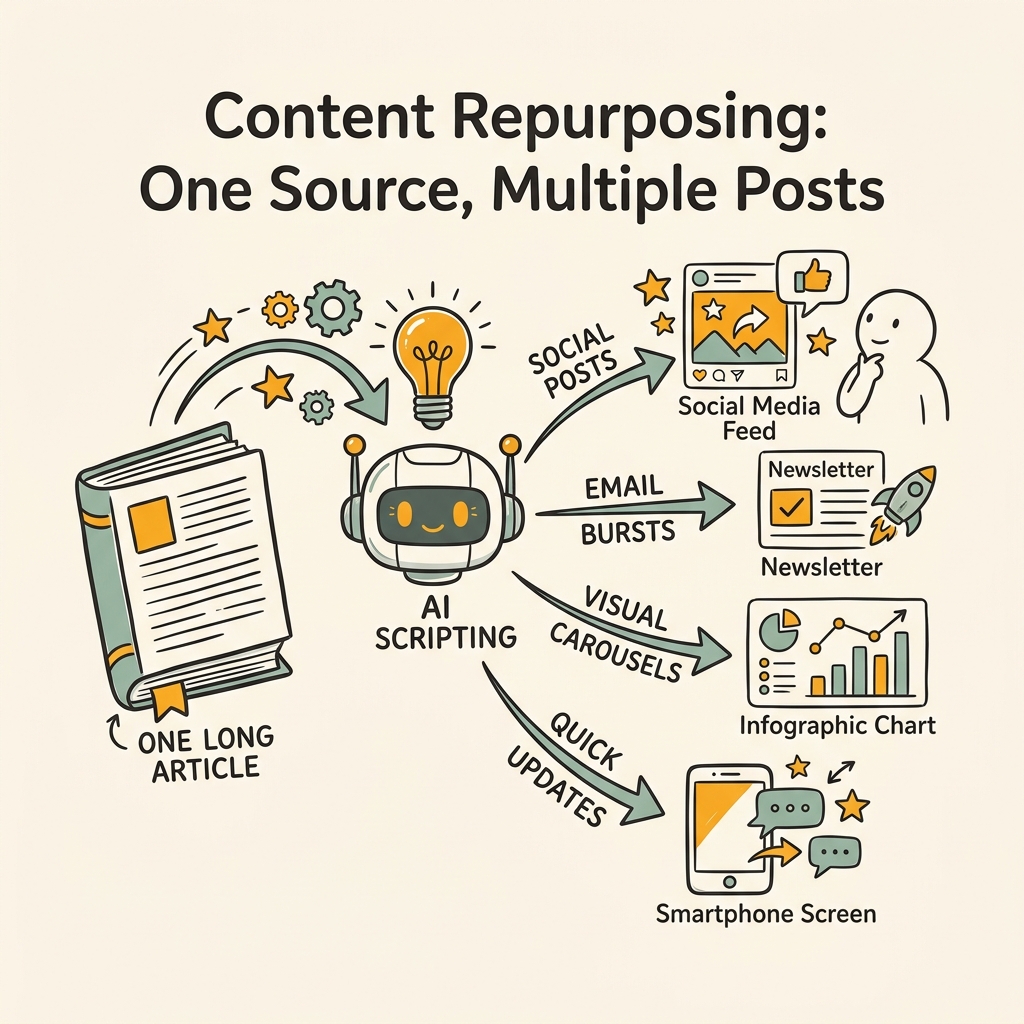
The efficiency multiplier in AI content generation comes from repurposing. One 3,000-word blog post converts into 10-15 platform-specific social posts, email sequences, and landing page copyall automatically, all maintaining consistent messaging. This is where 3.8x output multipliers come from in practice.
The Repurposing Workflow
Repurposing isn't just shortening; it's transforming. A single source piece gets decomposed into platform-native formats:
| Platform | Content Type | Typical Length | Tone Shift | Generation Method |
|---|---|---|---|---|
| Professional summary post | 150-300 words | Business-focused, data-backed | Extract key insights + add career angle | |
| Twitter/X | Multiple atomic posts (3-5) | 280 chars max per post | Punchy, hot-take style | Break main points into standalone tweets |
| Carousel caption + visuals | 2-3 sentences + 3-5 images | Conversational, story-driven | Extract narrative thread + generate captions for each slide | |
| TikTok/Reels | Short-form video script | 15-30 seconds of narration | Casual, entertainment-focused | Identify key moment or stat + write punchy hook |
| Email newsletter | Section summary | 100-150 words | Warm, personal, CTA-focused | Extract key takeaway + frame as insider insight |
How AI Handles Cross-Platform Adaptation
Smart AI tools don't just truncate; they reframe. A blog post about "5 Ways to Scale Content Production" becomes:
- LinkedIn: "We helped 47 companies 3.2x their monthly output in 90 days. Here's what changed." (Credential angle)
- Twitter: "Your team is manually writing posts. You should automate that. Here's why:" (Contrarian hot-take)
- Instagram: "Let's be honest: content burnout is real. But it doesn't have to be." (Empathy-first)
Each framing emphasizes different value propositions for the audience on that platform. This psychological adaptation is what separates mediocre tools from professional-grade platforms. Jottler handles this cross-platform adaptation automatically, ensuring consistent messaging across channels without manual rewriting.
The Human-AI Hybrid: Why Editing Still Matters
78.4% of marketers apply moderate-to-extensive editing before publishing AI-generated content. This isn't a failure of AIit's proof that hybrid workflows are winning. Pure automation sacrifices brand voice and authenticity. Pure manual writing sacrifices speed and consistency. The blend is where the real advantage lives.
What Editing Actually Fixes
AI content isn't imperfect because the model is broken; it's imperfect because it doesn't know your specific audience, competitive context, or the unstated norms of your brand. Editing fixes:
- Brand voice authenticity: AI tends toward formal, safe language. You inject personality, humor, or specific phrases that make the brand recognizable.
- Strategic context: AI doesn't know your current campaign priorities, competitor moves, or which messages you've over-used recently. You add that layer.
- Factual precision: AI hallucinates metrics and examples. You verify claims against your actual data.
- Call-to-action alignment: AI generates generic CTAs. You customize based on where the audience is in the funnel.
The Right Amount of Editing Time
Best practice: Spend 5-10 minutes editing each AI-generated post, not 30. If you're spending 30 minutes editing, your prompt was too vague or your AI tool isn't trained well enough. The math: if AI generates a draft in 2 minutes, and you edit for 5 minutes, you've cut content creation time by 70% compared to writing from scratch (25-35 minutes per post). Multiply that by 10 posts per week, and you're recovering 2.5+ hours of team time weeklyor 130+ hours annually.
Personalization and Audience Segmentation at Scale
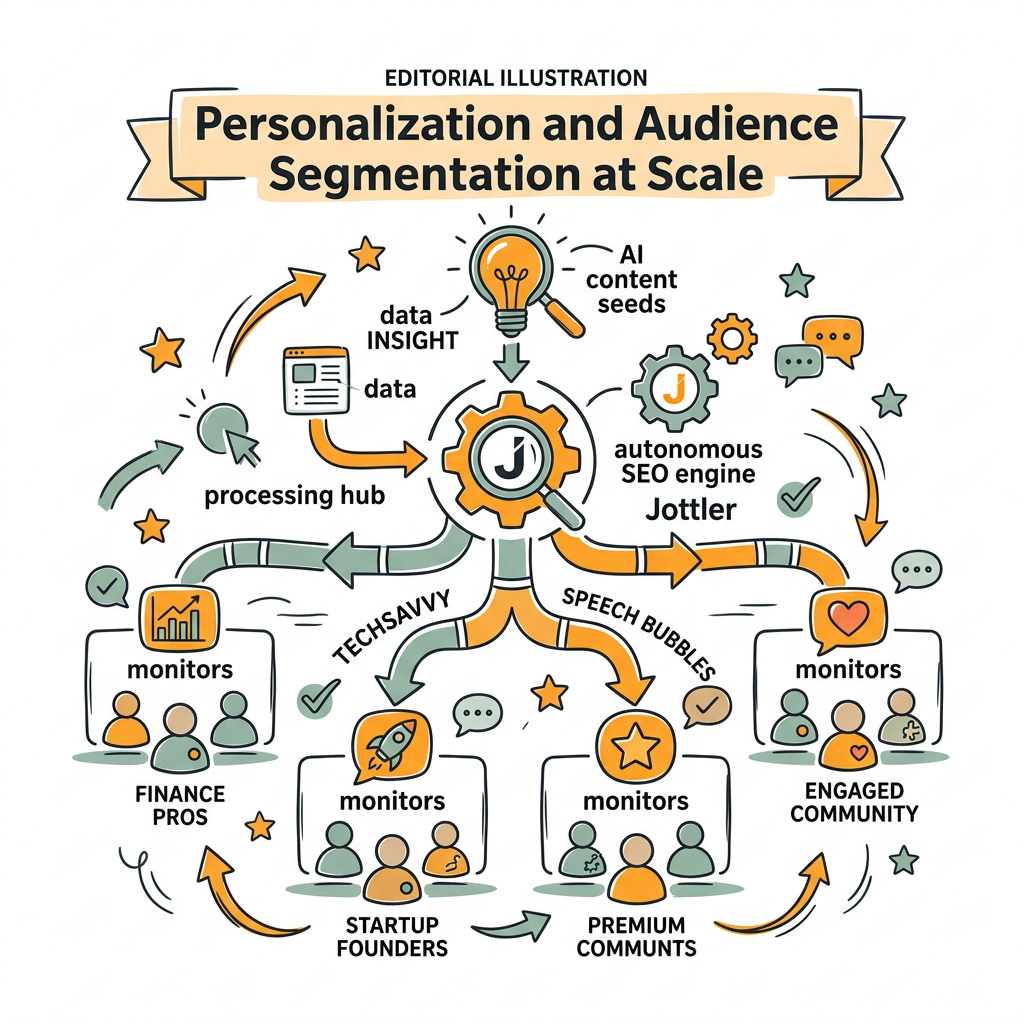
The frontier of AI content generation isn't just speedit's personalization. Modern tools segment your audience (by industry, company size, role, past engagement) and generate different post variations for each segment. 59.5% of social media marketers now use AI for content ideation and trend research, but fewer than 20% leverage AI's full personalization potential.
Segmentation-Driven Post Generation
Here's how it works: Instead of one post reaching everyone, the AI generates five variants of the same message:
- For CTOs: Technical depth, security and infrastructure focus
- For marketing leaders: ROI metrics, campaign velocity, competitive advantage
- For founders: Growth economics, time-to-value, team capacity
- For operations: Implementation simplicity, integration capabilities, onboarding
- For enterprise accounts: Compliance, scale, multi-team coordination
Each post makes the same core claim but leads with the pain point most relevant to that audience. This targeted approach delivers 2.7x-3.2x higher ROI than broadcast messaging (McKinsey, 2026), because the copy aligns with what each segment actually cares about.
Real-World Performance: When AI Content Wins
44.7% of marketers confirm that AI-assisted content performs better than non-AI posts. But performance varies wildly depending on how the AI is deployed. Here's when AI content wins, and when it underperforms:
Where AI Excels
AI-generated content consistently outperforms manual content in:
- Ideation and early-stage brainstorming: AI generates 20-50 post concepts in minutes. Humans pick the best ones and refine. Result: 3-4x more ideas tested, higher hit rate.
- Repurposing and adaptation: Converting one blog post into 10 social variants in 30 minutes. Manual repurposing takes 3-4 hours.
- Consistency and frequency: Maintaining 5-10 posts per week without burnout. Teams hit frequency targets that drive algorithm favor on all platforms.
- Speed-to-publish: Content goes from idea to edited and published in under 1 hour. Competitive response time improves dramatically.
Where Humans Still Win
Pure AI content struggles with:
- Emotional depth and vulnerability: Personal stories, founder narratives, cultural commentarythese need human voice and lived experience.
- Controversial or nuanced takes: AI defaults to safe, consensus-driven messaging. Differentiation often requires taking a stand.
- Real-time crisis or trending response: AI can draft quickly, but human judgment is non-negotiable when brand reputation is on the line.
- Community building and relationship investment: Replies, engagement, and relationship-nurturing posts benefit from genuine human time.
Choosing the Right AI Content Tool for Your Team
AI writing tools vary dramatically in architecture, data quality, and pricing. The best choice depends on your production volume, budget, and technical comfort. Here's how to evaluate:
Key Comparison Factors
- Training data and fine-tuning: Is the model trained specifically for social media, or general text? Social-specific tools outperform general LLMs by 40-60% on engagement metrics.
- Research and fact-checking: Does the tool pull real data (your website, news, trends) into generation, or rely only on training data? Real-time data prevents hallucinations and improves relevance.
- Multimodal support: Can it generate images, video scripts, and captions in a single workflow, or just text?
- Platform integration: Can it publish directly to LinkedIn, Twitter, Instagram, and Facebook, or require manual copy-paste?
- Editing and version control: How easy is the editing workflow? Can you A/B test multiple versions and track performance?
- Pricing model: Per-post, per-platform, unlimited, or credit-based? Volume-heavy teams need unlimited plans; low-volume users benefit from pay-per-post.
"Most teams treat AI content generation as 'write faster.' The real advantage is 'write smarter'using AI to test 5 messaging angles simultaneously and publish the winners to multiple platforms without manual work."
Alex Chen, Director of Growth, Typeface AI
Building a Sustainable AI Content Workflow
Deploying AI for social content isn't a one-time setup; it's building a system that compounds. Teams that systematize their AI workflows report 3.8x higher social media output by month three, and maintain that velocity without burnout. Here's how to build that system:
Step 1: Audit Your Current Content
Before automating, document what already works. Analyze your past 50 posts: engagement rates, comment sentiment, click-through rates, and shares. Identify patterns in:
- Content themes that drive engagement
- Optimal post length and structure by platform
- Time zones and posting frequency
- Visual style and brand aesthetic
This baseline becomes your AI training data. Tools that learn from your specific content library (not just generic training data) generate posts that feel native to your brand from day one.
Step 2: Create Your Brand Voice Library
Document your brand voice in a reusable library: tone adjectives, vocabulary preferences, forbidden phrases, signature phrases, and example posts that exemplify your style. This library becomes the backbone of every prompt. Better tools let you save and version these libraries so your whole team uses the same voice standards.
Step 3: Set Up Content Pillars and Scheduling
Define 4-6 content pillars (themes you focus on: "product updates," "customer wins," "thought leadership," "community," etc.) and assign a posting cadence to each. AI tools should respect these pillars automatically, rotating through them to maintain topical diversity. Smart content automation tools handle this scheduling and pillar balance without manual intervention.
Step 4: Establish Your Editing and Approval Process
Decide who edits, who approves, and what the SLA is. Best practice: AI generates → marketing team edits (5-10 min) → manager reviews (2-3 min) → publish. Total time per post: 10-15 minutes. This workflow keeps brand voice tight while capturing AI's speed advantage.
Conclusion
AI writing tools generate social media content by learning statistical patterns from billions of human texts, then predicting the next word millions of times to produce coherent posts in seconds. But raw speed without strategy is wasted potential. The real value comes from prompt engineering, fact-checking, audience segmentation, and human editinglayering intelligence on top of automation.
Teams adopting this hybrid approach report 3.8x higher content output and confirm that 44.7% of AI-assisted posts outperform manual content. The gap widens when you systematize: audit existing content, build brand voice libraries, respect content pillars, and establish editing workflows. With those foundations in place, 89.7% of social media marketers can maintain daily or near-daily posting without burnout.
The competitive advantage isn't in having AIit's in using it better than your competitors. That starts with understanding how it works, then building processes that keep the human touch where it matters most. Start your SEO agent and let AI handle research, writing, fact-checking, and publishing across all your channels. Plans start at $29/month.
FAQs
Can AI writing tools really match human-written social media content?
AI writing tools match or exceed human performance on speed and consistency, but excel differently. 44.7% of marketers confirm AI-assisted content outperforms purely manual posts, especially for ideation, repurposing, and high-frequency posting. The key is that AI drafts 80% faster than humans, leaving time for strategic human editing that adds brand voice and emotional depth. Pure AI content reads generic; human-edited AI content reads authentic. The hybrid approach wins because it captures AI's speed while preserving what makes your brand memorable.
How long does it take to generate a social media post with AI?
A well-configured AI writing tool generates a draft post in 30-60 secondsfrom research to caption to hashtags. Editing for brand voice and accuracy typically takes 5-10 minutes. Total time per post: 6-11 minutes from start to publish-ready. Compare that to manual writing, which takes 25-35 minutes for a single post. This is why 89.7% of social media marketers use AI dailythe velocity difference compounds into hours saved each week. Teams publishing 5-10 posts per week reclaim 2-4 hours weekly, or 100+ hours annually.
What AI tool is best for generating social media content?
The best tool depends on your needs, but look for three core capabilities: real-time research integration (pulls trends and your website data, not just training data), fact-checking and brand safety (prevents hallucinations), and direct platform publishing (LinkedIn, Twitter, Instagram without copy-paste). Tools that handle multimodal content (text + images + video scripts) in a single workflow save integration overhead. For SaaS and growing companies, purpose-built platforms beat generic LLMs because they're pre-trained on social media engagement patterns and include editing workflows optimized for team review. Free tools like ChatGPT work for drafting, but paid platforms with scheduling, fact-checking, and audience segmentation deliver 2-3x better results in practice.