Implementing Marketing Automation Without Extra Hiring
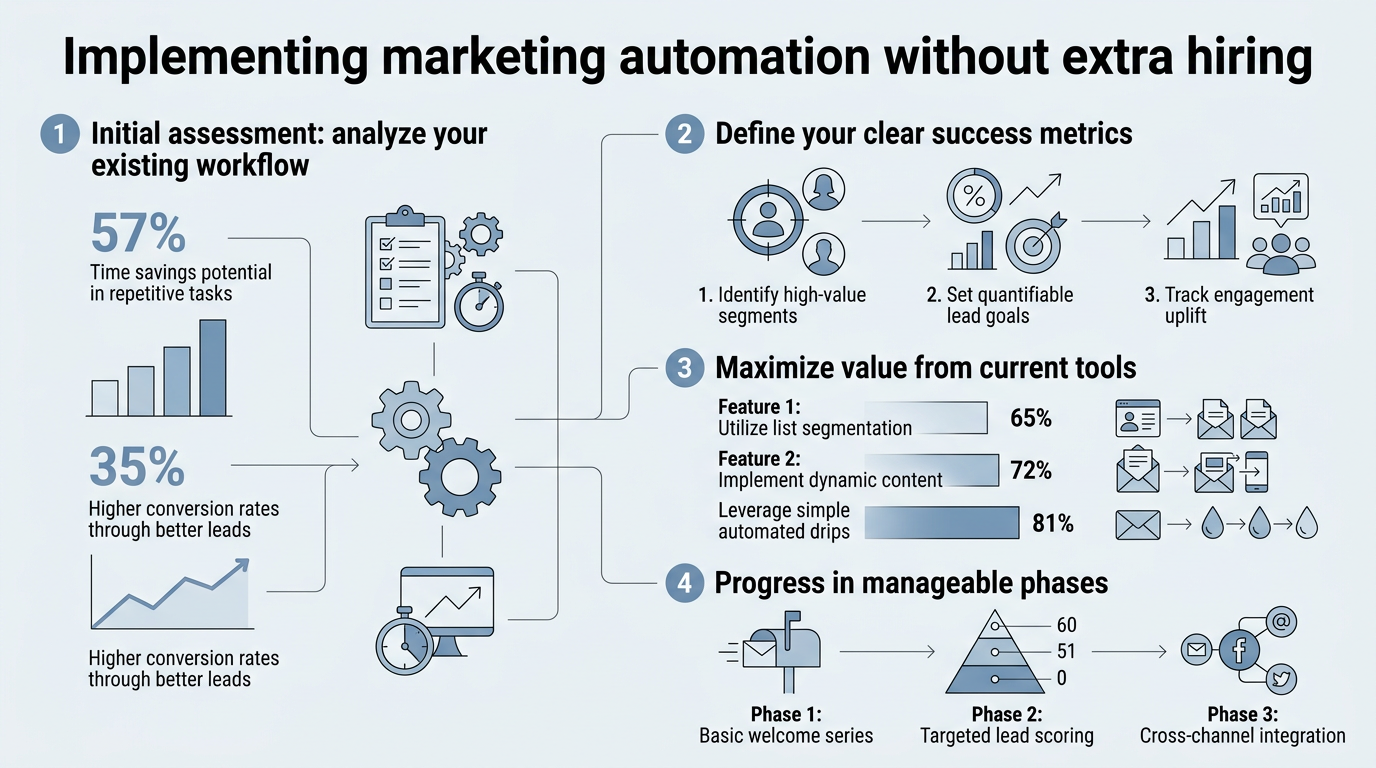
The scaling paradox is real: as companies grow, marketing demands multiply faster than budgets or headcount. Most marketing teams are 22% smaller than they were five years ago, yet expected to deliver 3× more content and campaign output. The fix is automation—not in the "set and forget" sense, but as a strategic multiplier that turns your existing team into a scalable machine.
Here's how top founders are doing it: they're automating repetitive tasks (keyword research, content production, lead nurturing, internal linking) so their teams can focus on strategy and conversion optimization. The result: companies implementing comprehensive marketing automation see $5.44 in revenue for every $1 spent, and recover 30–60 hours per week from manual work without adding a single hire.
Key Takeaways
- Marketing automation delivers $5.44 ROI per $1 invested, making it the most cost-effective growth lever for lean teams (2026, Nucleus/Thunderbit)
- Small teams using AI-driven automation reclaim 30–60 hours weekly from manual tasks like keyword research, content production, and lead scoring
- The fastest path to scaling is automating the workflows that consume the most time: content creation, lead nurturing, segmentation, and CRM synchronization
- Top performers consolidate tool stacks around a central automation engine rather than layering disconnected point solutions
Quick-Scan: Five High-Impact Automation Opportunities
- Automate Your Content Production Pipeline: AI-driven content creation cuts research and writing time by 70%, letting a single marketer ship 5–10× more articles and maintain topical authority without hiring.
- Implement Lead Scoring and Nurture Workflows: Rule-based automation routes leads to sales at the right moment, reducing manual qualification work by 40–50% while improving conversion velocity.
- Consolidate Your Tool Stack: Fewer, better-integrated platforms eliminate manual data transfers and context-switching, reclaiming 10–15 hours per team member weekly.
- Set Up Autonomous Keyword Research: Automated systems identify high-intent keywords and content gaps in real time, removing the research bottleneck that typically requires a dedicated role.
- Build Internal Linking Workflows: AI-assisted link discovery and placement multiplies SEO compounding without manual curation work.
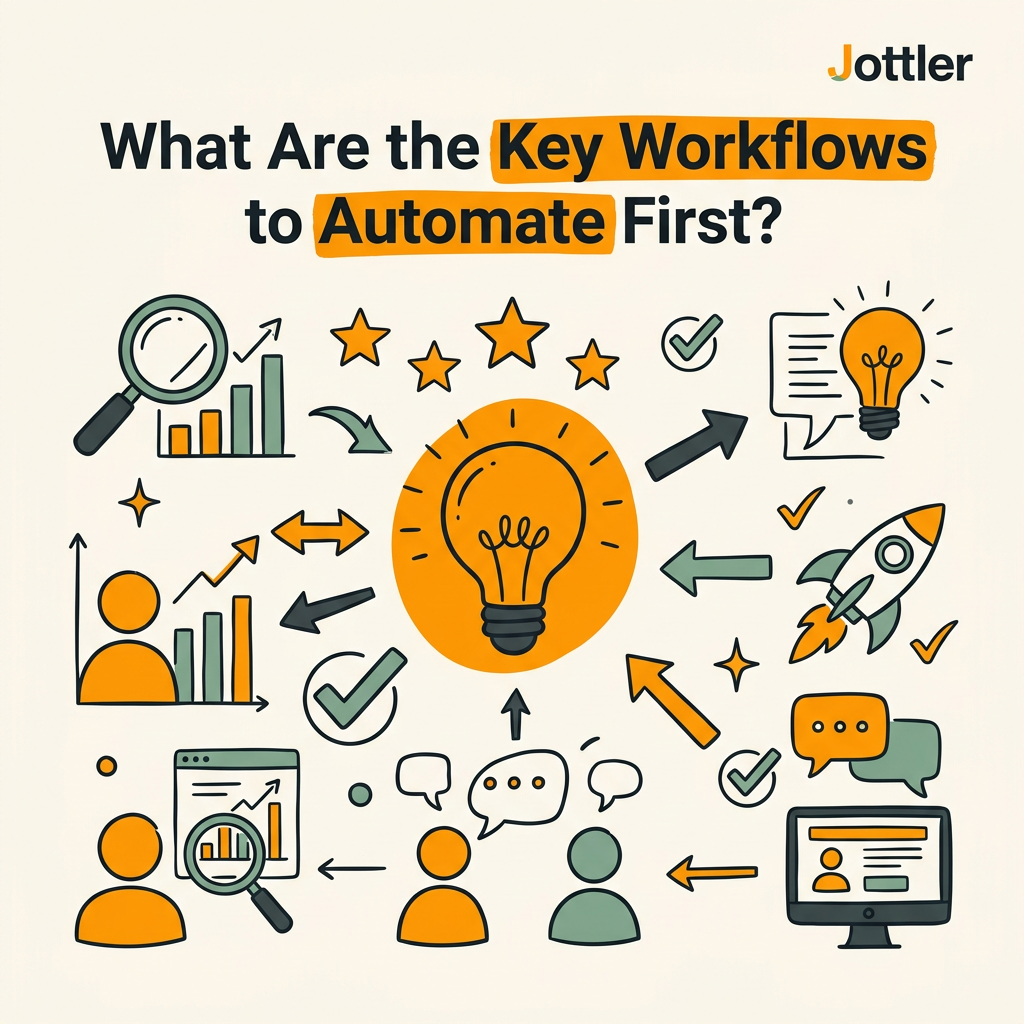
How Does Automating Content Production Scale Your Marketing Without Hiring?
Content is the single biggest time sink in marketing, and most teams still rely on manual research, writing, editing, and publishing. The average marketer spends 12–15 hours per week on content tasks alone—research, drafting, fact-checking, CMS uploads, and link integration. At that labor cost, a single hire adds $60k–$80k annually. Automation eliminates the labor without the cost.
"The teams that win with lean headcount aren't hiring faster—they're automating smarter. They compress what used to be a week of work into a day, then redirect that freed time to strategy and optimization. That's the real multiplier."
—Growth leaders across SaaS and content-first businesses
Here's what automated content production looks like in practice: your system ingests SEO data, researches competitors and sources, generates full-length articles optimized for ranking, fact-checks claims against live sources, and publishes directly to your CMS with internal links pre-built. A team of two marketers can manage 3–5 articles per day this way, compared to one article per week manually. That's a 15× multiplier on output capacity. According to Thunderbit's 2026 marketing automation statistics, companies optimizing content workflows through automation see the highest ROI gains.
AI-Powered Keyword Research and Topic Clustering
Manual keyword research is a bottleneck. A strategist spends 4–6 hours per week finding opportunities, analyzing competition, and sorting high-intent from low-intent terms. Automated systems do this in seconds, ingesting search volume, difficulty, intent signals, and CPC data across hundreds of keywords at once.
The deeper lever is topic clustering: grouping related keywords around a pillar topic and sequencing content to build topical authority. Tools that combine keyword research with content planning eliminate the mental model of "what should we write next?" Instead, the system shows you the exact cluster (e.g., "lead scoring" parent with sub-topics like "BANT framework," "behavioral scoring," "account-based automation") and ranks them by opportunity. Your team approves the cluster and the system executes the full content series.
Jottler operates this way, combining AI keyword research with deep research from 14+ sources and smart topic sequencing. A founder who'd normally spend 2–3 hours per week on research can let the system handle it and redirect that time to conversion optimization or customer interviews.
Autonomous Research and Fact-Checking
The second labor sink is research itself. Fact-checking is crucial for SEO and credibility, but it's tedious: verifying statistics, checking citations, confirming claims against source documents. 52% of marketers cite data quality as their biggest automation obstacle, because most content tools skip fact-checking entirely and leave the marketer to verify manually.
Advanced automation systems research topics from 10+ authoritative sources, cross-reference claims, flag unverified statistics, and attach source citations automatically. This cuts the fact-checking phase from 1–2 hours per article down to a quick skim. Your team reviews headlines and strategic angles, not raw research data.
CMS Publishing and Internal Link Building
After writing, publishing and linking is another 45-minute manual task per article. The system must upload to your CMS, format metadata (titles, descriptions, canonicals), and insert internal links to related content. Most content generators stop at the draft and hand off to a human for publication and SEO setup.
"When every article still requires manual CMS work and link placement, you've automated writing but not the workflow. True automation is end-to-end: research to publishing to internal linking without human intervention between steps."
—SaaS content leaders implementing at-scale production
Integrated automation systems publish directly to your CMS, write SEO titles and meta descriptions based on keyword intent, and automatically identify and insert internal links based on semantic relevance. This compounds topical authority and site structure without manual curation. When Jottler ships content, it handles the full pipeline from research through publication, including internal link discovery and placement, cutting the manual overhead to near zero.
What Are the Key Workflows to Automate First?
Automation at scale sounds abstract. In practice, successful founders focus on 2–3 high-impact workflows first, prove ROI quickly, then expand. The smart order matters: automate the highest-volume, most repetitive processes that directly affect revenue velocity.
Lead Capture and CRM Synchronization
Every form submission, demo request, or inbound inquiry should flow directly into your CRM with no manual data entry. The key workflows to automate include:
- Form-to-CRM automation: Zapier or native integrations between your website, landing pages, and CRM eliminate transcription errors and ensure sales sees qualified leads in real time.
- Lead deduplication: Rules that catch same email, similar names, and prevent duplicate outreach and wasted sequences.
- Enrichment triggers: Automatic company data lookup and firmographic enrichment so reps have context before first touch.
This alone saves 3–5 hours per week in a small sales-ops role and ensures no lead falls through the cracks.
Lead Scoring and Behavioral Routing
Not all leads are created equal. A prospect visiting your pricing page 5 times is warmer than someone reading a blog post once. Automated lead scoring assigns points based on activity (page views, email opens, whitepaper downloads) and demographic data (company size, industry, role). When a lead hits a threshold (say, 50 points), the system triggers a notification to sales or automatically enrolls the prospect in a "hot lead" nurture sequence.
This eliminates the sales qualification bottleneck. Instead of reps manually assessing 20 inbound leads per day, scoring routes only the ready ones to outbound, and nurtures the lukewarm in automated sequences. Typical result: 25–30% improvement in sales productivity and a 40% faster sales cycle.
Email Nurture and Lifecycle Automation
Once leads are in your CRM, nurture should be systematic. Key automation sequences include:
- Reactivation workflows for prospects who demo'd your product months ago
- Onboarding sequences for customers who just purchased
- Auto-unsubscribe rules for those who explicitly opt out
- Behavioral branching based on email engagement and link clicks
- Win-back campaigns for dormant leads or churned customers
Automated email campaigns generate 320% more revenue than non-automated campaigns, because automation ensures the right message reaches the right person at the right time without relying on a team member to manually track and send.
Advanced lifecycles branch based on behavior: if a prospect opens your first email and clicks a link, they get the "engaged" sequence; if they ignore it, they get a different angle. This personalization at scale is impossible to do manually but trivial with automation. Read more about how lean growth teams use marketing automation to scale without hiring.
Content Calendar and Publishing Cadence
A common trap: marketing teams commit to "post 2 blogs per week" and miss it because the workload doesn't scale with the team. Automation removes the constraint. Set your desired publishing frequency (1–5 articles per day) and the system researches, writes, and publishes autonomously. Your team reviews quality and strategy weekly, not daily. This is how a founder with no marketing hire can maintain a content engine that compounds organic traffic month over month.
Which Tools Should You Consolidate Around?

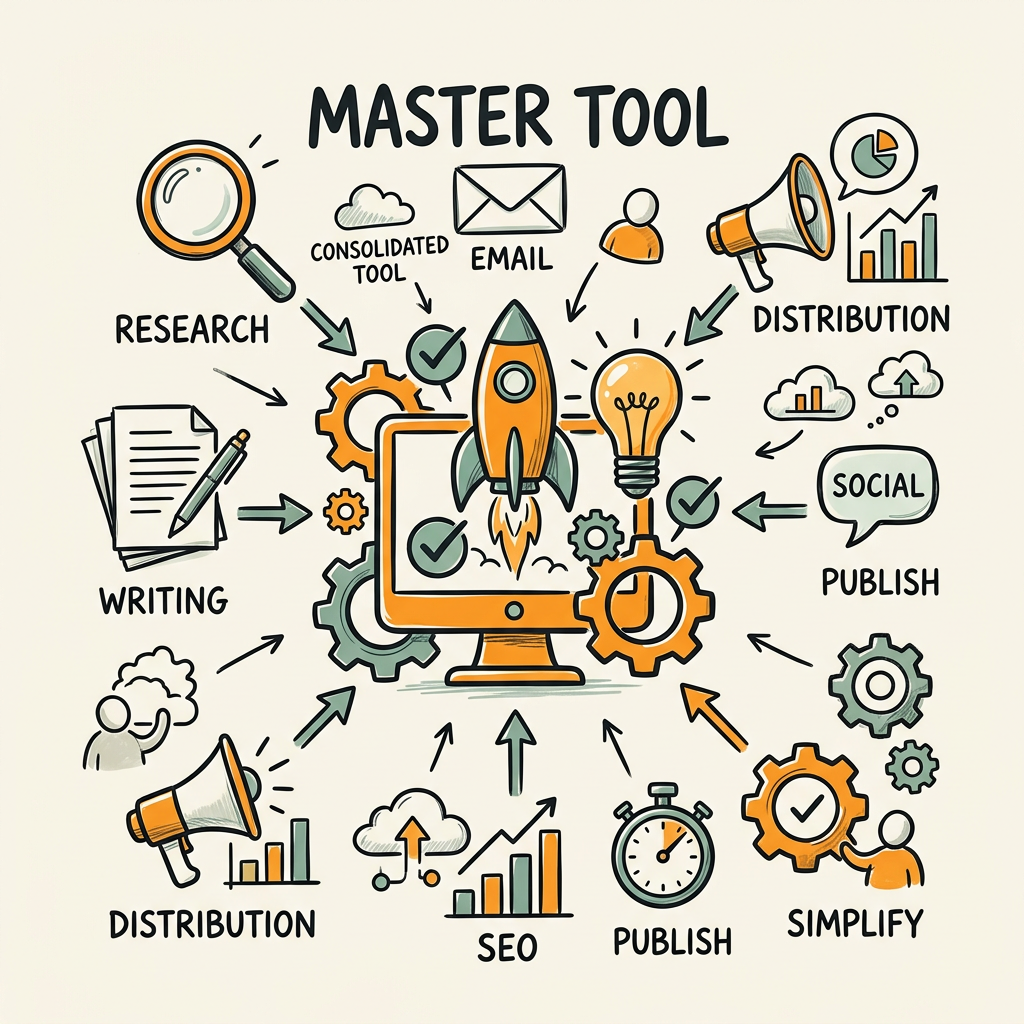
The worst automation setup is a fragmented stack: email tool, separate content platform, separate lead scoring, separate analytics. Every tool requires manual data passing, which eats hours and introduces errors. The most productive lean teams consolidate around one central automation engine that handles as many workflows as possible.
| Capability | Best-in-Class Approach | Why It Matters for Lean Teams |
|---|---|---|
| Content Production at Scale | AI agents that research, write, fact-check, and publish (like Jottler) | Eliminates 70% of content labor; one marketer can manage 5+ articles daily instead of 1 weekly |
| Keyword Research and SEO | Integrated research tools that feed content planning automatically | Removes manual keyword research bottleneck; prioritizes high-intent opportunities |
| Lead Scoring and Routing | CRM-native or tightly integrated tools (HubSpot, Marketo) | Eliminates manual qualification; sales focuses only on warm leads |
| Email Nurture | CRM-native email with behavioral branching and lifecycle triggers | Removes manual send-and-wait tasks; improves conversion through personalization |
| Analytics and Attribution | Unified dashboard showing pipeline influenced by each workflow | Proves ROI of automation; guides which workflows to expand next |
The pattern is clear: tools that integrate with your CRM and talk to each other beat standalone solutions. Jottler exemplifies this consolidation for content: it combines AI keyword research, deep research, writing, fact-checking, and direct CMS publishing without requiring manual data transfers to four different platforms.
Why Integration Matters More Than Individual Features
A niche fact-checking tool is useless if you then have to manually copy facts into your content platform. A standalone keyword research tool doesn't save time if you still manually create briefs for a content team. The ROI multiplier comes from end-to-end integration: data flows from keyword research through content production through publishing through internal linking without human intervention between steps.
When evaluating automation tools for your stack, ask: "How many manual handoffs does this create?" Tools that reduce handoffs from 10 steps to 2 are the ones that actually reclaim time. Tools that add steps (import, export, manual review, upload) create illusions of automation while keeping labor constant. Consider reading about content automation tools for SaaS teams to understand how to evaluate platforms by integration depth.
Building Around Your CRM as the Hub
Your CRM is your source of truth for contacts, companies, and deal stage. Every other tool should sync data bidirectionally with your CRM. This eliminates the "What happened to that lead?" anxiety and ensures sales has always-fresh data. The cost of a good CRM (HubSpot, Salesforce) is worth it because it becomes the hub that every other tool connects to. Content platforms, email tools, lead scoring, even customer success tools should all reference the CRM as the single source of truth.
How Should You Measure Automation ROI?
Without clear measurement, automation can feel like overhead. The trick is measuring the right things: not activity metrics (emails sent, articles published) but outcome metrics (leads generated, conversion lift, revenue influenced, time reclaimed).
Revenue Impact and Pipeline Attribution
The clearest ROI signal is pipeline and revenue influenced by automation. Track which workflows generated the most SQLs, which nurture sequences moved deals forward, which content pieces influenced which customers. Top-quartile automation programs achieve $8.71 in ROI per $1 spent, compared to the $5.44 average, because they tie automation to revenue, not activity.
Set a dashboard showing: "Leads captured this week," "Leads progressed by nurture automation," "Pipeline influenced by automated content," and "Revenue closed influenced by automation." This narrative connects automation spending to business outcomes and justifies continued investment. See Portage Labs' complete guide to marketing automation ROI for detailed measurement frameworks.
Time Reclaimed and Capacity Multiplier
The second metric is labor reclaimed. If your content process took 15 hours per week per marketer and now takes 4 hours (review, strategy, optimization only), you've reclaimed 11 hours. Over a year, that's the equivalent of 0.27 FTEs of work automated. At $60k–$80k per hire, that's a $16k–$22k labor cost avoidance per person per year, without the recruiting, onboarding, or benefits costs.
A three-person team automating content production and lead nurturing might reclaim 25–30 hours per week combined, equivalent to a full additional headcount. That math is powerful for founders deciding between "hire another marketer" and "implement automation." Learn more about the ROI of content marketing automation to understand how to measure success in your own organization.
Velocity Metrics: Time to Lead, Lead-to-Opportunity Conversion
Track how fast leads move through your pipeline. Key velocity metrics include:
- Time to first follow-up: Automated lead scoring should cut this from 2 days to a few hours
- Lead-to-opportunity conversion: Automated nurture should increase this by 15–25%, because systematic messaging beats sporadic outreach
- Sales cycle length: Faster qualification and warm handoffs reduce overall deal velocity
- Content influence velocity: Measure how many days it takes for a prospect to move from first content touch to SQL
These metrics compound: faster leads + higher conversion + more content = exponential revenue growth without proportional headcount growth.
What Common Pitfalls Should You Avoid?
Most automation implementations fail not because the tools are bad, but because teams try to automate everything at once or automate broken processes. Here's what kills implementations.
Automating Without Cleaning Data First
Garbage in, garbage out. If your CRM is full of duplicate contacts, invalid emails, or incomplete company data, automation will amplify the mess. Before implementing lead scoring or nurture, your data prep should include:
- Deduplicating contacts by email, name similarity, and domain
- Validating email addresses via a third-party service
- Standardizing company names and industry classifications
- Filling in missing fields for role, company size, and location
- Removing hard bounces and known invalid addresses
This foundational work takes 1–2 weeks but prevents months of wasted automation on bad data.
Building Processes in the Wrong Order
Don't start by automating your newsletter distribution. Start by automating lead capture and scoring—the workflows that directly affect sales velocity and revenue. Too many teams automate nice-to-haves (social scheduling, internal reporting) before the high-impact workflows. The 80/20 rule is real: 80% of your ROI will come from 20% of your workflows. Identify and automate those first. Explore how to scale organic traffic without burnout to understand prioritization for content-first teams.
Assuming Automation Requires a Dedicated Role
One myth: "We need to hire a marketing operations specialist to manage automation." In reality, well-designed automation should require minimal ongoing management. Your existing team reviews performance weekly, adjusts rules quarterly, and that's it. If automation is creating extra work instead of saving it, you've picked the wrong tool or implemented it wrong.
Conclusion
The biggest competitive advantage for lean teams is automation. Companies that implement comprehensive marketing automation without hiring gain a 3–5 year head start on competitors that scale headcount linearly. Your team can reclaim 30–60 hours weekly, which translates to the output of an additional full-time marketer at a fraction of the cost.
The path is clear: automate content production and keyword research first (highest time savings), then lead scoring and nurture (highest revenue impact), then consolidate your stack around a central hub so workflows feed each other without manual handoffs. The math compounds quickly—$5.44 ROI per $1 spent, plus reclaimed team capacity—creates a multiplier effect that turns a three-person team into a fifteen-person equivalent.
If you're a founder or marketer struggling to scale content output without hiring, Jottler is purpose-built for this challenge. It automates the entire content pipeline—keyword research, deep research, writing, fact-checking, CMS publishing, and internal linking—so your team handles only strategy and high-level editorial decisions. Start your SEO agent today and see the difference autonomous content production makes to your team's capacity and your organic traffic growth.
FAQs
Can marketing automation replace a hiring decision?
Yes, in most cases. Marketing automation can reclaim 30–60 hours per week per team member by automating repetitive tasks like keyword research, content production, lead scoring, and nurture sequences. For a growing company deciding between hiring a new marketer or implementing automation, automation typically delivers faster ROI and greater flexibility. Automation handles volume increases; hiring doesn't scale as quickly and locks in fixed costs. The best approach is to automate first, then hire only when automation hits its limits, usually around scaling into new channels or more specialized roles like paid media or creative direction.
What's the fastest workflow to automate first?
Start with content production and keyword research if your team is struggling with content volume, or lead scoring and nurture automation if your bottleneck is sales productivity. Content automation yields the fastest visible ROI—one marketer can manage 5–10 published pieces per week instead of one—because it's the most manual and time-intensive process most teams have. Lead scoring delivers ROI more directly to revenue (faster sales cycles, higher conversion) but requires clean CRM data first. Pick whichever bottleneck costs your company the most in lost productivity or revenue today.
How much time does marketing automation implementation take?
A single-workflow implementation (e.g., lead scoring or automated nurture) typically takes 2–4 weeks from decision to production, assuming your CRM data is clean. Full-stack integration—content, lead routing, nurture, analytics—takes 8–12 weeks because it requires mapping multiple processes, training the team, and iterating on rules based on early results. Start narrow: one workflow, 2–3 weeks, measure results, then expand. Don't try to automate your entire marketing operation in 90 days; most teams that do end up with unused workflows because they tried to boil the ocean instead of proving ROI quickly.