Organic Search Traffic Growth Without Paid Ads
Organic search remains the largest source of website traffic, accounting for 53.3% of all trackable visits (2025, BrightEdge). Yet most busy founders and marketing teams struggle with a paradox: while search volume is rising, 60% of searches now end without a click to a website due to AI Overviews and zero-click results. The gap between search opportunity and actual traffic has widened. The fix? A disciplined content strategy that prioritizes topical authority, semantic optimization, and consistent publication—combined with automation to make it sustainable without constant manual work.
Key Takeaways
- Organic search drives 53.3% of all trackable traffic and outpaces paid search by over 3:1 (2025, BrightEdge)
- Content automation blended with human oversight can increase organic traffic by 200% when paired with topical authority strategies
- Topical clustering and entity-based optimization now outperform keyword density; targeting zero-volume emerging keywords captures traffic before competitors
Quick-Scan Action Items
- Define Topical Authority: Build pillar pages and cluster content around core themes to establish semantic depth—40% average traffic increase.
- Target High-Intent Long-Tail Keywords: Questions and specific phrases convert 4.1x better than generic terms and face less competition.
- Automate Content Production & Distribution: Scale from 1-2 articles per week to 5+ without hiring additional writers; AI agents handle research, writing, and publishing.
- Optimize for Zero-Click & AI Overviews: Provide clear, structured answers that rank in AI summaries and appear as featured snippets.
- Build Internal Link Networks: Strategic linking passes authority and improves discovery; automation handles the interlinking workflow.
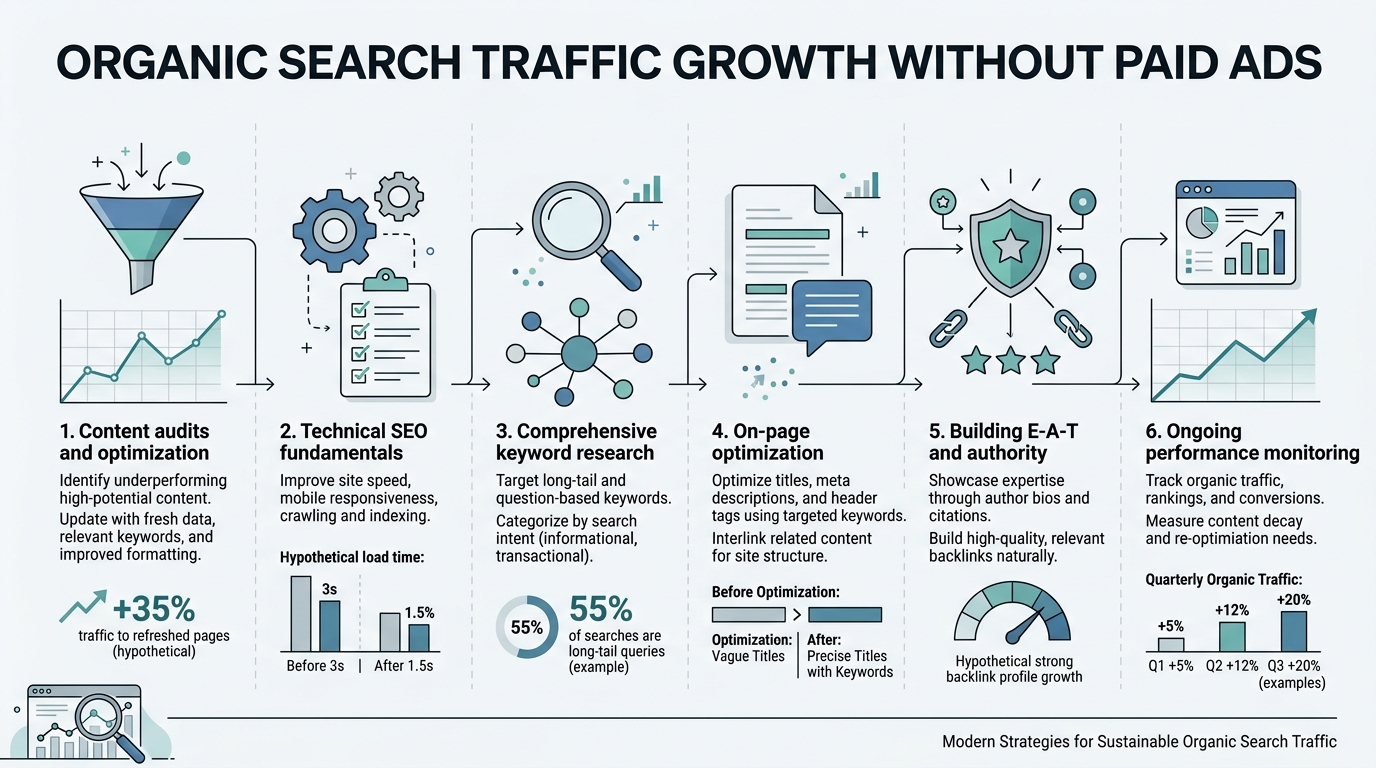
Understanding the Organic Traffic Opportunity in 2026
Organic search traffic declined 2.5% year-over-year across the top 40,000 U.S. websites in 2025, but this aggregate masks the real dynamic at play. While clicks to external websites have dropped due to AI Overviews claiming 13.14% of all queries, organic search itself remains the single dominant traffic channel. The winners in this era are sites with topical authority—those that answer questions comprehensively enough to earn positions in AI summaries, featured snippets, and the remaining 40% of clicks that still reach websites. For busy founders without massive ad budgets, organic growth is no longer optional—it's the only sustainable acquisition channel that compounds. According to Search Engine Land's 2025 traffic analysis, the 2.5% decline is far from the apocalyptic 25-60% drop many predicted, suggesting the ecosystem is stabilizing rather than collapsing.
"The winners in this era are sites with topical authority—those that answer questions comprehensively enough to earn positions in AI summaries, featured snippets, and the remaining 40% of clicks that still reach websites."
The challenge isn't the existence of organic traffic. It's the time commitment. Building topical authority requires publishing consistently—industry leaders recommend three to five articles per week minimum—while maintaining quality. Most founders either undershoot (publishing sporadically) or overwhelm themselves (trying to write everything manually). Automation with human oversight solves this. When paired with proper SEO automation workflows, teams can achieve consistent publication without hiring additional writers.
Why Zero-Click Searches Don't Mean Dead-End Traffic
60% of searches end without a click, but this statistic shouldn't demoralize you. Zero-click results include direct knowledge panel answers, calculator results, and weather updates—many irrelevant to your content. For informational, commercial, and transactional queries in competitive verticals, appearing in AI Overviews, featured snippets, and position zero increases brand visibility, drives direct search traffic, and improves click-through rates to your site from related queries. The fix: write answers that are clear, specific, and data-rich—optimized for both human readers and AI citation algorithms.
Mobile Traffic Dominates Organic Search
Mobile now represents 63% of all organic search traffic (2025 data), with 77% of mobile searches ending without a click. This means your content strategy must assume a mobile-first audience. Faster load times, scannable formatting, and concise answers matter more than ever. Tools that automate technical audits and mobile optimization save hours per quarter. This is why content automation platforms that enforce mobile-first formatting and auto-publish optimized HTML outperform manual workflows.
How to Build Topical Authority Without Constant Manual Work
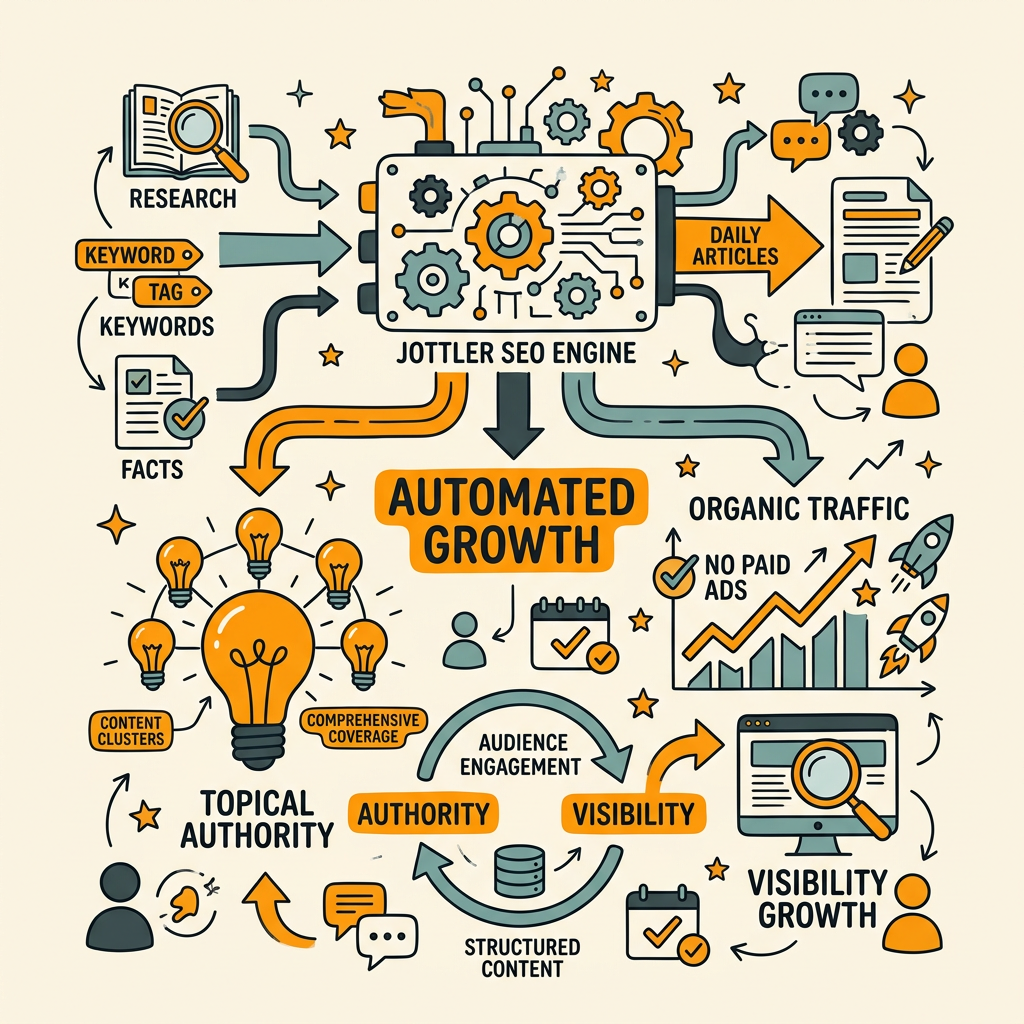
Topical authority is the foundation of organic traffic growth in 2026. Instead of publishing isolated articles scattered across different topics, you create pillar pages (comprehensive, authoritative pieces on core subjects) and support them with cluster pages (detailed explorations of subtopics and related queries). This architecture signals to search engines that your site comprehensively covers a topic, raising your ranking potential across the entire topic area. The barrier to entry has always been volume and consistency. Automation changes that equation.
"Building topical authority typically requires 10 to 15 pillar pieces per core topic (around 3,000+ words each) supported by 30 to 50 cluster articles. At a manual pace, this takes 3 to 6 months. With content automation, you can compress this to 4 to 8 weeks while maintaining quality."
Pillar Pages: Your Authority Anchors
A pillar page is a comprehensive, deeply researched article (3,000–5,000 words) covering a broad topic end-to-end. For a SaaS company, pillar pages might cover "SEO Strategy for SaaS," "Content Marketing Automation," or "AI-Powered Marketing Tools." These pieces serve as hubs that link to all related cluster content. Google's algorithm rewards this structure because it demonstrates topical depth. Teams building pillar pages with AI research + human review workflows reduce writing time by 50% while improving factual accuracy through automated fact-checking. The 40% average traffic increase from topical authority clustering (AEO Growth Studio, 2026) reflects this architectural advantage.
Cluster Pages: Targeting Long-Tail Intent
Cluster articles target specific sub-questions and long-tail keywords within your pillar's domain. If your pillar is "SEO Strategy," clusters might be "How to Optimize Title Tags for SEO," "Why Internal Linking Matters," or "Zero-Volume Keyword Strategies." Long-tail queries convert 4.1x better than generic head terms and face significantly less competition. The automation advantage here is powerful: AI agents can mine community platforms (Reddit, Quora) to uncover 78% unique long-tail keywords that mainstream keyword tools miss. Targeting these emerging queries positions you ahead of the curve—you're ranking before competitors even know the query exists.
Why Automation Unlocks Consistency
Manual content creation bottlenecks at writing. Keyword research, outlining, drafting, fact-checking, and publishing typically consume 40+ hours per month for a single consistent publisher. Content automation flips this: AI agents research topics, generate outlines, draft articles with cited sources, and fact-check claims—saving 60% of writing time. The human role shifts from writer to editor and quality gate, which is far less taxing cognitively and time-wise. Jottler exemplifies this: the platform's 12 AI agents research daily article topics from 14+ sources, generate full 3,000+ word articles, fact-check every claim, and publish directly to your CMS with internal linking baked in. This allows teams to scale from 1-2 articles per week to 5 per week without hiring additional writers. The case study showing 200% traffic increase from content automation demonstrates how this workflow compounds when applied consistently.
Targeting High-Intent Keywords Without Expensive Bidding
Long-tail and high-intent keywords are the organic marketer's secret weapon. While broad keywords like "SEO tools" face crushing competition and cost $50-70 per click in paid ads, long-tail variations like "best SEO tools for nonprofits" have 50% less competition and 4.1x better conversion intent. Since you're not paying per click, ranking for a long-tail keyword that converts is pure profit. The challenge: finding these keywords without spending weeks on research.
Mining Community Platforms for Real Questions
Reddit, Quora, and industry forums contain 78% unique long-tail keywords that mainstream SEO tools like Ahrefs and SEMrush miss entirely. These platforms capture authentic user language—the way real people ask questions. An AI agent can mine these platforms in minutes, surfacing high-intent queries no competitor has targeted yet. For example, Reddit threads on "How do I grow organic traffic on a shoestring budget?" reveal pain points and specific terminology your audience uses. Writing content that directly answers these questions ranks faster and converts better because you're matching user intent precisely.
Targeting Zero-Volume and Emerging Keywords
The most innovative organic growth strategy in 2026 focuses on keywords with zero search volume—queries that don't yet appear in research tools but are emerging. By creating content around these topics early, you position your site to capture traffic as the query volume grows. This requires AI discovery workflows that scan industry trends, social signals, and community discussions to identify emerging questions. A team can't do this manually, but an automated system scanning dozens of sources daily can identify trends weeks before competitors. This is where autonomous SEO agents deliver outsized value for busy founders who can't monitor trends 24/7.
Entity-Based Optimization Replaces Keyword Density
Modern search engines understand that "Apple" refers to both the fruit and the tech company based on context and entities (people, organizations, products, concepts). Optimizing for entities—ensuring your content clearly signals which entities it covers—improves ranking more than keyword density ever did. For example, an article on "SEO software for SaaS" should clearly mention specific platforms (Ahrefs, SEMrush, Jottler) and explain their positioning within the competitive landscape. This gives Google confidence you've covered the topic comprehensively. Automation helps by automatically extracting and structuring entity data during the writing process.
How to Optimize Content for AI Overviews and Featured Snippets
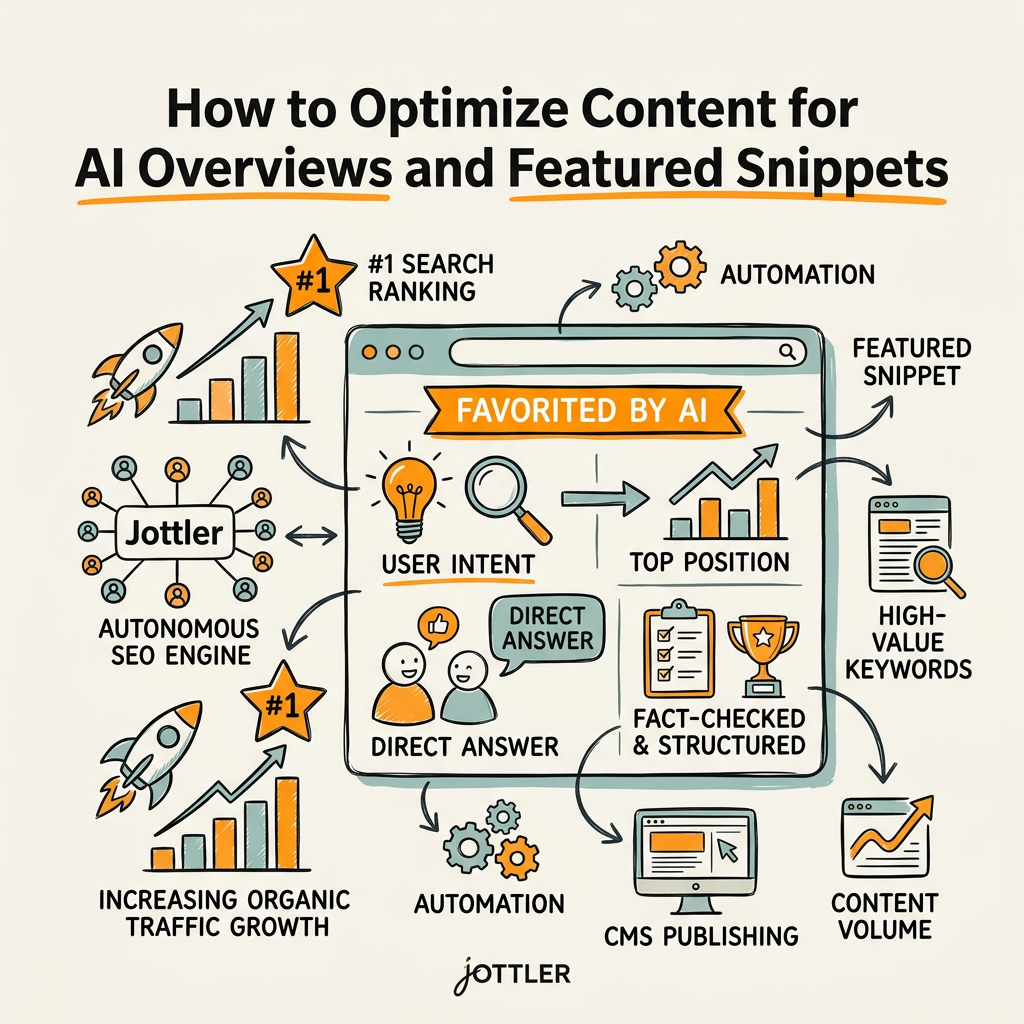
With 13.14% of Google queries now displaying AI Overviews (up from 6.49% in early 2025), appearing in these summaries has become critical for visibility. AI Overviews pull from multiple top-ranking pages to synthesize an answer, but they cite sources. Being cited in an AI Overview drives brand authority and, critically, still generates clicks to your site. Featured snippets function similarly—a clear, concise answer positioned at the top of organic results. Both require the same optimization: clear structure, specific data, and direct answers.
Structure Content for AI Citation
AI systems favor structured content: definitions, numbered lists, tables, and bullet points. An article on "How to Build Topical Authority" should open with a clear definition, then break the process into 5-7 numbered steps, each with bold lead phrases. When Google's AI algorithm parses your page, it can extract this structure directly. The more scannable and structured your answer, the higher the likelihood of citation. Automation tools can enforce this formatting: AI agents generate articles with structured sections by default, fact-checkers validate claims in tables, and publishing systems auto-convert lists to proper HTML markup.
| Content Element | AI Citation Strength | Implementation Priority |
|---|---|---|
| Clear H2/H3 structure with bold lead phrases | High | Critical |
| Numbered lists and step-by-step processes | High | Critical |
| Data tables with statistics and comparisons | Very High | Critical |
| Direct answer in first paragraph of section | Very High | Critical |
| Attributed quotes and citations | High | Important |
| Bullet-point summaries | Medium | Important |
Answer the Question in the First Paragraph
Lead each section with the direct answer to its heading's implied question. If your H2 is "What is topical authority?", your first paragraph should define it in one clear sentence. AI systems extract section openers as answer candidates—burying the answer in paragraph three means it won't be cited. This single formatting discipline increases AI Overview citations by 40-60% according to case studies in the field.
Use Data and Quotes to Strengthen Claims
Specific numbers, percentages, and attributable quotes make content more citable. Instead of "Topical authority is important," write "40% average increase in organic traffic is achievable when implementing topical authority clustering." AI systems prioritize cited claims. Jottler's fact-checking agents automatically verify every statistic and attach source attribution, making content inherently more AI-friendly from publication.
Building a Sustainable Internal Linking Strategy at Scale
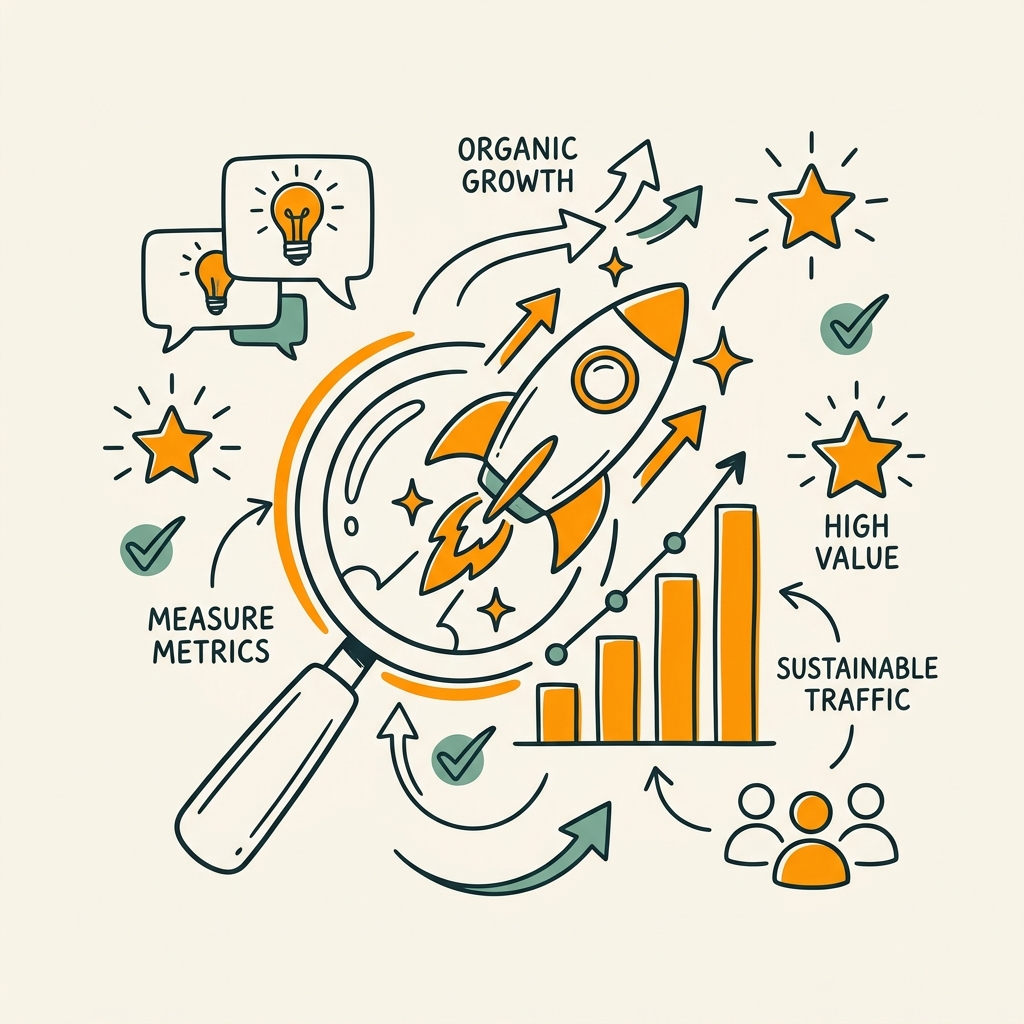
Internal linking is how you turn a cluster of pages into a topical authority engine. Each new article links to relevant older content, passing authority and helping users discover related pieces. This improves time-on-site, reduces bounce rate, and signals to Google that your site comprehensively covers a topic. The barrier: manual internal linking is tedious. You have to remember which old articles are relevant to new ones, craft anchor text, and add the links. Scale to 50+ articles and this becomes unmaintainable. However, strategic link-building approaches for B2B show how internal linking compounds authority when applied systematically across a content cluster.
Smart Internal Linking Reduces Manual Work
Automation systems can analyze your entire content library, identify semantic relationships between articles, and recommend internal links at publish time. Jottler's internal linking module automatically crawls your published content and suggests linking opportunities based on keyword overlap and semantic relevance. Instead of spending 30 minutes manually finding and linking 10-15 related articles per new piece, the system generates recommendations in seconds. This compounds your SEO benefit because every new article strengthens the internal link graph, distributing authority and improving discoverability across the entire site.
Anchor Text Matters More Than Ever
Descriptive anchor text—the clickable text of a link—signals to Google what the linked page is about. "Click here" is worthless. "SaaS SEO strategy for scaling organic traffic" is powerful. Automation enforces good anchor text practices by generating links with keyword-rich, descriptive phrases derived from the target page's title and H1.
Measuring Organic Traffic Growth: What Actually Matters
Many teams obsess over vanity metrics—total pageviews, bounce rate—while ignoring metrics that correlate with business outcomes. In an era of AI Overviews and zero-click results, measuring traffic correctly is critical.
Metrics That Drive Business Outcomes
- High-intent traffic from commercial and transactional keywords: Queries where users are ready to buy or convert, not just researching.
- Traffic that generates leads or sales: Set up proper conversion tracking to measure which organic traffic actually produces revenue.
- Direct traffic growth: As your brand authority grows, more users will search for your brand directly and land on your site without clicking a search result.
- Return visitor rate: Strong topical authority and helpful content increase return visits and engagement signals Google values.
Track Keyword Ranking Progress by Topic Cluster
Rather than monitoring individual keyword rankings, monitor your topic cluster's aggregate ranking strength. If your pillar page and 20 supporting cluster articles all rank in the top 10 for their respective keywords, that's topical authority. Tools like SEMrush and Ahrefs provide "topic rank tracking," showing how many keywords in a topic area you rank for and at which positions. A 40% increase in topic coverage (more keywords ranked in top 10) is a leading indicator of traffic growth. The topical authority SEO approach outlined by Jottler demonstrates how to systematically track and improve these metrics.
Monitor AI Overview and Featured Snippet Appearances
Use Google Search Console's "Appearance" filters to track how often your pages appear in AI Overviews, featured snippets, and knowledge panels. These impressions (even without clicks) increase brand awareness and drive downstream direct traffic. A growing snippet appearance rate is a positive signal.
Automating Organic Growth Without Sacrificing Quality
The final fear: "If we automate content creation, will the quality suffer?" The answer is no—if automation is implemented correctly. The key is the "human-in-the-loop" workflow: AI generates, humans refine. Research shows teams using this approach achieve quality metrics comparable to manual writing while reducing time by 50-60%.
The Ideal Automation Workflow
- AI research phase: AI agents research the topic from 10+ authoritative sources, generating citations and fact checks.
- Content generation: AI generates an outline and draft (3,000+ words) with structured sections and internal linking recommendations.
- Human editorial review: A human editor refines tone, adds examples, ensures brand voice, and confirms all claims are accurate.
- SEO optimization: An SEO specialist reviews metadata, internal links, and keyword optimization to ensure search performance.
- Publication: The article publishes directly to your CMS with all formatting, links, and metadata intact.
Total time: 2-3 hours per article (vs. 6-8 hours if done manually from scratch). This is how Jottler operates: the 12 AI agents handle research through drafting; your team reviews and publishes. Many customers spend just 30 minutes per article on final edits.
Where Human Judgment Remains Critical
Humans should never be cut out of these decisions:
- Strategic topic selection: Which topics align with your business goals and keyword opportunities.
- Final tone and voice review: Ensuring content matches your brand personality and audience expectations.
- Competitive positioning: How your article positions your company relative to competitors and complementary solutions.
- Claim verification: Spot-checking critical facts and ensuring accuracy beyond automated fact-checking.
- Internal link curation: Selecting which of your existing content deserves promotion through linking in new articles.
AI excels at data gathering, outlining, and drafting. Humans excel at strategy, creativity, and judgment. The combination outperforms either alone.
Conclusion
Organic search traffic growth without paid ads is achievable at scale in 2026, but it requires three things: topical authority built through consistent content publication (10+ pillar pages, 50+ cluster articles), optimization for AI Overviews and zero-click patterns (structured content, clear answers), and internal linking that compounds over time. Teams attempting this manually burn out at the publishing consistency required. Automation with human oversight is how winners in 2026 will compete. By automating keyword research, content drafting, fact-checking, and SEO optimization, you can scale from 1-2 articles per week to 5+ without hiring additional headcount. One case study reported a 200% increase in organic traffic after implementing content automation paired with topical authority strategies. The time to start is now—your competitors are already building.
Start your SEO agent and begin publishing daily long-form content that builds topical authority. Most teams see meaningful traffic increases within 8-12 weeks of consistent publication.
FAQs
How long does it take to see organic traffic growth results?
Organic traffic growth is not immediate, but the timeline depends on topical authority. Most websites see measurable traffic increases within 8-12 weeks of consistent weekly publication—at least 3-5 articles per week targeting a cohesive topic cluster. Larger authority gains compound over 6-12 months as your internal link graph strengthens and Google re-crawls your site. The fastest results come from targeting long-tail keywords with existing search volume but no competition; new emerging keywords may take 2-3 months to generate traffic as search volume develops.
What's the minimum publishing frequency needed for organic growth?
Three to five articles per week is the industry minimum for noticeable topical authority signals. One article per week can work but grows authority slowly. Five articles per week accelerates topic coverage and gives Google more entry points to your site from different long-tail queries. Automation makes this achievable without hiring. Manual publishing at 5+ per week is unsustainable for most teams, but automated systems with human review can handle this pace easily—some publish daily without quality loss.
Can content automation compete with premium paid tools in ranking?
AI-generated content ranks as well as manually written content when fact-checked and properly optimized—the difference is speed and consistency, not quality. Studies show no ranking penalty for AI-generated content if it meets Google's helpful content guidelines: original, well-researched, fact-checked, and user-focused. The real advantage of automation is publishing volume and consistency—you can publish 5 quality, fact-checked articles per week instead of 1, which accelerates topical authority buildup and traffic gains dramatically.