SaaS SEO Playbook for Product-Led Growth
Product-led growth has become the default motion for B2B SaaS, with 58% of companies now running a PLG model. Yet most teams struggle to align their SEO strategy with this shift. The problem is clear: traditional SEO playbooks prioritize broad keyword volume, while PLG companies need targeted organic traffic that drives activation and conversion. Organic search generates 53% of new user acquisition for PLG companies at near-zero marginal cost, yet without a cohesive playbook, teams waste this opportunity building content that ranks but doesn't convert. Here's how to build an SEO system that compounds your product-led growth.
Key Takeaways
- 58% of B2B SaaS companies now run some form of product-led growth, with 91% planning to increase investment (2026, Digital Applied)
- Organic search drives 53% of new user acquisition for PLG companies at near-zero marginal cost, converting at 2.1% visitor-to-lead rates
- SEO-driven leads convert 3x higher than traditional MQLs when aligned with product activation metrics
- Anchor content to activation events: Build SEO content around moments when users experience core product value, not generic features.
- Map keywords to the PLG funnel: Prioritize high-intent keywords that match users' problem states, reducing friction to first action.
- Track trial-to-paid conversion by traffic source: Link organic keywords to product analytics to identify which SEO topics drive fastest converters.
- Build topical authority in buyer problems: Create content clusters around core use cases, not scattered keyword targeting.
- Automate content production and internal linking: Scale content velocity while maintaining topical coherence without manual overhead.
How Product-Led Growth Changes Your SEO Approach
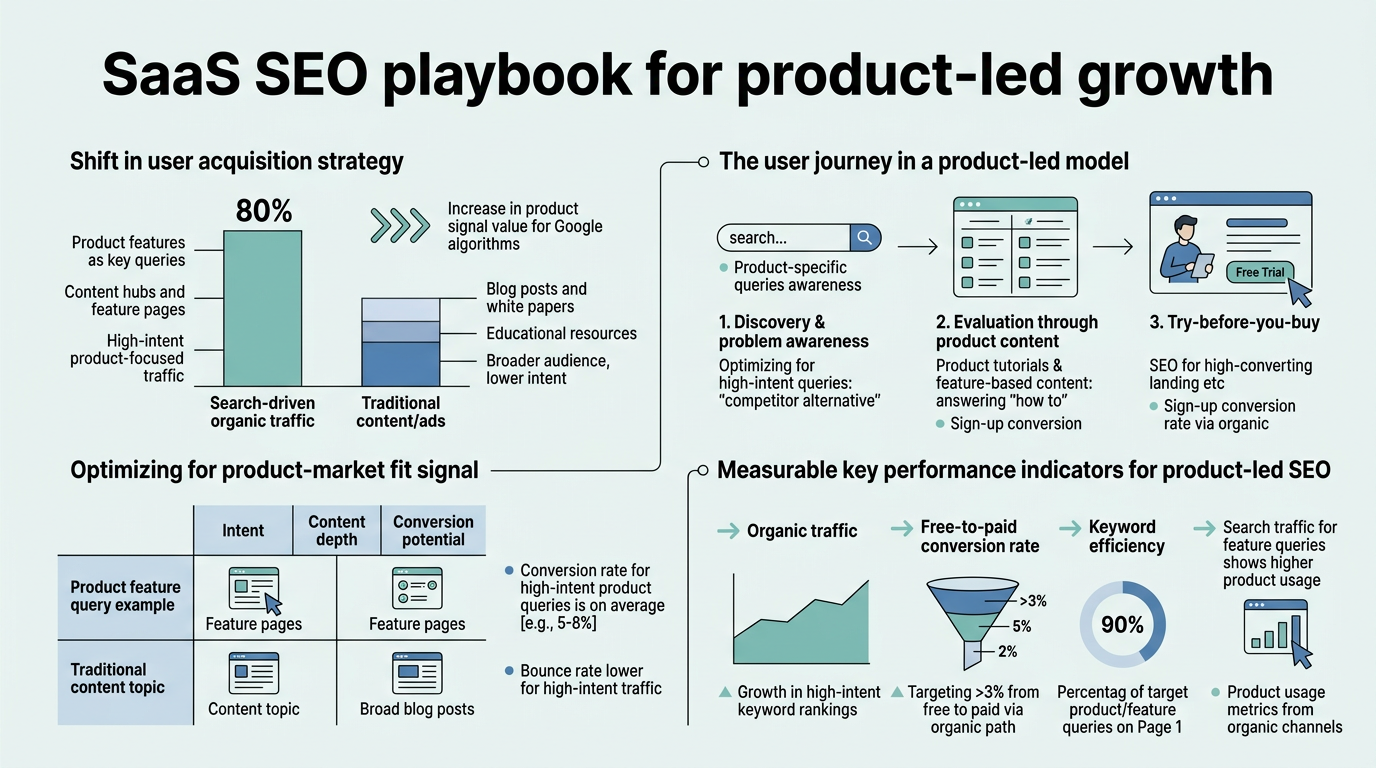
Product-led growth demands a fundamentally different SEO strategy than traditional marketing-led companies. In a PLG model, your product is your primary sales tool, and SEO's job is to drive qualified traffic that reaches the product quickly. Only 34% of PLG companies actively track activation, even though activation is the single best predictor of free-to-paid conversion. That gap reveals the core misalignment: teams build SEO content for ranking, not for guiding users toward that first "aha" moment. According to Mixpanel's 2026 analysis, the companies that do measure activation systematically see 3x higher conversion efficiency than those focusing on volume metrics alone.
"The companies that measure activation systematically see 3x higher conversion efficiency than those focusing on volume metrics alone. In a PLG motion, a prospect discovers your product, tries it, and converts within days—your SEO content competes against that clock."
The alignment problem between SEO and product activation
Traditional B2B SEO optimizes for information discovery. Teams target keywords like "what is a CRM" and build 3,000-word explainer posts. This works fine for sales-led companies where a prospect's journey spans months and involves multiple touchpoints. In a PLG motion, a prospect discovers your product, tries it, and converts (or churns) within days. Your SEO content competes against that clock.
The shift requires tracking organic traffic through the same funnel you measure in your product. A prospect who lands on a comparison page ("Best CRM for small teams") and signs up should flow directly into your activation metrics. If that segment activates at 65% within 7 days but only 40% of your general blog traffic activates, you now know which SEO topics drive product-qualified leads. Tools like Jottler automate this alignment by publishing topically cohesive content that maps directly to product capabilities, eliminating the gap between content and conversion through its autonomous SEO agent platform.
Why long-tail keywords dominate PLG organic traffic
Long-tail keywords now drive 68% of SaaS organic traffic, up from 58% in 2023. This shift reflects a deeper trend: PLG users arrive already problem-aware. They're searching for "how to onboard users to a SaaS product" not "product management software." This intent specificity is your advantage. Long-tail queries face less competition, convert faster, and directly signal where buyers' minds are at in their decision.
Build your content calendar around these specific buyer problems, not brand keywords. For each core use case your product supports, identify 5–10 long-tail variations that match how prospects describe their pain. Then publish educational content that answers that specific problem in a way that naturally showcases your product as a solution. This is topical authority: clustering content around buyer intent rather than scattered keyword targeting. A structured SaaS content marketing framework ensures every new piece reinforces your topical clusters.
Building Your Keyword Strategy Around Product Activation
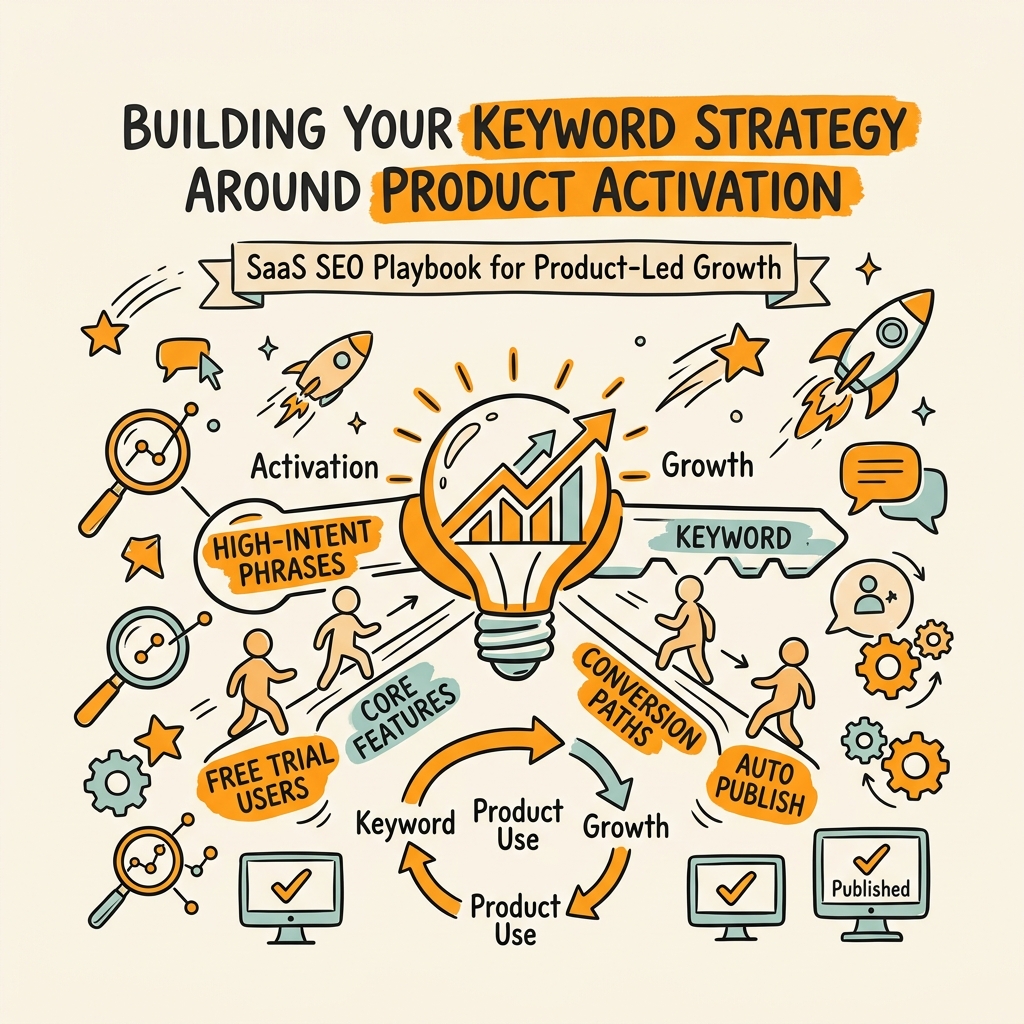
The first step in aligning SEO with PLG is reframing what "conversion" means. In traditional SaaS, a conversion is a sales-qualified lead. In PLG, conversion is activation—a user performing a core action within your product that correlates with paid subscription. Your keyword research must flow backward from that definition.
Map buyer intent stages to product moments
PLG buyers move through predictable intent stages. Awareness (they know they have a problem), Consideration (they're evaluating solutions), and Decision (they pick one and try it). Each stage maps to a product milestone: discovering the product, signing up for a trial, and taking first action. Your keyword strategy should explicitly rank these stages and assign content buckets to each.
- Awareness keywords: "Best [category] tools," "how to [core task]," "beginner's guide to [feature]"—high volume, broader match, goal is discovery.
- Consideration keywords: "[Tool] alternatives," "best [tool] for [use case]," "[Competitor] vs [Competitor]"—mid volume, high intent, leads to comparison.
- Decision keywords: "[Tool] pricing," "[Tool] free trial," "[Tool] templates"—lower volume, highest conversion, users are ready to try.
Most SEO teams weight keywords purely on search volume. A PLG playbook reweights them on activation potential. A low-volume decision keyword that drives 8% activation is more valuable than a high-volume awareness keyword that drives 1% activation. Start by identifying your 20 core use cases or buyer problems. For each, map 2–3 awareness keywords, 2–3 consideration keywords, and 1–2 decision keywords. This gives you a 60-piece content calendar with explicit ROI clarity.
Use product analytics to validate keyword-to-conversion paths
After publishing content, track which keywords drive users who activate. Most analytics platforms can't see this connection—they show you traffic, but not which traffic actually tried your product or upgraded. The solution is to tag your SEO traffic at the source.
Add UTM parameters to every article: utm_source=organic&utm_medium=seo&utm_campaign=[keyword_cluster_name]. Then link your analytics to your product database by user ID. Within 30 days, you'll see which content types drive your fastest-converting users. Double down on those topics. This feedback loop compounds: as you learn which problems drive conversion, you publish more content on those exact topics, multiplying activation rate while holding content volume constant. Automation systems that handle this correlation at scale—pulling data from 170+ SaaS SEO data points—dramatically accelerate this learning cycle.
Creating Content That Guides Users to Activation
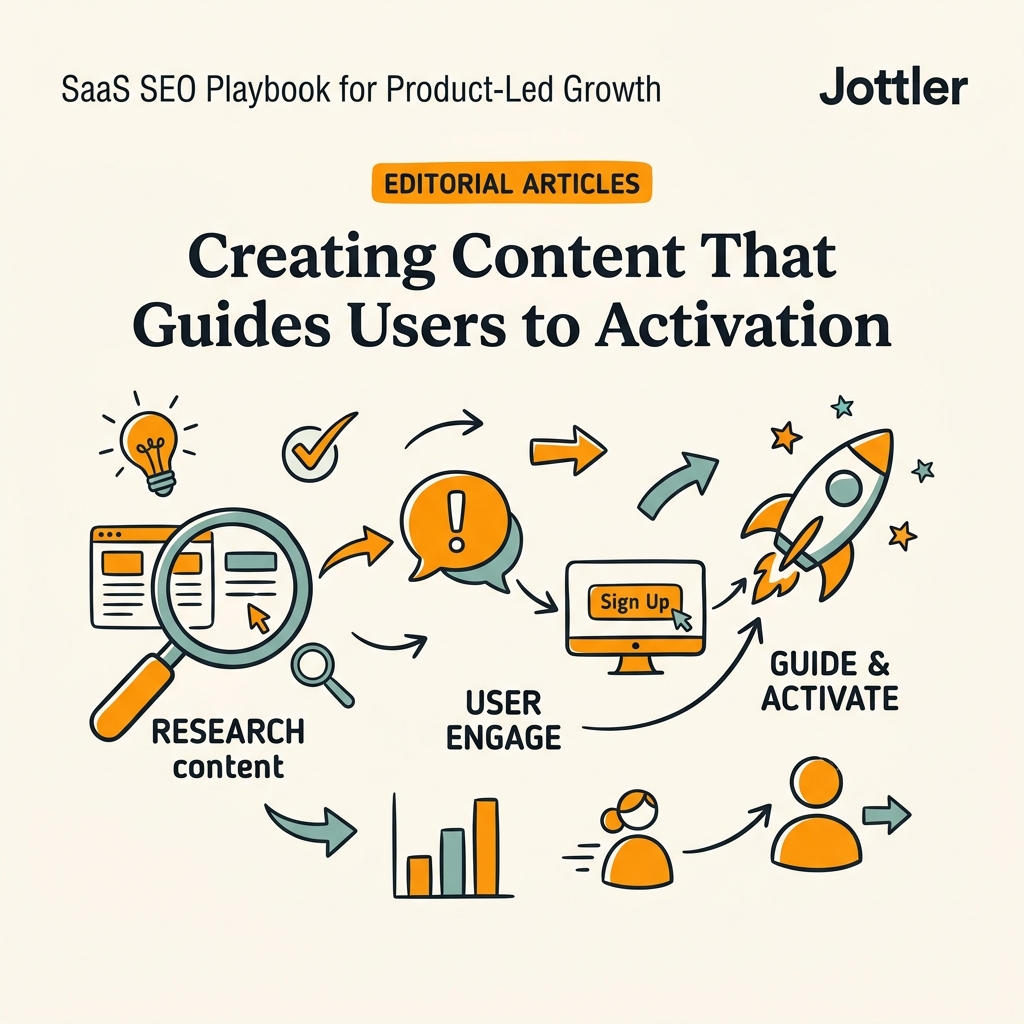
Product-led content is fundamentally different from traditional marketing content. It's designed to reduce friction toward trying your product, not to convince someone over multiple touches. Bottom-of-funnel content like comparisons, alternatives, and pricing pages convert best, yet most teams build 70% awareness-stage content because it's easier to rank.
"Bottom-of-funnel content like comparisons, alternatives, and pricing pages convert best for PLG companies, converting at 8-14% from visitor to trial signup. Yet most teams waste budget building awareness content because it's easier to rank, which is the opposite of activation-focused SEO."
Prioritize problem-aware over solution-aware content
The most activating content is "problem-aware": the reader knows they have a challenge and is seeking solutions, but may not know your product category exists. A prospect searching "how to reduce customer churn" is more likely to activate on a product trial than one searching "what is customer success software."
Problem-aware content templates include: how-to guides tied to a specific outcome, use-case spotlights, step-by-step tutorials, and templates that users can apply immediately. These articles naturally surface your product as the obvious next step. They're also lower-competition than broad category keywords, ranking faster and spending less effort per ranking. Creating this type of content at scale requires a systematic approach—the kind that content marketing automation enables.
Structure comparison and alternatives pages for conversion
Comparison content is the highest-converting content type in B2B SaaS. A prospect visiting "[Competitor] vs [Your Product]" has already shortlisted you and is deciding. The page's job is to map specific features to buyer pain, making your product the pragmatic choice.
Build a comparison table that addresses the most important dimensions to your audience. Then, beneath the table, add a section on each dimension explaining why your product's approach solves the underlying buyer problem better. Link to a free trial or demo. Test messaging: some audiences care about price, others about implementation time, others about integrations. A/B test comparison pages to find the messaging that drives highest trial-to-paid conversion.
Embed product tools and templates directly in content
The highest-activating content is interactive. A template calculator, feature comparison tool, or workflow checklist that users can act on immediately inside your blog reduces friction to product signup. If a prospect spends 5 minutes using your interactive tool and realizes they need it, activation is nearly guaranteed.
Examples: a CRM might embed a "customer segmentation calculator" that shows how many customer profiles a prospect should track. An analytics tool might embed a "funnel analysis template" they can populate with their own data. A project management tool might embed a "capacity planning template." Each embedded tool drives micro-conversions (email signups, tool usage) that feed your onboarding funnel. Publishing this type of content daily via automated systems like Jottler ensures consistent, scaled output without the bottleneck of manual creation.
Scaling Content Without Losing Topical Coherence
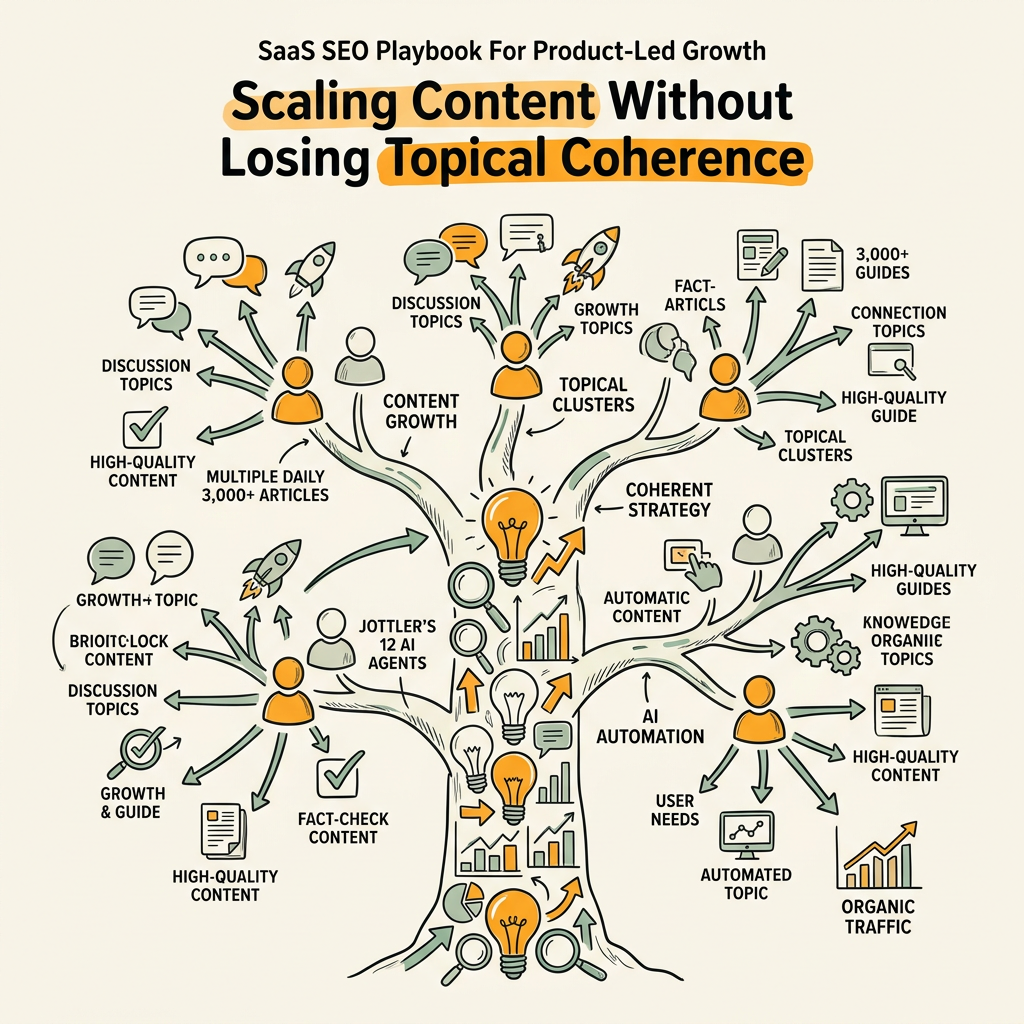
PLG companies need content velocity. SaaS companies publishing 8–12 high-quality pieces per month see dramatically faster ranking and conversion results than those publishing 2–3 pieces monthly. But scaling content manually doesn't work; most teams hit a wall around 4 pieces weekly where quality begins degrading. The solution is automation that maintains topical coherence.
"As you scale output, topical coherence becomes your competitive edge. If you're publishing 1 article per month, each link acquisition dilutes across 1 piece. If you're publishing 30 articles per month, the same link equity concentrates strategically on highest-converting content, multiplying activation per link invested."
Design your topical clusters before automating
Before scaling, map your content architecture. Identify 5–8 major topical clusters (core product capabilities or buyer problems). Within each cluster, define 15–30 content pieces that link together logically. Example: if your product is a webinar platform, one cluster might be "Webinar Strategy & Best Practices" with content on "how to structure a product demo webinar," "webinar engagement tactics," "best webinar tools for sales teams," etc.
This architecture is your guardrail. It ensures that as you scale output, each new piece slots into a cluster and links intelligently to 2–4 related pieces. That internal linking builds topical authority faster than scattered content, and it multiplies the SEO value of each piece published. Jottler's system automatically maps this architecture by analyzing your existing content and identifying semantic clusters, then publishing new pieces that fit the topology.
Automate research, writing, and internal linking in lockstep
Manual content production bottlenecks at three points: research (gathering data, competitor analysis, finding expert quotes), writing (drafting and editing), and linking (identifying relevant internal links and adding them). If any one step slows down, the entire pipeline jams.
Jottler solves this by automating all three. Its AI agents research a topic across 14+ sources, write a fact-checked article, and automatically link to related internal content. The system publishes directly to your CMS, producing 3,000+ word articles daily at a predictable quality baseline. For a busy founder or marketing team, this compounds: each day you publish, you're compounding the SEO effect of the previous day's topical clusters. After 90 days of daily publishing, your topical authority becomes clear to search engines, and rankings accelerate exponentially.
Link building compounds topical clusters
Topical authority alone doesn't guarantee rankings. The second lever is link equity. As you build clusters, identify external opportunities: industry news sites, expert communities, tool roundups that naturally link to your content. Aim for 15–25 links per month to stay consistent and predictable in Google's eyes.
Here's where most teams miss the compounding effect: if you're publishing 1 article per month, acquiring 15–25 links per month means each link is diluted across 1 piece. If you're publishing 30 articles per month (3 per day), those same 15–25 links get distributed more strategically, concentrating link equity on your highest-converting content. More velocity means more focused link acquisition, which means higher-ROI link campaigns. A systematic approach to SaaS link building for B2B companies ensures this effort stays disciplined.
Measuring SEO Success in a PLG Motion
PLG companies measure SEO differently than traditional SaaS. The metrics that matter are product activation and revenue contribution, not just organic traffic and leads. Standard SEO reporting (top keywords, traffic, rankings) misses the actual value of organic traffic in driving revenue.
Track activation by traffic source and landing page
Connect your website analytics to product telemetry. Build a dashboard that shows, for each organic landing page: traffic volume, signup rate, and 7-day activation rate. This reveals which content drives the most product-qualified users.
| Landing Page | Organic Traffic | Trial Signup Rate | 7-Day Activation Rate | Activation Value |
|---|---|---|---|---|
| Best [Category] Tools Comparison | 2,400 | 8.5% | 62% | $12,240 (est. LTV contribution) |
| How to [Core Use Case] | 1,800 | 5.2% | 48% | $4,493 |
| Product Alternatives Guide | 1,200 | 11.3% | 71% | $9,626 |
| Features & Pricing | 950 | 14.6% | 78% | $10,814 |
| Beginner's Guide (Awareness) | 3,100 | 2.1% | 31% | $2,015 |
This table shows what most SEO reports hide: the beginner's guide drives 3,100 monthly visitors but contributes less activation value than the alternatives page despite 2.5x more traffic. Your next quarter of publishing should heavily weight alternatives and comparison content, even if they drive less raw traffic. This is the PLG SEO optimization: maximize activation per content piece, not traffic per piece.
Measure net revenue retention contribution from organic
Top PLG performers achieve net revenue retention (NRR) exceeding 130%, driven largely by expansion revenue (existing customers upgrading). SEO plays a hidden role here: customers searching for "how to use [feature]" or "[feature] best practices" land on your educational content, which guides them toward feature adoption, which drives upselling.
Track this by tagging your educational content separately. A customer who lands on "advanced [feature] guide" from organic search should flow into your customer analytics as a product-engaged user. If that user upgrades at 2x the rate of customers who didn't encounter that content, you've just quantified organic's expansion revenue impact. This is often 40–60% of organic's total value for mid-market PLG companies and is almost never measured. Understanding how to scale this requires systematic SaaS SEO strategy aligned to scale organic traffic.
Conclusion
The 2026 SaaS landscape demands an SEO playbook built explicitly for product-led growth. 58% of B2B SaaS now runs a PLG model, with 91% planning to increase investment, yet most teams still follow traditional playbooks optimized for ranking volume over activation. The companies pulling ahead align three elements: keyword strategy around product activation events, content designed to reduce friction toward trial signup, and measurement tied to activation and revenue—not just traffic.
Starting now: audit your top 50 organic landing pages and categorize them by activation rate and trial-to-paid conversion. Double down on your highest-converting content types. Build your next quarter's publishing calendar around the buyer problems that drive fastest activation. Then scale that calendar from 2–3 pieces per month to 10+ pieces per month using automation. Within 90 days, you'll see topical authority compound, rankings accelerate, and most importantly, activation rates rise.
Start your SEO agent and begin publishing topically cohesive content daily. Jottler handles the research, writing, fact-checking, and internal linking automatically—so your team can focus on analyzing activation data and iterating on what converts.
FAQs
How do I align my SEO strategy with product-led growth?
Start by connecting your content analytics to product telemetry. Track which organic landing pages drive the highest 7-day activation rates and trial-to-paid conversion. Then reweight your publishing calendar to favor topics that drive product-qualified traffic, not just rank-able keywords. Map your buyer journey to product moments: awareness-stage content for discovery, consideration-stage content for evaluation, and decision-stage content for trial. Measure success on activation rate per landing page, not total organic traffic. Most teams waste budget ranking content nobody acts on; this framework ensures every published piece drives conversion.
What content types convert best for product-led SaaS companies?
Comparison pages, alternatives guides, and pricing/free trial pages convert best for PLG companies. These are decision-stage content: the prospect has already identified a problem and is evaluating solutions. Problem-aware how-to guides tied to specific use cases rank second. Bottom-of-funnel content typically converts at 8-14% from visitor to trial signup, while awareness-stage blog posts convert at 1-3%. Build your calendar so 60% of content targets consideration and decision stages, with the remaining 40% supporting awareness. This is the opposite of most marketing teams, which build primarily awareness content because it's easier to rank.
How often should a PLG company publish SEO content to see results?
SaaS teams publishing 8-12 high-quality articles monthly see significantly faster ranking and activation results than those publishing 2-3 monthly. For growing companies, 10-15 pieces per month is the minimum threshold to build topical authority fast enough to outrank competitors. The bottleneck is usually capacity: manual content creation maxes out around 4 pieces per week. Automation platforms enable teams to publish daily while maintaining topical coherence through structured content clusters, making consistent velocity sustainable without burnout.