Topic Cluster Strategy for SaaS Growth
Most SaaS teams abandon organic growth after 6 months. They've published sporadically, ranked for a few keywords, but can't compound momentum without a structured approach. The cost is real: organic search now generates 44.6% of all B2B revenue, yet 41% of top-performing SaaS teams attribute qualified pipeline to organic search, content, and answer engine optimizationwhile the rest are left behind.
The fix? A topic cluster strategy that ties every piece of content to a pillar topic, amplifies authority through intentional interlinking, and builds topical depth faster than scattered keyword-chasing ever could. Clustered content drives 30% more organic traffic and holds rankings 2.5x longer than standalone articles. Here's how to architect this system and scale it without burning your marketing team out.
Key Takeaways
- Clustered content delivers 30% more organic traffic and 2.5x longer ranking retention vs. standalone articles (2025, HireGrowth analysis via Search Engine Land)
- Topic clusters signal topical authority to search engines, improving both visibility and engagement metrics like bounce rate and conversion likelihood
- The fastest-growing SaaS teams build clusters around customer problems, not generic keywordsthen interlink intentionally to establish expertise depth
- Understand the Topic Cluster Model: A pillar page covers a broad topic; cluster pages target subtopics and link back to prove domain authority.
- Audit and Map Your Existing Content: Find high-performing pages to become pillars, then identify gaps in coverage.
- Build Clusters Around Customer Problems: Organize by real buyer questions and intent, not just keyword volume.
- Link Strategically with Descriptive Anchor Text: Cluster pages reference the pillar; the pillar links outward to cluster content.
- Automate Content Production and Linking: Tools like Jottler handle research, writing, and internal linking at scale so you focus on strategy.
What Is a Topic Cluster and Why Does It Matter for SaaS?
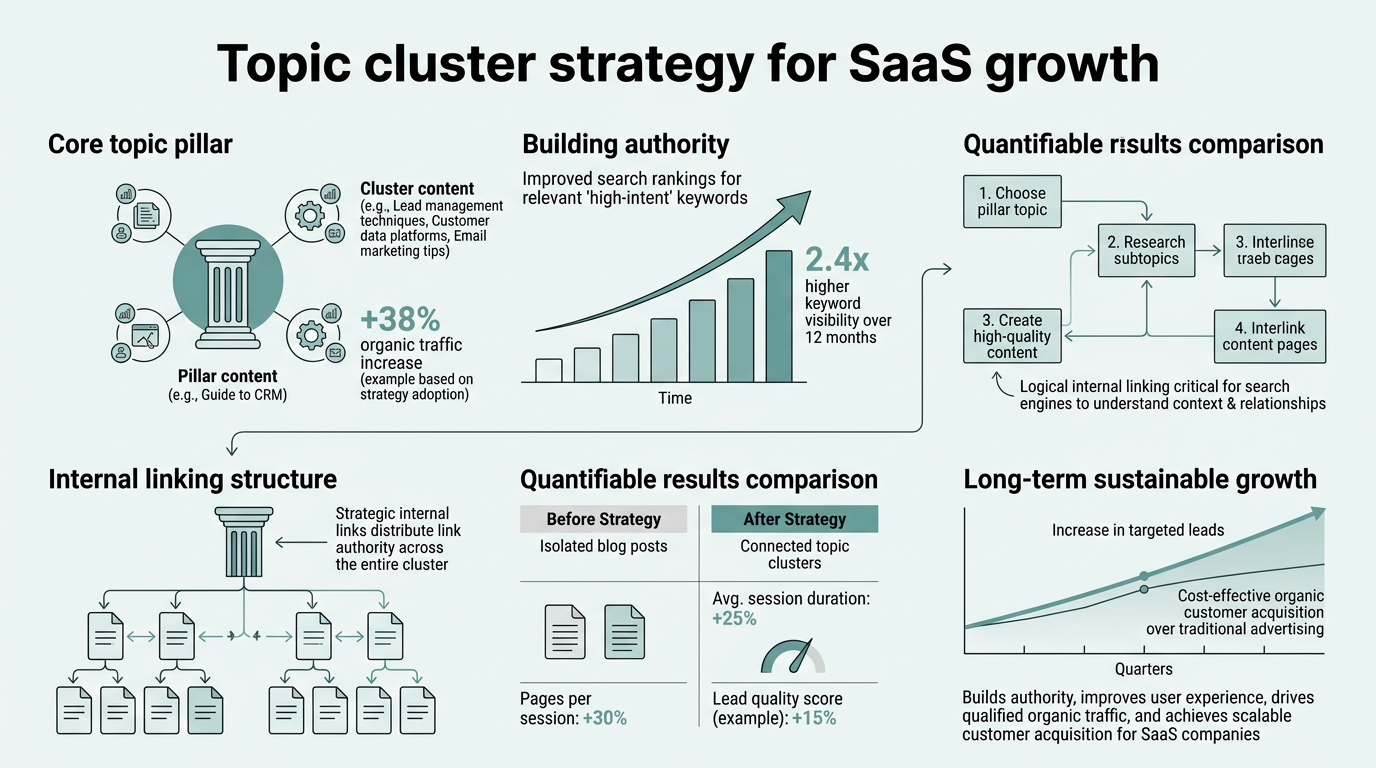
A topic cluster is a content structure where a broad pillar page sits at the center, surrounded by focused cluster pages that all address related subtopics. Each cluster page links back to the pillar, signaling to search engines that you've built comprehensive expertise. This architecture does two things at once: it helps Google understand the depth of your knowledge on a subject, and it creates multiple entry points for searchers at different stages of the buyer journey.
For SaaS specifically, clusters work because your buyer journey is long. Someone might search "How do I reduce churn?" (top-of-funnel awareness), then later search "Compare retention software" (mid-funnel comparison), then "Best customer retention tools for SMBs" (late-funnel, specific segment). One pillar topic"customer retention"can support all three clusters and each one links back, reinforcing authority and guiding the reader deeper into your ecosystem.
How Topic Clusters Signal Authority to Search Engines
Google has shifted from rewarding isolated keyword matches to rewarding topical authoritythe signal that you've deeply understood and comprehensively covered a subject. HubSpot research shows that the more interlinking teams did between pillar and cluster pages, the better the SERP placement, with impressions increasing as link density increased.
Clusters deliver that signal by:
- Demonstrating depth: You're not just answering the question onceyou're answering it from multiple angles (comparison, how-to, troubleshooting, use cases).
- Creating internal authority flow: Cluster pages funnel authority back to the pillar through backlinks, strengthening its standing for competitive keywords.
- Reducing keyword cannibalization: Each cluster page targets a unique keyword intent; there's no duplicate competition within your own domain.
The SaaS Growth Advantage: Compounding Authority
SaaS buyers are skeptics. They read 5–10 articles before a sales conversation. A topic cluster meets them where they are. One well-built cluster on "API rate limiting" can capture traffic from "What is API rate limiting?" (educational), "How to implement API rate limiting" (technical), "API rate limiting in Python vs Node" (comparison), and "API rate limiting best practices" (expert guide). That's one topic, four entry points, four chances to prove expertise, and one pillar dominating a category.
Clusters also compound over time. After 6 months, your pillar and 8–10 cluster pages form a net that catches more search traffic than the pillar alone ever could. After 12 months, that net deepensnew cluster pages expand coverage, existing pages pick up more backlinks, and rankings stabilize 2.5x longer than standalone content. This is why building a consistent content marketing framework with topic clusters is critical for SaaS teams scaling organic traffic.
How Should You Audit and Map Your Existing Content to Build Clusters?
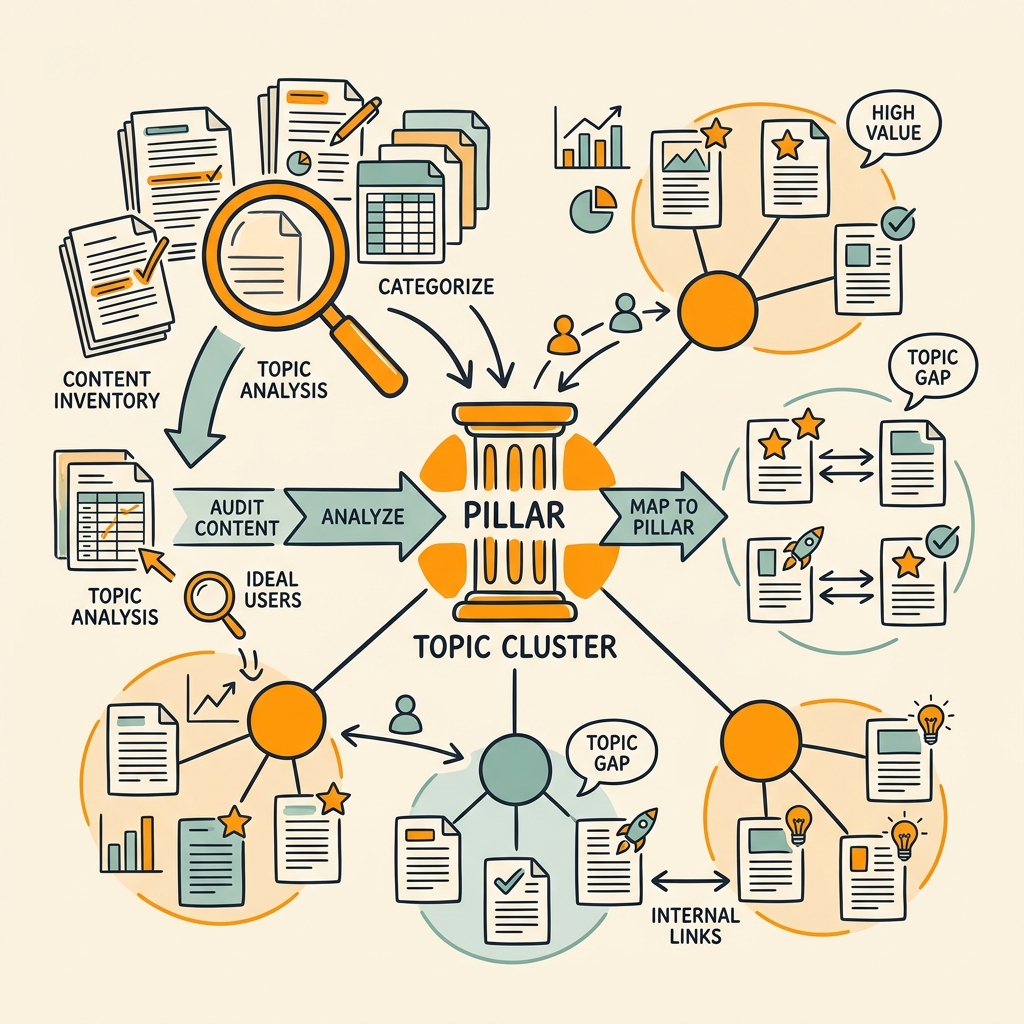
Most SaaS teams don't start with a blank page. You likely have 50–200 existing articles scattered across your blog. The fastest path to clusters isn't writing 30 new articlesit's reshaping what you've already published into a cluster architecture, then filling gaps. Content strategy experts recommend auditing current pages to find pages already ranking well, pages with strong backlinks, pages with high engagement, and keywords just outside top rankingsthen repurposing these as cluster anchors.
Identify Your Highest-Performing Pages as Pillar Candidates
Pull your Google Search Console and GA4 data for the last 12 months. Look for pages that rank for a broad keyword (not a super-specific tail) and drive consistent traffic. Broad keywords are a sign you've naturally covered a topic well.
Examples of pillar candidates:
- Pages with 50+ organic sessions per month and a bounce rate under 50%
- Articles ranking in positions 5–15 for high-volume keywords (ripe for clustering up to top-3)
- Pages with strong engagement (time on page > 2 min, pages per session > 1.2)
These are your starting anchors. Once identified, repurpose them as pillars: broaden the intro, expand the table of contents to cover all subtopics, and add a cluster map at the end linking to (or placeholder for) related content.
Map Related Keywords and Topics to Find Cluster Gaps
For each pillar, brainstorm the surrounding subtopics your buyer actually asks about. Don't rely on keyword volume alonelisten to your support team, sales conversations, and community channels. Tools like programmatic SEO approaches can help you scale this process by identifying semantic keyword relationships automatically.
For a pillar on "customer data platforms," the clusters might be:
- CDP vs. CRM (comparison)
- How to choose a CDP (buying guide)
- CDP for e-commerce (use case)
- CDP best practices (expert guide)
- Troubleshooting CDP data syncs (problem-solving)
Now audit your content: Do you have articles on all five? If you're missing 2–3, those are your cluster gaps. Prioritize by search volume and buyer journey stage, then create cluster pages to fill them.
Organize by Buyer Journey Stage, Not Just Volume
A common mistake is building clusters only around high-volume keywords. Better approach: build clusters that serve awareness, consideration, and decision stages. Awareness clusters ("What is a CDP?") bring traffic. Consideration clusters ("CDP vs. CRM") qualify intent. Decision clusters ("Best CDPs for SaaS") convert.
A balanced pillar should have:
- 1–2 awareness clusters: Definitional, high traffic, lower intent
- 2–4 consideration clusters: Comparisons, use cases, frameworks
- 2–3 decision clusters: Buying guides, pricing, implementation how-tos
How Do You Build Topic Clusters Around Customer Problems Rather Than Keywords?
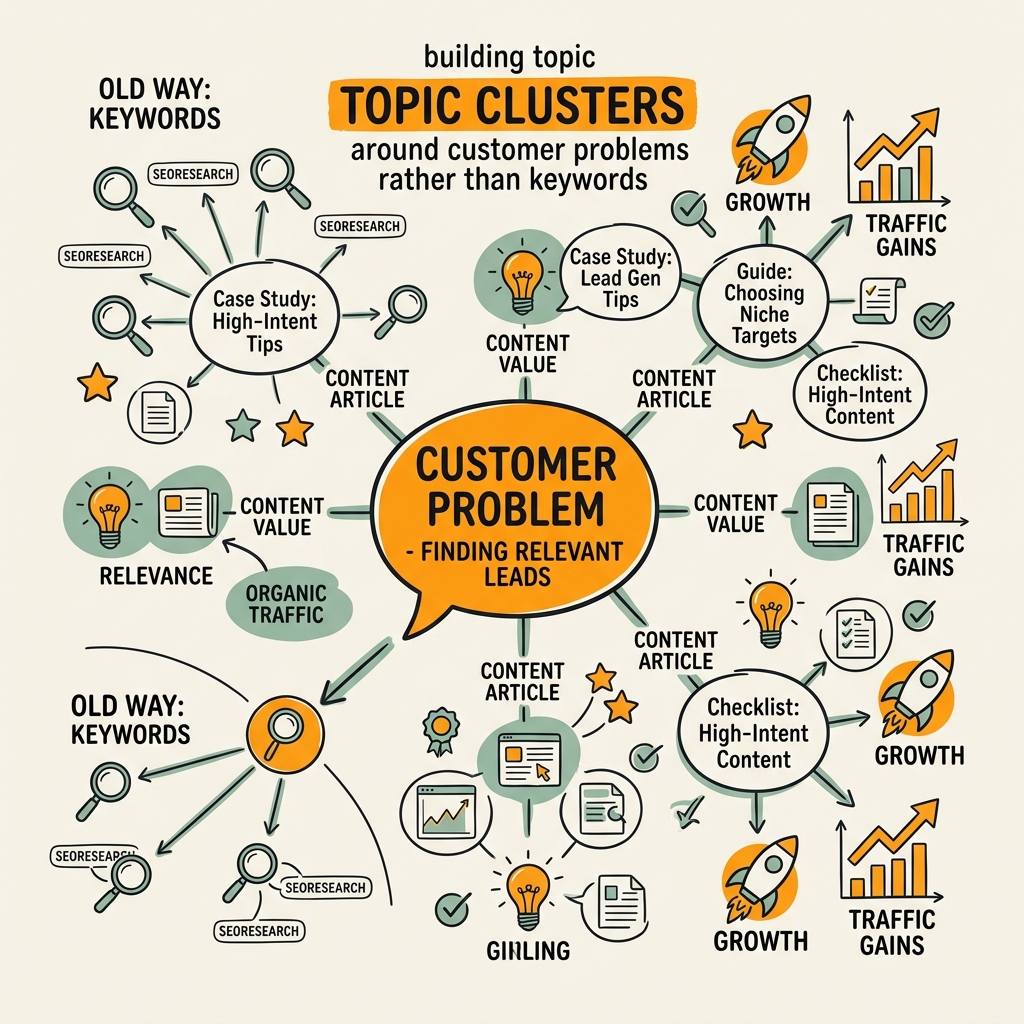
Keyword-first clustering fails because high-volume keywords don't always align with buyer problems. You chase "marketing automation" (40K searches), miss "how do I prevent email fatigue in marketing automation" (500 searches), and wonder why the 40K-volume article doesn't convert.
Buyer-problem clustering flips this: start with real customer friction points, then find the keywords people use to search for that problem. This alignment drives both traffic and conversions. According to Search Engine Land's comprehensive guide, building clusters from audience needs, questions, long-tail keywords, and search intent outperforms pure volume-based approaches.
Extract Problem Statements From Sales and Support Data
Before you open a keyword tool, sit with your sales and support teams for 30 minutes. Ask: "What problems do customers bring to you before they buy? What questions do they ask after?" Capture 10–15 problem statements verbatim.
Examples from a design tool company:
- "Our design team keeps creating variations that don't align with the brand."
- "We can't track who approved which version of a design."
- "We're spending 3 hours per week on file handoffs between teams."
These are cluster seeds. One of them might become "Design file management best practices" (pillar), supported by clusters on "Approval workflows," "Version control for design teams," and "Integrating design tools with Slack."
Map Problems to Keywords Using Search Intent
Once you have problem statements, translate them to search queries. Not every problem is a keyword, but most are. Use tools like Google's "People Also Ask," Reddit, and competitor content to find how your buyer actually searches for that problem.
Problem: "We can't scale design reviews across distributed teams."
Possible keywords:
- "Design review tools"
- "How to conduct async design reviews"
- "Remote design collaboration software"
- "Best practices for design feedback at scale"
Now you have clusters grounded in real buyer friction, not just keyword volume. This approach consistently outperforms volume-first clustering because your content answers the question the buyer is actually askingnot a variant the algorithm thinks might be searched.
Validate Cluster Themes With Your Ideal Customer Profile (ICP)
Not every problem is worth a cluster. Validate each pillar topic against your ICP: Is this a problem your best customers have? Is it material to their success with your product? Will solving it accelerate expansion or reduce churn?
If you're a B2B SaaS company selling to enterprise engineering teams, a cluster on "open-source security" is worth building. A cluster on "CSS frameworks" might not bethat's for your free tier users who never pay.
Strong clusters align with:
- ICP company size and function: Enterprise vs. SMB; engineering vs. marketing
- Revenue-critical outcomes: Reducing onboarding time, increasing retention, lowering cost per deployment
- Buying signals: Problems that trigger the search before a demo request
What Is the Internal Linking Strategy That Makes Clusters Work?
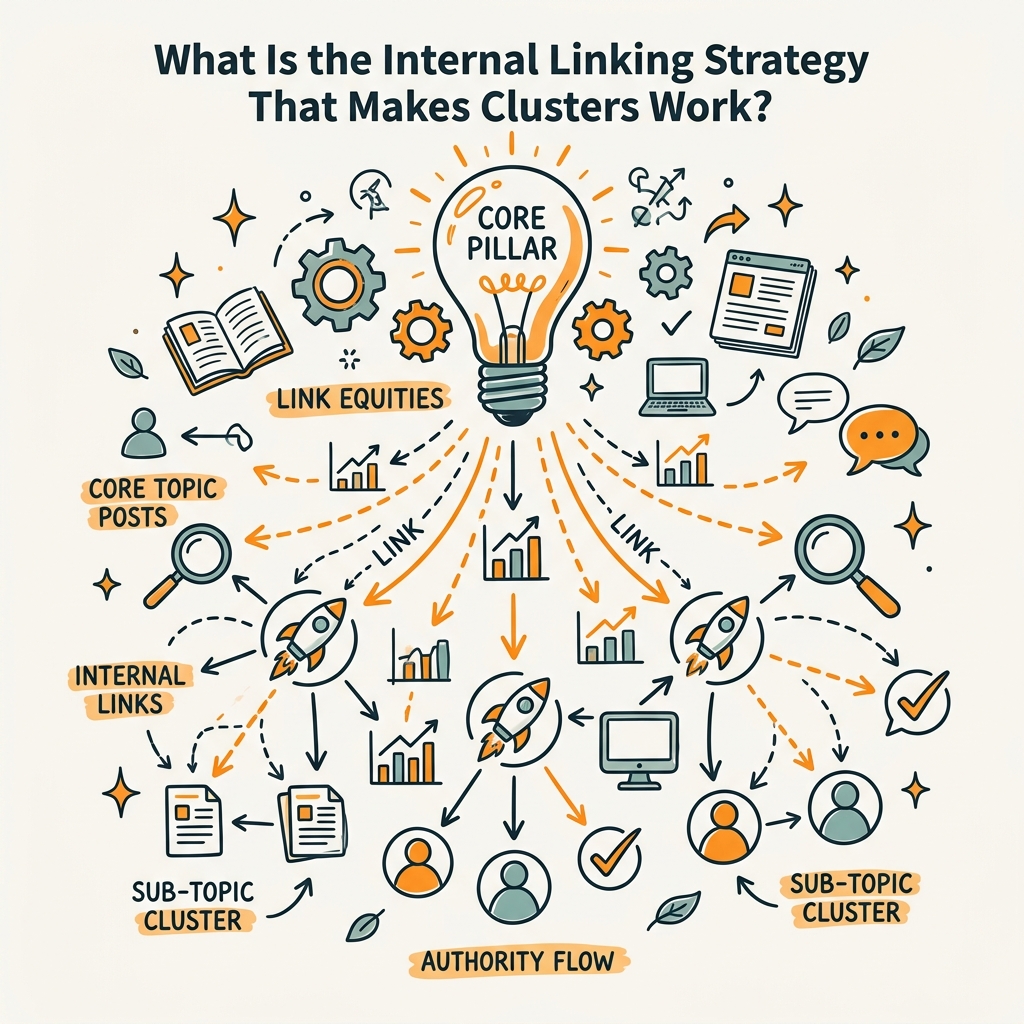
Topic clusters fail silently if the internal linking is weak. You can have a pillar and 10 cluster pages, but if they're not intentionally linked with descriptive anchor text, Google won't recognize the relationship and you won't capture the authority boost. That's why content automation tools that handle intelligent internal linking are increasingly critical for scaling topic clusters.
Implement Bidirectional Linking Between Pillar and Clusters
The standard cluster linking model is bidirectional:
- Cluster pages link UP to the pillar: Early in the article (within the first 300 words), each cluster page mentions the pillar and links to it using descriptive anchor text. Example: "For a comprehensive overview of design systems, see our guide to building design systems at scale."
- Pillar links DOWN to clusters: The pillar includes a section listing all related clusters with brief descriptions and links. Example: "To dive deeper, explore our guides on design system governance, design tokens, and design-to-dev workflows."
This structure signals relationship to search engines and guides readers naturally into the cluster content based on their interest. A reader lands on "Design Systems 101" (pillar), scrolls, finds "Design Tokens Best Practices" interesting, clicks through, reads the article, and clicks back to the pillar to explore another cluster. That reading path strengthens both pages.
Use Contextual Anchor Text That Explains the Link
Never use generic anchor text like "click here" or "learn more." Every link should be descriptive enough that the reader (and Google) understand what they'll find.
Bad: "For more on this topic, check out our other article on SEO."
Good: "The best way to scale design reviews is to combine async feedback loops with scheduled sync sessions. Learn how design-led companies structure design review workflows to cut feedback cycles from days to hours."
Descriptive anchors make the link feel native to the reader's experience and signal topical relevance to search engines. Aim for 2–4 words that describe the target page's core claim.
Avoid Orphan Pages and Ensure Full Cluster Interlinking
A cluster page that doesn't link to any other cluster page or to the pillar is an orphan. Orphans don't benefit from the cluster's collective authority and they offer readers no natural path to explore related content. Audit your clusters quarterly: every article should have at least 1–2 links to related cluster pages or the pillar.
Cluster linking checklist:
- All cluster pages link to the pillar within the first 300 words
- The pillar links to all cluster pages in a dedicated "Related Guides" section
- Related cluster pages link to each other (e.g., the "Comparison" cluster links to the "How-To" cluster)
- No page in the cluster is orphanedevery page has at least one inbound link from another cluster page
How Can You Scale Topic Clusters Without Burning Out Your Team?
Building 8–10 cluster pages per topic manually takes weeks. For 3–5 topics, that's months of work. SaaS teams with small marketing stafffounders, a content manager, a contractorcan't sustain this. The solution is automation.
Automate Research and Keyword Mapping for Each Cluster
Before you open a keyword tool, sit with your sales and support teams for 30 minutes. Ask: "What problems do customers bring to you before they buy? What questions do they ask after?" Capture 10–15 problem statements verbatim. Before writing a single word, your cluster structure should be fully mapped: pillar topic, cluster keywords, intent for each, outline points. This takes 20% of writing time but is often the bottleneck. Automation tools can handle keyword research, People Also Ask extraction, competitor outline analysis, and structure recommendations in hours instead of days.
Jottler's research pipeline, for example, queries 14+ data sources (SEO tools, news feeds, Reddit, academic papers, product sites) in parallel, extracts people also ask questions, and surfaces the outline before a word is written. This cuts research from 4–6 hours to 30 minutes per cluster page, freeing your team to focus on angle and positioning rather than hunting sources.
Use AI Content Generation to Draft Cluster Content Faster
AI can't replace your domain knowledge, but it can draft cluster pages 5–10x faster than a human writing from scratch. The most effective approach: AI drafts based on your research + outline + any custom angle (your POV, original data, product context), then a human editor fact-checks, rewrites weak sections, and adds voice.
This workflow (research → AI draft → human edit) typically takes 2–3 hours per article instead of 6–8. Over a year, that compounds: 50 cluster pages instead of 25 with the same team capacity.
Automate Internal Linking and Publication
The final bottleneck: publishing and linking. You've written 8 cluster pages. Now you need to:
1. Upload each to your CMS
2. Add the pillar link to each
3. Update the pillar's "Related" section with all clusters
4. Add cross-cluster links where contextually relevant
5. Configure metadata, images, and preview snippets
6. Publish and monitor Search Console for indexing
This checklist takes 3–4 hours for a single cluster topic. Tools that handle automatic internal linking, CMS publishing, and structured metadata can reduce that to 20–30 minutes.
Jottler automates the entire workflow: once you've connected your CMS and set your cluster strategy, the platform researches the topic, writes the article, identifies internal link opportunities, publishes directly to your blog, and links it back to related content. This means cluster pages appear on your site linked, optimized, and indexed within hours of initial requestnot weeks of manual work.
What Metrics Should You Track to Measure Cluster Success?
Many teams publish cluster content and measure success by traffic alone. That's incomplete. A cluster that drives 10K sessions but converts at 0.1% is waste. Measure what matters: pipeline contribution, engagement, rankings, and expansion potential.
Track Organic Traffic and Ranking Position Changes
Start with the basics. In Google Search Console, track:
- Impressions by cluster: Are you appearing more often for the topic keywords?
- Click-through rate (CTR): Are people clicking your results? If CTR is under 2%, your title tags need work.
- Average position: Are cluster pages climbing toward top-3?
Set a baseline before cluster publication, then measure 3, 6, and 12 months after launch. Expect modest movement in months 1–3 (indexing + initial authority accrual), then steeper gains in months 4–9 as backlinks accumulate and ranking signals strengthen.
Monitor Engagement Metrics: Bounce Rate, Time on Page, Pages Per Session
Cluster content should engage readers more deeply than standalone articles. In GA4, segment cluster pages and compare to your blog average:
- Bounce rate: Cluster pages should be 5–10 points lower than blog average (lower = more engagement)
- Engagement rate: Cluster pages should keep readers longer; aim for 2–3 min time on page minimum
- Pages per session: Cluster readers should explore related content; 1.5+ pages per session is healthy
If bounce rate is high, your cluster page isn't matching search intent or the writing isn't compelling. If pages per session is 1.0, your internal links aren't workingreaders aren't clicking through to related content.
Attribute Cluster Content to Pipeline and Revenue
This is the highest-leverage metric. Set up your CMS and analytics to tag all cluster pages with a topic cluster identifier. Then, in your CRM, connect content attribution to opportunities: Which articles did the winning deal's buyer read before the first conversation?
Best-practice teams track:
- Leads from cluster content: How many MQLs came from that topic cluster in the last quarter?
- Conversion rate by cluster: Which topic drives the most qualified leads? Which has the lowest MQL-to-SQL rate?
- Deal influence: Did cluster content appear in the buying journey of closed deals?
Search Engine Land suggests expanding a cluster when keyword breadth grows >20% QoQ, answer inclusion rises 25–40%, and engagement depth exceeds your site median. These signals indicate the cluster is gaining authority and should be deepened with more pages.
Conclusion
Topic clusters are no longer optional for SaaS teams serious about organic growth. Clustered content generates 30% more traffic and holds rankings 2.5x longer than standalone articles, and top-performing SaaS teams attribute 41% of qualified pipeline to organic search and content strategies. The model is simple: organize content around pillar topics, build supporting cluster pages for related problems and keywords, link intentionally, and measure impact on pipeline and retention.
The real friction isn't strategyit's execution at scale. Researching, writing, and linking 40–50 cluster pages manually in a year burns out small teams. Automation isn't a luxury; it's how modern SaaS teams compound organic growth without hiring a full content team. Start your SEO agent today and turn topic clusters from a theoretical advantage into a daily competitive reality: https://jottler.co/auth/signup
FAQs
How long does it take to see results from a topic cluster strategy?
Expect modest gains in the first 3 monthsGoogle is indexing and assessing your new cluster architecture. Real momentum typically appears around month 4–6 as rankings improve and backlinks accumulate. By month 9–12, you should see clustered pages holding positions 3–5 for competitive keywords, with steady organic traffic growth and engagement metrics improving as readers discover related content within the cluster. If you're seeing zero movement after 6 months, audit your on-page SEO (keyword density, structure, backlinks) rather than the cluster architecture itself.
Can I turn existing blog articles into clusters or do I need to start from scratch?
Most teams don't start from scratchthey reshape existing content. Audit your blog for pages already ranking decently (positions 5–15, 50+ monthly sessions). Repurpose your strongest existing article as the pillar, then build cluster pages around related subtopics you've never covered. This strategy is faster because the pillar already has authority signals (traffic, backlinks, engagement). You're adding cluster pages to amplify what's already working rather than rebuilding from zero.
What's the minimum number of cluster pages needed to see ranking improvements?
A pillar with 4–6 cluster pages signals sufficient topical depth to search engines for competitive topics. Aim for at least one cluster page per major subtopic your buyer searches for. Most SaaS teams see meaningful ranking improvements once they've completed one full cluster (1 pillar + 6–8 cluster pages) and maintained it for 3–4 months. Start with your highest-revenue pillar topic, fully flesh it out, let it mature, then move to the next topic cluster. Quality and completeness matter more than quantity.