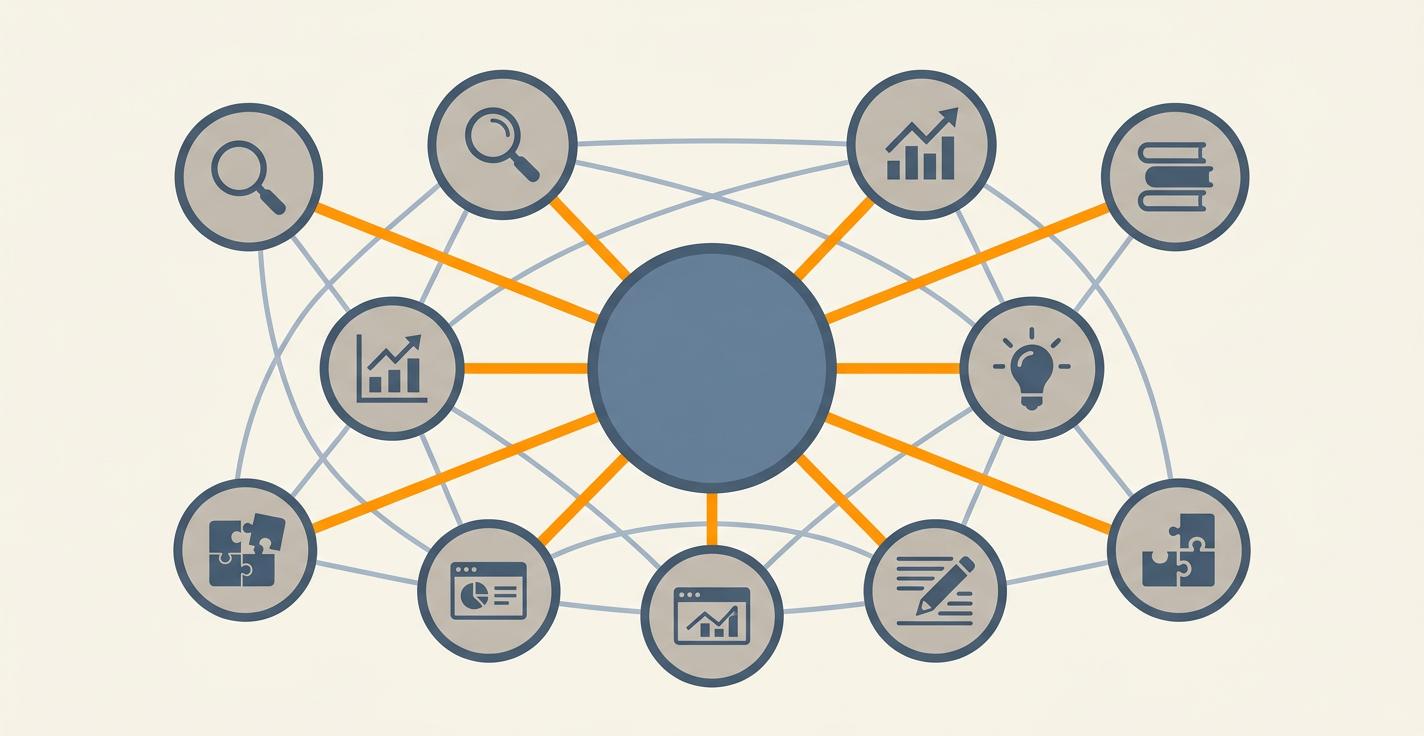
Topic clusters SEO is the practice of organizing a website's content around a central pillar page and many interlinked subtopic pages, so Google reads the whole collection as one deeply-covered subject rather than a pile of disconnected posts. That is the short answer. The long one, which is why you are here, explains why Google's ranking systems reward that structure, what the math actually looks like, and where most teams quietly sabotage themselves when they try to copy the model from a conference slide.
The concept is not new. HubSpot published the canonical framing in 2017, and the idea has been refined every year since by Google updates, the shift toward entity-based ranking, and now the arrival of AI Overviews and LLM citations. What has changed in 2026 is the stakes. Clustered content is not just nice-to-have anymore, it is the shape Google and the AI engines expect your site to take.
Key Takeaways
- A topic cluster is a group of interlinked pages covering one subject at different depths, with a pillar page at the center and 10-30 cluster pages addressing specific subtopics or questions.
- Google rewards clusters because its ranking systems evaluate entity coverage and internal link equity together, and a clustered structure signals that you cover a subject thoroughly rather than opportunistically.
- Sites with well-built topic clusters rank for 3-5x more keywords per published article than sites publishing standalone posts, and hold those rankings longer once they establish authority.
- Most clusters fail for two reasons: the pillar is too narrow to support a real tree of subtopics, or the internal linking is one-directional so authority never flows back to the pillar.
- In 2026, topic clusters also determine AI citation rates, because LLMs pull from pages that show contextual proof of expertise through surrounding content, not isolated articles.
What a Topic Cluster Actually Is
A topic cluster has three parts. A pillar page that covers a broad subject at a wide angle, a set of cluster pages that each address one specific aspect of the pillar subject, and the internal links connecting them into a bidirectional network.
The pillar page is the map of the territory. It introduces the subject, defines the key terms, and points to every deeper page. It is usually 2,500 to 5,000 words, though length matters less than coverage. A good pillar touches every major subtopic, even briefly, so the reader and Google both see the full shape of what you know.
Cluster pages are the detail. Each one targets one narrower keyword, answers one specific question, or walks through one specific process. They link up to the pillar, the pillar links down to them, and where it makes sense they link sideways to other cluster pages in the same group. That last link is the one most teams forget, and the one that does the most work.
Do not confuse topic clusters with keyword clusters. They are related but not the same. Keyword clusters are the upstream research artifact, a grouping of keywords that share search intent, often produced by a keyword clustering tool. Topic clusters are the downstream publishing artifact, the actual pages you build out of those groupings. One informs the other.
Why Google Rewards Cluster Architecture
To understand why clusters work, you have to understand what Google's ranking systems are actually measuring. Since the rollout of BERT in 2019, MUM in 2021, and the helpful content updates of 2023-2024, Google has moved decisively away from keyword matching toward entity and topic modeling. The algorithm is trying to figure out, for any given query, which sites have demonstrably covered the subject well.
Three signals matter most, and all three favor clusters.
The first is entity coverage. Google maintains a knowledge graph of entities, the people, products, concepts, and places that belong to a subject. If your page on "project management" mentions Gantt charts, Kanban boards, Agile sprints, PERT analysis, and burndown charts, you are demonstrating entity coverage. A cluster naturally builds this, because each cluster article goes deep on one entity and links back to the pillar, so the pillar inherits the topical proof from everything below it.
The second is internal link equity. PageRank is not dead, it is just one signal among many, but it still rewards structure. A pillar page with 20 cluster articles pointing to it accumulates internal authority. A standalone post with zero internal links pointing to it does not. According to Ahrefs' 2025 analysis of over two billion pages, pages with at least 10 internal links pointing to them rank in the top 10 for an average of 4.2x more keywords than pages with fewer than 3 internal links. (Source: Ahrefs study on internal linking, 2025.)
The third is topical depth as a trust signal. Google's guidelines explicitly reward sites that demonstrate Experience, Expertise, Authoritativeness, and Trustworthiness. Clustered content is the structural expression of expertise, a concept we cover at length in our piece on topical authority SEO. You cover a subject from every angle, so a reader landing on any one article can see the full shape of what you know. Google's systems read that shape the same way.
The Math Behind Cluster Gains
The rankings lift from clusters is not a mystery, it is a compounding effect of three measurable mechanics. Here is how it actually plays out.
When a cluster is built correctly, each new article serves two purposes at once. It targets its own long-tail keyword, so it can rank independently. And it feeds internal link equity to every other page in the cluster, raising the floor for everything else. Published in isolation, an article earns only its own rankings. Published inside a cluster, it lifts the cluster and is lifted by it.
Say you have a pillar page and ten cluster articles, each earning a modest amount of backlinks and traffic on its own. Every cluster article links to the pillar, so the pillar now has eleven internal-authority paths feeding it, plus whatever external backlinks accumulate. The pillar in turn links back to every cluster article, so each cluster inherits a fractional share of the pillar's authority. And when cluster articles link to each other where relevant, each one earns incremental signals from neighbors.
Semrush's 2025 State of Content Marketing report found that B2B companies using a documented pillar-cluster architecture produced content that drove 2.3x more organic traffic per article than companies publishing without a cluster framework. (Source: Semrush State of Content Marketing 2025, 2025.) The compounding shows up in the per-article ROI, not just in the total.
Real Case Studies of Cluster-Driven Wins
The theory only matters if it works in practice. Three brands have published enough data to make the case concretely.
HubSpot: The Origin Story That Paid Off
HubSpot created the topic cluster model in 2017 and rebuilt its own blog around it. Before the restructure, HubSpot's blog was a keyword-chasing operation with thousands of posts competing against each other for rankings. After the pillar-cluster rebuild, internal data HubSpot shared at INBOUND 2018 showed that pages organized into clusters earned 40-50% more impressions than the same content had earned as standalone posts. By 2024, the HubSpot blog was one of the top-ranked marketing properties in the world, with dozens of pillars covering CRM, sales, marketing, and service, each surrounded by hundreds of cluster articles.
The takeaway is not that HubSpot invented something magic. It is that the gains compounded. Every new cluster article added equity to the whole structure, and six years later the structure was a moat.
Nerdwallet: Clusters at Personal-Finance Scale
Nerdwallet rebuilt its personal finance content in the early 2020s around topic clusters organized by financial product category. Credit cards, mortgages, investing, banking, and insurance each got a pillar structure with dozens of cluster pages for specific product types, specific user questions, and specific decision points.
Ahrefs' public site explorer data shows Nerdwallet growing from roughly 10 million monthly organic visits in 2020 to over 30 million in 2024, almost entirely on the strength of its clustered content. The structural pattern is visible in the site architecture itself, with clear pillar URLs supported by tightly-scoped cluster URLs underneath.
Ahrefs: The SEO Tool That Practices What It Teaches
Ahrefs organizes its blog around clusters for each major SEO subtopic, link building, keyword research, content marketing, technical SEO, and more. Each cluster has a clear pillar, dozens of supporting articles, and a visible internal linking pattern. The Ahrefs blog is one of the top-cited SEO sources in LLM answers in 2026, according to a Profound analysis of AI citations across the SEO vertical. Their cluster architecture is a direct reason why.
The common thread across all three cases is commitment. None of these brands built a cluster in a quarter. They committed to the structure over years, and the compounding did the rest.
How to Design a Topic Cluster That Works
Most failed clusters are designed wrong at the start. The five steps below are the minimum viable process for getting the design right.
1. Pick a pillar topic that is broad enough to hold 20 subtopics. If your pillar topic only has five honest subtopics, it is not a pillar, it is a cluster article waiting to happen. Do keyword research to confirm the subject has enough search demand across its subtopics before you commit.
2. Map the entity universe. List every concept, tool, methodology, product, or person that Google associates with your pillar subject. A proper SEO content plan treats entity mapping as a discrete step before writing begins. Your cluster should cover every significant entity.
3. Define the pillar page's scope. The pillar must introduce every subtopic, not cover them exhaustively. 2,500-5,000 words is typical. The goal is topical breadth, with depth living in the cluster pages.
4. Plan 10-30 cluster pages. Too few and the pillar looks unsupported. Too many and you dilute your own authority before the cluster has a chance to consolidate. Ten is the floor, thirty is the comfortable ceiling for most subjects.
5. Design the link graph before you write. Draw the pillar in the middle. Every cluster article links to it with descriptive anchor text. The pillar links down to every cluster article. Cluster articles link to each other wherever the topical connection is real. Our deeper guide on pillar page strategy walks through the structural patterns in more detail.
Common Mistakes That Quietly Kill Clusters
Most clusters do not fail loudly. They just never deliver the rankings lift their authors expected. The reasons are usually one of these five.
Shallow pillars. A pillar page that barely covers the subject cannot anchor a cluster. If your pillar is 1,200 words and five of your cluster articles are longer than the pillar, your pillar is not doing the work.
Orphan cluster articles. Pages that no other page links to are orphans, and orphans cannot accumulate internal authority. Build the link graph before you publish. Every cluster article should have at least three internal links pointing to it within the cluster. The full pattern is covered in our internal linking strategy guide.
Keyword cannibalization inside the cluster. If two cluster articles target near-identical keywords, Google has to pick one, and the one it picks is often neither of them. Each cluster article must have a distinct primary keyword and a clear angle no other article in the cluster duplicates.
Pillar-only linking. Cluster articles that link only to the pillar and never to each other leave half of the potential authority on the table. Sideways links between cluster articles are the most frequently missed opportunity.
Abandoning the cluster after launch. A cluster is not a product launch, it is a living structure. New subtopics emerge. Old articles need refreshing. The teams that get the biggest compounding are the ones that treat the cluster as an ongoing system, not a project. The content cluster strategy playbook covers the maintenance cadence in detail.
Topic Clusters and AI Search
In 2026, the cluster question is no longer just about Google rankings. It is also about whether ChatGPT, Perplexity, and Google AI Overviews cite your site when they answer questions in your subject area.
AI engines do not just look at single pages. They look at the contextual proof around a page, the surrounding articles, the internal links, and the evidence that your site actually covers the subject. Clustered content provides that proof in a way standalone articles cannot. A Seer Interactive study of 25,000 AI Overview citations in 2025 found that pages from sites with a documented cluster structure were cited 3.1x more often than pages from sites publishing in isolation. (Source: Seer Interactive AI Overview study, 2025.)
This lines up with how LLMs retrieve. They sample from the corpus around the query, and the corpus they trust is the one where the evidence of expertise is structural, not anecdotal. The broader work of making content AI-citable overlaps heavily with generative engine optimization, but the cluster architecture is the foundation that makes everything else possible.
Automating Cluster Construction
Designing a cluster manually takes weeks. A product team of two people can easily spend 40-60 hours just on the pillar-cluster map before a single word is written. The main cost is keyword research and entity mapping, which are legitimate thinking work but are also repetitive and rule-based.
This is where an agent-based approach changes the economics. Jottler's topic tree feature builds a full cluster structure from a single input topic, proposing a pillar page, generating 15-30 cluster subtopics with real search volume and difficulty from DataForSEO, and producing the internal linking map before any writing starts. The content engine then writes each article with the cluster context preserved, so internal links are built into the drafts and the whole structure publishes as a real cluster rather than a pile of isolated drafts.
The advantage is not that an AI writes faster than a human, though it does. The advantage is that the cluster is designed as a whole from the first moment, which is the one thing manual processes consistently get wrong.
Frequently Asked Questions
How many articles should a topic cluster have?
A functional topic cluster has one pillar page and 10-30 cluster articles. Fewer than 10 and the cluster is too thin to establish topical depth. More than 30 and you risk cannibalization and diluted internal link equity. Most successful clusters land in the 15-25 range.
What is the difference between a topic cluster and a content hub?
A content hub is a broader concept covering any centralized collection of related content, including resource libraries and tag archives. A topic cluster is a specific SEO architecture with a pillar page at the center, interlinked cluster articles, and a defined internal linking pattern designed to build topical authority for Google.
How long does it take for a topic cluster to rank?
Most clusters begin earning rankings lift within 60-90 days after the full cluster publishes, with compounding gains through months 4-8 as Google reindexes internal links and backlinks accumulate. Clusters in competitive subjects can take 6-12 months to reach peak performance.
Do topic clusters still work with AI Overviews?
Yes, and arguably more than before. AI Overviews and LLM citations favor sites with structural proof of expertise, which is exactly what a topic cluster provides. Sites with documented cluster architectures are cited roughly 3x more often in AI answers than sites publishing standalone posts on the same subjects.
Can I build a topic cluster on an existing blog?
Yes. Start by auditing your existing content for topical overlap with a potential pillar subject. Consolidate redundant articles, identify gaps, draft the pillar page, and retrofit internal links across the qualifying existing articles. A retrofit cluster can be faster than a clean build because you already have the raw material.
The Bottom Line
Topic clusters are not a tactic, they are the underlying shape Google expects your site to take in 2026. Build them right and you get the compounding rankings lift, the AI citations, and the long-term authority that makes your content asset grow in value every year. Build them wrong, or skip them entirely, and you publish into a void.
The design work is where most teams lose. Get the pillar scope right, map the cluster before writing, and plan the link graph deliberately, and the compounding takes care of itself. How long would it take your team to design and publish a complete 20-article cluster this quarter?