Email Nurture Sequences: Automation Content That Converts
Manual email blasts deliver resultsonce. But prospects don't buy on the first touch. Lead nurturing emails generate 4 to 10 times the response rate of standalone blasts, and automated nurture sequences produce 320% more revenue from email than manual campaigns. The challenge isn't sending more emails; it's orchestrating the right sequence at the right time with the right message. Here's how automated nurture sequences bridge the gap between initial interest and ready-to-buy prospects.
Key Takeaways
- Automated nurture sequences generate 4–10x higher response rates than one-time email blasts (2026, Zendesk)
- Segmented nurture emails with personalized CTAs achieve 8.7% CTR versus 2.9% for non-segmented campaigns
- Leads receiving 12+ coordinated touchpoints convert 4.7x higher than those with fewer than 5 touches
- Behavioral triggers in automated workflows drive 42.1% open rates and 5.8% click-through rates, vs. 14.5% opens and 1.3% CTR for batch sends
- Trigger-Based Automation: Design sequences that fire based on user actions (signups, clicks, cart abandonment), delivering relevance at scale without manual effort.
- Segmentation & Personalization: Nurture sequences split by behavior and intent achieve 3x higher CTR than generic lists.
- Lead Scoring Integration: Route high-intent prospects into accelerated sequences, reducing sales cycle time and increasing conversion velocity.
- Content Strategy Across the Journey: Layer value-first content early in the nurture, delay hard sales asks until later sequences.
- Multi-Touch Attribution: Successful nurture tracks email impact alongside other channelsweb, retargeting, sales outreachto measure true conversion lift.
What Are Email Nurture Sequences and Why They Matter for Revenue Teams
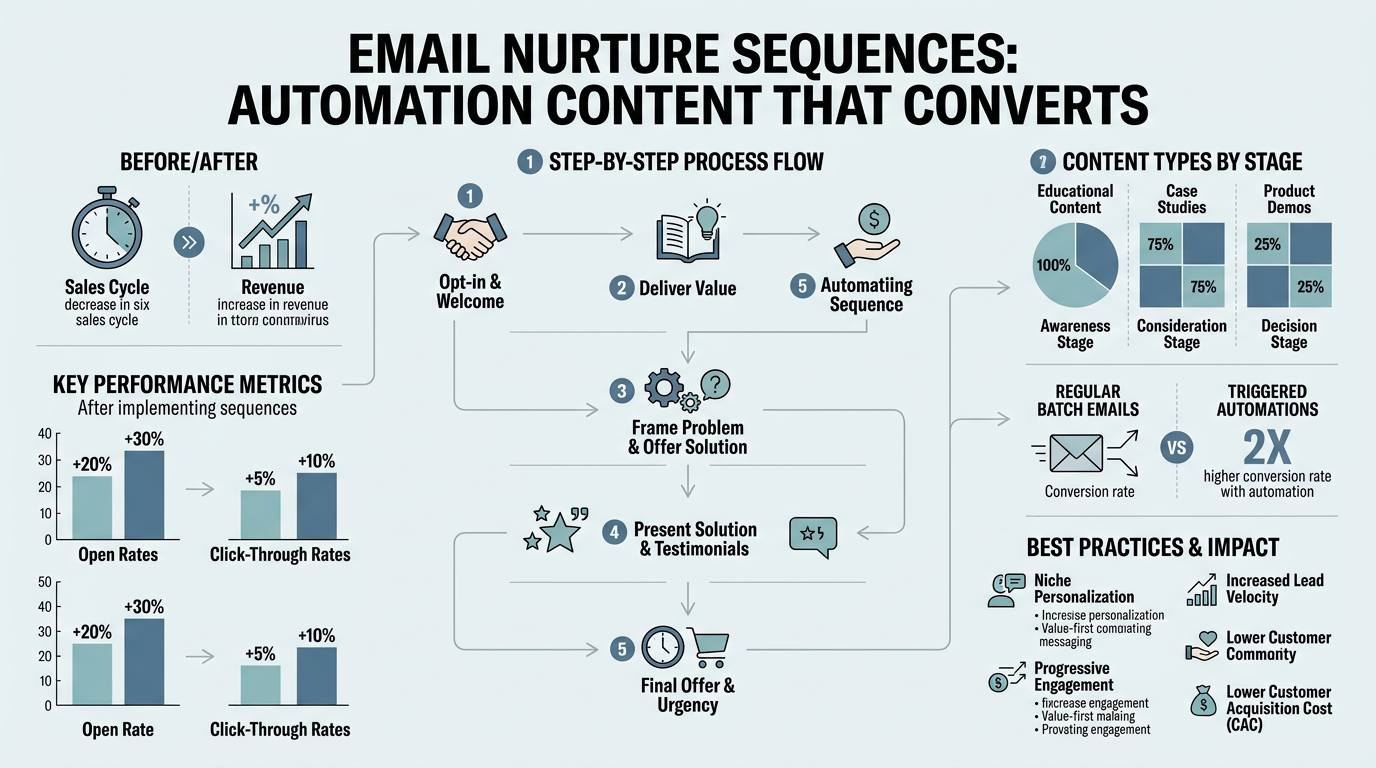
Email nurture sequences are multi-touch workflows that automatically deliver targeted content to prospects based on their behavior and stage in the buying journey. Unlike one-time campaigns, nurture sequences run continuouslyevery new prospect entering your list triggers the same sequence, but the timing and content adapt based on individual actions. Businesses using automated nurture sequences create 50% more sales-ready leads at 33% lower cost per qualified lead, making automation the lever that scales revenue teams without proportional headcount.
Automated vs. Manual: The Conversion Gap
The difference between automated and manual email workflows is stark. Manual campaigns rely on a single send date to a static list. Everyone gets the same message at the same time, regardless of intent or readiness. Automated workflows trigger on specific user actions, sending the right content at the moment it's most relevant. Automated trigger-based emails achieve 42.1% open rates and 5.8% click-through rates, compared to just 14.5% opens and 1.3% CTR for batch-and-blast sends. That's a 4.5x lift on click-through alone.
This isn't about sending more emailsit's about precision timing. When a prospect visits your pricing page, they're evaluating. When they download a case study, they're researching. When they read an email and click a link, they've signaled intent. Automated sequences capitalize on those signals in real-time, while manual campaigns miss the window entirely. According to Digital Applied's 2026 email automation guide, behavior-triggered automation outperforms batch-and-blast by aligning message timing with user actions.
The Multi-Touch Conversion Principle
One email rarely converts a prospect to customer. Leads receiving 12 or more coordinated touchpoints convert 4.7x higher than those with fewer than 5 touches, and the median deal requires 14 interactions before closed-won. Email nurture sequences deliver those touchpoints systematically. By layering automation across email, website, and sales outreach, revenue teams accelerate the buying cycle without burning out their prospects or sales teams.
The cost per touch drops dramatically when automated. Manual outreach is expensive. Sequences are set once and run infinitely. This multiplier effecthigh volume, low costis why businesses with automated nurture sequences generate 320% more revenue from email than those relying on only manual campaigns. The ROI compounds as volume scales.
How to Build Trigger-Based Nurture Sequences That Drive Conversions
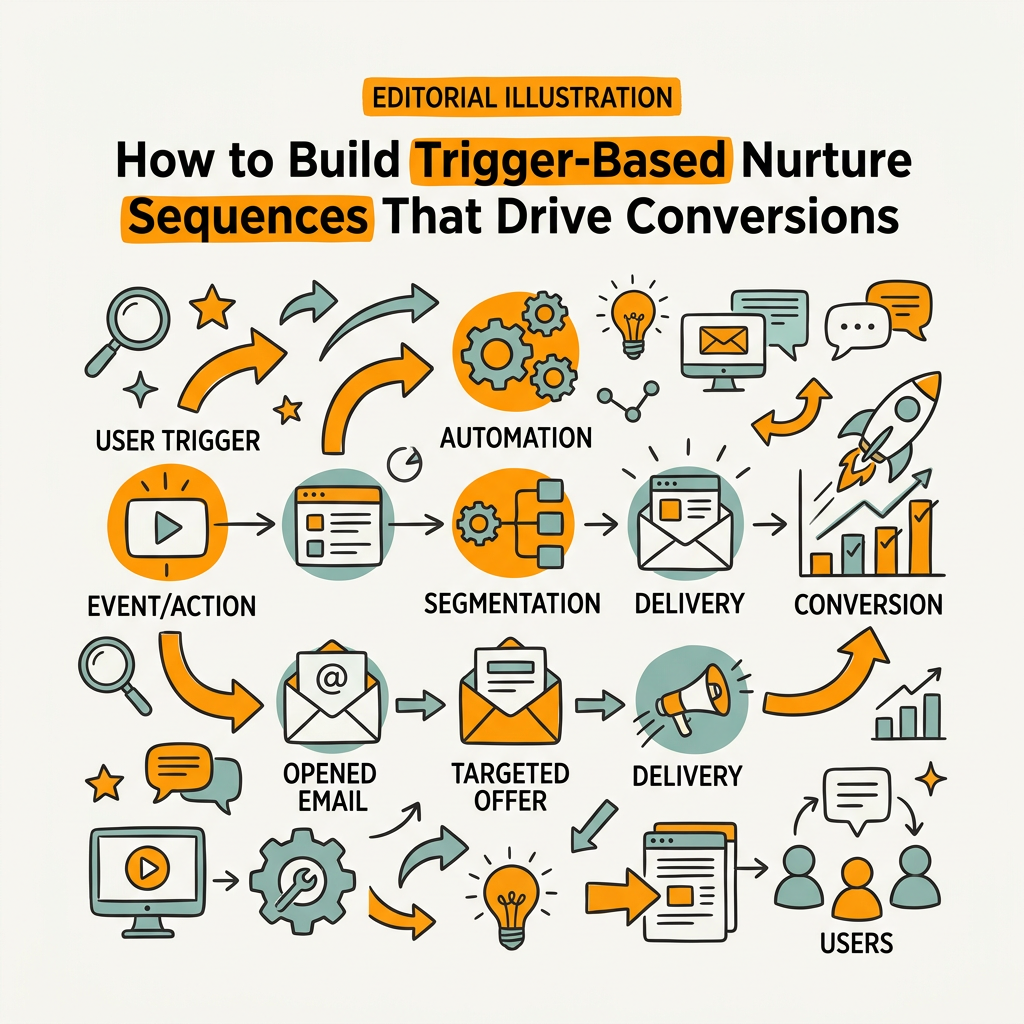
Trigger-based automation is the engine of modern nurture. Instead of scheduling sends, you define conditions: "When a user does X, send email Y after Z hours." This framework removes guesswork and aligns messaging with behavior. The strongest triggers are behavioral signals that indicate readiness to move forward in the journey.
Primary Triggers That Scale Conversions
Effective nurture sequences start with the right triggers. Not all user actions matter equally. Focus on triggers that correlate with buying intent and move the prospect to the next stage of evaluation. Key triggers include:
- Form submissions: Lead magnet downloads, demo requests, and content signups are explicit intent signals. Follow immediately with a welcome email, then layer in value-first content.
- Website behavior: Page visits to pricing, product pages, or competitor comparisons signal evaluation. Trigger educational emails that address objections.
- Email engagement: Opens and clicks show interest. Non-openers after 3-4 touches should move to a re-engagement sequence or pause until re-activation.
- Ecommerce or SaaS actions: Cart abandonment, signup, trial activation, and feature adoption are high-intent moments. Nurture here produces the fastest conversion.
- Time-based delays: Multi-step sequences that space emails 2-3 days apart allow digest time and reduce unsubscribe friction.
Sequencing Content by Buyer Stage
The most common mistake in nurture is sending sales pitches too early. Successful sequences front-load value and delay the hard ask. Organize your content across three zones: awareness, consideration, and decision. In the awareness zone, answer prospect questions and validate problems they're facing. In consideration, compare solutions and share proof. In decision, close with pricing, case studies, and guarantees.
This approach, called value-first sequencing, dramatically improves open rates and reduces unsubscribe friction. You're not selling yet; you're educating. By email 5 or 6, when the prospect has consumed enough value to trust you, the conversion ask feels natural, not intrusive. Building these sequences at scale requires both strategy and sustained content productionthe bottleneck most teams face. Automated content systems can generate segment-specific nurture emails systematically, enabling teams to build comprehensive nurture libraries without the weeks of manual research and writing.
Segmentation and Personalization: Driving Click-Through Rates 3x Higher
Generic nurture fails. Segmented nurture sequences with personalized CTAs achieve 8.7% click-through rates, versus just 2.9% for non-segmented campaigns. The lift is even larger in specific verticals: 11.2% CTR in financial services segmented campaigns compared to 2.6% non-segmented, and 9.8% in e-commerce versus 3.1%. Segmentation is not optionalit's the difference between a campaign and a revenue engine.
Behavioral Segmentation Over Demographics
Segment by behavior and intent, not just company size or industry. A prospect who visited your pricing page three times is further along than one who only viewed the homepage. A user who engaged with competitive comparison content has different objections than one browsing general educational articles. Create segments based on browsing patterns, email engagement, content consumption, and time spent on key pages. Layer CRM data (deal stage, interaction count, date of last engagement) to create dynamic segments that evolve as the prospect moves through the journey.
Personalization Beyond the First Name
True personalization means matching content to prospect needs, not just inserting their name. Use dynamic content blocks that change based on segment membership: show case studies relevant to their industry, reference product features they've shown interest in, and surface pricing tiers that match their company size. One-off personalization at massive scale requires automation. AI-driven content systems can generate segment-specific email variants, subject lines, and CTAs, scaling personalization that would otherwise require manual copywriting for each audience.
Lead Scoring: Route High-Intent Prospects to Fast-Track Sequences
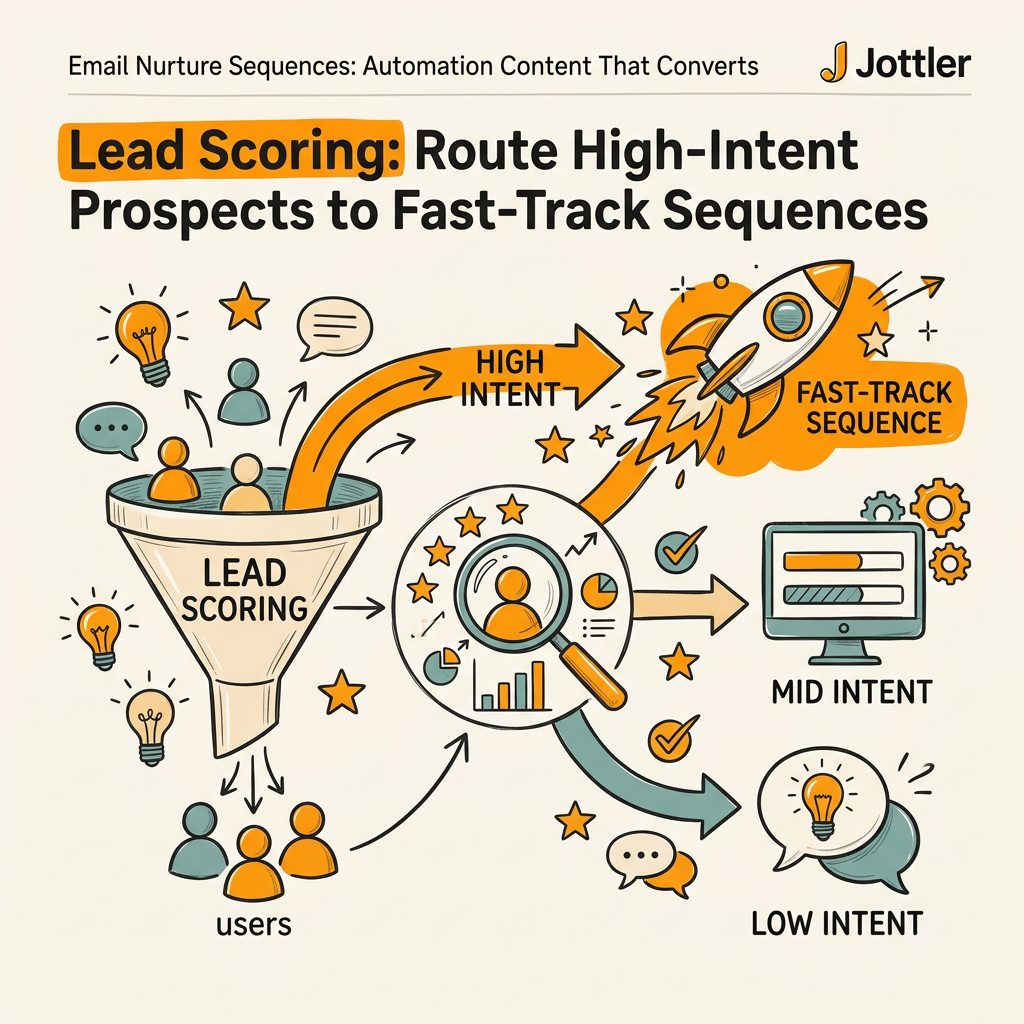
Not all leads are equal. A prospect with 8+ interactions and a visit to your pricing page is higher-intent than a user who opened one email six weeks ago. Lead scoring automates prioritization. AI-driven lead scoring paired with behavioral nurture sequencing raised nurtured lead-to-customer conversion to 2.6%, up from 1.8% baseline; the top quartile reached 4.1%. By scoring leads and routing high-intent prospects into faster, more aggressive sequences, sales teams spend time where conversion probability is highest.
Building a Scoring Model
Start simple: assign points for key actions. Form submission = 10 points. Pricing page visit = 5 points. Email click = 1 point. Email open = 0.5 points. Engagement decay over time (reduce points if no interaction in 30 days). When a prospect hits a threshold (e.g., 25 points), send an alert to sales or move them into an accelerated nurture sequence. Combine explicit signals (form data, downloads) with implicit signals (page visits, time on site) to build a composite score that adapts to your specific sales cycle.
Routing Automation Based on Score
High-scoring leads should move into a 5-email fast-track sequence that focuses on conversion, not education. Medium-scoring leads stay in standard nurture. Low-scoring leads enter a re-engagement sequence to reactivate. This tiering approach ensures your most engaged prospects get the attention they deserve, while the system automatically handles the volume below. AMRA & Elma's 2026 lead nurture benchmarks show that AI-driven lead scoring combined with behavioral triggers is a major conversion driver because it aligns messaging with intent spikes.
| Lead Score Range | Prospect Stage | Recommended Sequence | Email Cadence | Sales Action |
|---|---|---|---|---|
| 0–15 points | Awareness / Early interest | Educational nurture | 1 email every 5 days | No immediate outreach |
| 16–35 points | Consideration / Active evaluation | Standard nurture | 1 email every 3 days | Light touch / monitor |
| 36–50 points | Decision / High intent | Fast-track conversion | 1 email every 2 days | Sales follow-up within 24 hours |
| 50+ points | Actively buying / Ready for demo | Activation / onboarding | Daily until conversion | Immediate sales outreach |
Content Strategy for Nurture Sequences That Keep Prospects Engaged
The content in your nurture sequence determines whether prospects open, click, and move forward. Generic templates underperform. Research-backed, competitor-informed, segment-specific content performs 2–3x better. Building that library at scale is the bottleneck most teams face. This is where AI article generators that rank become valuablethey can research and produce segment-specific content at the volume and quality required for mature nurture programs.
Email Types That Drive Opens and Clicks
Vary your email types across the sequence to maintain engagement. Value-first educational emails should dominate early in the nurture. Case studies and social proof enter in the middle. Pricing and product-focused emails come late. Best practices for each type:
- Educational emails: Answer a specific question relevant to your prospect's stage. Lead with the insight, reference your experience or data, and include 1 CTA that moves them forward in the journey (not toward a demo yet).
- Case study emails: Feature a customer who solved the same problem your prospect has. Highlight the specific result and the time it took. Use a single CTA: "Read the full case study."
- Comparison emails: Compare your approach to alternatives your prospect is likely considering (including the status quo). Be transparent about trade-offs. Position your solution as the right fit for their specific needs.
- Product feature emails: Show, don't tell. Use short videos or GIFs demonstrating the feature in action. Explain the benefit (time saved, money saved, risk reduced), not just the feature.
- Social proof emails: Share specific metrics, awards, or testimonials. Specificity builds credibility: "99% of customers renew" is stronger than "Customers love us."
Subject Lines and CTAs That Move Metrics
Subject lines determine opens. Use curiosity, specificity, and relevance, not manipulation. "3 mistakes we see in [industry] procurement" outperforms "You won't believe this." CTAs should be single and clear. Multiple CTAs create decision friction; single CTAs improve click-through. Use action language: "Download," "Schedule," "Watch," not just "Learn more."
Measuring Nurture Effectiveness: Metrics That Matter
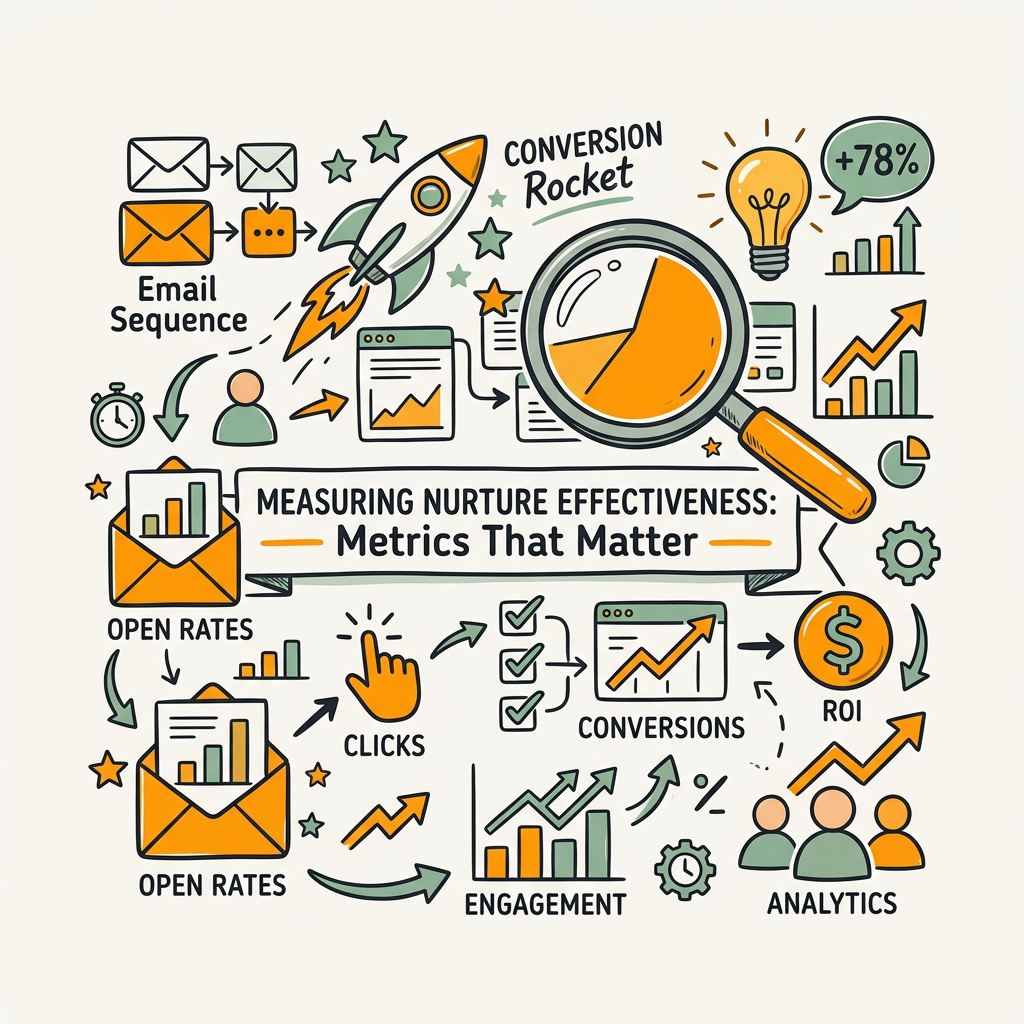
Open rate is no longer a reliable metric due to email privacy filters. Focus instead on metrics that correlate with revenue. Click-through rate, lead-to-opportunity rate, influenced pipeline, and sales cycle time are the KPIs that matter. Set targets: a healthy nurture should convert 1.5–2.6% of leads to opportunities within 30 days. If your rate is lower, revisit segmentation, content relevance, and lead scoring. Zendesk's 2026 lead nurturing guide emphasizes tracking unsubscribe rates, CTR, conversion rates, and sales cycle time rather than relying on a single vanity metric.
Testing and Optimization
Run A/B tests on subject lines, send times, email length, and CTA positioning. Test one variable at a time. Small wins compound: a 0.5% lift in CTR across all nurture sequences drives meaningful revenue improvement over a year. Measure unsubscribe rate carefullyhigh unsubscribes (>0.5%) signal content-market fit issues, not just bad emails. If unsubscribes spike, revisit your segmentation and content relevance.
Common Nurture Mistakes to Avoid
Even well-intentioned nurture sequences fail when foundational elements are missed. Avoid these patterns to maximize conversion impact.
Selling Too Early
The most common mistake is leading with product features or pricing. Prospects entering a nurture sequence are in research mode, not buying mode. Your first 3–4 emails should educate, validate problems, and build trust. Pushing a demo request or pricing conversation before the prospect is ready triggers unsubscribes and hurts deliverability. Lead with insights, not asks. Content frameworks for SaaS teams emphasize value-first positioning in nurture to build credibility before the hard sell.
Ignoring Engagement Decay
If a prospect doesn't open 3 emails in a row, your content isn't resonating or they've lost interest. Pause the sequence after 2 consecutive unopened emails, then send a re-engagement offer ("We haven't heard from youis there something I can help with?"). If they don't respond, move to a quarterly check-in sequence or remove them from active nurture. Dead sequences hurt sender reputation and waste email.
Generic Segmentation
Sending the same nurture to company size alone ignores the most important variable: readiness. A prospect who visited pricing is further along than one who only viewed the homepage. Build dynamic segments that shift as prospects engage. This requires integrated CRM data and an email platform that can layer behavioral triggers, not just static list membership.
Automation Platforms vs. Building Sequences In-House
Email platforms like HubSpot, Marketo, and Klaviyo provide the workflow engine to build and deploy nurture sequences. They handle triggers, segmentation, personalization, and reporting. But the contentthe emails themselvesstill requires research, writing, testing, and refinement. For founders and marketing teams stretched thin, content production becomes the bottleneck. Writing dozens of high-quality, research-backed nurture emails is weeks of work. Publishing and maintaining them across platforms is another week.
Jottler solves this constraint by automatically researching, writing, and publishing nurture email content at scale. Instead of spending weeks writing your nurture library, Jottler generates research-backed content tailored to your segments and buyer journey stages, publishing directly to your email platform. This removes the content bottleneck, letting your team focus on strategy, segmentation, and sales follow-up rather than the writing and publishing grind. Content automation tools for SaaS teams shift what was weeks of manual work into an automated pipeline.
Conclusion
Email nurture sequences are the automation layer that converts prospects into customers at scale. Leads receiving 12+ touchpoints convert 4.7x higher, and automated nurture generates 320% more revenue than manual campaigns. The blueprint is straightforward: trigger on behavior, segment by intent, personalize content, score leads, and route high-intent prospects into accelerated sequences. What makes nurture work is consistencysending the right message at the right time, repeated reliably across thousands of prospects. Automation does the heavy lifting; your job is to build the strategy and content once, then let it scale.
The challenge most founders and marketing teams face isn't strategyit's execution at scale. Building and maintaining a nurture library that evolves with your market takes time and research. If content production is the bottleneck in your nurture strategy, automation can remove it entirely. Start your SEO agent today and automate the research and content creation that powers your nurture sequences.
FAQs
What is the difference between email automation and a nurture sequence?
Email automation is the broader technology that sends emails based on triggers and conditions, without manual intervention. A nurture sequence is a specific type of automated workflow designed to move prospects through the buying journey with multiple, coordinated emails. All nurture sequences use automation, but not all automated emails are nurture sequencesa welcome email or cart recovery flow is automated but may be single-touch rather than multi-step nurture. A true nurture sequence layers 5+ coordinated emails across days or weeks, adapting to prospect behavior and stage.
How many emails should be in a nurture sequence?
Most effective nurture sequences contain 5–12 emails spread across 30–60 days. Shorter sequences (3–4 emails) rarely build enough trust or provide enough educational touchpoints to move prospects toward conversion. Longer sequences (15+ emails) increase unsubscribe risk and fatigue if not carefully segmented. The optimal length depends on your sales cycle: B2B enterprise deals may warrant 12+ emails over 90 days, while SaaS trials might convert in 5 emails over 15 days. Start with 8 emails over 45 days, then test and adjust based on engagement and conversion metrics. Leads receiving coordinated multi-touch sequences convert 4.7x higher, so invest in depth over sending fewer, rushed emails.
How often should you send nurture emails?
The optimal frequency is every 2–4 days for high-intent leads and every 5–7 days for general nurture. More frequent sends (daily) increase conversion from hot prospects but spike unsubscribe rates in cold segments. Segment your cadence by engagement level: send fast-track leads an email every 2 days, standard nurture every 4 days, and re-engagement sequences weekly. Automated trigger-based sends achieve 42.1% open rates because timing aligns with user readiness, not an arbitrary calendar. Monitor unsubscribe rate closelyif it exceeds 0.5%, reduce frequency or improve segmentation. Testing is key: compare 3-day vs. 5-day cadence over a full sequence and measure conversion lift.