
Measuring ROI from Automated SEO Publishing Systems
 Aidan Buckley
SEO
Aidan Buckley
SEO
March 20th, 2026
19 minute read
Table of Contents
- Quick-Scan Summary
- What Are Automated SEO Publishing Systems?
- Why Measuring ROI from Automated SEO Publishing Systems Matters
- Key Metrics for Measuring ROI
- Calculating ROI: A Step-by-Step Approach
- Maximizing ROI from Your Automated SEO Publishing System
- Common Challenges and Solutions in ROI Measurement
- Conclusion
In the rapidly evolving digital landscape of 2026, businesses face an unprecedented challenge: traditional search engine traffic is expected to fall 25% due to AI Overviews. This seismic shift, coupled with 60% of searches now yielding no clicks, presents a quantified cost to businesses relying on conventional SEO strategies. The stakes are high; without adapting, companies risk significant declines in organic visibility and customer acquisition. However, a powerful solution has emerged: Automated SEO Publishing Systems. These advanced platforms leverage AI to streamline content creation, optimization, and distribution, offering a pathway to not only mitigate these challenges but also to achieve substantial returns. This article will define these systems, explore their critical role in today's market, detail how to measure their impact, and provide actionable strategies to maximize their ROI, ensuring your business thrives in the AI-first search era.
Quick-Scan Summary
- Automated SEO Publishing Systems: Are AI-driven platforms that streamline content creation, optimization, and distribution for enhanced organic visibility.
- Why Measuring ROI Matters: Is crucial for validating investment, optimizing strategies, and demonstrating tangible business impact in a competitive, AI-influenced market.
- Key Metrics for Measuring ROI: Include organic traffic, keyword rankings, conversion rates, content production efficiency, and cost savings.
- Calculating ROI: Involves a systematic approach: identifying costs, quantifying benefits, applying a simplified formula, and interpreting the results.
- Maximizing ROI: Requires strategic implementation, continuous optimization, and leveraging advanced features like E-E-A-T and hybrid human-AI workflows.
- Common Challenges in ROI Measurement: Such as data attribution and the evolving search landscape, are vital for accurate and effective ROI measurement.
What Are Automated SEO Publishing Systems?
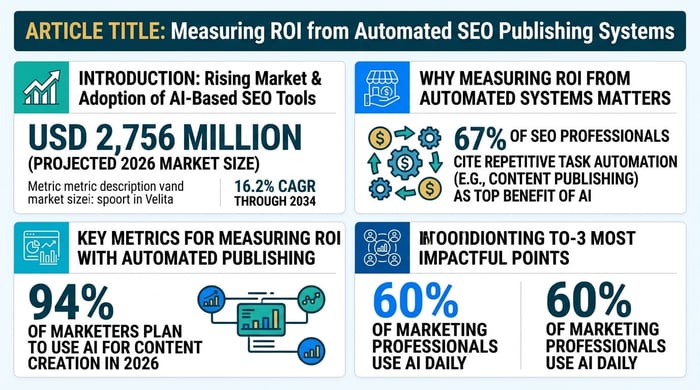
Automated SEO publishing systems are sophisticated software solutions that leverage artificial intelligence and machine learning to automate various stages of the content lifecycle, from research and creation to optimization and publishing. These systems are designed to enhance organic search performance by efficiently producing high-quality, SEO-optimized content at scale. The market for AI-based SEO Tools is projected to reach USD 2,756 million in 2026, indicating significant industry investment and growth.
Defining Automated SEO Publishing Systems
At their core, these systems integrate AI capabilities to perform tasks traditionally handled manually by SEO specialists and content creators. They can conduct keyword research, analyze competitor content, generate article outlines, draft full articles, optimize content for search engines (including for AI Overviews and Answer Engine Optimization), and even schedule and publish content directly to various platforms. The goal is to reduce human effort, accelerate content velocity, and improve the consistency and quality of SEO output. With 86% of SEO professionals using AI for automation, these systems are becoming standard practice for efficient content operations.
Key Characteristics and Capabilities
Modern automated SEO publishing systems are characterized by several advanced features:
- AI-Powered Content Generation: Utilizing generative AI, these systems can produce diverse content types, from blog posts and product descriptions to social media updates, often tailored to specific SEO briefs.
- Semantic SEO Optimization: Beyond basic keyword stuffing, these tools analyze semantic relationships, topical authority, and user intent to create comprehensive content that satisfies complex search queries.
- Integrated Publishing Workflows: Many systems offer direct integrations with Content Management Systems (CMS) like WordPress and Shopify, allowing for seamless publishing and updates.
- Scalability and Efficiency: They enable businesses to produce content at a volume previously unattainable, significantly increasing content output while reducing per-article costs. "Companies using AI tools see 40% production cost reductions with 300% output increases."
- Data-Driven Insights: These platforms often include analytics features that track content performance, identify ranking opportunities, and suggest optimizations based on real-time data.
Automated Systems vs. Traditional SEO Tools
While traditional SEO tools (like keyword research platforms or rank trackers) provide data and insights, automated SEO publishing systems take a more proactive, end-to-end approach. Traditional tools require significant human intervention to interpret data and execute content strategies. In contrast, automated systems can perform these tasks autonomously or semi-autonomously. For instance, a traditional tool might identify a keyword gap, but an automated system can then generate an entire article to fill that gap, optimize it, and publish it, all with minimal human input. This shift moves beyond mere data provision to active content production and deployment. The AI Content Creation & Optimization Software market is estimated at USD 2.3 billion in 2026, highlighting the growing demand for these comprehensive solutions.
Why Measuring ROI from Automated SEO Publishing Systems Matters
In 2026, with the digital landscape undergoing rapid transformation, understanding the return on investment (ROI) from automated SEO publishing systems is no longer a luxury but a strategic imperative. The market for AI-based SEO Tools is booming, projected to reach USD 2,756 million in 2026, yet the effectiveness of these investments must be rigorously evaluated.
Validating Investment in a Dynamic Market
The AI-powered SEO software market is experiencing rapid expansion, with a CAGR of 23.4% into 2035. Businesses are pouring resources into these technologies, with 86% of SEO professionals using AI for automation. Measuring ROI provides concrete evidence that these investments are yielding positive results, justifying the expenditure and securing future budget allocations. Without clear ROI metrics, businesses risk investing in tools that may not align with their strategic goals or deliver expected performance. Moreover, 65% of businesses report improved SEO outcomes after adopting AI, underscoring the tangible benefits when implemented correctly.
Optimizing Strategies for Evolving Search
The search landscape is dramatically shifting. "Traditional search engine traffic is expected to fall 25% by 2026 due to AI Overviews," and "60% of searches now yield no clicks." This means that simply generating content isn't enough; it must be optimized for new paradigms like Answer Engine Optimization (AEO) and Generative Engine Optimization (GEO). Measuring ROI helps businesses understand which automated strategies are most effective in this new environment. It allows for agile adjustments to content topics, formats, and distribution channels to capture attention where traditional organic traffic is declining, and AI search traffic is surging, having increased 527% year-over-year. This strategic optimization is critical for maintaining visibility and driving business growth.
Demonstrating Tangible Business Impact
For busy businesses, SaaS companies, e-commerce stores, and other stakeholders, the ultimate goal of any marketing investment is to drive measurable business outcomes. Automated SEO publishing systems promise increased efficiency and output, with "40% production cost reductions with 300% output increases" and "30% search ranking improvements within six months." Quantifying ROI translates these operational improvements into financial benefits, such as increased revenue, reduced costs, and improved profitability. This is particularly critical for securing executive buy-in and demonstrating the strategic value of SEO to the broader organization. As one expert notes:
"Strategic AI use yields 2x+ higher marketing-driven profitability."
This directly impacts the bottom line, making ROI measurement indispensable for any business leveraging these advanced systems. Digital marketers are increasingly adopting content strategy with AI, with 68% using AI for content strategy, keyword targeting, and publishing compliance.
Key Metrics for Measuring ROI
To accurately assess the return on investment from automated SEO publishing systems, a comprehensive set of metrics is required. These metrics span various stages of the content and customer journey, providing a holistic view of performance. With 65% of businesses reporting improved SEO outcomes after adopting AI, tracking these metrics helps validate that success.
Performance Metrics for Organic Traffic and Visibility
These metrics directly reflect the system's ability to improve search engine presence.
- Organic Traffic Growth: The total number of unique visitors and sessions coming from organic search results. This is a fundamental indicator of increased visibility.
- Keyword Rankings: Tracking the position of target keywords in SERPs. Higher rankings for relevant keywords directly correlate with increased visibility and potential traffic.
- SERP Feature Wins: Monitoring the appearance of your content in AI Overviews, featured snippets, knowledge panels, and other rich results, which are increasingly critical in a zero-click search environment.
- Impressions: The number of times your content appeared in search results, indicating potential reach.
- Click-Through Rate (CTR): The percentage of users who clicked on your content after seeing it in search results. With AI Overviews, a #1 ranking now yields only 8% CTR, emphasizing the need for compelling titles and descriptions.
Efficiency and Cost-Saving Metrics
These metrics quantify the operational benefits and cost reductions achieved through automation. 67% of SEO professionals cite repetitive task automation (e.g., content publishing) as the top benefit of AI, directly impacting these metrics.
- Content Production Volume: The number of articles, pages, or content assets produced within a given period. Automated systems can lead to "300% output increases."
- Time-to-Publish: The average time taken from content idea generation to live publication. Automation significantly reduces this cycle.
- Cost Per Article/Content Asset: The total cost (including software, human oversight, and other resources) divided by the number of content pieces produced. AI tools can lead to "75-85% lower cost per article" for Level 3 AI content teams.
- Labor Cost Reduction: Savings realized by reducing the need for manual content creation, research, and optimization tasks.
- Content Update Efficiency: How quickly and effectively existing content can be revised and optimized using automated tools.
Conversion and Revenue Metrics
Ultimately, SEO efforts must translate into business growth. Improved SEO outcomes after adopting AI directly contribute to these bottom-line figures.
- Conversion Rate: The percentage of organic visitors who complete a desired action (e.g., purchase, lead form submission, download).
- Organic Revenue: Revenue directly attributed to organic search traffic.
- Lead Generation (Organic): The number of qualified leads acquired through organic search channels.
- Customer Acquisition Cost (CAC) Reduction: Lowering the cost to acquire a new customer through organic channels due to increased efficiency and higher conversion rates.
- Lifetime Value (LTV) of Organic Customers: The total revenue a business can expect from a customer acquired through organic search.
Table: Key ROI Metrics for Automated SEO Publishing Systems
| Metric Category | Specific Metric | Definition & Importance | Data Source |
|---|---|---|---|
| Organic Performance | Organic Traffic Growth | Increase in visitors from organic search. Core indicator of visibility. | Google Analytics, Search Console |
| Keyword Rankings | Position of target keywords in SERPs. Direct impact on visibility. | SEO Tracking Tools (Semrush, Ahrefs) | |
| SERP Feature Wins | Content appearing in AI Overviews, snippets. Crucial for zero-click search. | Google Search Console, SEO Tools | |
| Click-Through Rate (CTR) | % of impressions resulting in clicks. Indicates content appeal. | Google Search Console | |
| Efficiency & Cost Savings | Content Production Volume | Number of content pieces generated. Measures scalability. | System Dashboards, Internal Logs |
| Cost Per Article | Total cost / number of articles. Quantifies cost efficiency. | Financial Records, System Costs | |
| Labor Cost Reduction | Savings from reduced manual effort. Direct financial benefit. | Payroll Data, Project Management Tools | |
| Conversion & Revenue | Conversion Rate (Organic) | % of organic visitors completing desired actions. Direct business impact. | Google Analytics, CRM |
| Organic Revenue | Revenue directly attributed to organic search. Ultimate financial measure. | CRM, E-commerce Platforms | |
| Lead Generation (Organic) | Number of leads from organic search. Vital for B2B. | CRM, Marketing Automation |
Calculating ROI: A Step-by-Step Approach
Calculating the Return on Investment (ROI) for an automated SEO publishing system provides a clear, quantifiable measure of its financial benefit. This process involves identifying all costs, quantifying all benefits, and applying a straightforward formula. For B2B SaaS companies using content automation platforms, understanding this calculation is key to demonstrating value.
Identifying All Costs Associated with the System
A thorough ROI calculation begins with a comprehensive understanding of all expenditures.
- Software Subscription Fees: The recurring cost of the automated SEO publishing system itself. This can range from Jottler's entry-level $29/month to more advanced platforms like Semrush at $165.17/month or Clearscope at $129/month.
- Implementation and Integration Costs: One-time expenses for setting up the system, integrating it with existing CMS (e.g., WordPress, Shopify), and configuring workflows.
- Training Costs: Expenses related to training staff on how to effectively use and manage the automated system, including any necessary human oversight for AI-generated content.
- Human Oversight and Editing Costs: While automation reduces labor, human review is still crucial for quality, factual accuracy, and E-E-A-T. These costs include salaries or contractor fees for editors, strategists, and SEO managers. As experts suggest:
"AI handles drafts, research, and SEO audits (e.g., keyword discovery, SERP analysis), while humans add strategic polish, lived experience, and originality."
This highlights the importance of balancing automation with human expertise.
- Ancillary Tool Costs: Any additional tools or subscriptions required to complement the automated system (e.g., advanced analytics, image generation tools like Midjourney at $10/month).
Quantifying the Benefits and Gains
The next step is to assign monetary values to the positive outcomes generated by the system. Marketers planning to use AI for content creation stand to benefit significantly here, with 94% planning to use it in 2026.
- Increased Organic Revenue: Direct revenue generated from sales or conversions attributed to organic traffic driven by the automated content.
- Lead Value: For B2B businesses, assign a monetary value to each lead generated through organic channels. B2B SaaS marketing automation can lead to 17% more leads and 15% higher sales.
- Cost Savings from Reduced Manual Labor: Calculate the wages and overhead saved by automating tasks previously performed by human content creators, researchers, and SEO specialists. AI tools can lead to "40% production cost reductions."
- Increased Productivity Value: Quantify the value of producing more content (e.g., "300% output increases") in the same or less time, leading to expanded market reach and keyword coverage.
- Improved Search Ranking Value: While harder to directly monetize, higher rankings lead to increased visibility and traffic, which can be indirectly linked to revenue.
- Reduced Customer Acquisition Cost (CAC): Lowering the cost to acquire new customers through more efficient organic channels.
The Simplified ROI Formula and Example
The basic ROI formula is:
ROI = (Net Gain from Investment / Cost of Investment) x 100%
Where:
- Net Gain from Investment = (Total Benefits - Total Costs)
- Cost of Investment = Total Costs
Example Scenario for a SaaS Company:
Let's assume a SaaS company invests in an content automation platforms over 12 months:
Total Costs:
- Software Subscription: $500/month x 12 = $6,000
- Implementation & Training: $2,000 (one-time)
- Human Oversight (part-time editor): $1,500/month x 12 = $18,000
- Total Cost = $26,000
Total Benefits (over 12 months):
- Increased Organic Revenue: $40,000 (from new customers acquired via organic search)
- Value of New Leads: 100 new qualified leads x $150/lead = $15,000
- Labor Cost Savings (reduced need for manual writing): $10,000
- Total Benefits = $65,000
Calculation:
- Net Gain = $65,000 (Total Benefits) - $26,000 (Total Costs) = $39,000
- ROI = ($39,000 / $26,000) x 100% = 150%
This means for every dollar invested, the company gained $1.50 back, representing a strong positive return. B2B SaaS companies using content automation platforms in 2026 achieve average ROIs of 544%, with SEO/content marketing delivering 748% ROI, indicating that this example is a conservative but realistic outcome.
Maximizing ROI from Your Automated SEO Publishing System
Achieving a high return on investment from an automated SEO publishing system requires more than just implementing the technology; it demands strategic planning, continuous optimization, and a nuanced understanding of the evolving search landscape. With 60% of marketing professionals using AI daily in 2026, leveraging these systems effectively is paramount.
Strategic Implementation and Content Planning
The foundation of high ROI lies in how the system is deployed and integrated into your overall marketing strategy.
- Define Clear Goals: Before automation, clearly articulate what you aim to achieve (e.g., specific organic traffic targets, lead generation numbers, revenue growth). These goals will guide content strategy and ROI measurement.
- Hybrid Human-AI Workflows: Don't rely solely on AI. Implement a workflow where AI handles initial drafts, research, and SEO audits, while human experts add strategic polish, unique insights, and ensure E-E-A-T (Experience, Expertise, Authoritativeness, Trustworthiness). "Human-edited content over pure AI generation, with predictions that human content outranks AI-generated material due to Google's smarter detection algorithms."
- Content Cluster Strategy: Focus on building comprehensive content clusters around core topics rather than isolated keywords. This establishes topical authority, which is increasingly vital for ranking and AI citation.
- Integrate with Existing Tech Stack: Ensure seamless integration with your CMS (WordPress, Shopify), CRM, and analytics platforms to create a unified data flow and streamline publishing.
Continuous Optimization and Adaptation
The digital environment is constantly changing, especially with the rise of AI in search. Maximizing ROI means staying agile.
- Monitor AI Summaries: Pay close attention to how AI tools like Google's AI Overviews summarize your content. Optimize your content structure with clear headings, direct answers, and concise summaries to increase the likelihood of favorable AI citation.
- Optimize for AEO and GEO: Beyond traditional SEO, structure content for Answer Engine Optimization (AEO) and Generative Engine Optimization (GEO). This means providing precise, factual answers that AI models can easily extract and present.
- Diversify Content Distribution: With traditional search traffic declining, explore other high-attention platforms like YouTube, Reddit, and TikTok. Automated systems can help repurpose content for these channels. As Rand Fishkin advises:
"Marketers need to optimize for influence, not traffic, focusing on YouTube, Reddit, TikTok, and other high-attention platforms."
This shift in focus is crucial as "traditional search engine traffic is expected to fall 25% by 2026."
- Leverage Hyper-personalization: Use AI to generate tailored content that matches individual user intent and preferences, boosting engagement and conversion rates.
Using Jottler to Achieve High ROI
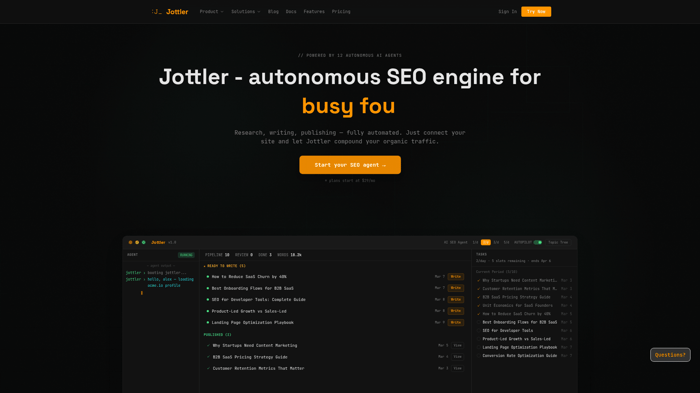
Platforms like Jottler, an autonomous AI SEO engine, exemplify how to achieve high ROI from automated SEO publishing. By automating content research, writing, and publishing, Jottler enables businesses to produce 15-250 articles per month with same-day turnaround, generating 3,000+ word articles from 14+ sources. This level of efficiency and scale directly contributes to the "300% output increases" and "75-85% lower cost per article" seen with advanced AI content teams, driving significant organic traffic growth and ultimately, higher ROI.
Jottler's integrated approach, from AI keyword research and topic clustering to smart internal linking and automatic CMS publishing, addresses many of the challenges associated with manual content creation. This end-to-end automation allows marketing teams to focus on strategic oversight and E-E-A-T, ensuring that the high volume of content produced is also high quality and impactful. The platform's ability to cover vast topic clusters programmatically helps establish topical authority, a key factor in ranking well in the evolving search landscape.
Common Challenges and Solutions in ROI Measurement
While the promise of automated SEO publishing systems is significant, accurately measuring their ROI comes with its own set of challenges, particularly in a rapidly evolving digital landscape. Addressing these head-on is crucial for reliable insights. Over 80% of companies report no measurable EBIT impact from generative AI due to being stuck in pilot stages, highlighting the need to overcome these hurdles.
Data Attribution in a Complex Customer Journey
One of the primary difficulties is accurately attributing conversions and revenue to specific organic touchpoints, especially when customers interact with multiple channels.
- Challenge: The customer journey is rarely linear. A user might discover content via an AI Overview, visit your site, leave, and then return directly or through another channel to convert. Traditional last-click attribution models often fail to capture the full impact of initial organic discovery.
- Solution: Implement multi-touch attribution models (e.g., linear, time decay, U-shaped) that assign credit to all touchpoints in the customer journey. Utilize advanced analytics platforms and CRM integrations to track user paths more comprehensively. Focus on assisted conversions and view-through conversions in addition to direct organic conversions. Segment your data to isolate the impact of content generated by the automated system.
Evolving Search Landscape and AI Overviews
The rise of AI Overviews and the increase in zero-click searches fundamentally alter how organic visibility translates into website traffic and conversions.
- Challenge: "Traditional search engine traffic is expected to fall 25% by 2026 due to AI Overviews," and "60% of searches now yield no clicks." This means that even if your content ranks well and is cited by AI, direct website traffic (a traditional ROI metric) may decrease.
- Solution: Shift focus from solely measuring website traffic to also tracking other forms of engagement and influence. Monitor mentions and citations in AI Overviews. Measure brand visibility and authority, not just clicks. As Rand Fishkin suggests:
"Automated SEO content optimization for clicks will yield diminishing returns as the number of available clicks shrinks over the next decade."
This perspective emphasizes the need for a broader approach to measuring success.
- Adapt Metrics: Incorporate metrics like "SERP Feature Wins" and "AI Citation Rate" into your ROI calculation. Recognize that a direct answer provided by an AI Overview, even without a click to your site, still fulfills user intent and builds brand awareness.
Ensuring Quality and E-E-A-T with AI-Generated Content
While AI can generate content at scale, maintaining quality, factual accuracy, and E-E-A-T (Experience, Expertise, Authoritativeness, Trustworthiness) is a persistent challenge that impacts long-term ROI.
- Challenge: Over-reliance on pure AI generation can lead to generic, inaccurate, or low-quality content that Google's algorithms may penalize. "Google's algorithms are becoming smarter at detecting AI-generated content, and human-edited content is predicted to outrank pure AI output."
- Solution: Implement robust hybrid human-AI workflows. Use AI for efficiency (drafts, research), but always involve human experts for review, editing, and adding unique insights, original data, and lived experience. Prioritize E-E-A-T signals by showcasing author credentials, citing reputable sources, and building a strong brand reputation. Invest in tools that help verify factual accuracy and originality. This ensures that the content produced by the automated system not only ranks but also builds trust and authority, contributing to sustainable ROI.
Conclusion
The digital marketing landscape of 2026 presents both formidable challenges and unprecedented opportunities. With traditional search engine traffic projected to fall 25% and 60% of searches now yielding no clicks, the imperative to adapt is clear. Automated SEO publishing systems offer a powerful solution, enabling businesses to navigate these shifts by scaling content production, enhancing optimization, and driving measurable results.
By rigorously defining costs, quantifying benefits across organic performance, efficiency, and conversion metrics, and applying a systematic ROI calculation, businesses can validate their investments and refine their strategies. The potential returns are substantial: B2B SaaS companies using content automation platforms, for instance, are seeing average ROIs of 544% from marketing automation, with SEO/content marketing delivering an impressive 748% ROI. Moreover, companies leveraging AI tools report 30% search ranking improvements within six months and 40% production cost reductions with 300% output increases.
Maximizing this ROI requires a strategic approach: embracing hybrid human-AI workflows, optimizing for new search paradigms like AEO and GEO, diversifying content distribution, and continuously adapting to the evolving search environment. By doing so, businesses can not only mitigate the impact of declining traditional search traffic but also unlock significant growth and efficiency, ensuring their content strategy remains future-proof and profitable. Start your SEO agent today to begin compounding your organic traffic.
FAQs
like this today.