The Pillars Model for B2B Content Strategy
Most B2B content teams abandon their strategies within six months. They publish inconsistently, chase trending topics instead of buyer problems, and wonder why their organic traffic stalls. The root cause? No structural framework. 45% of B2B marketers cite alignment with sales as their top content priority, yet they're writing without a coherent pillar-based architecture. When you build your content strategy on pillars, everything changes: you clarify what you own topically, you link pages with intention, and you compound growth instead of scattering effort across disconnected articles. This guide covers the exact pillars model that works, and how to execute it at scale without the manual overhead.
Key Takeaways
- 45% of B2B leaders prioritize sales alignment, a pillar-based architecture ensures every content cluster supports actual buyer decision journeys (CMI, 2026)
- The pillar-cluster model creates topical authority: 3-5 core pillars surrounded by 8-12 cluster articles that link bidirectionally, compounding your rankings for each topic cluster
- Content must address five types per topic: definitional, comparison, implementation, measurement, and evaluation, this full coverage earns citations in AI Overviews and builds buyer trust
- Strategic Pillar Foundation: Define 3–5 core topics your business owns, structured around buyer problems not product features, to anchor topical authority across your site.
- Pillar-to-Cluster Architecture: Create comprehensive pillar pages surrounded by 8–12 cluster articles, with bidirectional linking that signals topical relevance to search engines.
- Five-Content-Type Coverage: Each pillar requires definitional, comparison, implementation, measurement, and evaluation content to fully address buyer research needs.
- Sales-Aligned Messaging: Extract pillar themes directly from sales calls and common objections to ensure content guides prospects toward conversion, not generic education.
- Measurement and Iteration: Track which pillar clusters drive pipeline, then scale the winning topics, treating your content as a system, not a publishing calendar.
What Are Content Pillars and Why They Matter?
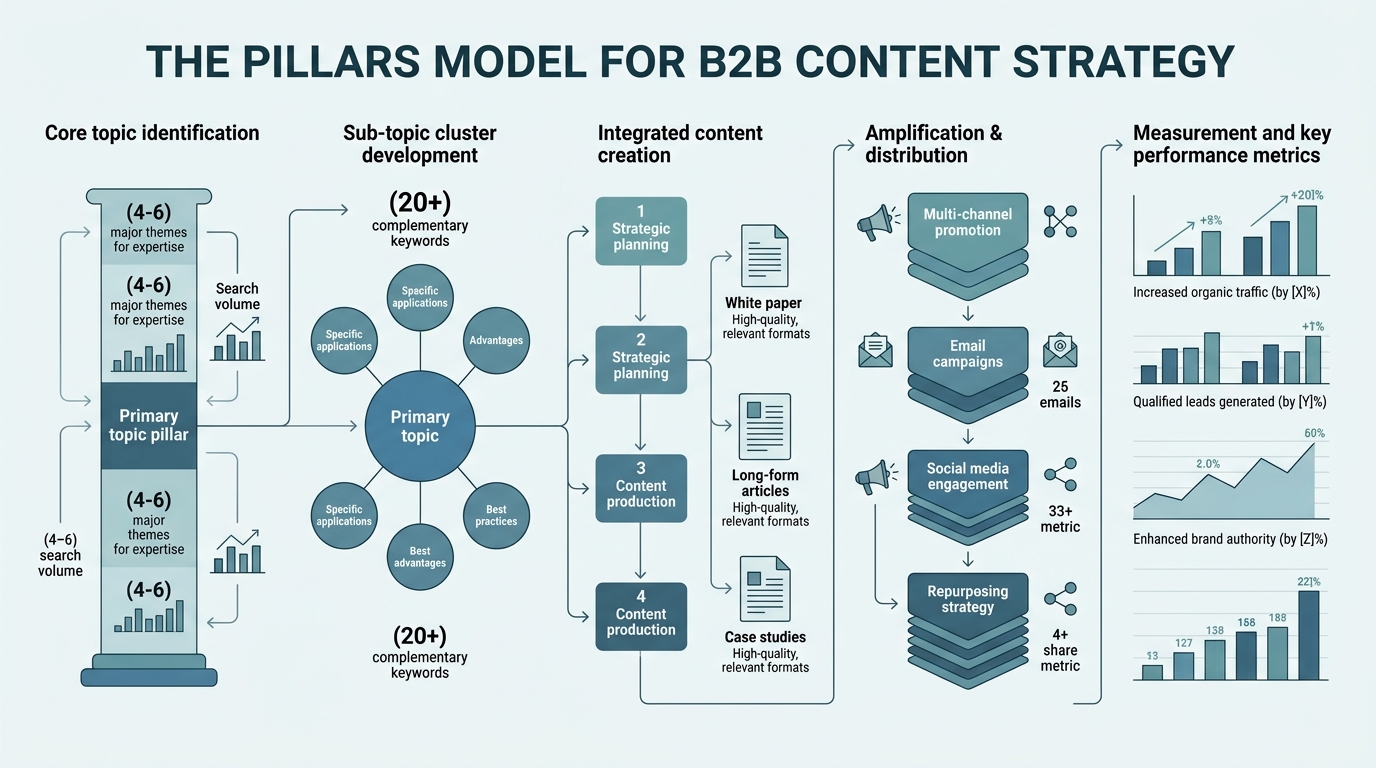
A content pillar is a broad topic your company claims authority over. It's not a keyword or a single page, it's a topic cluster that encompasses everything a buyer needs to know before they evaluate your category. Instead of writing random articles hoping something ranks, you systematically own topics like "Lead Scoring," "Sales Acceleration," or "Revenue Intelligence." When done right, pillar-based content earns 3x more links and citations than scattered, topic-agnostic content. Building topical authority through pillar content compounds over time, driving exponential growth in qualified organic traffic.
Most B2B teams skip this step. They see a trending keyword, write an article, publish, and hope. Six months later, they're frustrated because nothing ranks, nothing converts, and they've built zero topical authority. The pillar model inverts that: you decide what you want to own, build a 10-15 page cluster around it, interlink strategically, and let search engines recognize your expertise. Sales teams also benefit, when they share a pillar page, it legitimizes your product category and positions you as the authority before a prospect even touches your product page. This approach is the foundation of what experts now call Answer Engine Optimization (AEO) for B2B, where comprehensive pillar content earns citations in AI Overviews and positions your brand as the trusted source.
How Do You Define Your Core Content Pillars?

Pillar selection is strategic, not guesswork. You're identifying the 3–5 topics where you can credibly claim category leadership and where your buyers spend research time. This requires input from three sources: market research, sales data, and competitor intelligence. Start by listing every question your sales team hears during discovery calls. "How do I know if a lead is sales-ready?" "What's the difference between lead scoring and lead grading?" "Can I automate this?" These questions become pillar themes.
Extract Pillar Themes from Sales Conversations
Your sales team knows what keeps prospects awake at night. Schedule a 30-minute call and ask: "What are the top five buyer questions you hear that your product solves?" You'll hear patterns, common pain points that repeat across deals. These patterns become pillars. A sales intelligence platform might identify pillars like "Revenue Intelligence," "Sales Acceleration," and "Competitive Intelligence." A recruitment SaaS might have "Candidate Sourcing," "Interview Preparation," and "Hiring Team Coordination." The specificity matters. Avoid vague pillars like "Best Practices" or "Industry Insights." Your pillars should map directly to buyer decisions.
Validate Pillar Topics Against Search Demand and Competition
Not every problem your sales team hears has organic traffic behind it. Validate each pillar candidate by checking search volume and keyword difficulty. You want topics with real search demand (500+ monthly searches) but beatable competition (KD under 50-60). Use keyword research to uncover the 15-20 long-tail queries within each pillar. If a pillar has fewer than 10 searchable subtopics, it's likely too narrow. If it has 40+, it's too broad and you should split it. A pillar on "Lead Scoring" might include: "What is lead scoring," "Lead scoring models," "How to implement lead scoring," "Lead scoring best practices," "Lead scoring software," and 10-15 more variants. That's a legitimate pillar. This validation step is critical, without it, you'll waste months building authority in topics with zero buyer interest.
Map Pillars to Buyer Journey Stages
Your pillars should span the full buyer journey: awareness, consideration, decision, and implementation. If all your pillars target awareness-stage prospects (beginner guides, "what is" articles), you'll never attract active buyers researching solutions. A balanced pillar set covers early-stage education, mid-funnel differentiation, and bottom-funnel buying guides. Many B2B teams use an integrated content marketing framework that maps pillars across these stages systematically. This full-funnel approach ensures you capture prospects wherever they are in their research, from first question to final vendor evaluation.
How Should You Structure Pillar Pages and Cluster Articles?
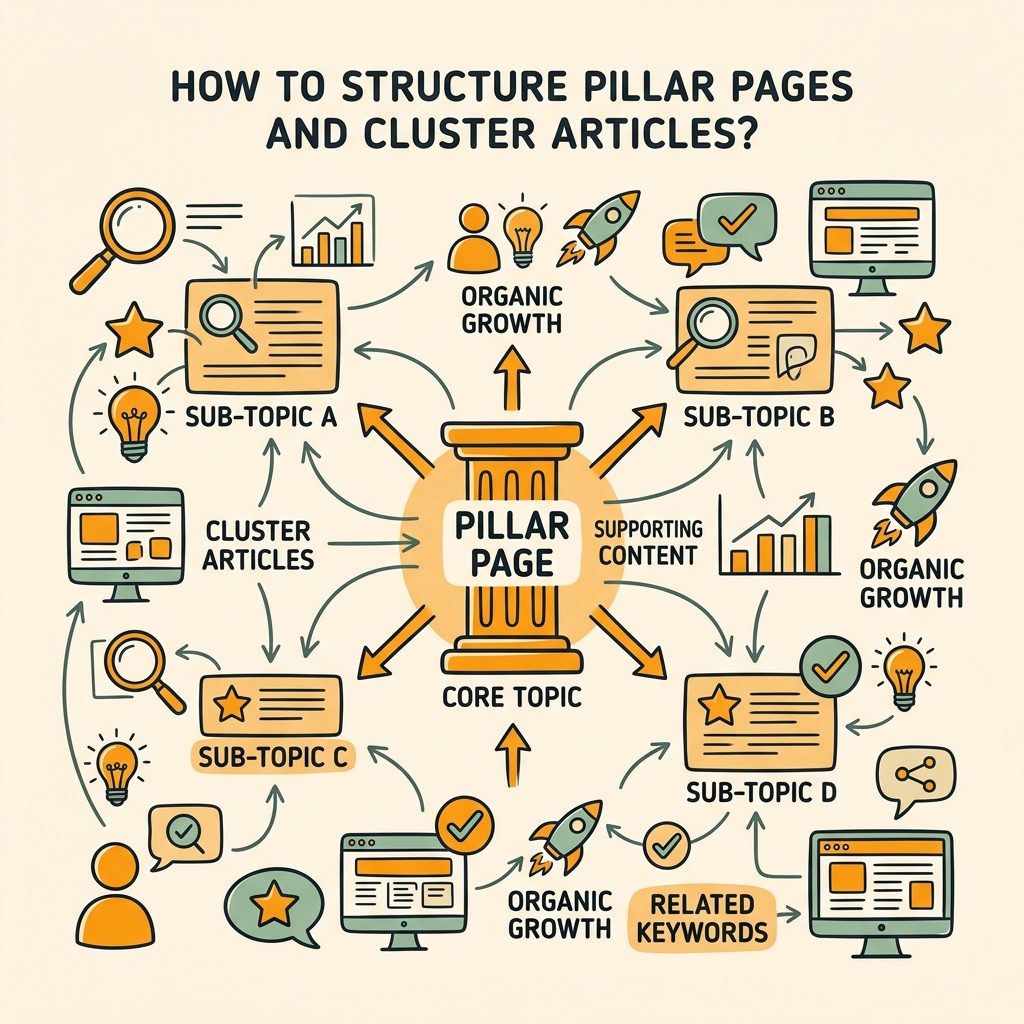
Once you've identified your pillars, the architecture is straightforward: one comprehensive pillar page per topic, supported by 8–12 cluster articles, all linked bidirectionally. This creates a topical hub that search engines recognize as authoritative. The pillar page covers the topic at the highest level, the "big picture." The cluster articles dive into specific subtopics and link back to the pillar. This structure signals to Google that your entire content cluster is about a single, related topic, which improves rankings for all articles within that cluster.
Building Pillar Pages for Maximum Coverage
A pillar page is comprehensive and foundational. It should be 3,000-5,000 words and answer the broadest, most valuable question in your cluster. For a pillar on "Lead Scoring," the pillar page might be titled "Lead Scoring: A Complete Guide for B2B Sales Teams" and cover: what lead scoring is, why it matters, the main scoring models (behavioral, demographic, explicit, implicit), implementation steps, measurement and optimization, and comparison of scoring approaches. It's not a 500-word overview, it's the definitive guide someone would read to understand the entire topic. Internal links point to each cluster article. The pillar also includes a table of contents linking to each section, which helps both readers and search engines navigate the cluster structure.
Cluster Articles: Five Content Types That Address Every Buyer Need
Each pillar should be surrounded by 8–12 cluster articles covering five critical content types. This ensures you address every stage of buyer research. Best practices suggest covering five types per topic: definitional, comparison, implementation, measurement, and evaluation content. Definitional articles answer "What is lead scoring?" and "What's the difference between lead scoring and lead grading?" Comparison articles target "Lead scoring vs predictive scoring" and "Manual lead scoring vs automated lead scoring." Implementation articles are how-to guides: "How to set up lead scoring in Salesforce," "How to build a custom lead scoring model," and "How to train your sales team on lead scoring." Measurement articles address "How to measure lead scoring effectiveness" and "Lead scoring KPIs and metrics." Evaluation articles help buyers choose vendors: "Best lead scoring software," "Top lead scoring platforms," and comparative guides like "HubSpot vs Marketo for lead scoring." An integrated content cluster strategy ensures all five types are covered systematically across your pillar.
Linking Strategy: Bidirectional Internal Links That Build Authority
The power of the pillar model comes from strategic interlinking. The pillar page links to every cluster article, introducing them and guiding readers to relevant subtopics. Each cluster article also links back to the pillar page (in the intro or conclusion) and to 2-3 related cluster articles. This bidirectional linking tells search engines that your content is related and topically cohesive. It also keeps readers engaged on your domain longer, reducing bounce rate and signaling quality to search. A lead scoring implementation article, for example, would link to: the lead scoring pillar page (in the first paragraph), the lead scoring comparison article (when discussing scoring models), and the measurement article (when covering KPIs). That's 3-4 internal links per article, natural, relevant, and purposeful.
What Content Types Drive Sales Alignment and Pipeline?
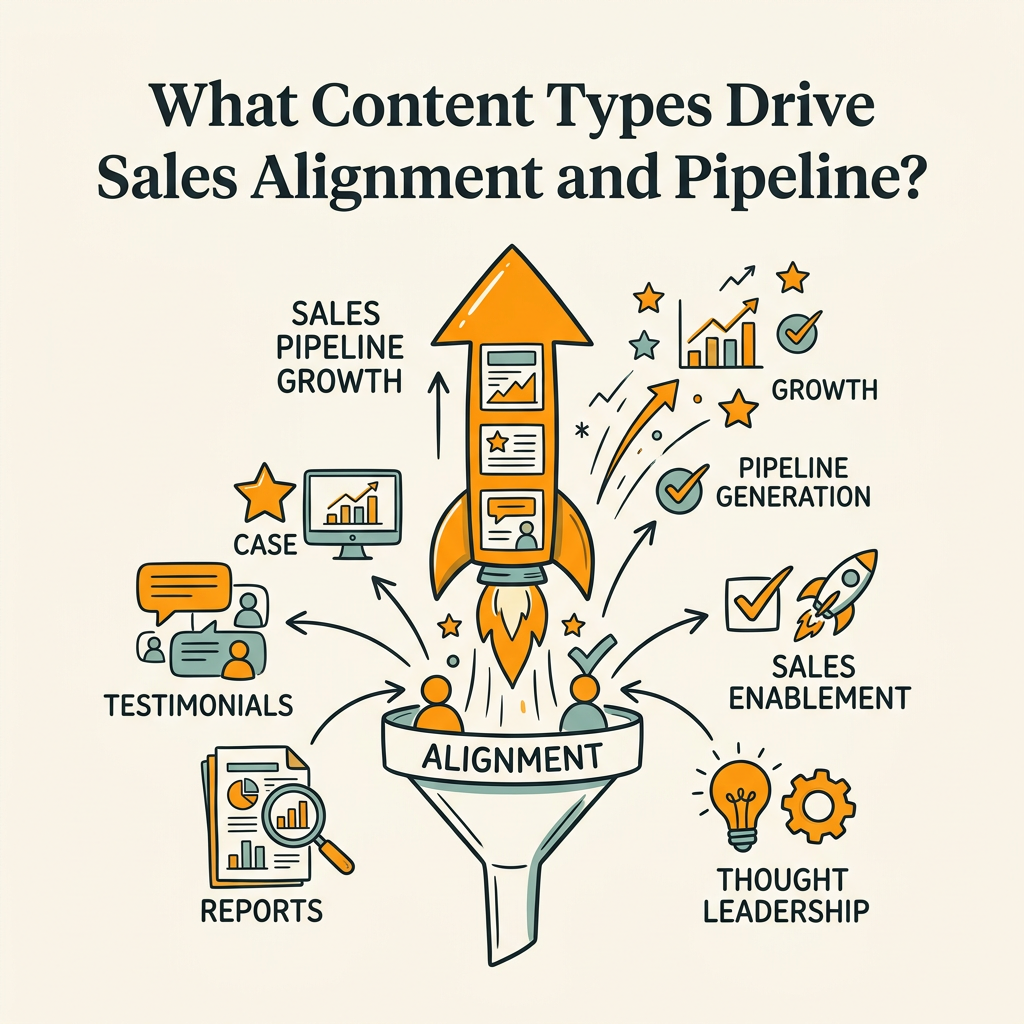
Writing content for the sake of content is how you waste months and see zero pipeline impact. Your pillar architecture only works if the content actually guides buyers toward a decision and your product. This requires sales alignment, working with your sales team to understand which buyer problems are actually close to the sale, and which are just educational curiosities. Content that mentions a buyer's top two objections ranks higher and converts better because it directly addresses what buyers care about: overcoming their hesitations to buy.
Objection-Based Content That Converts Prospects to Pipeline
Every sales team has a list of objections that repeat across deals. "I don't think we have the bandwidth to implement this." "How do I know this actually works?" "Isn't manual scoring good enough?" "Won't this replace our sales reps?" Create content that directly addresses these objections. An article titled "Does Lead Scoring Replace Sales Judgment?" lets you address the fear head-on. "How long does lead scoring take to implement?" targets implementation anxiety. "Lead Scoring ROI: How much revenue does it actually impact?" overcomes the "does it work?" doubt. When prospects find content that addresses their specific concern, they perceive you as trustworthy and buyer-centric. Platforms that automate this research process at scale, like those covered in guides on best AI writing tools for content marketing, can generate pillar clusters while ensuring each article addresses a specific buyer objection, all without requiring you to manually interview sales every week.
Comparison and Alternative Content: Capturing Active Buyers
Buyers researching solutions actively search "X vs Y" queries and "alternatives to X" pages. This is high-intent traffic, people actively evaluating options. A comprehensive comparison article (your main competitor vs. your solution, or internal method vs. external platform) positions you directly in the buyer's consideration set. Comparison and alternative SEO pages are now one of the four surviving moats of B2B content strategy in 2026, alongside founder content, customer stories, and programmatic SEO. A guide like "Manual lead scoring vs. automated lead scoring" or "HubSpot lead scoring vs. custom Salesforce lead scoring" captures buyers who are actively deciding which approach to use. The best comparison articles are balanced and credible, you acknowledge the strengths of alternative approaches, then explain why your approach (and your product) fits their use case better.
Measurement and Success Content: Proving Impact and Building Confidence
Buyers want proof that your approach works. Content about measurement and impact ("How to measure lead scoring effectiveness," "Lead scoring metrics and KPIs," "What's a good conversion rate for a lead scoring model?") builds buyer confidence. Include specific benchmarks when possible, "Top-performing sales teams score lead with 90%+ accuracy" or "Companies that implement lead scoring see a 20-30% increase in sales productivity." This content is typically lower-search-volume (fewer people search for KPIs than for "how-to" guides), but it has high conversion value because it reaches prospects late in their research, when they're trying to make a final decision.
How Do You Build and Maintain Your Pillar Content System?
A pillar-based strategy only works if you execute it consistently. Most teams start strong, publish a few pillar pages and clusters, then lose momentum and drift back to random topic publishing. Building a sustainable system requires three things: a clear content calendar, accountability for publication, and automation where possible. When you're managing 3-5 pillar clusters, each with 8-12 articles, you're looking at 24-60 pieces of content. Doing this manually is unsustainable. This is precisely why content marketing automation has become essential for scaling B2B content teams.
Content Calendar and Pillar Sequencing
Plan which pillar you'll tackle first based on: search volume, sales urgency, and competitive opportunity. Start with your highest-value pillar (the topic closest to your product and with the most buyer intent). Create a 3-6 month calendar for launching that pillar and its cluster articles. Publish 1-2 cluster articles per week, building toward the pillar page. Once the first pillar is solid (pillar page + 8-12 clusters), move to pillar #2. This phased approach prevents overwhelm and lets you monitor each pillar's performance before moving to the next. A SaaS platform might sequence pillars like: Pillar #1 (Months 1-3): "Sales Automation", 12 cluster articles; Pillar #2 (Months 4-6): "Lead Scoring", 12 cluster articles; Pillar #3 (Months 7-9): "Sales Intelligence", 10 cluster articles. By month 9, you've published 34 pieces of structured, interconnected content that all reinforce each other.
Measurement: Tracking Pillar Performance and Scaling Winners
Not every pillar will perform equally. Track organic traffic, rankings, and pipeline attribution for each pillar. Which pillar drove the most qualified traffic? Which generated the most pipeline? Double down on winners. A pillar on "Revenue Intelligence" might drive 10x more qualified traffic than "Sales Methodology." Once you identify the winner, expand it, add more cluster articles, deepen existing ones, and add internal links to amplify its authority further. This measurement-driven approach ensures you're investing content effort where it actually moves the business needle. Understanding content marketing ROI metrics helps you track which pillars are actually driving revenue attribution.
Automation and AI for Pillar Content Production
Creating 24-60+ articles manually is a multi-month, resource-intensive project. This is where content automation becomes essential. An autonomous SEO engine like Jottler can research and write entire pillar clusters in days, not months. You define your pillar and the 8-12 subtopics, the system researches each topic using 14+ sources, writes comprehensive articles optimized for AEO and internal linking, and publishes directly to your CMS. Jottler generates 3,000+ word articles daily, meaning a full five-pillar strategy (60 articles) can be researched, written, fact-checked, and published in under a month. The alternative, hiring writers, managing editorial calendars, and waiting weeks between assignments, is why most teams never finish their pillar architecture. Automation removes that friction. According to Directive Consulting's research on B2B content statistics for 2026, teams using content automation tools are 3x more likely to complete their full content strategy compared to those managing everything manually.
| Approach | Time to Complete 5 Pillars (60 articles) | Cost | Quality Control | Internal Linking |
|---|---|---|---|---|
| Manual In-House Writing | 6-12 months | $40K-$100K+ (writer salary/hiring) | Inconsistent | Manual, ad-hoc |
| Freelance Writers | 4-8 months | $12K-$20K (per article cost) | Requires heavy editing | Requires coordination |
| Jottler Autonomous SEO | 2-4 weeks | $29/mo-$299/mo | Built-in fact-checking & verification | Automated intelligent linking |
For busy founders and marketing teams, the difference is dramatic. Instead of spending 6-12 months researching, writing, and managing content, you define your pillars, set publication frequency (1-5 articles per day), and let the system run. Jottler's AI agents handle keyword research, deep research across 14+ sources, fact-checking to ensure accuracy, and strategic internal linking to build your pillar architecture. The system learns your brand voice and topic preferences, continuously improving output. This is why autonomous content platforms are becoming table-stakes for B2B teams trying to build topical authority at scale.
What Are Common Pillar Model Mistakes and How Do You Avoid Them?
Even with a solid framework, teams stumble on execution. The most common mistake is poorly chosen pillars, topics with insufficient search demand or low strategic fit. Another is incomplete cluster coverage. You build 3-4 articles around a pillar then move on, leaving it incomplete and weakly ranked. The third mistake is poor interlinking. Articles exist in isolation with no internal links, so search engines don't recognize them as a cluster. Let's address each.
Pillar Selection: Avoiding Low-Demand and Low-Intent Topics
Choose pillars that have real search volume AND strategic importance to your business. A pillar on "Industry History" might be interesting but has minimal search demand and zero buying intent. A pillar on "Product Features" sounds relevant but is too product-focused, buyers search for solutions and problems, not features. Validate every pillar candidate with keyword research before committing. A pillar needs 15+ searchable subtopics and 500+ combined monthly searches to be worth building. If a topic has fewer than 10 related queries, make it a single article within another pillar instead of a standalone pillar.
Cluster Incompleteness: The "Half-Built Pillar" Problem
Many teams launch a pillar page, add 3-4 cluster articles, then abandon it halfway. The pillar sits incomplete for months, ranking poorly because it lacks the full topical authority of a mature cluster. Commit to finishing clusters once you start. Set a hard deadline: "We will launch Pillar #1 complete with all 12 cluster articles by Month 3." This prevents the "let's move to the next thing" mentality that kills momentum.
Internal Linking That Actually Works
Generic internal links ("click here," "read our guide") don't help SEO or the reader. Anchor text should be descriptive and keyword-rich: "Learn how to implement lead scoring in your CRM," not "click here to learn more." Place links naturally within the first 100 words of an article (to guide readers early) and in topic-relevant sections (where they make sense contextually). Bidirectional links matter: cluster articles link to the pillar, and the pillar links back to each cluster. This reinforces topical relevance in both directions.
Conclusion
The pillars model transforms B2B content from scattered publishing into a system. You define what you own, build comprehensive clusters that address every buyer need, and let search engines and buyers recognize your authority. 45% of B2B leaders prioritize sales alignment, this model delivers it by anchoring content to buyer problems, not random trends. When you add strategic internal linking, sales-aligned messaging, and consistent measurement, your pillar clusters compound over time, driving more traffic, more qualified leads, and ultimately more revenue.
The biggest barrier isn't strategy, it's execution. Most teams understand the pillar model but lack the resources to build 5 pillars (60+ articles) in a reasonable timeframe. This is where automation changes the game. Systems like Jottler's autonomous SEO engine can research, write, and publish entire pillar clusters in weeks, not months, while building internal link networks automatically. For busy founders and marketing teams, this removes the friction that has prevented you from executing your strategy. Define your pillars today, and let automation handle the research and writing at scale.
FAQs
How many pillars should a B2B content strategy have?
Most B2B companies perform best with 3–5 core pillars. Too few (1-2) limits your topical coverage and leaves money on the table; too many (7+) spreads your effort thin and prevents you from achieving deep authority in any single topic. Each pillar requires 8–12 cluster articles to build real topical authority, so 5 pillars means 40–60 articles minimum. Start with your highest-value, highest-intent pillar and complete it fully (pillar page + all 12 clusters). Once it's established and driving traffic, move to pillar #2. This phased approach prevents overwhelm and ensures quality. Your first pillar should directly address your buyer's most urgent problem, the one your sales team hears every week. This gives you momentum and quick wins.
What's the difference between a pillar page and a regular blog post?
A pillar page is comprehensive, foundational, and built to establish authority. It's typically 3,000–5,000 words covering an entire topic at a high level, the "ultimate guide." A blog post is narrower, usually 1,500–2,500 words, addressing one specific subtopic or question. Pillar pages are hub pages that link to cluster articles; blog posts are spokes that link back to the pillar. Pillar pages target high-search-volume, broad keywords while cluster articles target long-tail variations. In a lead scoring pillar, the pillar page might be "Lead Scoring: A Complete Guide," while cluster articles are "How to set up lead scoring in HubSpot," "Best lead scoring models," and "Lead scoring implementation checklist." Pillar pages serve as entry points; cluster articles provide depth and drive conversions.
How do you measure if your pillar content strategy is working?
Track four metrics per pillar: organic traffic (total sessions and traffic growth trend), ranking improvements (how many keywords in your pillar ranking in top 10), qualified lead generation (traffic that actually visits your pricing or product pages), and pipeline attribution (how many deals mention pillar content as a research source). A healthy pillar typically generates 50-200 qualified organic sessions per month within the first 6 months. Use Google Analytics to segment traffic by pillar content, and ask your sales team to note which pillar articles prospects mention during discovery calls. If a pillar is driving traffic but not qualified leads, the content may lack buying intent signals, add comparison articles and product-aware content. If a pillar drives no traffic after 4-6 months, the topic may lack search demand or face intense competition; deprioritize it and focus on winners.