Free AI Tools for Generating Blog Outlines and Drafts
80% of bloggers now use AI for content ideation, outlining, and drafting, yet most rely on generic tools that lack SEO depth and content intelligence. Creating a compelling blog outline shouldn't demand hours of research and manual structure-building. People using AI publish 42% more content per month than those managing everything manually, and 73% of marketers cite outlining as one of their top AI use cases. The challenge: most free outline generators lack the tactical features that turn a basic framework into a ranking-ready content plan.
Key Takeaways
- 80% of bloggers use AI for outlining — making it the most efficient starting point for content production (Ahrefs, 2025)
- Free tools like ChatGPT, Claude, and Grammarly generate basic outlines; SEO-focused automation demands deeper research integration
- Content teams publishing with AI assistance produce 42% more monthly articles — but quality requires human editing and fact-checking
- ChatGPT: Flexible, prompt-driven outlining for any format; best for iteration and customization across all content types.
- Claude: Excels with long, complex briefs; superior context retention for detailed strategy-based outlines.
- Grammarly: Fastest free option for clean, simple outlines; ideal for beginners but lacks SEO-specific depth.
- Specialized outline tools: Copy.ai, Infrasity, and workflow platforms add SEO signals, keyword mapping, and CMS integration.
- The outline-to-publication gap: Free tools generate structure; publishing at scale requires automation of research, fact-checking, and internal linking.
How Free AI Outline Generators Help Teams Ship Content Faster
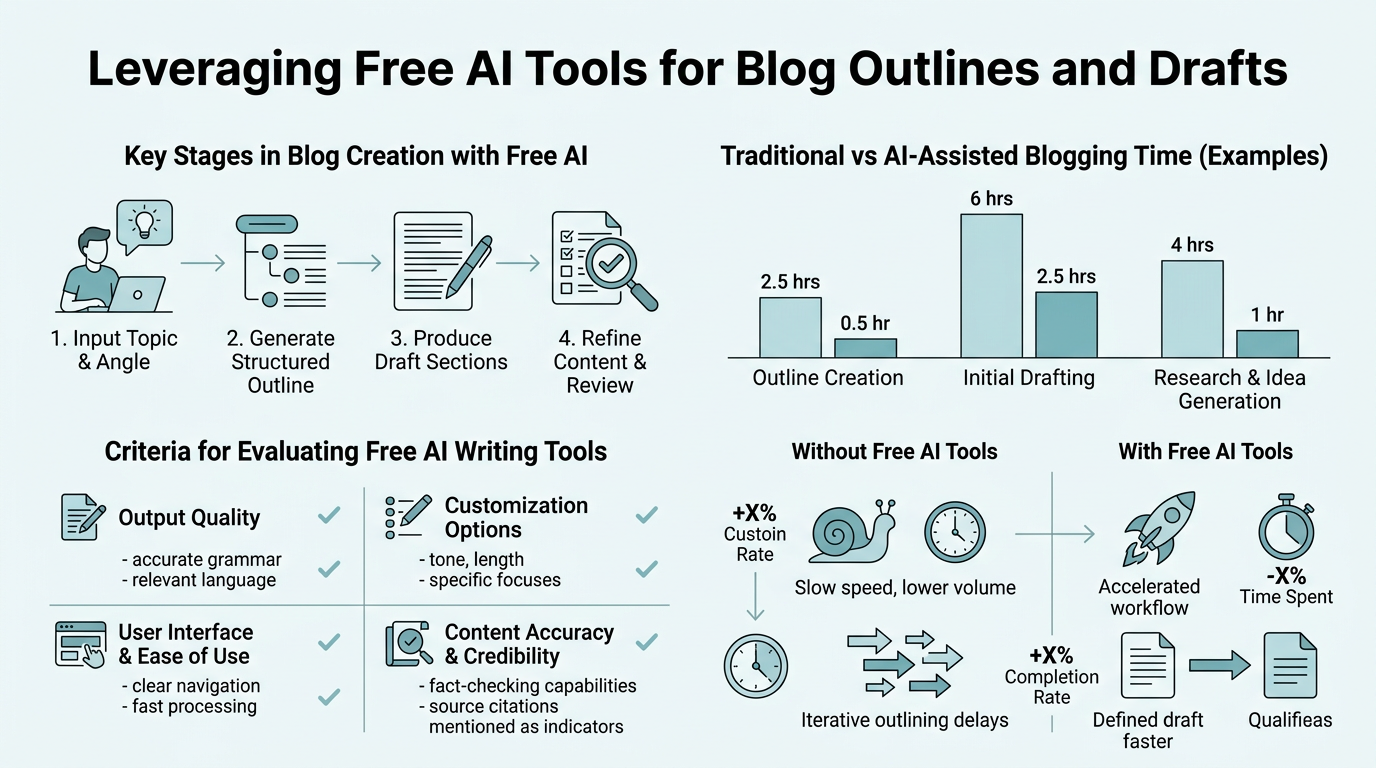
The blank page is the biggest friction point in content creation. Ahrefs' 2025 analysis shows that brainstorming and outlining are among the top three AI content use cases, ahead of drafting or editing. Free outline generators reduce time-to-first-draft by automating the structural planning phase, eliminating the cognitive load of deciding what sections matter and in what order.
"Outlining is where content strategy compounds. The teams shipping the most content aren't writing faster—they're deciding faster. An outline generator collapses the planning phase from hours to minutes, which removes the biggest barrier to consistency."
For busy founders and marketing teams, this matters because outline generation is the multiplier. Teams that adopt AI for outlining ship more often because they've removed the biggest barrier to consistency: deciding what to write about and how to organize it. Implementing a structured content marketing framework helps teams maintain publishing frequency when working with AI tools.
Why outlines are the real bottleneck
Writing a blog post takes time. But planning one takes longer. Most content teams spend 30-60 minutes deciding on section order, heading structure, and narrative flow before a single paragraph is drafted. A free outline generator collapses that decision cycle into seconds. Instead of staring at a blank page, a writer receives 5-10 structured options and picks the best fit. The time saved compounds: marketers using AI outline tools report moving from one article per week to three or four.
This speed advantage isn't just about throughput. Faster outlines mean more experimentation. Teams can test multiple angles on the same keyword, compare structural approaches, and pick the one most likely to rank. That's content strategy accelerated.
From outline to publishable draft
Free outline generators do one job: structure. They don't research keywords, verify claims, or optimize for search intent. That's where the manual workflow resurfaces. Microsoft's 2025 AI adoption data shows that enterprise teams treat AI as part of a workflow, not a replacement. The best outlines come from: (1) AI generation, (2) human editorial review for tone and audience fit, (3) keyword and search-intent validation, and (4) fact-checking before publication.
ChatGPT vs Claude vs Grammarly: Free Outline Generation Compared
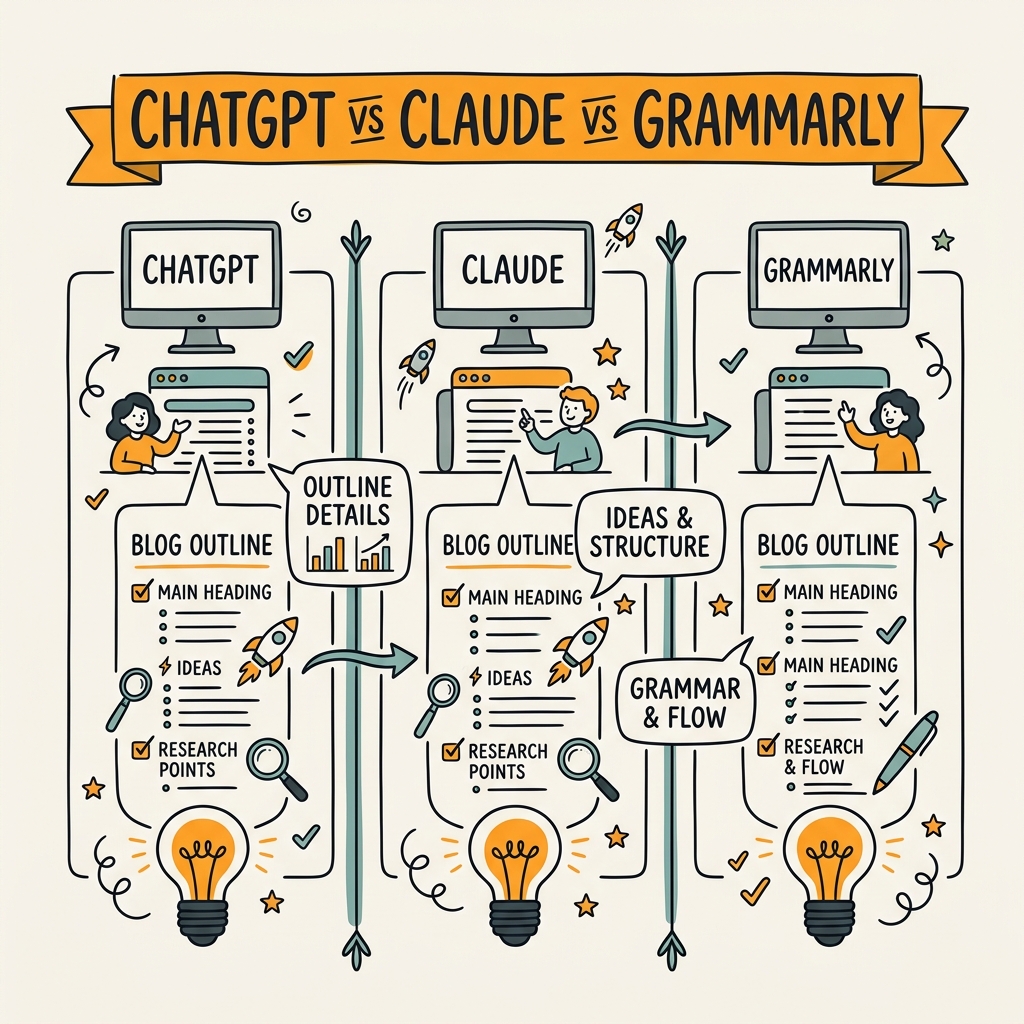
Three free tools dominate the outline-generation space. Each excels at a different job, and choosing the right one depends on your workflow, content type, and comfort with AI prompting. Understanding when to use each tool for specific scenarios can improve your overall content marketing workflow.
ChatGPT: Flexibility and iteration
ChatGPT's strength is versatility. Feed it a topic, keyword, audience, tone, and desired length, and it produces outlines for blog posts, essays, whitepapers, sales pages, email sequences, and product guides. Its real power emerges in iteration: ask it to reorder sections, expand certain points, add FAQ elements, or combine outlines, and it adapts instantly.
"ChatGPT's iterative capability is what separates it from static outline templates. You're not locked into the first output—you can refine, expand, and reorder in real time, which makes it perfect for teams testing multiple content angles before committing to a draft."
For content teams, this matters because no two articles follow the same blueprint. Some pieces need a problem-solution arc. Others work better as numbered tips. ChatGPT handles both and can switch between them in follow-up prompts. The downside: prompt quality determines output quality. Generic prompts yield generic outlines.
Claude: Long-form context and depth
Claude's distinguishing feature is context window size. While ChatGPT handles standard prompts well, Claude accepts vastly larger inputs—full briefs, competitor articles, existing internal content, or research notes. This is crucial for outline generation when you're working from detailed strategy documents or want the outline to reference proprietary frameworks.
Teams using Claude for outlines report better coherence when they pass in a detailed brief: a three-page strategy doc, target keywords, competitor headlines, and internal messaging guidelines. Claude absorbs all of it and generates outlines that align with existing voice and strategy. Grammarly and ChatGPT can do this too, but Claude's larger context window means you're not forced to truncate or summarize your input.
Grammarly: Simplicity and speed
Grammarly's free outline generator is the fastest option for teams that want a clean interface and no hidden settings. Open it, enter your topic, and receive a structured outline in seconds. No prompting skill required. It's designed for everyone: students, professionals, and creators.
The trade-off is depth. Grammarly's outlines are solid but generic. You can't specify keyword targeting, search intent, or competitive positioning. It generates a logical structure—problem, solution, benefits—but doesn't optimize for SEO signals or audience-specific pain points. For teams that plan to hire writers to flesh out sections, Grammarly works fine. For SEO-focused content, you'll need supplemental research.
| Tool | Free Tier | Best For | Speed | Customization | SEO Features |
|---|---|---|---|---|---|
| ChatGPT | Yes | Flexible, iterative outlining; multiple formats | Fast | Extensive (prompt-driven) | None (user-added) |
| Claude | Yes | Long briefs, complex context, strategy-based outlines | Fast | High (context-aware) | None (user-added) |
| Grammarly | Yes | Quick, simple outlines for any content type | Fastest | Limited (templates only) | None |
| Jottler | No (14-day free trial) | SEO-driven outlines with research, internal linking, fact-checking | Automated daily | High (AI agents, keyword research) | Full (keyword research, SERP analysis, topical depth) |
The table reveals a critical gap: free outline generators don't include SEO research. They structure content but don't validate it against search intent, competitor content, or keyword opportunity. For marketing teams focused on organic traffic growth, that means additional manual work—keyword research, SERP analysis, competitive headline review—layered on top of the outline before drafting begins.
Beyond Basic Outlines: Adding SEO and Research Depth
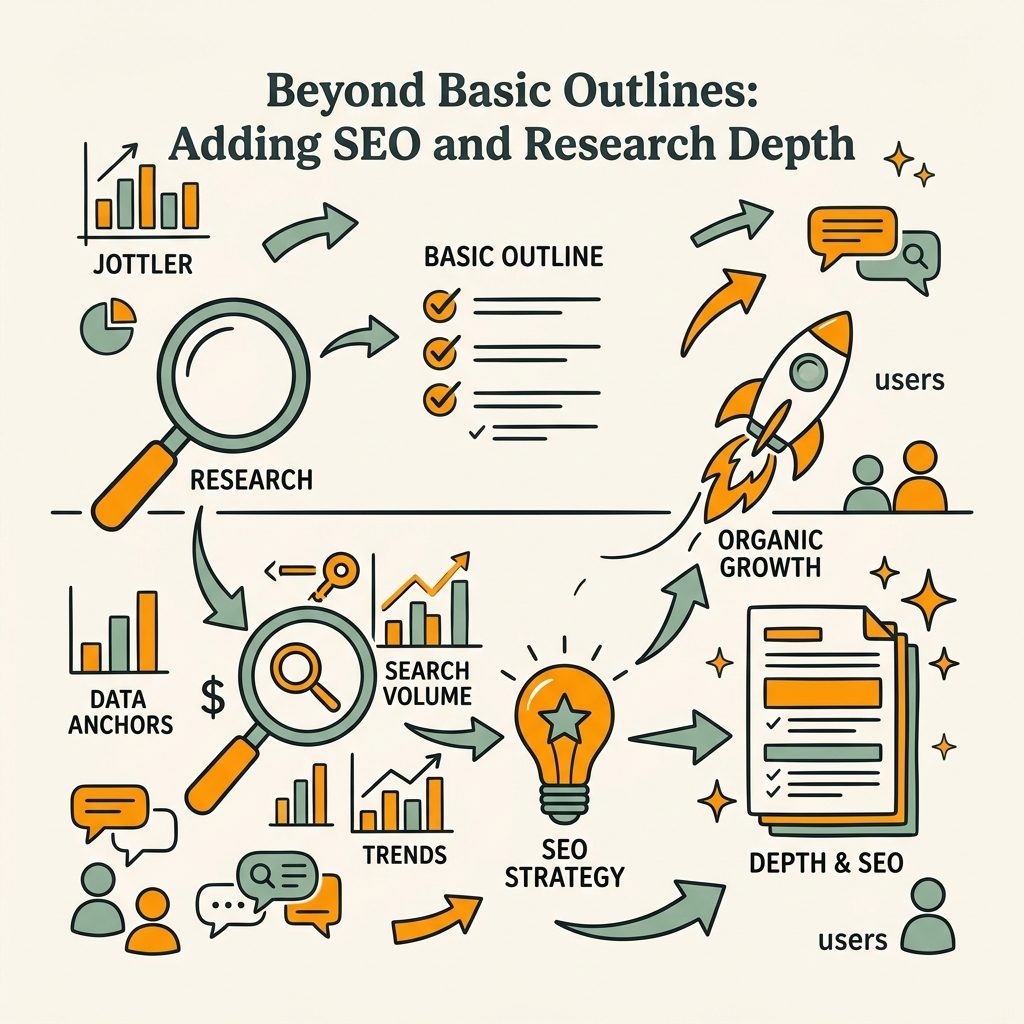
A great outline answers: What problem does the reader have? What sections will solve it? What questions are they asking? Free tools address the third question. They miss the first two, which is where ranking opportunity lives.
Why generic outlines underperform in organic search
Google's ranking algorithm rewards content that deeply addresses search intent. An outline that doesn't align with "people also ask" questions, search features (featured snippets, knowledge panels), and competitor-proven structures will produce content that ranks lower and converts worse.
Consider a search like "best AI writing tools." A generic outline might list: Introduction, Overview of Top Tools, Comparison, Pricing, Conclusion. A SEO-optimized outline adds: Tool 1 Deep Dive, Integration Capabilities, Use Cases by Industry, Limitations and Trade-offs, Expert Reviews, FAQ Section. The second outline is longer, but it targets the subtopics and questions that searchers actually care about.
Free outline generators can't produce this level of sophistication because they lack access to search data. They don't know the keyword difficulty, search volume, or competitive gap in your market. Building that intelligence into an outline requires keyword research, SERP analysis, and topical mapping—tasks that free tools don't handle.
Structuring for content hubs and internal linking
Content hubs—clusters of related articles linked through a central pillar page—compound organic traffic over time. But hub architecture must be planned at the outline stage. Each article's outline should anticipate:
- Pillar article link: Where will this outline link back to the hub's main page?
- Sibling articles: What other pieces in the cluster should this outline cross-reference?
- Topical depth: What subtopics does this article cover that shouldn't appear in other cluster pieces?
- Keyword ownership: Which keywords does this outline "own" versus which belong to sibling articles?
Free outline generators don't ask these questions. They generate isolated outlines. Building content hubs demands outline-level coordination across multiple pieces—a task that requires either manual planning or automation that integrates research, linking strategy, and AI-driven content calendars for coordinated publishing.
The Complete Workflow: From Outline to Published SEO Content
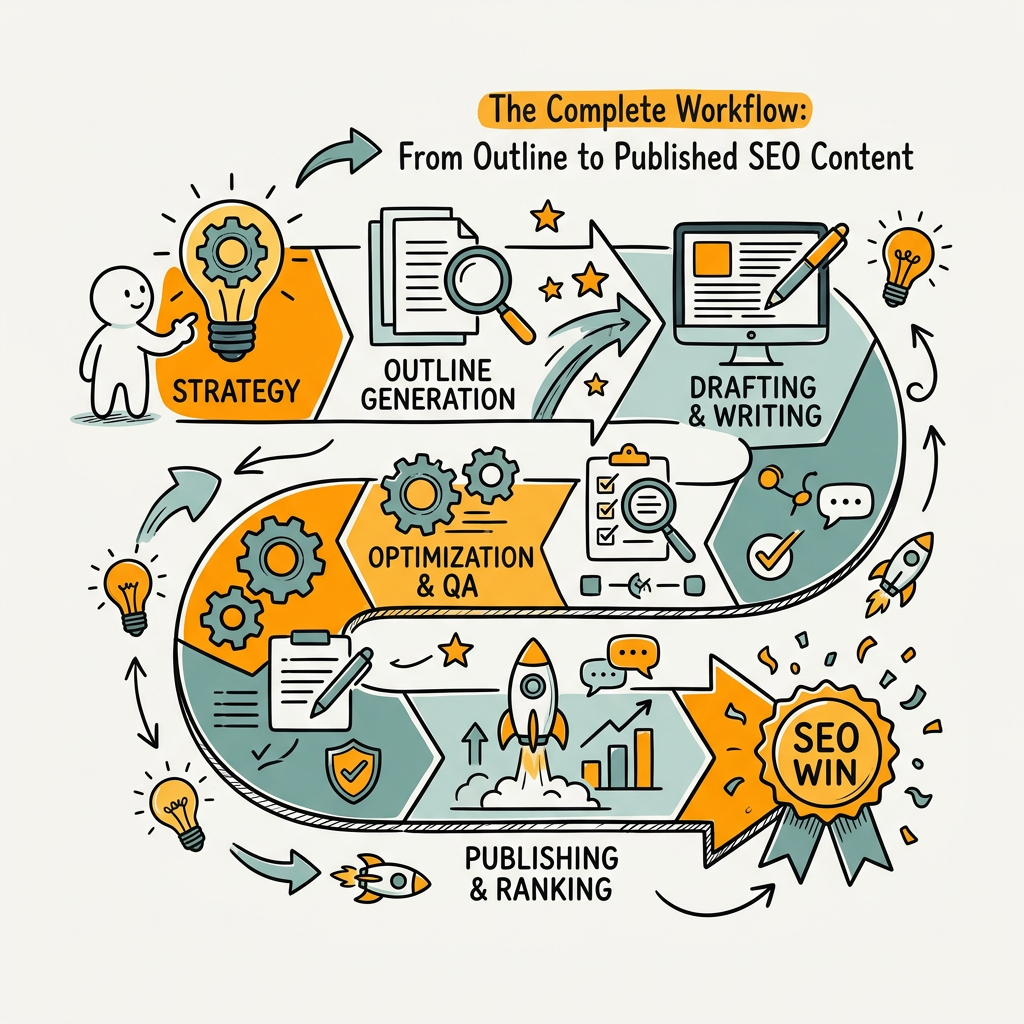
Free tools are part of the content workflow, not the entirety. The full pipeline looks like this:
- Research: Keyword difficulty, search volume, competitor headlines, "people also ask" data, SERP features
- Outline generation: Structured framework based on research insights and search intent
- Draft writing: Filling the outline with original, well-sourced content
- Fact-checking: Verifying claims, citations, and statistics against sources
- SEO optimization: Headline testing, internal link mapping, keyword placement
- Publishing: CMS upload, metadata configuration, content hub linking
Free outline generators handle step 2. Steps 1 and 3-6 remain manual for most teams. This is where the time gets spent. One blog post might have a four-minute outline (ChatGPT) but a four-hour publication cycle if you're hand-researching keywords, manually drafting, fact-checking sources, and building internal links.
When to use free outlines vs automation
Free outline tools make sense when:
- You're writing one or two articles per month
- Your content is educational (how-tos, guides) rather than SEO-competitive
- You have time for manual research and keyword validation
- Your audience doesn't penalize you for slower publishing
Automation becomes essential when:
- You need to publish consistently (3+ articles weekly)
- Your traffic depends on organic search and keyword rankings
- Keyword research and competitive analysis are full-time work
- Internal linking and topical authority matter to your strategy
- Your team lacks dedicated SEO and content resources
For busy founders and scaling marketing teams, the second scenario is the default. Free outlines solve a real problem but create a bigger one: they make publishing easy to start but hard to maintain at scale.
Bridging the gap with smarter workflows
The highest-leverage approach combines free outline tools with targeted automation:
- Use ChatGPT or Claude for outline generation — leverage their flexibility for rapid iteration
- Layer in keyword research — validate outlined sections against SERP data before drafting
- Add fact-checking automation — verify claims and citations programmatically or through spot-checks
- Automate internal linking — map outline sections to existing content hubs during the outline phase, not after publication
- Publish directly to CMS — eliminate manual metadata entry and formatting
This hybrid approach preserves the speed of free outlines while adding the depth that ranks. The key insight: outlining is the highest-value AI task in content workflows because it removes friction early. Adding SEO intelligence to that moment compounds the advantage.
Free Tools for Blog Drafting After the Outline
Once you have an outline, drafting becomes the next bottleneck. Free outline generators don't draft; they structure. But the tools that do draft vary widely in quality, especially for SEO content. Free AI writing tools that rival premium alternatives can supplement your outline, but they still require human fact-checking and editorial review.
ChatGPT and Claude for full draft generation
Both ChatGPT and Claude can draft full blog posts from outlines. Feed them the outline plus a brief of your target keyword, audience, and tone, and they'll produce a complete first draft. Quality varies: generic prompts yield thin, templated content. Detailed briefs with examples, voice guidelines, and cite-worthy claims produce much better results.
The advantage is speed. A 2,000-word blog post can be drafted in under five minutes. The disadvantage is accuracy. Free LLMs hallucinate citations, misstate statistics, and invent quotes. Every draft requires fact-checking before publication—a step most teams can't skip.
Specialized free drafting tools
Tools like Copy.ai and Fibr AI offer free tiers for blog post generation. These are faster than ChatGPT for templated content (listicles, comparison posts) but less flexible for nuanced topics. They shine when your content follows a predictable structure and you're optimizing for speed over depth.
The trade-off: specialized tools are easier to use but produce cookie-cutter content. A "top 5 AI tools" listicle generated by Fibr AI looks like dozens of others. ChatGPT, with the right prompt, can make it distinctive.
Conclusion
Free AI tools for blog outlines have become essential infrastructure for content teams. 80% of bloggers now use AI for outlining and ideation, and for good reason: automated structure generation eliminates the biggest friction point in writing. ChatGPT, Claude, and Grammarly are all excellent starting points, each with distinct strengths for different workflows.
But free tools have a ceiling. They generate outlines; they don't ensure ranking-ready content. Teams publishing 42% more content with AI assistance are combining outline generation with keyword research, fact-checking, and intelligent internal linking. That full-cycle automation is where organic traffic compounds.
For scaling teams that need consistent SEO-driven content without constant manual overhead, a complete content automation platform integrates research, outlining, drafting, fact-checking, and publishing in one workflow. Free outline tools are perfect for occasional writers. But if your goal is to build topical authority and own search results, you'll need research and validation depth that free tools can't provide.
Start your SEO agent today to automate the full research-to-publish pipeline. Jottler handles keyword research, outlining, drafting, fact-checking, and CMS publishing—the complete workflow that free tools leave incomplete.
FAQs
What is the best free AI outline generator for blog posts?
ChatGPT is the most flexible and widely used free outline generator because it adapts to any content format, allows iterative refinement, and requires no technical setup beyond a web browser. Its strength is customization—you can specify tone, audience, keyword, and desired structure, then reorder or expand sections with follow-up prompts. Claude is best if you're working from a detailed brief or need to preserve complex context. Grammarly is fastest for straightforward outlines but lacks customization depth. For SEO-competitive content that must rank, none of these free tools should be your only resource; pair them with keyword research and SERP analysis.
Can I use free AI outline generators for SEO blog posts?
Free outline generators create structure but not SEO strategy. They don't analyze competitor content, validate search intent, or map keywords to sections. The result is an outline that looks good but may not rank because it misses the subtopics and question-based sections that Google rewards. Use free tools for basic structure, then layer on keyword research, SERP analysis, and "people also ask" mapping before you draft. Better yet, use a tool that combines outline generation with SEO research in one step.
How do free AI outline generators compare to paid alternatives?
Free tools like ChatGPT and Grammarly excel at structural planning for any content type. Paid outline generators add SEO features, keyword integration, competitor analysis, and CMS publishing. The gap matters if you care about rankings. Free tools are ideal for educational content, internal documents, or one-off blog posts. For consistent organic traffic growth and topical authority, paid platforms that combine outline generation with research, fact-checking, and internal linking automation provide faster ROI by eliminating the manual work between outline and publish.