Future-Proof Your Content with Autonomous AI SEO Agents
 Aidan Buckley
SEO
Aidan Buckley
SEO
March 20th, 2026
16 minute read
Table of Contents
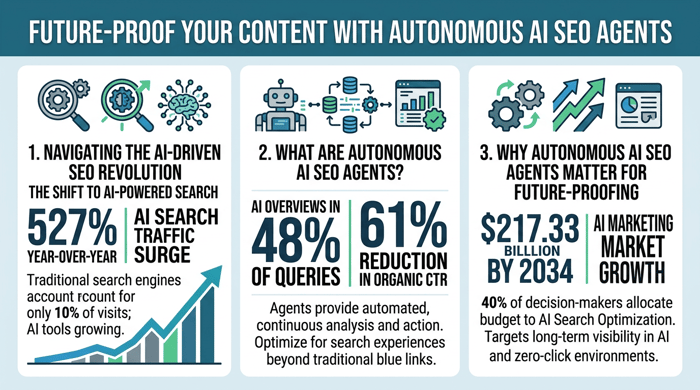
The digital landscape is undergoing a seismic shift, with AI search traffic surging 527% year-over-year between January-May 2024 and 2025. This rapid evolution presents a critical challenge for businesses: how to maintain and grow organic visibility when traditional SEO methods are increasingly insufficient. The stakes are high; between 60% and 68% of Google searches in 2026 now generate no clicks to websites, and AI Overviews reduce organic click-through rates by 61%. Without adapting, businesses risk becoming invisible in an increasingly AI-dominated search environment. Autonomous AI SEO agents offer a powerful solution, automating the entire content lifecycle from research to publishing, ensuring businesses can not only keep pace but thrive. This article will define autonomous AI SEO agents, compare them to traditional approaches, explain their critical importance for future-proofing content, and provide actionable steps for implementation, ultimately revealing how they are reshaping the future of content.
Quick-Scan Summary
- Autonomous AI SEO Agents: These are advanced AI systems that independently perform and optimize SEO tasks, leveraging machine learning and natural language processing.
- Autonomous vs. Traditional SEO: Unlike traditional SEO, autonomous agents offer continuous, data-driven optimization and superior scalability, increasing productivity by 24.69%.
- Future-Proofing Content: Autonomous agents are crucial for navigating the zero-click search era and maintaining visibility in AI Overviews, where 61% of organic click-through rates are reduced.
- Implementing AI SEO Agents: This involves strategic integration, starting with well-defined goals, selecting appropriate tools, and continuous monitoring for optimal results.
- The Future of Content: The future will be characterized by hyper-personalized, AI-driven experiences that prioritize E-E-A-T and human-AI collaboration.
What Are Autonomous AI SEO Agents?
Autonomous AI SEO agents are sophisticated artificial intelligence systems designed to perform a wide range of search engine optimization tasks with minimal human intervention. These agents leverage machine learning, natural language processing, and advanced algorithms to understand search intent, identify content gaps, generate optimized content, and even publish it, all while continuously learning and adapting to changes in search engine algorithms and user behavior. Their autonomy stems from their ability to execute complex, multi-step processes and make data-driven decisions independently. As of 2026, 40% of enterprise applications are projected to include task-specific AI agents, highlighting their growing prevalence.
Defining the Core Capabilities of Autonomous Agents
At their core, autonomous AI SEO agents are characterized by their ability to operate without constant human oversight. This includes automating tasks such as keyword research, content ideation, drafting, optimization, and even publishing. They can analyze vast datasets, including competitor content, search trends, and user engagement metrics, to formulate and execute SEO strategies. This capability allows businesses to scale their content efforts dramatically and maintain a consistent presence across diverse search platforms. In fact, businesses using AI report an average 24.69% increase in productivity, demonstrating the efficiency gains these agents provide.
- Automated Task Execution: Agents can perform keyword research, content ideation, drafting, optimization, and publishing without direct human input.
- Vast Data Analysis: They analyze extensive datasets, including competitor content, search trends, and user engagement metrics.
- Strategic SEO Formulation: Agents can formulate and execute SEO strategies based on their data analysis.
- Dramatic Content Scaling: This capability allows businesses to significantly scale their content efforts.
- Consistent Presence: Autonomous agents help maintain a consistent presence across various search platforms.
Key Characteristics of Autonomous AI SEO Agents
Autonomous AI SEO agents possess several distinguishing characteristics that set them apart from simpler AI tools. They are proactive, continuously scanning the digital landscape for opportunities and threats. They are adaptive, adjusting their strategies in real-time based on performance data and algorithm updates. They are also integrated, often connecting with various platforms like CMS systems and analytics tools to streamline workflows. This integration enables them to manage the entire content lifecycle, from initial concept to published, optimized article. 23% of companies are already scaling task-specific AI agents, indicating a clear trend towards these advanced capabilities.
- Proactive Optimization: These agents don't wait for instructions; they actively seek out optimization opportunities by analyzing trending topics and search queries.
- Continuous Learning: They adapt to new data, algorithm changes, and user behavior patterns, ensuring strategies remain effective in dynamic environments.
- End-to-End Automation: Capable of handling multiple stages of the content process, from research to publishing, significantly reducing manual effort.
- Data-Driven Decision Making: All actions are based on real-time analytics and predictive insights, leading to more effective and efficient SEO outcomes.
- Integrated Workflows: They connect with CMS systems, analytics tools, and other platforms to streamline the entire content lifecycle.
Autonomous AI SEO Agents vs. Traditional SEO
The shift from traditional SEO to autonomous AI SEO agents represents a fundamental change in how businesses approach organic growth. While traditional SEO relies heavily on manual processes, human expertise, and reactive adjustments, autonomous agents offer a scalable, proactive, and continuously optimized solution. Nearly 40% of decision-makers now allocate budget specifically for AI Search Optimization, signaling a clear move away from purely traditional methods.
The Limitations of Manual SEO in an AI-First World
Traditional SEO, with its reliance on manual keyword research, content creation, and periodic optimization, struggles to keep pace with the dynamic nature of AI-driven search. The sheer volume of data, the speed of algorithm changes, and the rise of zero-click search results make manual processes inefficient and often insufficient. As Rand Fishkin notes, "In a zero-click world, traffic is a terrible goal." This sentiment underscores the need for a more agile and automated approach. With 60-68% of Google searches in 2026 generating no clicks to websites, the traditional focus on driving traffic is increasingly challenged.
- Inefficient Manual Processes: Traditional SEO struggles with the volume of data and speed of algorithm changes.
- Slow Adaptation: Manual methods are too slow to adapt to the dynamic nature of AI-driven search.
- Insufficient for Zero-Click: Traditional SEO is ill-equipped for the rise of zero-click search results.
- Challenged Traffic Focus: The traditional goal of driving website traffic is increasingly difficult to achieve.
How Autonomous Agents Redefine Efficiency and Scale
Autonomous AI SEO agents dramatically enhance efficiency and scalability by automating repetitive and data-intensive tasks. They can analyze millions of data points, identify emerging trends, and generate content at a speed and volume impossible for human teams alone. This frees up human experts to focus on high-level strategy, creativity, and quality assurance. For instance, businesses using AI report an average 24.69% increase in productivity and 15.7% in cost savings. AI content creation also leads to 59% faster content creation and 77% higher content output volume, showcasing the significant gains in efficiency and scale.
- Automation of Repetitive Tasks: AI agents handle data-intensive and repetitive SEO tasks.
- Massive Data Analysis: They can analyze millions of data points to identify trends.
- High-Volume Content Generation: Agents generate content at speeds and volumes unattainable by human teams.
- Focus on Strategy: Human experts are freed to concentrate on high-level strategy and creativity.
- Significant Productivity Gains: Businesses using AI report an average 24.69% increase in productivity.
- Cost Savings: AI implementation leads to an average of 15.7% in cost savings.
- Faster Content Creation: AI enables 59% faster content creation.
- Higher Content Output: There's a 77% higher content output volume with AI.
HTML Comparison Table: Autonomous AI SEO Agents vs. Traditional SEO
| Feature | Traditional SEO | Autonomous AI SEO Agents |
|---|---|---|
| Approach | Manual, reactive, periodic | Automated, proactive, continuous, adaptive |
| Scalability | Limited by human resources and time | Highly scalable, capable of generating high volumes of content |
| Data Analysis | Human interpretation of reports | Real-time analysis of vast datasets, predictive insights |
| Optimization Speed | Slow, dependent on manual implementation | Real-time adjustments and continuous optimization |
| Cost Efficiency | High labor costs, potential for human error | Reduced operational costs, increased ROI (15.7% cost savings) |
| Content Creation | Manual drafting, editing, and publishing | AI-driven generation, optimization, and direct publishing (77% higher output) |
| Adaptability | Slow to adapt to algorithm changes | Rapid adaptation to algorithm updates and search trends |
| Focus | Primarily website clicks | AI visibility, answer engine optimization (AEO), E-E-A-T |
Why Autonomous AI SEO Agents Matter for Future-Proofing Content
The rapid evolution of AI search, characterized by zero-click results and AI Overviews, necessitates a fundamental shift in content strategy. Autonomous AI SEO agents are not just a luxury; they are a necessity for businesses aiming to maintain visibility and relevance in the coming years. With AI search traffic surging 527% year-over-year, ignoring this shift is a critical mistake.
Adapting to the Zero-Click Search Phenomenon
With 60-68% of Google searches generating no clicks to websites in 2026, and Google's AI Overviews appearing in 48% of queries while reducing organic click-through rates by 61%, the traditional goal of driving traffic to a website is being redefined. Autonomous agents help businesses adapt by optimizing content for direct answers within AI search results and AI Overviews, ensuring brand visibility even when users don't click through. This shift requires content strategies targeting AI citations, which over 25% of decision-makers are already planning.
"In a zero-click world, traffic is a terrible goal."
Rand Fishkin, SparkToro
- Redefining Traffic Goals: Traditional website traffic goals are less relevant in a zero-click environment.
- Optimizing for Direct Answers: Content must be optimized to provide direct answers within AI search results.
- Ensuring Brand Visibility: Autonomous agents help maintain visibility even without direct clicks.
- Targeting AI Citations: Over 25% of decision-makers are planning content strategies specifically for AI citations.
Prioritizing E-E-A-T in an AI-Driven Landscape
In a world where AI can generate vast amounts of content, the emphasis on Experience, Expertise, Authoritativeness, and Trustworthiness (E-E-A-T) becomes paramount. Autonomous AI SEO agents can be configured to prioritize E-E-A-T signals, ensuring that generated content is not only optimized for search but also credible and valuable. This involves sourcing information from authoritative domains, integrating expert quotes, and structuring content to demonstrate deep knowledge. One comprehensive 5,000-word guide, for example, outperforms ten 500-word posts because AI can generate thin content infinitely. This deep, authoritative content is critical as 52% of consumers reduce engagement when they suspect AI-generated content.
- Paramount E-E-A-T: Experience, Expertise, Authoritativeness, and Trustworthiness are increasingly important.
- Configuring for E-E-A-T Signals: AI agents can prioritize these signals in content generation.
- Credible and Valuable Content: Ensures generated content is optimized for search, credible, and valuable.
- Authoritative Sourcing: Involves drawing information from authoritative domains and integrating expert quotes.
- Deep Knowledge Demonstration: Structuring content to showcase profound understanding.
- Combating Thin Content: Comprehensive guides outperform numerous shorter posts in demonstrating authority.
- Consumer Engagement: 52% of consumers reduce engagement with suspected AI-generated content.
Gaining a Competitive Edge Through Scalable SEO Growth
The ability to rapidly research, create, and optimize content at scale provides a significant competitive advantage. While 82% of businesses are using AI tools for content creation as of 2026, the real differentiator lies in the autonomous capabilities that allow for continuous, high-volume, and high-quality output. This enables businesses to dominate niche topics, respond quickly to emerging trends, and consistently rank for a broader range of keywords, leading to scalable SEO growth. For example, B2B SaaS companies achieve 24% average organic traffic growth over 12 months, and those publishing 9+ blog posts monthly increased organic traffic by 35.8% year-over-year.
- Rapid Content Production: Ability to research, create, and optimize content quickly.
- Continuous High-Quality Output: Autonomous capabilities ensure consistent, high-volume, and high-quality content.
- Niche Dominance: Enables businesses to become authorities in specific topics.
- Quick Trend Response: Allows for rapid adaptation to emerging trends.
- Broader Keyword Ranking: Consistently rank for a wider array of keywords.
- Significant Organic Growth: B2B SaaS companies see 24% average organic traffic growth over 12 months.
- Increased Traffic from Publishing: Publishing 9+ blog posts monthly leads to a 35.8% year-over-year increase in organic traffic.
How to Implement Autonomous AI SEO Agents in Your Strategy
Implementing autonomous AI SEO agents requires a strategic approach, moving beyond simple tool adoption to a comprehensive integration that aligns with your business objectives. The goal is to empower experts to focus on strategy while AI handles execution. As of 2026, a significant portion of B2B marketing budgets are allocated to AI-powered marketing tools, indicating widespread investment in these solutions.
Defining Clear Objectives and Success Metrics
Before deploying any autonomous agent, clearly define what you aim to achieve. Are you looking to increase AI visibility, improve content production efficiency, or enhance E-E-A-T signals? Establish specific, measurable, achievable, relevant, and time-bound (SMART) goals. For example, rather than just tracking website traffic, monitor autonomous content performance by measuring how consistently your brand appears across multiple AI tool queries. This shift in focus is critical in the zero-click era, where Google's AI Overviews reduce organic click-through rates by 61%.
- Set SMART Goals: Define specific, measurable, achievable, relevant, and time-bound objectives.
- Focus Beyond Website Traffic: Shift from traditional traffic metrics to AI visibility.
- Measure AI Tool Presence: Monitor brand appearance across various AI tool queries.
- Adapt to Zero-Click Era: Recognize the impact of AI Overviews reducing CTR by 61%.
- Improve Content Efficiency: Aim to streamline content production processes.
- Enhance E-E-A-T Signals: Prioritize building Experience, Expertise, Authoritativeness, and Trustworthiness.
Selecting the Right Autonomous AI SEO Tools
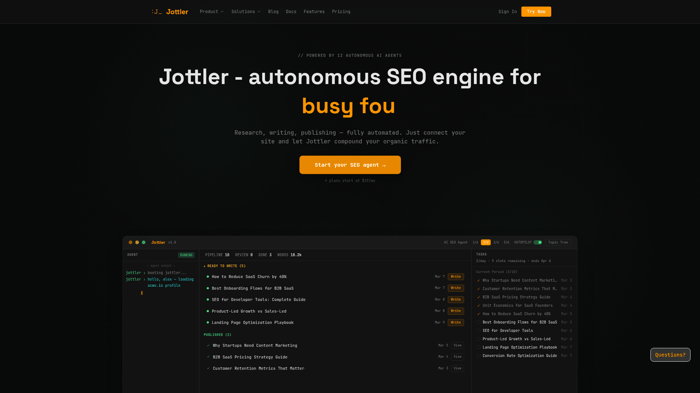
The market for AI SEO tools is rapidly expanding, with various platforms offering different levels of autonomy and features. When selecting a tool, consider its capabilities for keyword research, content generation, optimization, and integration with your existing CMS. For busy businesses, SaaS companies, and affiliate marketers seeking a fully autonomous solution that automates content research, writing, and publishing to compound organic traffic, Jottler is an example of an AI SEO engine designed for this purpose. It handles the entire process, from identifying high-potential keywords to fact-checking and direct publishing to platforms like WordPress, Webflow, and Shopify. Solutions like Semrush and Surfer SEO also offer advanced AI features for content optimization and generation.
Using Jottler to Automate Content Workflows
Jottler exemplifies how autonomous AI SEO agents can streamline content production. It functions as an end-to-end engine, automating keyword research, generating long-form articles (3,000+ words), performing fact-checking against multiple sources, and even generating featured images. Its core strength lies in its ability to publish directly to various CMS platforms, including WordPress, Webflow, and Shopify, with smart internal linking and SEO meta/FAQ schemas built-in. This level of automation allows businesses to consistently publish 1-5 articles per day, ensuring a constant stream of high-quality, SEO-optimized content without manual intervention. This directly addresses the pain point of lacking time for content creation, enabling busy teams to scale their content efforts efficiently and achieve significant organic traffic growth, such as the 269% organic traffic increase seen by one SaaS company through content optimization.
- End-to-End Automation: Automates keyword research, content generation, fact-checking, and image creation.
- Long-Form Content: Capable of generating articles exceeding 3,000 words.
- Direct CMS Publishing: Publishes directly to WordPress, Webflow, Shopify, and other platforms.
- Built-in SEO Features: Includes smart internal linking and SEO meta/FAQ schemas.
- High Publishing Volume: Enables consistent publication of 1-5 articles per day.
- Significant Organic Growth: Contributes to substantial organic traffic increases, like the 269% growth for one SaaS company.
Monitoring and Iterating for Continuous Improvement
Autonomous agents are not "set it and forget it" solutions. Continuous monitoring of their performance is crucial. Track key metrics, analyze the quality and relevance of AI-generated content, and solicit feedback from your team. Use these insights to iterate on your strategy, fine-tune the agent's parameters, and ensure it remains aligned with your evolving business goals and the dynamic AI search landscape. This iterative process ensures that your autonomous agents are always optimizing for the best possible outcomes. As 71% of organizations now use generative AI regularly in at least one business function, the importance of ongoing oversight cannot be overstated.
- Continuous Performance Monitoring: Regularly track the agent's effectiveness.
- Quality and Relevance Analysis: Evaluate the output of AI-generated content.
- Team Feedback Integration: Solicit and incorporate feedback from your team.
- Strategic Iteration: Use insights to refine and improve your AI strategy.
- Parameter Fine-Tuning: Adjust agent settings for optimal alignment with goals.
- Adaptation to AI Search: Ensure strategies evolve with the dynamic AI search landscape.
- Ongoing Oversight: Essential given that 71% of organizations use generative AI regularly.
The Future of Content with Autonomous AI SEO Agents
The integration of autonomous AI SEO agents marks a pivotal moment in the evolution of content marketing. The future will be defined by hyper-personalized experiences, a renewed focus on authentic authority, and a symbiotic relationship between human creativity and AI efficiency. The market for AI marketing is projected to reach $217.33 billion by 2034, underscoring the scale of this transformation.
Hyper-Personalization and Dynamic Content Generation
Autonomous agents will enable unprecedented levels of hyper-personalization, generating dynamic content variations tailored to individual user demographics, behavior, and preferences. This means content that truly resonates with each segment of your audience, leading to higher engagement and conversion rates. Companies excelling at personalization generate significantly more revenue. This capability will move beyond simple keyword matching to understanding complex user intent and delivering highly relevant answers, a critical factor given that AI search traffic surged 527% year-over-year.
The Rise of Authentic Authority and E-E-A-T
As AI generates more content, the value of authentic authority and E-E-A-T will only increase. Businesses will need to build trust ecosystems, developing proprietary research and genuine voices to stand out. Autonomous agents can support this by identifying authoritative sources, integrating expert insights, and ensuring factual accuracy, but human oversight will remain essential to imbue content with unique perspectives and genuine experience. This is especially important considering that 52% of consumers reduce engagement when they suspect AI-generated content.
"The most successful approach empowers experts to focus on strategy and creativity while AI handles execution and monitoring."
Unknown, OrangeMantra
A Symbiotic Relationship Between Humans and AI
The future of content marketing will not be about AI replacing humans, but rather about a symbiotic relationship where AI handles the heavy lifting of data analysis, content generation, and optimization, while humans provide strategic direction, creative oversight, and the unique insights that only human experience can offer. This collaboration will unlock new levels of efficiency, creativity, and impact, ensuring that content remains compelling and effective in an increasingly AI-driven world. 86% of SEO professionals have integrated AI into their strategy, demonstrating this growing partnership.
Conclusion
Autonomous AI SEO agents are no longer a futuristic concept; they are a present-day imperative for businesses seeking to future-proof their content strategy. By automating complex SEO tasks, these agents enable unparalleled efficiency, scalability, and adaptability in a rapidly changing digital landscape. Businesses leveraging autonomous AI can expect to see an average 24.69% increase in productivity, 15.7% in cost savings, and significantly improved organic visibility in the face of zero-click searches and AI Overviews, which reduce organic click-through rates by 61%. Embracing this technology allows businesses to not only survive but thrive, ensuring their content remains relevant, authoritative, and discoverable in the AI-first era. To stay ahead, focus on defining clear objectives, selecting the right autonomous tools, integrating them into your workflow, and continuously monitoring for optimal performance.
FAQs
like this today.