Measure Topical Authority's Impact on Organic Search
 Aidan Buckley
SEO
Aidan Buckley
SEO
March 20th, 2026
13 minute read
Table of Contents
In the rapidly evolving digital landscape of 2026, where AI-driven search accounts for 50% of all queries, the traditional SEO playbook is no longer sufficient. Businesses that fail to adapt risk being left behind, losing out on valuable organic traffic and conversions. The cost of neglecting a robust topical authority strategy is significant: sites with weak topical signals see their content buried, struggling to rank and capture the attention of both human users and advanced AI algorithms. This guide provides a comprehensive framework for busy businesses, SaaS companies, e-commerce stores, and other digital enterprises to effectively measure the impact of their topical authority efforts, ensuring sustained organic growth and market relevance.
- Define Objectives: Establish clear, measurable goals for topical authority initiatives and benchmark current organic performance.
- Map Topic Clusters: Systematically identify and structure core topic clusters with pillar pages and supporting content for comprehensive coverage.
- Track Performance: Implement robust tracking for keyword rankings, organic traffic, and AI/LLM visibility to monitor progress effectively.
- Analyze Gaps: Regularly audit content, identify new subtopics, and optimize for E-E-A-T to maintain relevance and find new opportunities.
- Automate Measurement: Leverage automation tools to streamline content research, creation, and continuous optimization based on performance data.
Define Your Topical Authority Goals and Baseline
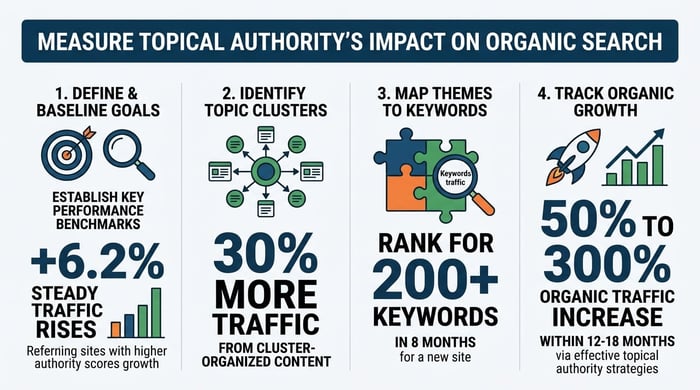
Before embarking on any measurement journey, it's crucial to establish what success looks like for your organization. This involves setting clear, measurable goals for your topical authority initiatives and taking a precise snapshot of your current performance across key metrics. Businesses building topical authority through topic cluster models report organic traffic increases of 50% to 300% within 12-18 months.
Establish Clear Objectives for Topical Dominance
Outline specific, quantifiable goals that align with your business objectives. Are you aiming for a certain percentage increase in organic traffic, higher rankings for specific keyword clusters, or improved visibility in AI Overviews? For instance, businesses building topical authority through topic cluster models report organic traffic increases of 50% to 300% within 12-18 months, with targeted benchmarks of 20-50% growth in 6-12 months. Define these targets clearly to provide a measurable outcome for your efforts.
- Organic Traffic Growth: Aim for a 20-50% increase in organic traffic within 6-12 months.
- Keyword Ranking Improvement: Target significant gains in Top 3 and 4-10 positions for core topic keywords.
- AI Overview Features: Strive for increased appearance in AI Overviews, which can offer up to 10x more features for authoritative brands.
Conduct a Comprehensive Topical Authority Audit
Perform an in-depth audit of your existing content to understand its current topical coverage and identify areas of strength and weakness. This involves analyzing your current content's depth, breadth, and relevance to your target topics. Look for thin content issues, which affect 92% of lowest-performing e-commerce sites, and duplicate content problems, faced by 38.78% of high-visibility e-commerce sites, as these directly impact performance and unique topical signals.
- Content Inventory: Catalog all existing content, noting its topic, format, and publication date.
- Gap Analysis: Identify topics relevant to your niche that are not adequately covered by your current content.
- Quality Assessment: Evaluate content for depth, accuracy, E-E-A-T signals, and potential for consolidation or expansion.
Benchmark Current Organic Performance Metrics
Gather baseline data for critical organic performance indicators. This includes overall organic traffic, keyword rankings, domain authority (DA), and engagement metrics like bounce rate and time on page. Document these metrics meticulously to provide a clear starting point for measuring future impact. For example, new sites achieved topical authority via content clusters, ranking for 200+ keywords in 8 months despite a Domain Authority (DA) under 25.
- Traffic Volume: Record total organic sessions and users from analytics platforms.
- Keyword Positions: Document average ranking positions for your target keyword clusters.
- Engagement Rates: Track metrics like bounce rate, pages per session, and average session duration to understand user behavior.
- Domain Authority (DA): Note your current DA score as a general indicator of site strength.
Identify and Map Your Topic Clusters
The foundation of topical authority lies in organizing your content into comprehensive topic clusters. This strategic approach signals to search engines your expertise and breadth of knowledge within a specific domain. Analysis of over 250,000 search results identifies topical authority as the strongest on-page ranking factor in 2026.
Uncover Core Topics and Subtopics
Utilize keyword research tools and audience insights to identify the overarching topics most relevant to your business and target audience. Then, break these down into granular subtopics that address every facet of the user's journey and intent. This process helps you map entities, not just keywords, focusing on understanding and covering entire topic ecosystems. Remember, long-tail keywords drive significantly more search traffic.
- Audience Research: Understand user pain points, questions, and search queries related to your industry.
- Competitor Analysis: Identify topics where competitors have established authority and areas where you can differentiate.
- Keyword Clustering: Group related keywords into thematic clusters, revealing potential subtopics for content.
Structure Content with Pillar Pages and Cluster Content
Organize your identified topics into a hierarchical structure. Create robust "pillar pages" that provide a high-level overview of a broad topic, then support these with interconnected "cluster content" articles that delve into specific subtopics in detail. This model, often referred to as topic cluster models, is proven to increase organic traffic.
- Pillar Page Creation: Develop comprehensive, high-level content pieces that cover a broad topic.
- Cluster Content Development: Produce detailed articles that explore specific subtopics linked to the pillar page.
- Topical Breadth: Ensure each cluster covers a topic exhaustively, demonstrating deep expertise.
Implement Strategic Internal Linking
Crucially, establish a strong internal linking structure between your pillar pages and cluster content. Use descriptive anchor text to reinforce the topical relationships between articles, improving crawlability and signaling to search engines the depth of your coverage. Content organized into topic clusters drives approximately 30% more organic traffic and holds rankings 2.5x longer than standalone posts.
- Contextual Links: Embed links naturally within the body text, connecting related concepts.
- Descriptive Anchor Text: Use clear, keyword-rich anchor text that accurately describes the linked content.
- Link Density: Ensure a balanced internal link profile, avoiding over-optimization or under-linking.
"This kind of model, where we combine the best of these two worlds, I think, is the way of the future. I don’t think it pays to stick to your old-school keyword targeting methodology, nor do I think it pays to ignore keyword targeting and keyword research entirely. I think we’ve got to merge these practices and come up with something smart."
Rand Fishkin, SEO expert, SparkToro
Track Keyword Rankings and Organic Traffic Performance
Consistent monitoring of your keyword rankings and organic traffic is essential to gauge the effectiveness of your topical authority building efforts. Organic search drives 53% of website traffic overall, with Google dominating 89.66% of search traffic, making accurate tracking paramount.
Monitor Keyword Ranking Fluctuations
Regularly track the ranking performance of your target keywords, both for your pillar pages and individual cluster articles. Pay attention to not only your primary keywords but also the long-tail variations that topical authority naturally attracts. Topical clusters lead to 3-5x more ranking keywords per cluster, indicating broader visibility.
- Primary Keyword Tracking: Monitor core terms associated with your pillar pages.
- Long-Tail Keyword Monitoring: Track the performance of more specific, longer search queries that indicate deep topical coverage.
- Competitor Ranking Comparison: Benchmark your keyword positions against key competitors to identify opportunities and threats.
Analyze Organic Traffic Growth and Sources
Dive deep into your analytics to observe changes in overall organic traffic, as well as traffic specifically attributed to your topic clusters. Identify which pages are driving the most traffic and analyze the sources of this traffic to understand user behavior. An unnamed B2B SaaS client saw 340% organic traffic increase by prioritizing topical coverage.
- Segmented Traffic Reports: Analyze organic traffic specifically for your topic cluster pages.
- Traffic Source Breakdown: Understand which search engines and referral sources are driving traffic.
- Conversion Tracking: Link organic traffic to conversion goals to measure direct business impact.
Evaluate AI/LLM Visibility and Featured Snippets
In 2026, with AI-driven search accounting for 50% of queries, monitoring your visibility in AI Overviews and featured snippets is paramount. Brands with strong topical signals can see increased AI Overview features. Track how often your content appears in these prominent positions, as they are key indicators of recognized authority.
- AI Overview Tracking: Monitor appearances in AI-generated summaries at the top of SERPs.
- Featured Snippet Capture: Track opportunities to rank for featured snippets, which offer prime visibility.
- Zero-Click Search Analysis: Understand how your content performs in a landscape where 60% of overall searches are zero-click.
Analyze Content Gaps and Opportunities
Topical authority is not a static achievement; it requires continuous analysis and adaptation. Regularly identifying content gaps and new opportunities ensures your strategy remains dynamic and effective. Quarterly content audits are crucial for sustained gains, as neglecting them can stall traffic.
Conduct Regular Content Audits
Perform quarterly content audits to assess the performance of your existing content. Identify underperforming articles, outdated information, and areas where your competitors are outranking you. This helps you maintain freshness and relevance, which is crucial for sustained gains. Remember, 92% of lowest-performing e-commerce sites have thin content issues, directly impacting topical depth.
- Performance Review: Evaluate content against KPIs like traffic, rankings, and engagement.
- Freshness Check: Update or refresh outdated content to ensure accuracy and relevance.
- Consolidation Opportunities: Identify similar articles that can be combined or streamlined for greater impact.
Identify New Subtopics and Emerging Trends
Stay abreast of industry trends, news, and evolving search queries to discover new subtopics that can enhance your topical coverage. Use tools to analyze competitor content and identify areas where they have established authority that you have not yet addressed. Mapping entities, not just keywords, helps cover entire topic ecosystems, which is critical for the strongest on-page ranking factor in 2026.
- Trend Monitoring: Follow industry news, forums, and social media to spot emerging topics.
- Competitor Gap Analysis: Use SEO tools to find keywords and topics where competitors rank but you don't.
- Audience Feedback: Listen to customer questions and feedback for new content ideas.
Optimize for E-E-A-T and User Intent
Ensure your content consistently demonstrates Experience, Expertise, Authoritativeness, and Trustworthiness (E-E-A-T). This means publishing content written by identified experts, linking to trusted sources, and demonstrating firsthand experience. Sites with strong E-A-T signals rank significantly higher. Remember, topical authority is the strongest on-page ranking factor in 2026.
- Expert Author Profiles: Attribute content to qualified authors with clear bios and credentials.
- Factual Accuracy: Ensure all information is well-researched, cited, and fact-checked.
- Trust Signals: Include testimonials, case studies, and external links to reputable sources.
Refine Your Strategy and Automate Measurement
The final stage involves refining your topical authority strategy based on your analysis and leveraging automation to make the measurement process more efficient and scalable. AI automation is projected to handle a significant portion of SEO tasks by 2026, highlighting the necessity of integrated tools.
Iteratively Improve Content Based on Performance Data
Use the insights gained from your tracking and analysis to make data-driven improvements to your content. This could involve updating existing articles, expanding on specific subtopics, or creating new content to fill identified gaps. For instance, a finance section case study saw significant rankings improvement within 9 months by publishing 60+ interlinked articles with 15 expert citations.
- Content Updates: Refresh existing articles with new data, examples, or expanded sections.
- New Content Creation: Develop content for previously identified gaps or emerging subtopics.
- A/B Testing: Experiment with different content formats, titles, or calls to action to optimize performance.
Using Jottler to Automate Topical Authority Measurement

Leverage automation tools for content research, creation, and publishing to free up resources and ensure consistency. For example, Jottler is an autonomous AI SEO engine that automates content research, writing, and publishing to compound organic traffic for busy businesses, directly aiding in the refinement and automation of topical authority measurement. Jottler's AI agents produce 3000+ word articles daily, replacing the need for extensive manual content processes.
This automation allows businesses to maintain a consistent publishing schedule, which is critical as startups publishing weekly content drive 3.5x more conversions than those publishing monthly. By integrating with your CMS, Jottler ensures that your topical content is not only generated efficiently but also published and optimized with minimal human intervention, allowing teams to focus on strategy rather than execution.
Continuously Monitor and Adapt to Algorithm Changes
The search landscape is constantly evolving, especially with the increasing influence of AI. Stay informed about algorithm updates and adjust your strategy accordingly. This proactive approach ensures your topical authority remains robust and resilient against changes. The AI and search landscape is dynamic, with AI Overviews appearing on 13.14% of queries, leading to a nearly 50% drop in click-through rates.
- Algorithm Tracking: Stay updated on major search engine algorithm changes and their potential impact.
- SERP Analysis: Regularly analyze search engine results pages for shifts in ranking factors or content formats.
- Strategy Adjustments: Be prepared to pivot your content strategy based on new data and algorithmic shifts.
| Tool | Starting Price (2026) | Key Notes |
|---|---|---|
| Topical Map AI | Free tier; Pro $29/month | 800-1,200 keywords in 60 seconds; $0.23 per authority point; best for speed and affordability. |
| MarketMuse | $149/month | Enterprise content planning; topic depth scoring; higher cost suits large teams. |
| Surfer SEO | $89+/month | On-page editor, SERP analysis; integrates with Google Docs/WordPress. |
| Semrush | $129+/month (Topic Research included) | Authority clustering 67% more effective for opportunities; all-in-one platform. |
| Clearscope | Not specified | Semantic coverage, readability scores; for high-volume content teams. |
| Ahrefs | Not specified | Content gap, keyword explorer; $0.45 per authority point; pairs with clustering tools. |
| Jottler AI | $29/month | Fully autonomous SEO engine; 3000+ word articles daily; 12 specialized AI agents. |
"It’s not about inventing a new name for SEO, but understanding that we must optimize everywhere people search for information—whether in Google, ChatGPT, or Reddit."
Rand Fishkin, founder of SparkToro
Conclusion
Measuring the impact of topical authority on organic search is no longer optional; it's a critical component of a successful digital strategy in 2026. By defining clear goals, systematically mapping topic clusters, diligently tracking performance, analyzing gaps, and refining your approach with automation, businesses can unlock significant organic growth. Expect to see organic traffic increases of 50% to 300% within 12-18 months, with content organized into topic clusters driving approximately 30% more organic traffic and holding rankings 2.5x longer. Embrace this data-driven approach to topical authority and watch your organic visibility and business impact compound. Start building your comprehensive topical authority strategy today to ensure sustained relevance and superior search performance.
FAQs
like this today.